
Results
-
 £159.99
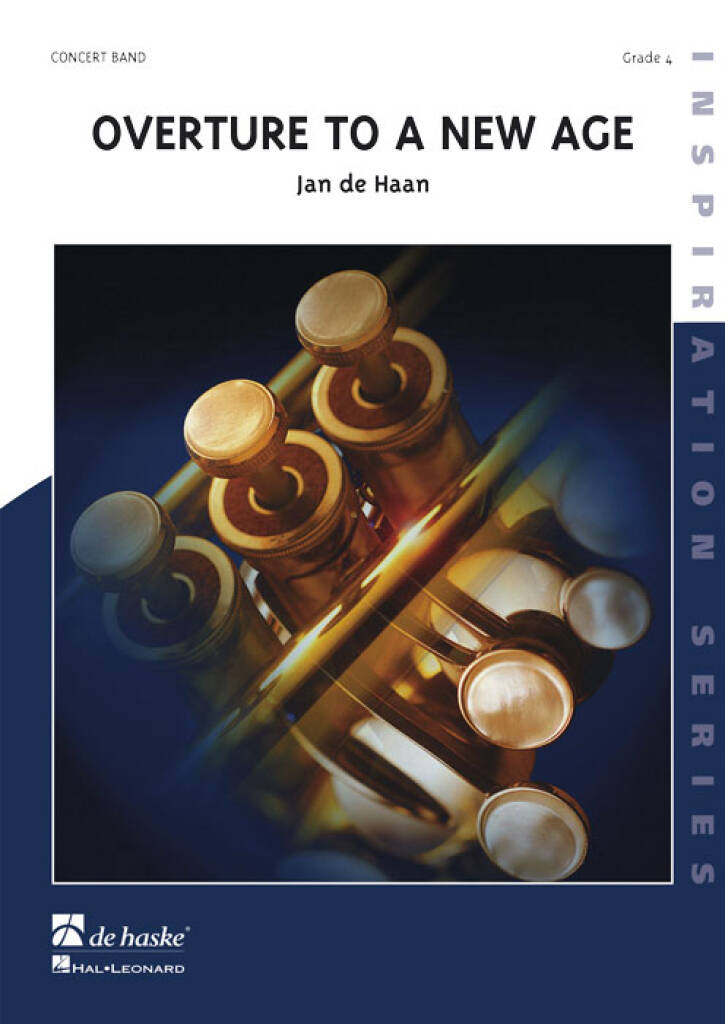
Overture to a New Age - Jan de Haan
A new era dawns-heralded by solemn brass fanfares. What does the future hold? In his work Overture to a New Age, Jan de Haan expresses on the one hand anticipation, on the other also an awareness that things won't always be as rosy as theysometimes appear. Ultimately, however, confidence and hope win through, represented by Jan de Haan in a brilliant coda. The new age can begin!
Estimated dispatch 7-14 working days
-
 £68.99
Handel in the Strand - Percy Aldridge Grainger
Handel in the Strand is one of Grainger's early light orchestral pieces, written in 1911, before he enlisted in the US Army during World War I. Grainger had no trouble allowing other musicians to arrange his music to suit their needs, so Handel in the Strand has existed in several different versions. Grainger himself said of this piece, "...the music seemed to reflect both Handel and English musical comedy... as if jovial old Handel were careening down the Strand (London's Broadway) to the strains of modern English popular music." What can one add to that? Try it and find out!
Estimated dispatch 7-14 working days
-
 £139.99
Kyrill - Otto M. Schwarz
Many people vividly remember January 18, 2007. The weather service issued alerts of an impending storm of the century and a worst case scenario began to unfold. Hurricane Kyrill left unimaginable death and destruction in its wake.Composer Otto M. Schwarz was so deeply moved, he decided to capture what he felt in a new composition. Dur: 10:00
Estimated dispatch 7-14 working days
-
 £91.99
The Sun Will Rise Again - Philip Sparke
The composer writes:"On March 11th 2011 a massive 9.0- magnitude earthquake occurred off the coast of north-eastern Japan.I'm writing these programme notes barely a week later and the death toll caused by the quake and resulting tsunami already exceeds 6000, with thousands of people still unaccounted for. I have many friends associated with many bands throughout Japan and one of these, Yutaka Nishida, suggested I write a piece to raise money to help those affected by the disaster. I was immediately attracted by the idea and have arranged Cantilena (a brass band piece recently commissioned by the Grenland International Brass Festival, Norway) for wind band, giving it a new title tohonour my friends in the Land of the Rising Sun.I will be donating royalties from this piece to the Japanese Red Cross Society Emergency Relief Fund and am delighted to say that my distributors, De Haske, who will generously also donate all net profits from sales of this piece, have pledged a substantial advance payment to the Red Cross so that what little help this project generates can be immediate.It is my sincere wish that this 'Band Aid' project will allow wind bands around the world support the people of Japan, where bands are a way of life for many, in this difficult time".Philip Sparke
Estimated dispatch 7-14 working days
-
 £202.99
By the River - Jan Van der Roost
Jan Van der Roost and the commissioner of this work have strong personal ties, making By the River a very personal work for both of them. The first part is pastoral and describes the rural character of what is actually an industrial region.The next movement, a dynamic allegro that creates an exciting contrast to the first. All instruments are put to good use, letting everyone have their moment in the limelight. All the interesting thematic and melodic elements Van der Roost createswill keep the audience engaged through to the very last note!
Estimated dispatch 7-14 working days
-
£71.50
The Race - Anthony Susi
Straight from the 80's this new work for concert band is a major harmonic throwback to what the kids might now call "ancient". Perfect for your audiences - this one is a winner!
Estimated dispatch 7-14 working days
-
 £38.50
The Hey Song (Rock & Roll - Part II)
Explorer Level (correlates with Book 1, p. 11) Paul has skillfully arranged this stadium anthem so that even beginning bands can rock on. What a great motivational tool for your young players!
Estimated dispatch 7-14 working days
-
£248.99
Odysseia - Maxime Aulio
Washed up on the Phaeacian shore after a shipwreck, Odysseus is introduced to King Alcinous. As he sits in the palace, he tells the Phaeacians of his wanderings since leaving Troy. Odysseus and his men fi rst landed on the island of the Cicones wherethey sacked the city of Ismarus. From there, great storms swept them to the land of the hospitable Lotus Eaters. Then they sailed to the land of the Cyclopes. Odysseus and twelve of his men entered the cave of Polyphemus. After the single-eyed giantmade handfuls of his men into meals, Odysseus fi nally defeated him. He got him drunk and once he had fallen asleep, he and his men stabbed a glowing spike into the Cyclop's single eye, completely blinding him. They escaped by clinging to the belliesof some sheep. Once aboard, Odysseus taunted the Cyclop by revealing him his true identity. Enraged, Polyphemus hurled rocks at the ship, trying to sink it. After leaving the Cyclopes' island, they arrived at the home of Aeolus, ruler of the winds.Aeolus off ered Odysseus a bag trapping all the strong winds within except one - the one which would take him straight back to Ithaca. As the ship came within sight of Ithaca, the crewmen, curious about the bag, decided to open it. The winds escapedand stirred up a storm. Odysseus and his crew came to the land of the cannibalistic Laestrygonians, who sank all but one of the ships. The survivors went next to Aeaea, the island of the witch-goddess Circe. Odysseus sent out a scouting party butCirce turned them into pigs. With the help of an antidote the god Hermes had given him, Odysseus managed to overpower the goddess and forced her to change his men back to human form. When it was time for Odysseus to leave, Circe told him to sail tothe realm of the dead to speak with the spirit of the seer Tiresias. One day's sailing took them to the land of the Cimmerians. There, he performed sacrifi ces to attract the souls of the dead. Tiresias told him what would happen to him next. He thengot to talk with his mother, Anticleia, and met the spirits of Agamemnon, Achilles, Patroclus, Antilochus, Ajax and others. He then saw the souls of the damned Tityos, Tantalus, and Sisyphus. Odysseus soon found himself mobbed by souls. He becamefrightened, ran back to his ship, and sailed away. While back at Aeaea, Circe told him about the dangers he would have to face on his way back home. She advised him to avoid hearing the song of the Sirens; but if he really felt he had to hear, thenhe should be tied to the mast of the ship, which he did. Odysseus then successfully steered his crew past Charybdis (a violent whirlpool) and Scylla (a multiple-headed monster), but Scylla managed to devour six of his men. Finally, Odysseus and hissurviving crew approached the island where the Sun god kept sacred cattle. Odysseus wanted to sail past, but the crewmen persuaded him to let them rest there. Odysseus passed Circe's counsel on to his men. Once he had fallen asleep, his men impiouslykilled and ate some of the cattle. When the Sun god found out, he asked Zeus to punish them. Shortly after they set sail from the island, Zeus destroyed the ship and all the men died except for Odysseus. After ten days, Odysseus was washed up on theisland of the nymph Calypso.
Estimated dispatch 7-14 working days
-
£184.99
Rubicon - Bert Appermont
The Rubicon is a river in Northern Italy which Julius Caesar crossed with his army in 49 BC in defiance of the leaders of Rome, who feared his power. A civil war against rival Pompey ensued, which culminated in Caesar seizing power as the absoluteruler of Rome. The phrase "crossing the Rubicon" therefore refers to any person committing himself irrevocably to a risky, decisive and irrevocable of course of action.The work consists of three parts that deal with this important moment in history.Part 1 (Meditation) symbolises Caesars request to the Gods to assist him in his difficult choice. In a slow introduction we hear the melancholy and beseeching sounds of the duduk (alternatively, this part can be played by a soprano saxophone)and of the soprano solo singer over the bourdon accompaniment. The soprano solo singer then sings "dona tibi pacem" (give him rest) in a melodious and probing theme.In Part 2 (Battle of Pharsalus) trumpets and trombones resound alternately ina stately Roman fanfare, producing a stereophonic effect. This develops into a martial theme in which Caesars impressive army goes to battle against the army of rival Pompey. While the theme of Caesars army fades away, Pompeys theme emerges as anaive dance in six-eight time. His army is definitely in the majority and it believes it can easily defeat the enemy. Suddenly trumpets and trombones clash on two sides of the orchestra: Caesars army advances and attacks. A fierce battle ensues inwhich the two themes are played alternately as well as simultaneously. Thanks to his shrewd battle tactics, Caesar manages to win this legendary battle after all: his theme resounds ever louder in trumpets and horns until everything dies out andchanges into a kind of reconciliation between the soldiers of the two armies. The melancholy "dona tibi pacem" from part 1 now serves as a reconciliation theme.Caesar is now the sole ruler of the New Roman Empire, which would be destined to leave itsmark on our Western civilisation to this day. The third part is a sparkling succession of dance music (Dance) with many Greek and Roman elements in which Caesars victory is praised and celebrated. It is common knowledge that the culture(arts, gods, etc.) of the Romans drew heavily on Greek culture. I have therefore used an authentic Greek theme (the Seikolos song) several times in this part (bar 17 in the euphonium, bar 60 in the base section, bar 68 in the sopranosaxophone) to suggest the music of that era and to evoke the right atmosphere. After a gradual increase in tempo in the entire orchestra, the opening melody gloriously resounds once more, surrounded by virtuoso dance music. The work ends withbombastic brass fanfares in which Caesars theme triumphs once more.NOTE FOR THE CONDUCTOR:The Armenian duduk and the monochord that are used in the introduction give a special tone to the music, but could be substituted (soprano saxophone instead ofthe duduk) or left out (monochord). The soprano solo is also doubled within the orchestra and could therefore also be left out if necessary, although it does provide the work with an extra dimension. The male voices in the introduction and the finalecould possibly be replaced with a synthesizer with choral setting.As a visual and acoustic element in part 2, the trumpets, the e-flat cornet, the small drum and trombones can be stood up and placed at two sides of the orchestra (bar 80).Seen fromthe point of view of the conductor, put the trumpets, the e-flat cornet and the small drum in the left section and the trombones in the right section of the orchestra. This also helps to create a visual contrast between the two themes of the secondpart. The players can be seated again at bar 97 or bar 121. The soprano soloist can be placed in or in front of the orchestra, depending on what gives the best result. For the conclusion of the work the soprano solo can be sung from afar (from thewings) to create additional atmosphere.This work was composed especially for the "St Joseph" brass band from Pey/Echt (Belgium) with conductor Mark Prils.
Estimated dispatch 7-14 working days
-
 £154.99
Ouverture Allemande - Thomas Doss
This festive overture by the Austrian composer Thomas Doss, whose father was German, is intended to be a symbol of the friendship between Germany and Austria, and the countries that border on these two states. In times of union and cooperation, the European thinking should be one of tolerance and openness when it comes to national identities and cultures. European culture has many faces - that is what makes it unique. The shadows of the past, however, should never be forgotten, but they must not obscure the present and the future. Many ghosts wander through this overture, and those who listen carefully will also hear a great master of classical music ghost around. Acreative new opening work for any concert.
Estimated dispatch 7-14 working days
 View Music