
Results
-
 £87.50
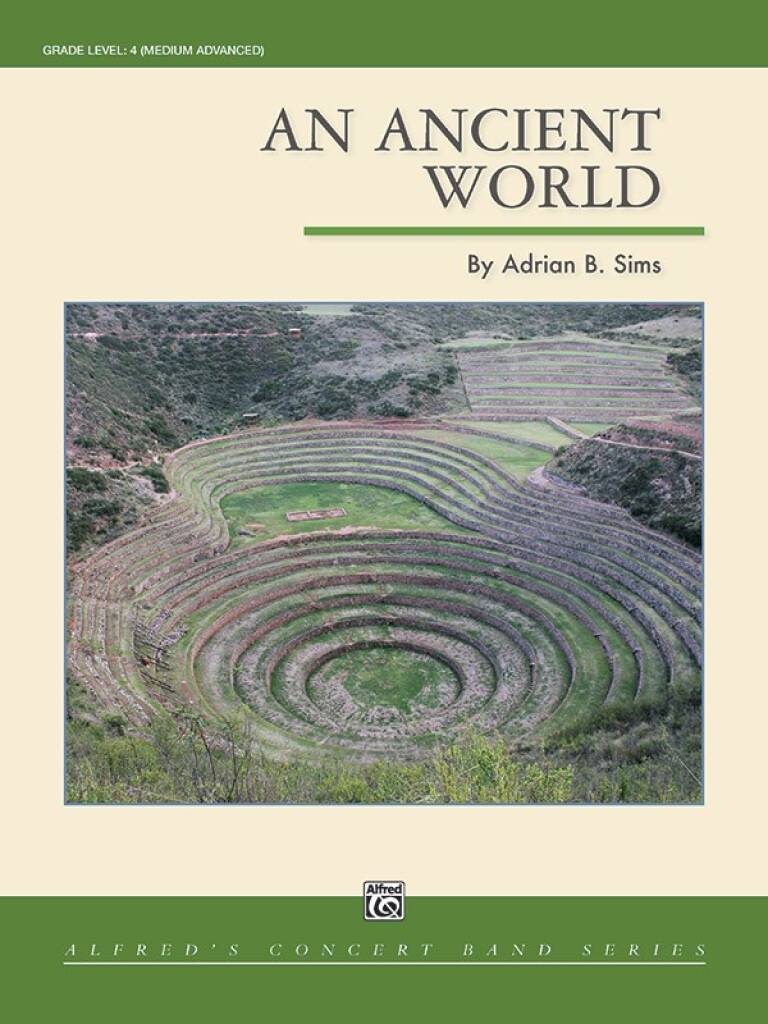
An Ancient World - Adrian B. Sims
An Ancient World, by Adrian B. Sims, imagines the ruins of a past civilization. The work explores the mysterious and fascinating landscapes that were once so beautiful. Reawakened in a new light, the world reignites with energy. After a final mourning of that which was lost and can never be restored, (measures 95--130), the work lives out the essence of ancient royalty with one last celebratory musical statement.
Estimated dispatch 7-14 working days
-
 £53.95
Time Lord - Jarod Hall
If a time-traveling superhero were the conductor of a concert band, this is the music they would play! Inspired by an incredible battle sequence, Time Lord dives into time signature changes at an introductory level while maintaining an epic tone throughout. JaRod Hall does an incredible job of making this piece exciting, pedagogical, and extremely playable!
Estimated dispatch 7-14 working days
-
 £66.95
Rio Bravo - Scott Watson
Rio Bravo draws on artifacts of iconic western film music to portray the rugged landscape surrounding one of the longest, most fabled rivers in North America. The challenging, arid region along the "brave river" that divides Mexico from the southwestern United States---depicted in many a song and story---is characterized by mountains, canyons, and desert plains. The river, known north of the border as the Rio Grande, has called to itself settlers, cattle drivers, gunslingers, and outlaws. Rio Bravo transports listeners to a time and place where legends of the Old West were made!
Estimated dispatch 7-14 working days
-
 £72.99
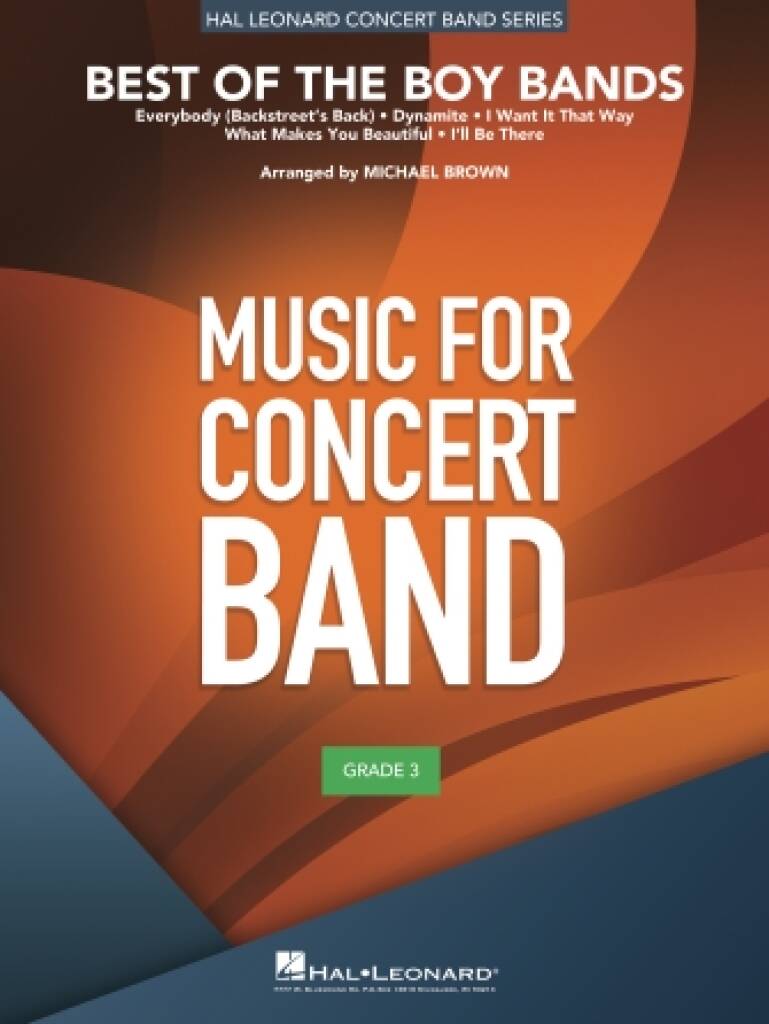
Best of the Boy Bands
We're not sure boy bands ever really went out of style, but their music is certainly here to stay! This fun medley features a mix of older classics as well as newer chartbusters. Includes: Dynamite (BTS), Everybody (Backstreet Boys), I Want It That Way (Backstreet Boys), What Makes You Beautiful (One Direction), and I'll Be There (Jackson 5).
Estimated dispatch 7-14 working days
-
 £119.60
In Flanders Fields - Guillaume Détrez
"In Flanders Fields" is a play recounting the Battle of Vimy Ridge (France) which took place from April 9 to 12, 1917. The introduction refers to the thousands of graves found at the site of Notre-Dame de Lorette. Then begins the episode of preparation and fierce battle. Thanks to the Canadian Expeditionary Force that came as reinforcements, the battle was won and the site secured at 6 a.m. (brass choir accompanied by 6 bells). The title of this work also refers to a poem by John Mac Rae located at the entrance to the memorial museum."In Flanders Fields"By Col. John McCrae,In Flanders Fields The poppies blowBetween the crosses row on rowThat mark our place; and in the skyThe larks, still bravely singing, flyScarce heard amid the guns below.We are the dead, short days agoWe lived, felt dawn, saw sunset glow,Loved and were loved and now we lieIn Flanders Fields.Take up our quarrel with the foeTo you, from failing hands, we throwThe torch, be yours to hold it high.If ye break faith with us, who dieWe shall not sleep, though poppies growIn Flanders Fields
Estimated dispatch 7-14 working days
-
 £73.60
West of the Mississippi - Dean Jones
There's always a sense of adventure about America that makes it a really exciting topic to write about. The 3 States that sprang to mind in bringing a piece of music together were: California, Hawaii and Texas.We start out our American journey on the West Coast....California has provided much in the way of film and music for over 100 years. Combining this sense of free expression with the 'Surfing' culture, this initial section of the piece has an easy-going, fun feel in a pop idiom. Maybe wearing some shades might be quite a good look for this section!We move even further West now to the island of Hawaii where the free and easy goes onto a new level! The use of chromatics is a feature of Hawaiian melodies and has a feel a 'sliding' between notes that somehow sums up this feel of living on a tropical island! Have some fun with this section and have a Hawaiian garland to wear!Back into the USA mainland, and the fabulous state of Texas! Here we have the concept of the old fashioned rodeo and the 'Wild West'. Even today, the culture of horses, cowboys and tales of adventure are celebrated in places such as Fort Worth. The music captures some of these themes and has a fun and enjoyment...some get your Cowboy hats at the ready and enjoy the finale!
Estimated dispatch 7-14 working days
-
 £76.99
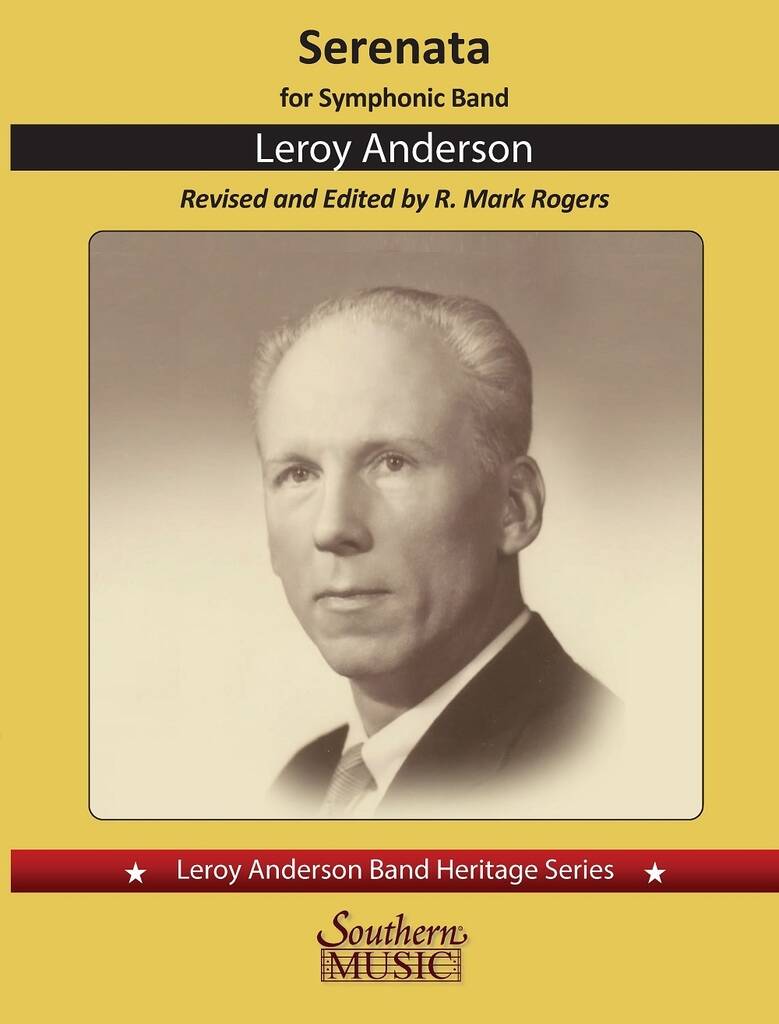
Serenata - Leroy Anderson
Serenata was first performed on May 10, 1947 as an encore at the Boston Pops, with Arthur Fiedler conducting. Fiedler would later praise the piece as among the conductor's favorites. Lyrics were added by Mitchell Parish in 1950, which would lead to recordings by the likes of Sarah Vaughan and Nat King Cole. With a beguine rhythm as a background, Anderson's inspiration from the Latin-American serenade would give the piece its title. This publication is the first-ever to offer a full score, edited by Mark Rogers, offering Anderson's enchanting work to new generations of audiences.
Estimated dispatch 7-14 working days
-
 £131.00
Notes from the Road - Franco Cesarini
"May your trails be crooked, winding, lonesome, dangerous, leading to the most amazing view. May your mountains rise into and above the clouds." - Edward AbbeyNotes from the Road was commissioned to Franco Cesarini by the music Federation of the Canton of Thurgau, Switzerland, as compulsory piece for the second category of the Canton Festival in 2023. The piece is written in the typical form of an Italian overture, with the sequence of veloce-lento-veloce tempi. Reflections on life and the street as its metaphor were the driving elements in composing this piece. The way represents a symbol characteristic to many cultures, so much so that the verb "to walk" or the word "path" indicate a way of being in life and of fulfilling oneself. "Making one's way" means affirming oneself; "Having a way" indicates one's own and personal approach. The road is the most beautiful metaphor of life: there is a departure, a destination, and in the middle lies a path that is sometimes winding, with challenges to overcome and directions to take.An introspective piece, an invitation to each of us to reflect on our own "path".
Estimated dispatch 7-14 working days
-
 £236.00
Pome symphonique en forme d'ouverture - Paul Gilson
In September 1925, on the occasion of the sixty-fifth birthday of their 'master', seven students of Paul Gilson gathered to form the first composers' collective in Belgian national music history. The members of Les Synthtistes (the Synthetists) are Ren Bernier, Francis de Bourguignon, Gaston Brenta, Tho Dejoncker, Marcel Poot, Maurice Schoemaker and Jules Strens. Their intent is twofold and both theoretical and practical. Les Synthtistes want to distinguish themselves as the 'Brussels seven' by breaking away from the prevailing late-romantic music of their time. Their theoretical aim is to synthesize the modern tendencies in music from 1925 onwards, to connect with the 'acquisitions of contemporary music' and to apply them within balanced and well-defined forms. Their practical goal is to make it easier to find a stage to perform their new symphonic music by uniting. In a period when there is no professional symphonic orchestra in Belgium, apart from the opera orchestra, they compose and transcribe their original symphonic works for wind band. They work together with Arthur Prevost and the Royal Band of the Belgian Guides which grew into a model instrumentation of 85 musicians during the interwar period. Thanks to Prevost and the Guides a unique collection of original, modern music for wind band by Les Synthtistes can be heard on the Brussels concert stages during the interwar period. Because only a few works of this unique, forgotten collection of 75 works were published, this unique canon remained largely unknown. Thanks to a historical study of sources by Luc Vertommen, these works for wind band are now, a century after their creation, made accessible and recorded for the first time.
Estimated dispatch 7-14 working days
-
 £236.00
Gil blas - Jules Strens
In September 1925, on the occasion of the sixty-fifth birthday of their 'master', seven students of Paul Gilson gathered to form the first composers' collective in Belgian national music history. The members of Les Synthtistes (the Synthetists) are Ren Bernier, Francis de Bourguignon, Gaston Brenta, Tho Dejoncker, Marcel Poot, Maurice Schoemaker and Jules Strens. Their intent is twofold and both theoretical and practical. Les Synthtistes want to distinguish themselves as the 'Brussels seven' by breaking away from the prevailing late-romantic music of their time. Their theoretical aim is to synthesize the modern tendencies in music from 1925 onwards, to connect with the 'acquisitions of contemporary music' and to apply them within balanced and well-defined forms. Their practical goal is to make it easier to find a stage to perform their new symphonic music by uniting. In a period when there is no professional symphonic orchestra in Belgium, apart from the opera orchestra, they compose and transcribe their original symphonic works for wind band. They work together with Arthur Prevost and the Royal Band of the Belgian Guides which grew into a model instrumentation of 85 musicians during the interwar period. Thanks to Prevost and the Guides a unique collection of original, modern music for wind band by Les Synthtistes can be heard on the Brussels concert stages during the interwar period. Because only a few works of this unique, forgotten collection of 75 works were published, this unique canon remained largely unknown. Thanks to a historical study of sources by Luc Vertommen, these works for wind band are now, a century after their creation, made accessible and recorded for the first time.
Estimated dispatch 7-14 working days
 View Music