
Results
-
 £116.40
Trianon - Serge Lancen
A jewel, compositionally, simple technically, Lances has written a fantastic piece of music. This work along with two others was commissioned by the French government for the 'more minor' orchestras. The quotation marks here are intentional, for we feel that this piece is just as worthy of top orchestras.
Estimated dispatch 7-14 working days
-
 £214.80
Missa Solemnis - Serge Lancen
This Mass has been dedicated to His Holyness Pope John Paul II, to witness Lancens deep and respectful admiration for the Holy Father. The work was composed in 1986 and written for two solo voices: a soprano and a baryton-Martin (high baritone), mixed choir, harp (ad libitum) and symphonic band or organ. It has ten parts: INTROIT - KYRIE - GLORIA - OFFERTORIUM - SANCTUS - PATER NOSTER - AGNUS DEI - COMMUNIO - DEO GRATIAS - and as final part an ALLELUIA. Lancen expressed his views about this Mass as follows: 'The most important aspect of the Mass is the praising of God and the sacrificing to God; that is why I thought it suitable to use both the themes of the Sanctus and the Offertorium in writing the Introtus. It seemed to me also quite logical that the initial themes of the Kyrie and the Agnus Dei would be rather similar as these are two moments where the priest and the worshippers invoke God. The composition ends with a brilliant Alleluia in which I also briefly quote the theme of the Sanctus.' This Mass was premiered on 27 may 1989 at 'Our Lady's Church' in Maastricht, The Netherlands, as part of the celebrations of the fiftieth anniversary of the Roman Catholic Band Federation of the Limburg County. The Bishop Castermans celebrated the Mass, whereas Jan Cober conducted this first performance. The Missa Solemnis is an alternation of meditating, though often impressive, orchestral passages with angelical choral sounds and the pious singing of both soloists. This may not be the type of music we usually expect from Serge Lancen, but nevertheless the composer remains faithful to his own typical style of composition. You can call this work romantic, though it surely is 'contemporary' or, why not, 'from all times'. The instrumentation is varied and extremely rich, mostly due to Lancen's typical use of 'wind band colours'. This Latin Mass suits perfectly well in the tradition of Roman-Catholic Masses that have been written by several great composers.
Estimated dispatch 7-14 working days
-
 £52.70
Far Eastern Dream - Paul Voet
The longest trip we make is to the Far East. Japan, China, Tibet,... all countries with an enormous cultural background and history. Percussion is very important here to give a rich dimension to this Japanese 'Black Bamboo' theme. Tam-tam, Chinese cymbals, Tibetan gong and a kododrum (if not possible, large floor tom) together with marimba and glockenspiel are used all the time in a carefulway. A solo cornet presents the main theme that is answered by the whole lower brass section. Whilethis theme develops now and then the sounds of the impressive 'dung' is heard. (dung is the Tibetan very large trumpet-like instrument with loud and very deep sounds) In a quicker tempo Eb bass, euphonium and solo cornet start with the theme and even the counter theme. The whole group joins the party but everything ends very silently with mute.
Estimated dispatch 7-14 working days
-
 £52.70
The Goodbye - Paul Voet
We sail the ocean with stubborn, hardworking but weak hearted Flemish fishermen to the Northern parts of the Atlantic. A sailor is leaving his wife or girlfriend not knowing if he is going to come back soon. Leaving for good fishing grounds around Iceland. This sad song(the first line of the text says; The wind that blows from the east, my love, is not going to blow for ever) is a solo for flugelhorn accompanied by the whole lower brass section. In a certain way of counterpoint tenorhorns, baritones and euphoniums are woven around thesoloist. The warmth from these saxhorn section is coloured by some chords from trombones and a quite virtuosi marimba line.
Estimated dispatch 7-14 working days
-
 £87.60
Floris - Fred Vogels
The composition Floris was first of all written for the movie picture 'Floris', based on the old television series of the same name, with, among others, Rutger Hauer in the leading role. This series told the adventures of Knight Floris in a traditional old Dutch scenery.Together with thousands of Dutch children at that time, composer Fred Vogels was glued to the television and played the thrilling adventures all over in the garden. The music consists of several scenes suggesting the sound of hoofs and sword fights, as well as the exciting moments when the hero triumphs. We also hear when he shows compassion with the defeated enemy and, of course, there are the romantic descriptions of the meetings with his sweetheart as well. It is up to the listener to guess how it all ends...
Estimated dispatch 7-14 working days
-
 £90.30
Salt and Pepper - Patrick Millstone
Referring somehow to Ted Huggens's composition 'Choral and Rock out', Patrick Millstone composed 'Salt and Pepper'. As you find salt and pepper on each restaurant table, we advise conductors and technical commissions to program 'Salt and Pepper'. Both ingredients are necessary for both a good meal and a good concert. Musicians and listeners alike will certainly enjoy it very much.
Estimated dispatch 7-14 working days
-
 £53.30
Echo - Orlando di Lasso
Here we have a rather easy piece with a grand effect. This 2 x 4 voice Renaissance piece was composed by Orlando di Lasso for double choir. It can be performed by two (half) bands or by a band and a quartet. The separate parts are not really difficult, yet the performance as a canon can cause some difficulties, but that's precisely the pedagogical characteristic of the piece.
Estimated dispatch 7-14 working days
-
 £138.00
San Pedro de Alcntara - Valdemar Gomes
The Spanish war galleon with 64 cannons, built in Cuba between 1770 and 1771 for an English shipowner in the service of the King of Spain left Peru for Cadiz in 1784 with a huge cargo of copper, gold, silver and other valuables on board. There were also more than 400 people on board, including passengers, crew and Inca prisoners after a revolt. The Atlantic crossing went smoothly, passing Portugal to take advantage of favourable winds. The shipwreck off Peniche was the result of human error, apparently due to French maps with dramatic errors in the position of the islands of Berlengas and neighbouring islets. On 2 February 1786, the sea was calm and the night clear, but they hit the rock formation Papoa and the hull immediately broke in two. The bottom sank quickly, while the deck remained afloat for some time. 128 people lost their lives, including many Indians who were trapped in the basement. This shipwreck is considered one of the most important in maritime history.What the composer wants to convey, and what can be felt as one listens, is first of all the sound of power, of hope, of the glory of conquest, of the splendour of wealth. This is followed by the perception of the maritime environment, the harmony with the softness of the ocean, the gliding of the hull in the foam of the sea on sunny, blue days. But along with this tranquillity, you soon hear a rhythmic chain that makes you feel a representation of the hustle and bustle, of the busy crew, of the hard work of a sailor, of the desperation of an exotic people imprisoned in a dark, damp cellar. A distinct rhythm that reminds us of the "salero" of Andalusia, with its Arab influences and its people, the soothing of the resignation of others who are forced to submit. Then we clearly hear a crescendo that makes us imagine the agony of the collision that precedes the shipwreck. The breaking of the hull, the water flooding everything, the despair, the clash of bodies on the rocks, the tragedy to come. Before the "grand finale", in which the return of musical softness reminds us that the story is over. The supremacy of nature over human greed. The waves, though gentle, sweep the wreckage, the lives and the treasures of the New World to the bottom of the sea.
Estimated dispatch 7-14 working days
-
 £228.70
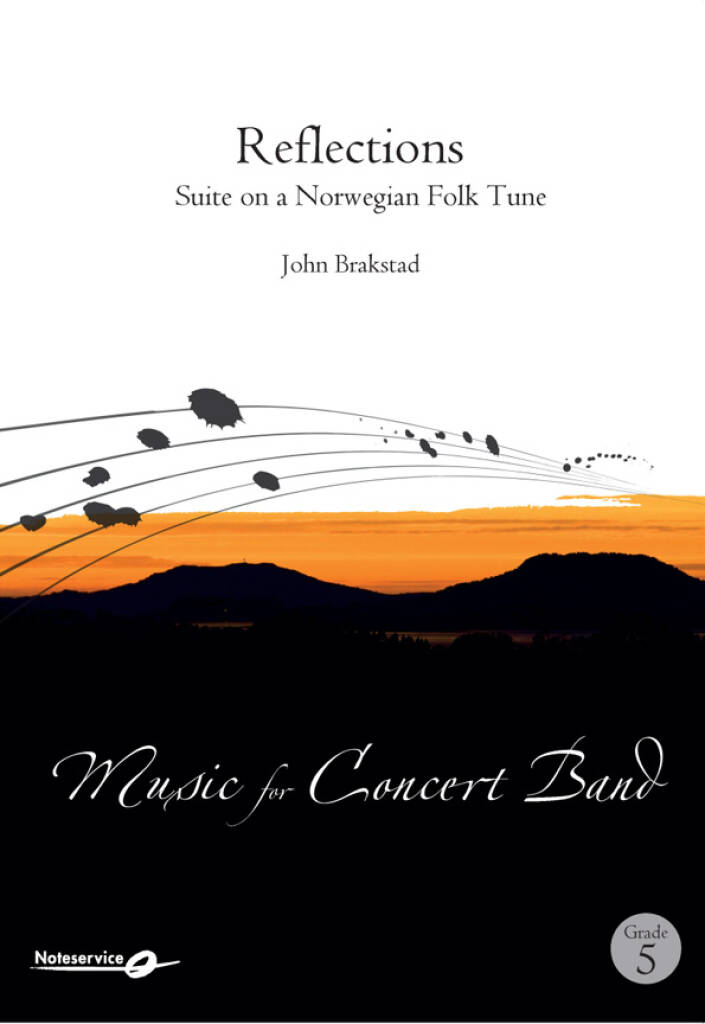
Reflections - Suite on a Norwegian Folk Tune - John Brakstad
The suite is constructed around a Norwegian folk tune. The melody is called "Dark Forebodings", and the words of the song revolve around thoughts and reflections on a future that can take unexpected, insecure, or perhaps dramatic and tragic turns.This is essentially a sad song with a beautiful melody. The folk tune itself is presented in the 2nd movement. In the 1st movement, the folk tune is joined with fleeting themes that indicate the unexpected; as if the music sometimesis confused as to which way to go. There are constant changes in atmosphere and feeling, from the harsh and dissonant, to the harmonious and melodic. The 3rd movement presents a more lively variant of thefolk tune, showing optimism andhappiness, even though the "halting" character of the rhythm underscores the unpredictable. The title "Reflections", therefore, refers to thoughts we can have about life. To the Conductor:The 2nd movement has an alternativeending which is may be used if the movement is played as an independent lyrical piece in a concert.It is advisable to begin first rehersal with the 2nd movement so that the main theme is known, before beginning on the 1st movement with itsmore semi-tonal parts. Intervals and intonation can provide much of the challenge in this movement.The 3rd movement can be more technically challenging, but there is considerable leeway in the tempo marking! It is important to maintain theenergy and intensity of the music through the whole movement.
Estimated dispatch 7-14 working days
-
£149.40
Starsleet - Aslak Dørum
Stjernesludd is a hit single from the popular Norwegian band DumDum Boys. The song-writer Aslak Drum is the bass-player in the band. It was recorded in 1997, and it has been a well know radio-hit ever since. The lyrics are set in a dark tone, andthey tell the story of a gloomy and "black and white" feeling in the cold weather before Christmas. "But when the winter comes, we can make angels in the snow..." In 2010, Norwegian singer Kurt Nilsen accompanied by The Norwegian RadioOrchestra recorded it for their CD "Have Yourself a Merry Little Christmas".If performed with Tenor Sax soloist, the first time bracket can be omitted.
Estimated dispatch 7-14 working days
 View Music