
Results
-
£204.99
Credentium - Jan Van der Roost
A spectacular dive via an extended chromatic scale immediately submerges us in a charged and somewhat archaic-feeling atmosphere. Trumpets, horns and trombones resound in rhythmic patterns, buttressed by restless motifs in the percussion. A second theme, in the woodwinds, begins much calmer but is quickly pushed aside by that same brass offensive. This introduction is the musical expression of the sometimes tumultuous early history of the town of Peer in Belgium. It closes with a D scale played over two octaves and repeated three times, symbolizing the church steeples that dominate the townscape. Peer has the credentials of a town, and people should know about it.There followsa rhythmic, turbulent passage: in the course of history, Peer has not been spared the ravages of war, arson, occupation, epidemic and other evils. In contrast, a slow, pastoral, lyrical part expresses the periods of peace and prosperity the town has known, as well as the serene geographic setting that still characterizes the place. Various instruments in groups are developed in solo style while the accompaniment displays vast, painterly images of sound. Now and then an exotic intonation is heard: a variety of peoples and cultures have left their mark on the town.This episode of tranquility and peacefulness comes to a sudden end when, via a surprising, almost chaotic transitional passage, we are in effect transported back to our own time. A hopeful, festive march expresses the confidence in the future that the Royal Concert Band of Peer exudes. This confidence is wholly justified: under the direction of conductor Willy Fransen, the 95 members of the concert band have experienced an extended period of good fortune, and the 75 musicians of the youth band - and the 45 little musicians of the mini-band - are involved in thriving operations.
Estimated dispatch 7-14 working days
-
£73.50
Where Valor Proudly Sleeps - Robert Longfield
The Civil War has long been a source of inspiration for poets, artists, and composers. Robert Longfield offers an exciting new work as a musical salute to this dramatic time in American history. Based on original material from the 1800s, the piece is scored to include field drums, a 21 cannon volley, and a sensitive brass treatment of Taps featuring solo horn.
Estimated dispatch 7-14 working days
-
 £149.99
Heaven and Earth - Jan Bosveld
An Astrological Composition. Astrology is based on the principle that each sort of time has its own quality. In order to determine the quality of a particular moment, an astrologer looks at the position of the planets in the solar sustemat that moment. Each planet has specific types of energies and its location provides unique information for a certain moment on Earth. Thus: its position in the sky tells something about what happens on Earth. In this composition the typesof energies of four planets are musically translated. The four planet were not randomly chosen. There are two pairs, whose influence and energy are opposite. Venus and Mars. Venus represents the feminine principle: harmony, beauty,art, and the ability to make relationships and to keep the peace. Venus connects, and communicates in order to maintain the balance. Mars represent the masculine principle: winning, impulsiveness, enthusiasm, and sexual energy for procreation.He creates war enabling the strongest to triumph. Mars is musically depicted in a stirring march in which enthusiasm characterises the masculine character. Saturn and Jupiter. Saturn represents concentration and withdrawal: the strongnotion of responsibility, seriousness, self-discipline and melancholy. Saturn is the hermit who will conquer his fears and worries in minimal conditions and by self-chastisement. This contemplative character is depicted in the music as if it isalmost standing still, which also reflects the given character of this planet. Jupiter represents growth and expansion: the positive, self-confidence, the good Samaritan, the healer. Jupiter is the philosopher who will make the world a betterplace, sees future possibilities, and searches for eternal values. He is the prophet who sometimes rants and raves his doctrine and proclamations, resulting musically in a whirling and upbeat finale. not looking back at what has been but searchingfor new challenges. "Heaven and Earth" was commisioned by the Music Lending and Information Centre (MUI), a department of the library for the province of Gelderland in Arnhem, The Netherlands.Een astrologische compositie. Astrologie is gebaseerd op het principe dat elke tijd zijn eigen kwaliteit heeft. ""Tijd voor koffie"" of ""het was je tijd nog niet"" als bijvoorbeeld een baan aan je neus voorbij is gegaan. Om de kwaliteit van een moment te lezen kijkt deastroloog naar de stand van de planeten in ons zonnestelsel op dat tijdstip. Elke planeet heeft specifieke energien en de plaats aan de hemel geeft unieke informatie over een bepaald moment op aarde. Oftewel: de stand aan de hemel (Ouranos) verteltiets over wat er op aarde (Gaia) gebeurt. In deze compositie worden de energien van vier planeten muzikaal vertaald. De vier planeten zijn niet lukraak gekozen. Het zijn twee paren, die qua invloed en energie tegenovergesteldzijn. Venus en Mars. Venus vertegenwoordigt het vrouwelijke principe: harmonieus, schoonheid, de kunst, het vermogen om verbindingen aan te gaan en de vrede te bewaren. Venus geeft door en verbindt om de balans te bewaren. Marsvertegenwoordigt het mannelijke principe: winnen, anderen aftroeven, impulsief en enthousiast, seksuele energie voor de voortplanting. Mars creert oorlog om de sterkste te laten zegevieren. Venus staat tot Mars als vrede staat tot oorlog, alsverbinden staat tot verbreken, als harmonie staat tot competitie. Jupiter en Saturnus. Jupiter vertegenwoordigt groei en expansie: het positieve zelfvertrouwen, de weldoener, de genezer. Jupiter is de filosoof die de wereld wilverbeteren, vooruitkijkend en zoekend naar eeuwige waarden, de profeet die soms al te bombastisch zijn leer verkondigt. Saturnus vertegenwoordigt concentratie en inkrimping: het sterke verantwoordelijkheidsbesef, soberheid, zelfdiscipline enmelancholie. Saturnus is de kluizenaar die onder minimale voorwaarden en zelfkastijding zijn angsten wil overwinnen. De harde, serieuze werker die volgens vaste regels stug doorgaat om aan zijn hoge eisen te voldoen. Jupiter staat tot Saturnusals uitbreiding staat tot inkrimping, als zelfvertrouwen staat tot faalangst, als vrijheid staat tot structuur.
Estimated dispatch 7-14 working days
-
 £79.99
Funeral March - Samuel Barber
The Funeral March is a spectre-like fantasy on the U.S. Army Air Corps Song. This publication is the fully realized performance edition from the short score manuscript left by the composer from his time in the military during World War II.
Estimated dispatch 7-14 working days
-
 £138.00
San Pedro de Alcntara - Valdemar Gomes
The Spanish war galleon with 64 cannons, built in Cuba between 1770 and 1771 for an English shipowner in the service of the King of Spain left Peru for Cadiz in 1784 with a huge cargo of copper, gold, silver and other valuables on board. There were also more than 400 people on board, including passengers, crew and Inca prisoners after a revolt. The Atlantic crossing went smoothly, passing Portugal to take advantage of favourable winds. The shipwreck off Peniche was the result of human error, apparently due to French maps with dramatic errors in the position of the islands of Berlengas and neighbouring islets. On 2 February 1786, the sea was calm and the night clear, but they hit the rock formation Papoa and the hull immediately broke in two. The bottom sank quickly, while the deck remained afloat for some time. 128 people lost their lives, including many Indians who were trapped in the basement. This shipwreck is considered one of the most important in maritime history.What the composer wants to convey, and what can be felt as one listens, is first of all the sound of power, of hope, of the glory of conquest, of the splendour of wealth. This is followed by the perception of the maritime environment, the harmony with the softness of the ocean, the gliding of the hull in the foam of the sea on sunny, blue days. But along with this tranquillity, you soon hear a rhythmic chain that makes you feel a representation of the hustle and bustle, of the busy crew, of the hard work of a sailor, of the desperation of an exotic people imprisoned in a dark, damp cellar. A distinct rhythm that reminds us of the "salero" of Andalusia, with its Arab influences and its people, the soothing of the resignation of others who are forced to submit. Then we clearly hear a crescendo that makes us imagine the agony of the collision that precedes the shipwreck. The breaking of the hull, the water flooding everything, the despair, the clash of bodies on the rocks, the tragedy to come. Before the "grand finale", in which the return of musical softness reminds us that the story is over. The supremacy of nature over human greed. The waves, though gentle, sweep the wreckage, the lives and the treasures of the New World to the bottom of the sea.
Estimated dispatch 7-14 working days
-
 £87.40
Lord of Seven Seas - Kees Vlak
The plot of this overture takes place in the year 3000 A.D. At that time traffic between the earth and the planets relies exclusively on space flights. War as a last resort to "settle" arguments between people on earth no longer exists. There is only one gigantic spacecraft which is able to navigate both above and beneath the surface that supervises the oceans. This vessel, the "Lord of Seven Seas", is a hundred times larger than the "Nautilus" or the "Titanic" and must not be compared to any ship of our times. In the introduction of the overture, the gigantic vessel is presented by employing a musical style which is commonly associated with space flights. The introduction isfollowed by a fragment, which evokes the wild fury of rain and storm, and therefore reminds us of the story of the "Flying Dutchman". The middle section is written as a barcarole. The vessel investigates the local fauna in the depths of the Arctic Ocean. People on board enjoy the calmness as well as the variety and beauty of the animals. In the final part, the gigantic vessel emerges from below the surface and climbs to high altitudes flying from one ocean to the other. The magnificent finale portrays once again the incomparable sight which is offered by the impressive "Lord of Seven Seas".
Estimated dispatch 7-14 working days
-
 £75.50
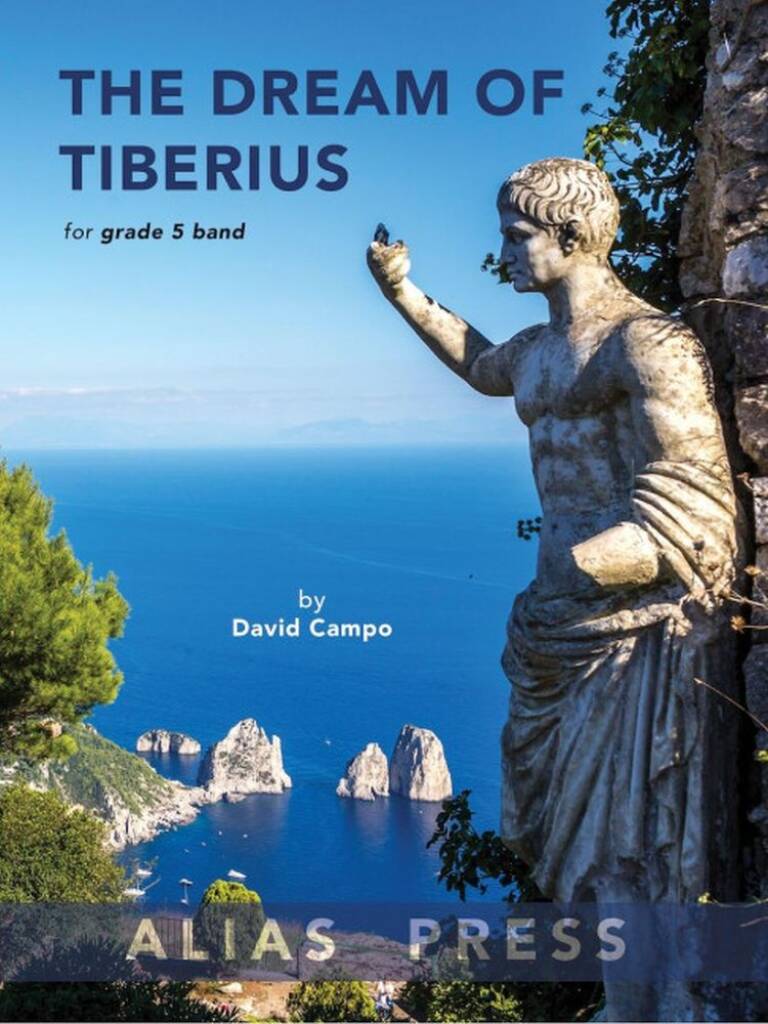
The Dream of Tiberius - David Campo
The Roman Emperor Tiberius was born in 42 BCE to Tiberius Claudius Nero and Livia Drusilla, both descendants of prestigious political families, at a time when Rome was undergoing significant political upheaval. Julius Caesar had begun a brutal civil war in 49 BCE to end Rome's rule as a Republic and consolidate his power as supreme ruler. Following Caeser's assassination in 44 BCE, Tiberius' father backed the forces wishing to return Rome to a Republic, but they were defeated by Caesarian loyalists led by Caeser's heir Octavian. As a result, Tiberius' early life was spent on the run and in political exile with his parents. In 27 BCE, Octavian would become the first Emporer of Rome and assume the name Augustus. Augustus forced Tiberius' parents to divorce and took Tiberius' mother as his new bride, separating the family and forcing Tiberius to live with his father. Upon his father's death, Tiberius went to live with his mother and Emporer Augustus, a situation Tiberius found extremely uncomfortable but one over which he had no control. Having been adopted by the Emperor, Tiberius assumed the military and political life thrust upon him. He proved to be an outstanding military and political leader, and with his marriage to Vipsania Agrippina his life took on a heretofore unknown stability. However, Augustus would intervene in Tiberius' life once more, forcing him to abandon his happy marriage and take Augustus' daughter Julia (Tiberius' step sister) as his new wife. This arrangement, while securing Tiberius' place as Augustus' heir and ensuring he would one day be Emperor of Rome, was disastrous. Julia's drunken licentiousness was a constant source of scandal and embarrassment for Tiberius (and her father, the Emperor) and she was eventually exiled by her father Augustus. Tiberius was named Emperor of Rome upon the death of Augustus in AD 14, assuming his position as the most powerful man on Earth. However, no matter how powerful he had become, Tiberius never felt as if he had ever had any control over his life, having been manipulated from childhood through adulthood by the whims of Augustus. As Emperor, he soon became disgusted with the political intrigue of the Roman Senate and by AD 26 left Rome and took up residence on the island of Capri, where he lived out the rest of his life. History does not regard Tiberius fondly and by all accounts towards the end of his reclusive life on Capri, he had become a miserable, sick and mentally unstable old man reveling in debauchery and cruelty. It is also informative to note that he was Emperor of Rome when Jesus of Nazareth was crucified, and while there is no indication that Tiberius was even aware of the existence of Jesus, as Emperor he was responsible for the appointment of Pontius Pilate as Governor of Judea. Even considering this, it is difficult to look on the life of the Emperor Tiberius and not feel some sympathy and pity. It's in this spirit that I composed "The Dream of Tiberius." I imagine the man sitting in thoughtful seclusion on the beautiful island of Capri imagining what his life might have happily been had not power been thrust upon him: husband, father and humble servant of the people.
Estimated dispatch 7-14 working days
-
£82.50
Heros Tale - Daniel W. Chisham
A very playable, and very descriptive composition, this musical narrative tells the story of a hero and his adventure, musically leading us into a war with polytonality as the battleground. The upper winds introduce the main theme, which is then counterattacked by the lower winds. All this time the percussion plays a steady drone to the rhythm of the battle. The work ends with the hero emerging triumphantly in a majestic finale.
Estimated dispatch 7-14 working days
-
 £82.50
The Shady Grove - Travis J. Weller
Shady Grove is a folk song that began to be heard in the southern Appalachians around the time of the Civil War. The memorable melody has a distinctively haunting quality that one cant help but be affected by. Many different lyrics exist for the song (some estimate it could be as many as 250), but the central themes are that of longing, love, and friendship. The use of washboard and spoons at one point brings this catchy bluegrass tune to life, helping us connect to this delightful American folk song.
Estimated dispatch 7-14 working days
-
 £139.99
Story of a Village - André Waignein
This work relates the story of Maasbracht, a town on the banks of the Meuse River in the Dutch province of Limburg. Like all fairy tales, the story begins serenely with ?Once upon a time?? The music evokes the atmosphere of this very pleasant region, where the gentle way of life is the key to happiness. A lively and joyful passage depicts the cheerfulness of the people of Maasbracht. Maasbracht, like many other towns, suffered during World War II: sound colours darken and pictures of destruction run through our mind. In the midst of despair there is hope, from grief comes new life. The future looks promising. The work leaves Maasbracht, looking forward to the 21st century withconfidence. A highly descriptive work that is suitable for any concert or contest situation.
Estimated dispatch 7-14 working days
 View Music