
Results
-
 £159.60
Radiovariations - J. Alamá-Gil
In his 'Radiovariations' the Spanish composer Jos Alam-Gil wrote four very different variations on a 'radio theme' that is heard in the broad introduction. The 1st variation is lively and very rhythmical. The 2nd variation is a blues with slightly swinging accompaniment. The 3rd variation has a faster tempo and uses typical traditional Spanish folk instruments such as the Dulzaina (a treble shawm) and tabla (small timpani). The 4th variation is also very lively, whereas the short finale picks up again the initial theme to conclude this fine composition.
Estimated dispatch 7-14 working days
-
 £84.99
Variations on a Theme by Elgar - Árpád Balázs
In rpd Balzs's diverse and varied oeuvre, works for wind orchestra play a prominent role alongside choral music. He composed the Elgar Variations in 2022 on the theme of one of Edward Elgar's (1857-1934) short early works (Love's Greetings, 1888). As rpd Balzs writes ''The theme I used as the starting point for my work may already be considered a variation, since I 'peeled off' the dense ornamentation and the tonicisations from it, and what remained was the melody, beautiful in its own place. What come back from time to time from the theme in the variations are: the arched structure, the double peak point, and mostly the major sixth leaping downwards, then upwards. The modest, transparent orchestration, which then is amplified at the repetition of the theme is also a defining feature. There is a personal family secret hidden in the third variation: a late compliment to a loyal spouse for the past half century... The closing variation is calm and quiet - similarly to the chorale-like slow movement in Bla Bartk's 3rd Piano Concerto. It is like a message from an old composer to the Future.'' The Elgar Variations together with the Concertino (1992, Z. 14909) and the Rhapsody (2015-2021, Z. 15167) form an ambitious, emotionally wide-range trilogy for a concert band.
Estimated dispatch 7-14 working days
-
 £51.60
Sakura Variations - Kees Vlak
The blooming of the cherry trees each spring is a great event in Japan. In the evening friends meet under the pink and white cherry blossoms for a picnic. It is a striking sight, especially in big cities. Vendors sell Japanese food, entertainers andclowns perform, and the typically cautious Japanese seem to be more relaxed during the cherry blossom, or "Sakura". Kees Vlak captured this atmosphere with his "Sakura Variation"; its theme employs a subtle drum rhythm. The first variation is titled"clowns" and opens with three bass drum strikes. The theme appears in 3/4 time and is repeated several times with surprising changes. An impetuous tempo with dissonant elements suggests a clown's mischievous behaviour. The second variation in a minormode sounds very sad and dramatic. Is this the sadness when thinking of the end of the cherry blossom, as all the petals "snow" down from the trees? The cherry trees will bloom again next year, so the finale celebrates a joyful "Sakura".
Estimated dispatch 7-14 working days
-
 £74.00
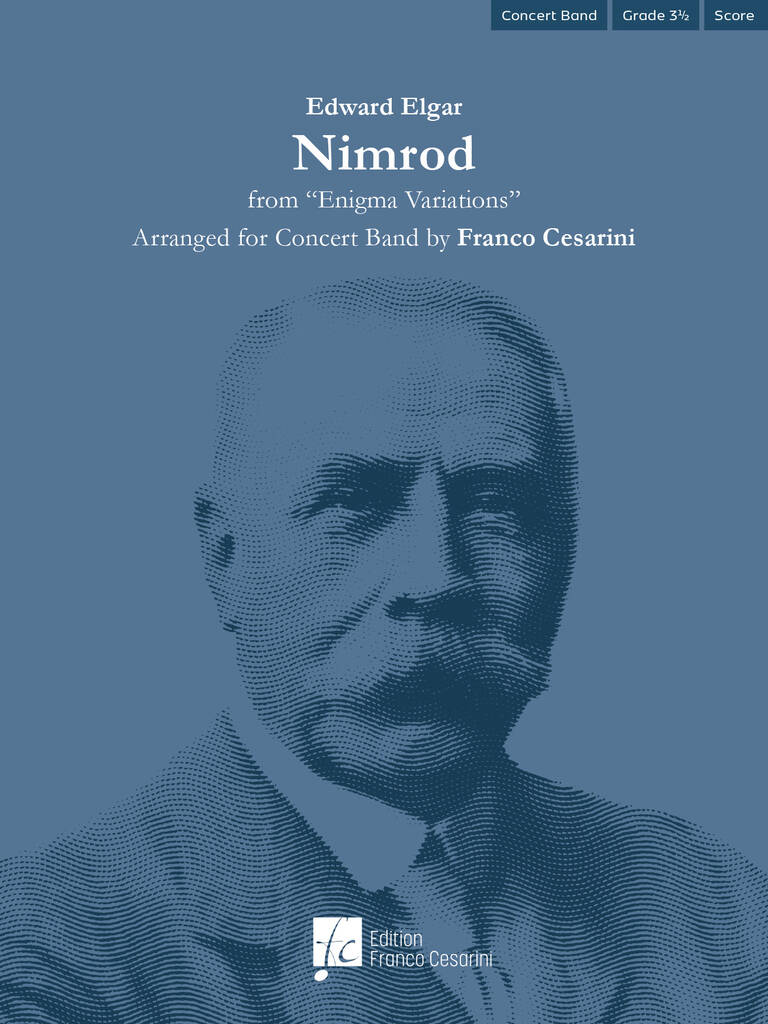
Nimrod - Edward Elgar
Nimrod is the name given to the ninth and best-known variation inEdward Elgar's Enigma Variations, an orchestral work of 14 variations on an original theme composed between 1898 and 1899. Each variation is also a portrait of one of 14 members of Elgar's family and circle of friends. A celebrated work, Nimrod is a portrait of Augustus Johannes Jaeger, who in addition to being his best friend was also Elgar's editor.The variations all represent a series of portraits and as such are entitled with a name or initials that identify the person. Biblically, Nimrod is a great hunter of the Old Testament, thus representing his muse through a play on words: Jger in German means 'hunter'. The melody appears to represent a nocturnal stroll during which the two discuss Ludwig van Beethoven's slow movements; the first eight bars, in fact, recall the beginning of the second movement of the Pathtique Piano Sonata.An arrangement of classical music signed by Franco Cesarini which stands out for its skilful and careful instrumentation.
Estimated dispatch 7-14 working days
-
 £171.00
Passacaglia and Fugue in C-minor BWV 582 - Johann Sebastian Bach
The Passacaglia is a set of instrumental variations based on an ostinato bass. Bach's Passacaglia and Fugue in C-minor for organ represents the pinnacle of what had been achieved in this compositional form at that time. In Franco Cesarini's arrangement for large wind orchestra, the particularly careful interpretation of the original piece enables him to exploit all the sound colors at his disposal, and in this sumptuous guise Bach's work also takes on a grandiose dimension, albeit tinged with late-Romanticism. The exposition of the beautiful theme begins in the bass part, immediately creating a solemn and serious atmosphere which is accentuated by the intensely pathetic character of the first variations. Up to the tenth variation it remains confined to the bass, but in subsequent ones it also passes to the soprano and alto register. The integrity of the theme is also embellished with elegant arpeggios, in whose lower and higher extensions the theme can be distinguished. Towards the end it returns to the bass in an impressive thickening of the polyphonic texture that swiftly re-establishes the key of C-minor. The "Thema fugatum" which follows immediately does not constitute a Fugue in its own right, rather it is nothing but the twenty-first and most extensive variation of the Passacaglia. This time Bach uses only the first half of the theme, superimposing a rhythmic countersubject that considerably enlivens the entire development of the composition. The polyphonic discourse becomes increasingly dense, until the building tension peaks in a powerful "Neapolitan sixth" chord, followed by a sudden pause. This culminating moment then leads to the coda and final cadence on a bright C-major chord.
Estimated dispatch 7-14 working days
-
£71.50
Song With Variations - Timothy Broege
The song itself is a 32-bar popular song form. The first variation subjects the gentle song to some fragmentation and varied harmonies, while the second variation turns the song into ragtime.Captivating!
Estimated dispatch 7-14 working days
-
£104.99
Partita Piccola - Henk van Belcum
As the title suggests, this work is a partita: it consists of a number of variations on a chorale melody. The partita has been popular for centuries, especially when it comes to organ music. Henk van Belcum, who is active in the choir world, chose for his Partita Piccola the German hymn Wunderbarer Knig as a starting point. Partita Piccola consists of four variations and a choral setting. After a majestic opening fanfare, the second variation follows, based on a canon by Pachelbel. Hndel's Sarabande is the basis of the third variation. Next comes the chorale setting, after which the work ends festively with a dance that has been written in the form of a courante. PartitaPiccola is an asset for church services and for concert platforms.
Estimated dispatch 7-14 working days
-
 £104.99
Variations on Shalom Chaverim - Andreas Ludwig Schulte
Shalom Chaverim is an ancient Hebrew (farewell)song, which was originally sung at the end of a celebration or meeting. It was and is mostly sung as a round. Freely translated the words mean "Goodbye, friends, goodbye and see you again!". The varying moods at a parting have been captured very well by Andreas Schulte in his arrangement 'Variations on Shalom Chaverim'. The composer himself says about the song, 'Although the melody is in a minor key, the overall atmosphere in the song is positive. one wishes each other all the best. Saying goodbye, however, also hurts. When you slow down the pace of the melody and add 'blue notes' in the harmonies, this can be sensed immediately.'Schulte refers here to the first variation. The second variation is very intense with possibly even deeper-felt emotions. 'Variations on Shalom Chaverim' ends on a cheerful and positive note, in fast tempo, and with oriental elements in the melody: 'L'hitra'ot, Shalom' (See you again, and farewell!).
Estimated dispatch 7-14 working days
-
 £115.60
Hymne til gleden - Ludwig van Beethoven
Schiller's text of 1785 was partially used by Beethoven in1824 when he did finish the 4th movement of his 9th Symphony. The melody has later been used in very many contexts. As the anthem of the European Union, a lot of movies (A clockwork Orange, Die Hard, etc.), music to video games, as the anthem of Rhodesia, as rebel song in Chile and by FIFA. Therefore, it can be used in most settings This Young Band arrangement focuses on the main melody. In the original, the B part is repeated in each variation, but to get three variations (out of four), this repetition has been cut. The first variation should be played as soft as possible, but still with a nice sound. Crescendo to forte(f) and going back to pp should be as a surprise.
Estimated dispatch 7-14 working days
-
 £104.50
Variations On A Mighty Fortress - Darren W. Jenkins
A truly powerful setting that is worthy of this famous hymn that uses an impressive set of three variations. It opens with a slow, legato presentation of the melody stated by solo trumpet followed by the first lively variation, driven by a strong rhythmic accompaniment. The second variation features an alto saxophone solo that builds and alternates between woodwind and brass choirs before closing with a majestic fanfare and the full ensemble driving to a jubilant conclusion. Extremely uplifting!
Estimated dispatch 7-14 working days
 View Music