
Results
-
 £115.00
DIVERTIMENTO FOR BAND (Concert Band) - Woolfenden, Guy
Includes:I. ToccataII. AubadeIII. ScherzoMany of the principal musical ideas for Divertimento for Band are derived from music composed for a documentary film called Country Camera, which celebrated the work of the earliest photographers who recorded a way of life which vanished at the outset of the first World War.The three movements are played without a break. The Toccata pits a four-note motif (which always appears with its mirror image) against several other derived ideas, including a sour horn (later trumpet) figure, a tiny lyrical passage initiated by a solo alto saxophone, and a more gentle, but still staccato episode. Many polytonal devices keep the four-note motif active. The Aubade contrasts a lyrical pastorale, initiated by a solo flute, with a more intense central section on the brass. The Scherzo finale has three main ideas; a tune for principal bassoon and euphonium of a playful child-like nature, a rushing figure for the woodwinds later developed by the full band, and a solo for trumpet and clarinet, involving a descending scale and a lyrical wide-leaping recovery. The exuberant coda is derived from themes from the previous two movements.The world premiere of Divertimento for Band was given at the conference of the World Association for Symphonic Bands and Ensembles in Killarney on 13th July 2007 conducted by the composer, and is affectionately dedicated to Keith Allen, Jayne Rollason and Birmingham Symphonic Winds. -GW
Estimated dispatch 7-14 working days
-
£64.95
WHEREVER YOU ARE (Concert Band) - Mealor, Paul - Stubbs, Duncan
Commissioned by Gareth Malone for Series Four of BBC TV's 'The Choir' and first performed by Malone and The Military Wives Choir as part of The Royal British Legion's Festival of Remembrance at the Royal Albert Hall on 12 November 2011, in the presence of Her Majesty The Queen. The text is taken from poems, letters and prayers written by the Military Wives, selected and adapted by Paul Mealor, and a passage from the Book of John. Selling a staggering 556,000 copies in the week leading up to Christmas, more than the rest of the Top 12 combined, Wherever You Are became the UK's Official Christmas No. 1 of 2011. A brass band version is also available. A contribution from the sales of the sheet music will be donated to the two nominated charities: The Royal British Legion and SSAFA Forces Help.
Estimated dispatch 7-14 working days
-
 £125.00
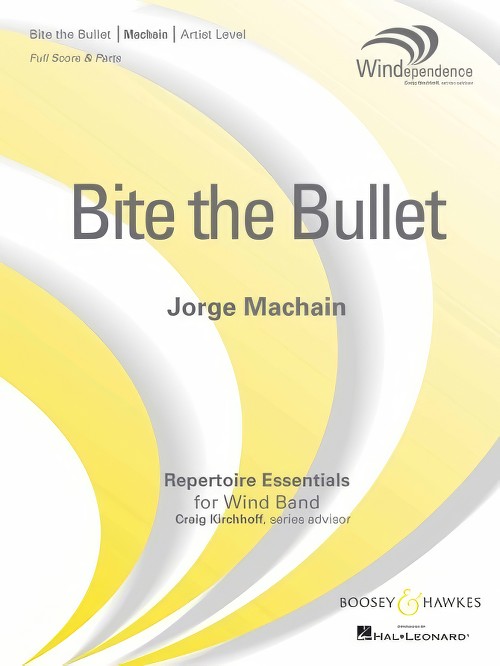
Bite the Bullet (Concert Band - Score and Parts) - Machain, Jorge
Bite the Bullet by Mexican-American composer Jorge Machain was named 2019-2020 winner of acclaimed The American Prize for music, in addition to being a finalist in the 2018 NBA Revelli competition. The work was inspired by a painting by Venetian artist, Carlo Marchiori, which depicts two Pulcinelli (Venetian clowns) engaged in a gun battle. As the bullets meet in the middle of the scene, a colorful and vibrant cloudburst is created. Using a unique sonic colour scheme, the brass and percussion portray the gunshots, while the woodwind flourishes emulate the painter's vibrant brush strokes. Duration: 7.00
Estimated dispatch 7-14 working days
-
 £69.95
Aylesbury Dances (Concert Band - Score and Parts) - Wiffin, Rob
The suite Aylesbury Dances was commissioned by the Aylesbury Concert Band to mark the occasion of their 25th Anniversary in 2019. Its three movements depict different aspects of Aylesbury: I. Pavane: The Town - Having read something of the town's history and its architecture I decided I wanted to write something ceremonial with the feel of music from Tudor times. Aylesbury was given its charter and borough status in 1554 by Mary Tudor so I took that as my starting point but then added some harmony that moves forward in time. This fits with the town's motto: Semper Prorsum (Always forward) and also with the Band's evolution from Aylesbury Town Band to Aylesbury Community Concert Band to Aylesbury Concert Band. The music can be defined as a pavane, or a cortege. The sense of procession is slightly disturbed by a 'Blue Leanie' moment. The Blue Leanie is an iconic Aylesbury building, an oblique rhombic prism which stands at an angle of 17% inclination. I took a quaver out of the time signature (I know the maths don't work!) to reflect this and added some bluer harmony at that point. This opening movement gives a sense of the grandeur and heritage of Aylesbury town and a chance for my friends from the brass section to warm up! II. Siciliana: Waterside - To balance the outer two movements, the middle movement of the suite has a slow lilting 6/8 rhythm. It is in the style of a Siciliana, a dance form originating in the baroque era. It is a graceful, tender and melancholic dance, cast here in a minor key and featuring the dark voice of the cor anglais. The Siciliana was often linked with pastoral scenes and Aylesbury itself sits amid some beautiful countryside. It may, therefore, seem a bit of a stretch to call this movement 'Waterside', especially as Aylesbury is so far from the sea, but the town has a theatre of that name and that was the genesis for this particular music. There is a statue of Ronnie Barker in the grounds of the Waterside theatre as he started his career in repertory theatre in Aylesbury, so I included a fleeting reference to the theme music of the comedy programme 'Open all Hours'. III. Frolic: Ducks in a Row - It was impossible to write a piece connected with Aylesbury without considering the famous Aylesbury ducks. Duck rearing was a major industry in the town in the 19th century. The white Aylesbury Duck is a symbol of the town, appearing on its coat of arms and in the logo of the Aylesbury Concert Band! This movement is all about trying to get the little darlings in a row so they can sing their 'Duck Chorus' together but they keep on scattering, flying off or swimming away as quickly as they can manage. It's a bit like watching ducks disperse when my dog jumps into the stream after them. Eventually we get more of them in a row - even though they protest. Hidden amongst the ducks is a reference to Erica Miller, saxophonist and chairman of the band, and there's even a veiled reference to a shark in the hope of getting them out of the water. Ducks in a Row is a fun romp bringing this suite of Aylesbury Dances to a suitably celebratory conclusion.- Rob Wiffin.Duration: 9.15
Estimated dispatch 7-14 working days
-
 £140.00
Capriccio (Concert Band - Score and Parts) - Holst, Gustav - Noble, Paul
The following notes have been excerpted by the arranger from those presented in the Introduction by Imogen Holst, daughter of Gustav Holst: Holst wrote this work in the spring of 1932, while he was guest Lecturer in Composition at Harvard University. He had been asked by Nathaniel Shilkret to write 'a short radio piece, not longer than five or six minutes.' for a composers' series on folk music themes. Holst wrote to me on 13 May 1932, saying: 'On May 1 I started sketching a piece for Shilkret's Radio jazz band in New York. I finished the sketch on the 4th and the full score on the 8th... Shilkret wanted something on American airs but I've left them out because I prefer my own so he may reject the thing.' Shilkret was enthusiastic about the piece, but he was unable to use it for his series. 'I hate to give it up,' he told the composer, 'but I cannot play it because it is not based on a definite English or American folk theme.' Holst never revised his hurriedly-written work, probably because he had too many other things to write during the remaining two years of his life, when he was having to spend a good deal of his time in hospital. The autograph manuscript of his original full score is in the British Library, MS Add.47833. The work had no name: Holst referred to it either as his 'Jazz band piece' or as 'Mr. Shilkret's Maggot.' The score needed editing. There were gaps and patches, with incomplete dynamics and phrase marks. I made the version for orchestra and named it 'Capriccio' in spite of the viola's (now saxophone's) expressive opening, because from the moment of the marimba's first animated remark there can be no doubt about the mood of the music. - Imogen Holst (1968)
Estimated dispatch 7-14 working days
-
 £60.99
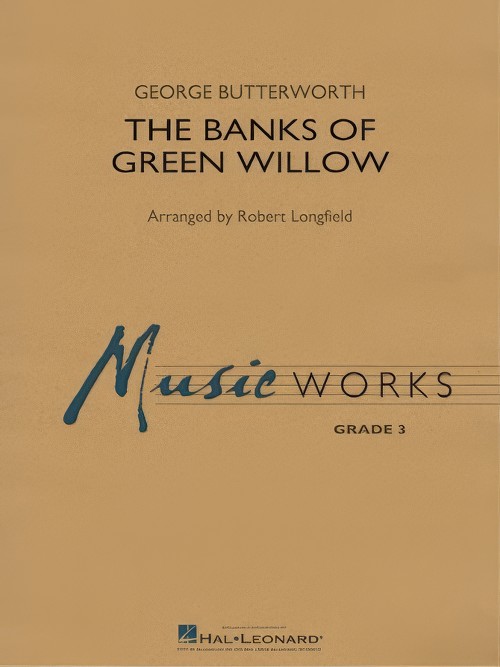
The Banks of Green Willow (Concert Band - Score and Parts) - Butterworth, George - Longfield, Robert
Written by British composer George Butterworth in 1913, this classic work is based on two folk songs - The Banks of Green Willow and Green Bushes (the latter also appearing in works by Grainger and Vaughan Williams). Butterworth died in World War I at the age of 31, and this composition remains his most popular, regarded as an anthem for Unknown Soldiers. Here is a masterful setting for winds adapted by Robert Longfield.Duration: 3:50
Estimated dispatch 7-14 working days
-
 £495.00
English Dance Suite (Concert Band - Score and Parts) - Gardner, John - Noble, Paul
Original Scoring. Arranged for the modern Concert/Wind Band, scored for three trumpets, reasonable doubling of parts where the original musical effect is not altered so that players can have a more responsible and enjoyable experience, more legible parts with less doubling on one staff, etc. The piece is offered either as a complete suite of seven movements, and also as seven individual movements which may be purchased independently. The English Dance Suite was originally composed by John Gardner for Wind Band, and has been re-set for the modern Concert Band instrumentation. Both the original version, edited and type-set by Paul Noble, and this arrangement are first editions now available for purchase to bands around the world. The set of seven Renaissance dances depict John Gardner's love of Scottish music, the Renaissance heritage, and some of his own mischievous approach to music. The first movement, Chacony on a Golden Theme, reminiscent of the Allegro movement of Purcell's Golden Sonata, is much used as a vehicle for variation on a repeated short harmonic progression, often involving a fairly short repetitive bass-line which offered a compositional outline for variation, decoration, figuration and melodic invention. In this it closely resembles the passacaglia. The Alman originated in the 16th century as a duple metere dance of moderate tempo, already considered very old, with a characteristic double-knocking upbeat of one or occasionally three sixteenth notes. It appears to have derived from a German dance but no identifiable dance and no German dance instructions from this era survive. The Hornpipe, usually in 3/2 dance rhythm, is an Irish, Scottish and English dance. It is done in hard shoes, which are used to help keep track of how the dancer keeps in time. There are two variations of the hornpipe dance: fast and slow. Usually, more experienced dancers will do the slow hornpipe but younger dancers will start out with the fast hornpipe and then switch in later years. The Corranto is a 16th-century court dance characterized by short advances and retreats, in quick triple time. The Volta (Italian: the turn or turning) is an anglicised name from the later Renaissance. Its main figure consisted of a turn and lift in a sort of closed position. The Pavan is a slow processional dance common in Europe during the 16th century. The Reel, indigenous to Scotland, consists largely of quaver (eighth note) movement with an accent on the first and third beats of the bar.
Estimated dispatch 7-14 working days
-
 £125.00
English Dance Suite - I. Chacony on a Golden Theme (Concert Band - Score and Parts) - Gardner, John - Noble, Paul
Arranged for the modern Concert/Wind Band, scored for three trumpets, reasonable doubling of parts where the original musical effect is not altered so that players can have a more responsible and enjoyable experience, more legible parts with less doubling on one staff, etc. The piece is offered either as a complete suite of seven movements, and also as seven individual movements which may be purchased independently. The English Dance Suite was originally composed by John Gardner for Wind Band, and has been re-set for the modern Concert Band instrumentation. Both the original version, edited and type-set by Paul Noble, and this arrangement are first editions now available for purchase to bands around the world. The set of seven Renaissance dances depict John Gardner's love of Scottish music, the Renaissance heritage, and some of his own mischievous approach to music. The first movement, Chacony on a Golden Theme, reminiscent of the Allegro movement of Purcell's Golden Sonata, is much used as a vehicle for variation on a repeated short harmonic progression, often involving a fairly short repetitive bass-line which offered a compositional outline for variation, decoration, figuration and melodic invention. In this it closely resembles the passacaglia. The Alman originated in the 16th century as a duple metere dance of moderate tempo, already considered very old, with a characteristic double-knocking upbeat of one or occasionally three sixteenth notes. It appears to have derived from a German dance but no identifiable dance and no German dance instructions from this era survive. The Hornpipe, usually in 3/2 dance rhythm, is an Irish, Scottish and English dance. It is done in hard shoes, which are used to help keep track of how the dancer keeps in time. There are two variations of the hornpipe dance: fast and slow. Usually, more experienced dancers will do the slow hornpipe but younger dancers will start out with the fast hornpipe and then switch in later years. The Corranto is a 16th-century court dance characterized by short advances and retreats, in quick triple time. The Volta (Italian: the turn or turning) is an anglicised name from the later Renaissance. Its main figure consisted of a turn and lift in a sort of closed position. The Pavan is a slow processional dance common in Europe during the 16th century. The Reel, indigenous to Scotland, consists largely of quaver (eighth note) movement with an accent on the first and third beats of the bar.
Estimated dispatch 7-14 working days
-
 £75.00
English Dance Suite - II. Alman (Concert Band - Score and Parts) - Gardner, John - Noble, Paul
Arranged for the modern Concert/Wind Band, scored for three trumpets, reasonable doubling of parts where the original musical effect is not altered so that players can have a more responsible and enjoyable experience, more legible parts with less doubling on one staff, etc. The piece is offered either as a complete suite of seven movements, and also as seven individual movements which may be purchased independently. The English Dance Suite was originally composed by John Gardner for Wind Band, and has been re-set for the modern Concert Band instrumentation. Both the original version, edited and type-set by Paul Noble, and this arrangement are first editions now available for purchase to bands around the world. The set of seven Renaissance dances depict John Gardner's love of Scottish music, the Renaissance heritage, and some of his own mischievous approach to music. The first movement, Chacony on a Golden Theme, reminiscent of the Allegro movement of Purcell's Golden Sonata, is much used as a vehicle for variation on a repeated short harmonic progression, often involving a fairly short repetitive bass-line which offered a compositional outline for variation, decoration, figuration and melodic invention. In this it closely resembles the passacaglia. The Alman originated in the 16th century as a duple metere dance of moderate tempo, already considered very old, with a characteristic double-knocking upbeat of one or occasionally three sixteenth notes. It appears to have derived from a German dance but no identifiable dance and no German dance instructions from this era survive. The Hornpipe, usually in 3/2 dance rhythm, is an Irish, Scottish and English dance. It is done in hard shoes, which are used to help keep track of how the dancer keeps in time. There are two variations of the hornpipe dance: fast and slow. Usually, more experienced dancers will do the slow hornpipe but younger dancers will start out with the fast hornpipe and then switch in later years. The Corranto is a 16th-century court dance characterized by short advances and retreats, in quick triple time. The Volta (Italian: the turn or turning) is an anglicised name from the later Renaissance. Its main figure consisted of a turn and lift in a sort of closed position. The Pavan is a slow processional dance common in Europe during the 16th century. The Reel, indigenous to Scotland, consists largely of quaver (eighth note) movement with an accent on the first and third beats of the bar.
Estimated dispatch 7-14 working days
-
 £110.00
English Dance Suite - III. Hornpipe (Concert Band - Score and Parts) - Gardner, John - Noble, Paul
Arranged for the modern Concert/Wind Band, scored for three trumpets, reasonable doubling of parts where the original musical effect is not altered so that players can have a more responsible and enjoyable experience, more legible parts with less doubling on one staff, etc. The piece is offered either as a complete suite of seven movements, and also as seven individual movements which may be purchased independently. The English Dance Suite was originally composed by John Gardner for Wind Band, and has been re-set for the modern Concert Band instrumentation. Both the original version, edited and type-set by Paul Noble, and this arrangement are first editions now available for purchase to bands around the world. The set of seven Renaissance dances depict John Gardner's love of Scottish music, the Renaissance heritage, and some of his own mischievous approach to music. The first movement, Chacony on a Golden Theme, reminiscent of the Allegro movement of Purcell's Golden Sonata, is much used as a vehicle for variation on a repeated short harmonic progression, often involving a fairly short repetitive bass-line which offered a compositional outline for variation, decoration, figuration and melodic invention. In this it closely resembles the passacaglia. The Alman originated in the 16th century as a duple metere dance of moderate tempo, already considered very old, with a characteristic double-knocking upbeat of one or occasionally three sixteenth notes. It appears to have derived from a German dance but no identifiable dance and no German dance instructions from this era survive. The Hornpipe, usually in 3/2 dance rhythm, is an Irish, Scottish and English dance. It is done in hard shoes, which are used to help keep track of how the dancer keeps in time. There are two variations of the hornpipe dance: fast and slow. Usually, more experienced dancers will do the slow hornpipe but younger dancers will start out with the fast hornpipe and then switch in later years. The Corranto is a 16th-century court dance characterized by short advances and retreats, in quick triple time. The Volta (Italian: the turn or turning) is an anglicised name from the later Renaissance. Its main figure consisted of a turn and lift in a sort of closed position. The Pavan is a slow processional dance common in Europe during the 16th century. The Reel, indigenous to Scotland, consists largely of quaver (eighth note) movement with an accent on the first and third beats of the bar.
Estimated dispatch 7-14 working days
 View Music