
Results
-
£149.40
Dancing Trolls [Norwegian Dance] - Øystein Olsen Vadsten
"Dancing Trolls" is a sequel to "The Battle of the Hats", which was published in 2015. Like "The Battle of the Hats", "Dancing Trolls" is a piece of music based on Norwegian traditional dances. This time around,its the reinlender dance which takescentre stage.The music is composed by ystein Olsen Vadsten who keeps the strong melodic and tempo, which is dear to this kind of dance. Admittedly given a make-over with a more rhythmic accompaniment and more excitingharmonization.This makes it a fun piece, both to Listen to and play. The reinlender dance derives from the Rhineland in Germany,and is also known as the German Polka.To the conductor:Because this is a dance form whichisdependent on the right "swing", it is of great importance to keep as close to the metronome mark as possible. A steady groove, primarily specified by the drum set, is also essential for a good result. Remember to keep a good balance between themelody carrying instruments and the accompaniment. Good luck and have fun with this "crazy" little tune.
Estimated dispatch 7-14 working days
-
 £127.30
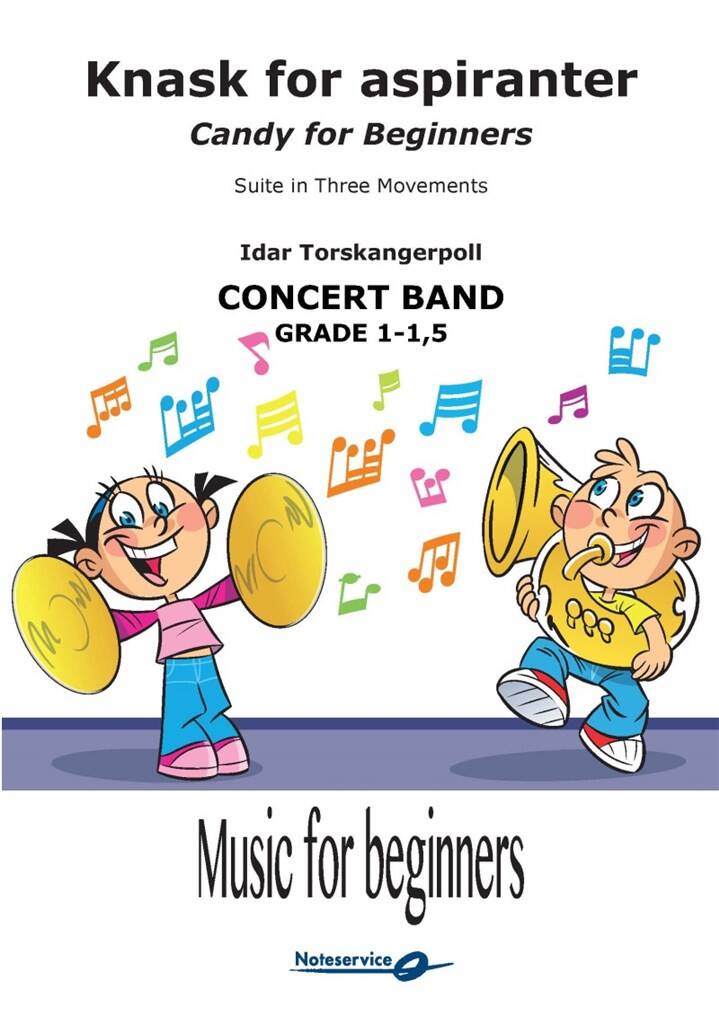
Knask for aspiranter - Suite in Three Movements - Idar Torskangerpoll
Candy for Beginners is a suite of three songs used by the composer with the youngest beginners throughout several years. The method is to sing the melodies before learning it on the instruments. Lyrics about candy has proven to be very popular among the youngsters.... In English it can goes like this: "Candy floss, candy floss, candy floss, candy floss, oh yeah". And: "Soda for me, give me soda for free". And: "Lefse, it is good, lefse, now you should, Lefse, give me one, lefse, sure is fun." The composer urges the band to find their own lyrics to the melodies, making it their own with a local twist. This is a good rhythmic exercise for the young players.
Estimated dispatch 7-14 working days
-
£78.95
Power - Larry Clark
This is one of Harold Bennett's (pseudonym of Henry Fillmore) lesser-known marches, but that is no indication of its quality. It is a 6/8 march in standard march form but what is unique about this classic from the original Bennett Band Book is that it is one of the few Bennett marches that includes a "break strain." This makes it a great introduction for younger students to prepare them to play the more challenging marches of Fillmore, Sousa, and others.
Estimated dispatch 7-14 working days
-
£106.95
To Be Found - Tyler Arcari
This beautiful piece by newcomer Tyler Arcari is based on a quote by Nelson Mandela - There is no passion to be found playing small - in settling for a life that is less than the one you are capable of living. It is heartfelt and will be a great piece to push the musicianship of your students. Though this piece is technically easy for this level, it is challenging in its sophistication and the depth of emotion and musicianship required to play it well.
Estimated dispatch 7-14 working days
-
 £149.40
Bekken (Fra Lyriske stykker opus 62) - Edvard Grieg
Brooklet is one of the movements from Grieg's Lyric Pieces for Solo Piano opus 62. Information for the conductor: Brooklet is an technically advanced work for solo piano. In this arrangement, technical passages are simplified by overlapping and doubling some of the parts. To master the technical challenges and make it sound effortless, it is important to pay close attention to balance and precision. Some of the parts also have alternative parts added which can lower the technical challenges a bit. The normal instrumentation are Clarinet 1-2-3, but there is also an "optional" part for Solo Clarinet. This is included on the same sheet as Clarinet 1. Both parts can stand alone or be played together. (i.e. The Solo Clarinet part can be played in addition to Clarinet 1, in whole or in part if desired, or it can replace Clarinet 1 entirely, using only Solo Clarinet and Clarinet 2 and 3.). From bar 5 to bar 13, there is a suggested solo for Solo Clarinet. If played by Solo Clarinet, please omit Clarinet 1, 2 & 3 for these bars.
Estimated dispatch 7-14 working days
-
 £129.99
Ratatouille Satirique
Erik Satie, born in Honfleur in Normandy (France) in 1866 is undoubtedly one of the most striking personalities in the history of French music. He composed in various, often quite divergent, styles. Besides light-hearted, entertaining works he also wrote several serious compositions, among which the three ballets: Parade, Rel che and Les Aventures de Mercure. However his piano pieces, such as Trois Gymnopdies or Gnossiennes will remain his most popular compositions. Satie co-operated with almost all great artists of his time: Pablo Picasso, Jean Cocteau, Sergej Diaghilev and Georges Braque and the composers Darius Milhaud (Le Groupe des Six) and Claude Debussy. Johan deMeij made an orchestration of three short pieces by Erik Satie: I. Prlude (from: Jack in the Box) II. Rverie (from: Trois petites pices montes) III. Marche: Le Piccadilly (1904) It was only after Satie's death in 1925 that the manuscript of the piano piece Jack in the Box was recovered. Satie himself thought he had lost the manuscript in a bus. When his flat in Arceuil was cleaned out, a small notebook was discovered behind his piano and it contained the manuscript which was assumed to be lost forever. The Rverie (De l'Enfance de Pantagruel) is an extract from Trois petites pices montes, originally composed for small symphony orchestra. In this suite it is meant as a restful intermezzo. It is clear that, as with Milhaud (La Cration du Monde) and Debussy (Golliwogg's Cakewalk; Le Petit Ngre), it is hard to deny obvious influences of jazz music in Erik Satie's compositions. Le Piccadilly, dating from 1904, displays a lot of similarities with the compositions of Scott Joplin.
Estimated dispatch 7-14 working days
-
£134.99
Recalls - Ben Haemhouts
Recalls obviously refers to memories. This piece of music is in fact a series of flashbacks, however, it does not highlight the actual memories of specific thoughts, people or events.The composition evolves around the late Frans Steurs, who for manyyears was the inspirational artist behind the brass band that is currently commissioning this work. The main theme of the work is based on the name STEURS". E = mi, U = do, R = re and S = "si" which is Dutch for the note "ti". This idea forms themusical theme for the entire composition and different variations are used throughout. The structure of the work is based on the concept of a story which father Steurs is telling his two daughters, who play the flute and the clarinet. Each part ofthe work has a story-like character:1. Introduction: following a short ominous intro, the main theme is presented for the first time.2. The Story: father Steurs has both his daughters on his knee and he tells them stories from the old days. Trumpetsand trombones play variations of the theme. The story gets very exciting (accelerande, poco a poco agitato) until the tale takes a dramatic turn when the father tells an exciting story at the time of the Second World War. He tells of being hunteddown by the occupying army and these adventurous episodes are related to us musically in part3. Danger, with its skilful references to "vor dem Sturm" from "Eine Alpensinfonie" by Richard Strauss.4. called Fugitives, is about how he fled in the nightfrom the enemy and this is reflected in the bass tones of a new theme. The aggression of the war is illustrated from bar 117 onwards, by a harsh brass section. The main theme is repeated once again and this time up-tempo. The second theme is broughtonce again from bar 149 onwards.5. Dialogues, depicts the conversations between the two daughters and their father. Father speaks (bar 155); the daughters answer (bar 164 - flute, bar 166 - clarinet); bar 178: father answers with the tune of the maintheme to the two daughters. The discussions gradually intensify but ultimately end in peace in the last part called Conclusion.The piece of music "Recalls" is a free interpretation by the composer who consulted the letters between the two daughtersof Steurs and their father and in this respect it is not really music for a programme."
Estimated dispatch 7-14 working days
-
 £129.99
Ratatouille Satirique - Traditional
Erik Satie, born in Honfleur in Normandy (France) in 1866 is undoubtedly one of the most striking personalities in the history of French music. He composed in various, often quite divergent, styles. Besides light-hearted, entertaining works he also wrote several serious compositions, among which the three ballets: Parade, Rel che and Les Aventures de Mercure. However his piano pieces, such as Trois Gymnopdies or Gnossiennes will remain his most popular compositions. Satie co-operated with almost all great artists of his time: Pablo Picasso, Jean Cocteau, Sergej Diaghilev and Georges Braque and the composers Darius Milhaud (Le Groupe des Six) and Claude Debussy. Johan deMeij made an orchestration of three short pieces by Erik Satie: I. Prlude (from: Jack in the Box) II. Rverie (from: Trois petites pices montes) III. Marche: Le Piccadilly (1904) It was only after Satie's death in 1925 that the manuscript of the piano piece Jack in the Box was recovered. Satie himself thought he had lost the manuscript in a bus. When his flat in Arceuil was cleaned out, a small notebook was discovered behind his piano and it contained the manuscript which was assumed to be lost forever. The Rverie (De l'Enfance de Pantagruel) is an extract from Trois petites pices montes, originally composed for small symphony orchestra. In this suite it is meant as a restful intermezzo. It is clear that, as with Milhaud (La Cration du Monde) and Debussy (Golliwogg's Cakewalk; Le Petit Ngre), it is hard to deny obvious influences of jazz music in Erik Satie's compositions. Le Piccadilly, dating from 1904, displays a lot of similarities with the compositions of Scott Joplin.
Estimated dispatch 7-14 working days
-
 £286.40
Poeme du Feu - Ida Gotkovsky
Major Albert Fasce, head of the musical department of the French Army, wrote about Pome du Feu:The Pome du Feu by Madame Ida Gotkovski is probably one of the original compostitions for symphonic band which has been most successful in recent years. I have had to conduct this work at concerts with different orchestras, and in particular at Budapest, and each performance was greeted by enthusiastic ovations. Moreover, it is quite rare in contemporary music to achieve, at the same time, the satisfaction of the musicians and success with the public. This is significant. This magnificent work is written remakably for wind instruments. There is no major technical difficulty, but the character of this work calls for meticulous placing and a certain orchestral glow. There is a "key" to be found in the first movement, which is in some way the rhythmic genesis of the work. The metronome marking of the first movement should be absolutely respected, and proper interpretation of the accents and the articulations are imperative. The fortissimi and rallentandi should not be exaggerated. As far as the little "trick" is concerned, this lies in the execution of the double crochets which should be considered in two ways: the first, a rhythmical one for those which arise from the rhythmic genesis, and the second more melodic for those arising in passages.Finally, to unseal the rhythmic origin of the double crochets, it is necessary to proceed by recurrence, starting from the four double crochets of the finale.These four double crochets must be executed very rhythmically in the different times. For the first, they arise:1: from the second bar of the first movement2: from the bar three bars before A for the second3: from the bar from G to the fourth time for the third.These double crochets must be played rhythmcally, while diminishing, however, those three bars before A.All this is of great importance, otherwise the whole execution will be in contradition with the spirit and the rhythmic inspiration of the work. Moreover, this beautiful work could very well support a ballet.As Head of Broadcast Music I must express all our gratitude to Madame Gotkovski for her contribution to constituting a real repertoire for wind ensemble. This articular and sometimes unappreceated band possesses unsuspected riches. This magnificent work is now in the repertoire of Musique de l'Air de France.
Estimated dispatch 7-14 working days
-
 £54.99
Cats' Night Out - Phillips
"Cats' Night Out" follows the adventures of a cat as it makes its big escape to explore the magical mysteries that await our feline friend in the darkness of the great outdoors. The opening line foreshadows the upcoming movements of our cat as it experiences a night outside. The first movement, "On the Prowl," musically represents the cat as it roams around the neighborhood looking for adventure. The second movement "Mouse Hunt," melodiously depicts a cat as it hunts down its favorite prey the mouse. The surprise ending represents the mouse making his great escape. This is a truly enjoyable selection for students and audiences alike. This programmatic work is an excellent choice for your next concert.
Estimated dispatch 7-14 working days
 View Music