
Results
-
 £50.50
Entry of the Noblemen (Concert Band - Score and Parts) - Ford, Ralph
Proudly the valiant royal knights return to the kingdom. This original work begins and ends with a grand march encompassing an expressive chorale section. The contrasts permit varied teaching opportunities, including breath support, diverse dynamics, and opposing styles and articulations. An impressive choice for your first presentation. Duration: 2.15
Estimated dispatch 7-14 working days
-
 £105.80
Magellano - Andrea Moncalvo
This composition was written on the occasion of the 500th anniversary of the death of Ferdinand Magellan, a Portuguese explorer (1480 - 1521), who embarked on what would have become the first circumnavigation of the globe. Unfortunately, he did not complete it because, in 1521, he was killed in the region that is today the Philippines. This adventure triggered various images in the author's mind; evocations that the composer elaborated in this piece, which is in a tripartite form (A B A) and is introduced and concluded by a solemn fanfare evoking the departure of the expedition, consisting of 5 ships with a total of 234 crewmen. The first part (Allegro) presents a main theme with a cantabile character that describes the fleet that, intrepid, plows the ocean. This initial melody is then contrasted by a more rhythmic and syncopated theme in a minor key, which instead refers to the indigenous peoples they have encountered during the journey. The central section (Adagio) is an oasis of reflection because, as in other great adventures, this too has tragic aspects: mutinies, shipwrecks, clashes with indigenous peoples, up to the disappearance of those who had desired and planned this enterprise. The last part proposes the themes of the first section but in reverse order, to describe the return to the homeland. The solemn fanfare welcomes the arrival of the Victoria, the only surviving ship with only 18 men on board, which returns to the port of departure after completing the circumnavigation of the earth in 2 years, 11 months, and 17 days.
Estimated dispatch 7-14 working days
-
 £159.60
Suite Acadienne - Bernhard Bogisch
1. La belle Franoise.This song tells the story of the beautiful Franoise, who is visited by her lover on the eve of his departure. She helps him prepare for his voyage and they talk for the last time at the foot of a rock, which has been their trysting place. The next day, when he has left the harbour, he hears the sound of a bell. It is the bell that tolls for Franoise, who is being carried to her grave.2. Le Prince Eugne.At least two versions of this song are in existence, both of which are represented here. It tells of the prince Eugne, who, on his way to Paris, encounters twenty of his worst enemies. He manages to kill fourteen of them before his sword breaks. He then asks his page to get him another sword, but the lad is too afraid for his own life. This being the case the prince tells him to tell his wife to take care of his son, who 'will have his revenge by lighting a candle in Paris'.3. Pinson et Cendrouille.This song deals with the marriage of two not further specified animals, who have nothing with which to prepare a wedding feast, and need help from the other animals. But when the rat comes in carrying a fiddle, he is chased away.4. Le Dpart de l'Amant.At least two versions of this song are known, both of which are represented here. It is one of many songs dealing with departure, and is of Canadian origin. The lover is warned of the charms of the pretty 'canadiennes' which among Acadiens refers to French Canadians from Qubec. 'Be true to me save your heart. When I return from my voyage I will make you happy'.5. Le Remde son Talon.This, like many children's/folk songs is a bit of a nonsense song. Marguerite has trouble with the heel of her shoe, and asks her mother for help. Mom suggests various things, such as an onion (too round), a tomato (too flat) etc. In the end it turns out that a bachelor is her best bet.
Estimated dispatch 7-14 working days
-
 £138.00
San Pedro de Alcntara - Valdemar Gomes
The Spanish war galleon with 64 cannons, built in Cuba between 1770 and 1771 for an English shipowner in the service of the King of Spain left Peru for Cadiz in 1784 with a huge cargo of copper, gold, silver and other valuables on board. There were also more than 400 people on board, including passengers, crew and Inca prisoners after a revolt. The Atlantic crossing went smoothly, passing Portugal to take advantage of favourable winds. The shipwreck off Peniche was the result of human error, apparently due to French maps with dramatic errors in the position of the islands of Berlengas and neighbouring islets. On 2 February 1786, the sea was calm and the night clear, but they hit the rock formation Papoa and the hull immediately broke in two. The bottom sank quickly, while the deck remained afloat for some time. 128 people lost their lives, including many Indians who were trapped in the basement. This shipwreck is considered one of the most important in maritime history.What the composer wants to convey, and what can be felt as one listens, is first of all the sound of power, of hope, of the glory of conquest, of the splendour of wealth. This is followed by the perception of the maritime environment, the harmony with the softness of the ocean, the gliding of the hull in the foam of the sea on sunny, blue days. But along with this tranquillity, you soon hear a rhythmic chain that makes you feel a representation of the hustle and bustle, of the busy crew, of the hard work of a sailor, of the desperation of an exotic people imprisoned in a dark, damp cellar. A distinct rhythm that reminds us of the "salero" of Andalusia, with its Arab influences and its people, the soothing of the resignation of others who are forced to submit. Then we clearly hear a crescendo that makes us imagine the agony of the collision that precedes the shipwreck. The breaking of the hull, the water flooding everything, the despair, the clash of bodies on the rocks, the tragedy to come. Before the "grand finale", in which the return of musical softness reminds us that the story is over. The supremacy of nature over human greed. The waves, though gentle, sweep the wreckage, the lives and the treasures of the New World to the bottom of the sea.
Estimated dispatch 7-14 working days
-
 £165.60
Atlantis - Kelly Bennette
Atlantis: A Lost Empire tells the story of the people of Atlantis, their culture, their amazing architecture and their incredible technology. Sadly, as time goes on, Atlantis becomes increasingly militaristic and aggressive towards Europe and Africa. Atlantis eventually invades Europe with many successful victories, but are soon defeated by Athens. When the defeated Atlantean forces return to Atlantis, their land quickly sinks into the sea, killing all of the citizens and eliminating all of their art, music and culture. Download Horn in Eb and Trombones in BbDownload the parts here: download
Estimated dispatch 7-14 working days
-
 £292.00
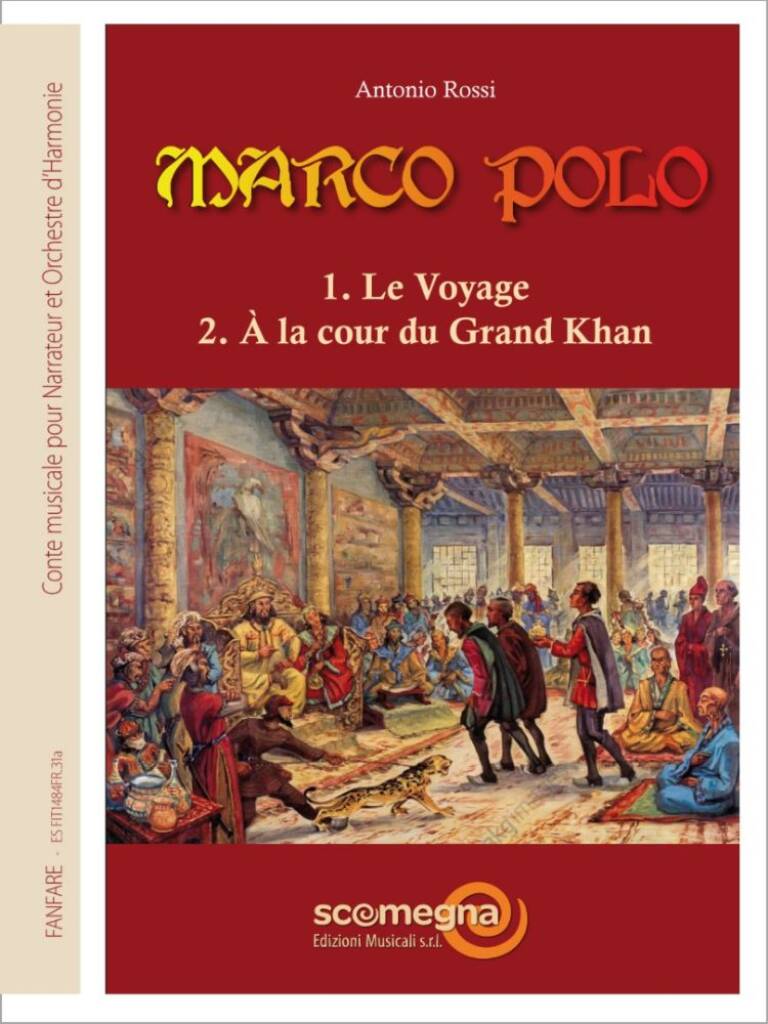
Marco Polo (French text) - Antonio Rossi
Marco Polo (Venice, 1254), son of Venetian merchants, left in 1271 with his father Niccol and his uncle Matteo, towards the distant China at the court of the Mongol emperor Kublai Khan. The long journey, which lasted three and a half years, led the Polos to cross Turkey, Central Asia, the Pamir, and the Gobi desert. The intelligence of the young Marco and his curiosity towards new customs and languages raises the interest of the emperor so much that he decides to keep him at his court by appointing him ambassador. This assignment takes him to newly conquered southern China and other parts of southern Asia. In 1292, the Great Kublai Khan agrees, albeit reluctantly, to let him go.Marco, after 17 years at his service, can finally return to Venice, but not before completing a last mission for the Grand Khan: accompanying his niece, Princess Kokachin, to Persia, where she would marry. A few years after his arrival in Venice, Marco finds himself involved in a naval battle against the Genoese people in which the Venetians are defeated. Consequently, Marco is captured and taken to prison in Genoa. There, he meets the storyteller Rustichello da Pisa to whom he tells the story of his adventurous journey. After his release, Marco returned to Venice and led a comfortable life until his death in 1324.
Estimated dispatch 7-14 working days
-
 £104.50
Festival and Ballade For Winds - Travis J. Weller
Festival and Ballade for Winds was written for the 2009 Pittsburgh Diocesean Honor Band hosted by Bishop Canevin High School. The opening fanfare contains a number of melodic fragments out of which the rest of the work grows and develops. The Allegro Spiritoso at the beginning of the piece gives way to a lush and reflective Ballade section in which there are wonderful moments for dynamic expression by the ensemble. There are a number of solo/small group performance opportunities which occur before the percussion ushers in a return to the original tempo, followed by a brief development section that leads to an energetic and uplifting conclusion.
Estimated dispatch 7-14 working days
-
 £144.99
Magic Overture - Thomas Doss
Magic Overture was written as an anniversary present for the Brgermusik Gtzis in Austria. The magic of the music and landscape in the Austrian region of Vorarlberg are in abundance in the charming village of Gtzis. Visiting a place as wonderful as this helps one appreciate local traditions and experience the joy of living. Once touched by the magic, every visitor will gladly return time after time. This new overture reflects the carefree cheerful atmosphere, taking the band on a walk through the village on an icy winters night to participate in the sparkling celebrations of the villagers.
Estimated dispatch 7-14 working days
-
 £84.99
Toccata - Claudio Monteverdi
Claudio Monteverdi composed this toccata as an instrumental introduction for the opera L'Orfeo (1607). According to the composer, this introduction should be played three times before the rising of the curtain. This is actually the first overture in the history of opera.)The story of Orfeo, who enchanted nature with his music, is tragic, as he loses his beloved Eurydice and decides to retrieve her from the underworld. On their return journey, one glance back at her is fatal: he loses her for the second time.)This arrangement for wind band is very suitable as a concert opener. The toccata is played three times just like the original. The first time it is played by a quintetconsisting of two trumpets and three trombones.)Various ways of performing this toccata are possible. The tension builds up more intensely if the quintet starts off stage. Eventually, these five players join the band, after which the tutti version follows two times. You can also have the brass play from the gallery during the second or third time for a double choir effect.
Estimated dispatch 7-14 working days
-
 £53.95
Adventus - Scott Watson
Adventus, meaning "arrival" or "debut" and celebratory in nature, was written to showcase the playing achievements of students. After a bold fanfare statement, the main theme is developed (first playfully, then with more grandeur). A contrasting moment of calm transitions to the exciting return of the opening theme, followed by triumphant closing material. Written squarely for Grade 1 players but with an attractive, mature sound that belies its level, Adventus, by Scott Watson, would make the perfect concert opener or closer. (2:30) Correlates to Sound Innovations, Book 1, Level 5.
Estimated dispatch 7-14 working days
 View Music