
Results
-
 £53.50
Linden Lea - Ralph Vaughan Williams
Linden Lea is a straightforward adaptation of the famous song by Ralph Vaughan Williams. The song is especially familiar in Britain, where the melody is known in virtually every household. Varied instrumental color and slighttempo changes are utilized to heighten the emotional appeal of this attractive melody. (2:45)
Estimated dispatch 7-14 working days
-
 £89.99
Norwegian Overture - Traditional
It is not entirely sure where the melody originates that forms the basis for Norwegian Overture. Most sources point in the direction of a certain J.H. Nebelong in about 1881. It is also possible that he was the first to note down this traditional melody and put his name to it.The lyrics are by a certain A.H. Brorson and were set to the music at a later date. The original title is "store hvide flok", which means "the big white herd". Several composers have used this theme, including Edvard Grieg and the Danish Carl Nielsen.
Estimated dispatch 7-14 working days
-
 £141.99
Funiculi-Funicula Rhapsody - Luigi Denza
This famous melody was written for the 1880 opening of Mt. Vesuvius' funicular railway, lyrics were by Peppino Turco. Mr. Goto's fantasy commands immediate excitement with unmuffled percussion and bold fanfares that segue into a proper tarantella and trombone soli. Carefully observe relative dynamics throughout the 6/8 section, and give all dotted quarter notes equal treatment. Dynamic contrast is critical to maintaining interest in the returning melodic line. The alto/tenor voiced counter line at G should dominate. Take advantage of the novel woodwinds solis at H emphasizing lower voices. The polyrhythmic feel at J and K is best conducted in one; have all "play to" the melody. Enjoy the romantic potential of section L and do not exceed the indicated tempo. Sections N and O can be decidedly mechanical. Certainly "pull out the stops" at the concluding 6/8, but continue to observe all tempi and dynamics for a most effective finale.
Estimated dispatch 7-14 working days
-
£104.99
Sayonara
This traditional melody is known worldwide as a song of farewell. Jan Van der Roost treated it as an anthem in this splendid arrangement. The melody is brought to us in whole or in part by various instruments and is surrounded by logical yet original - sometimes surprising - chords that dare to fluctuate. After a broad tutti, the ensemble begins to die out. The piece ends with an impressive diminuendo of the final chord, almost as if the orchestra itself were saying goodbye.
Estimated dispatch 7-14 working days
-
 £154.60
Den store dagen - Benny Borg
This beautiful song contains a huge contrast between the hopeful and the disappointing. A mother has her birthday and is waiting her children to celebrate it. Each verse starts optimistically, but the short chorus is characterized by the disappointment, that everyone calls, and cannot come. This has been tried recreated musically, mostly in the last two choruses, as it dawns on her that she will not receive a visit. It's a beautiful tune, but with a serious message that it's easy to take someone for granted.One of the elements the musicians came up with after rehearsal, was that they really liked the change between the ballad parts with even eights and the swing parts. This also gives the piece a sense of "parlando" character, which tells a story, and is therefore important to focus. It is not quite simple, as the melody also in those parts with even eights has some triplet rhythms. Therefore, this is a topic you can work on.Regarding instrumentation, Flugelhorn, Alto Saxophone and Euphonium have important roles, in addition to the rest of the first parts in the Band. The arrangement is written so you are not depending on "special" instruments. Important details are also often duplicated so you can use the arrangement for a smaller Wind Band.It is also possible to use a vocal soloist, but then you must soften the instruments that holds the melody.
Estimated dispatch 7-14 working days
-
 £60.99
Journey (Paddle Song) - Chief Ian Campbell
In partnership with Squamish First Nation Chief Ian Campbell, Robert Buckley has creatively re-imagined this haunting melody for full concert band. Journey features an underlying rhythmic pulse over which the melody evolves in a variety of moods and textures. The end result is quite dramatic and offers a rare glimpse of an ancient culture. Dur: ca. 3:20
Estimated dispatch 7-14 working days
-
 £47.50
Candy Cane Lane - Robert Buckley
Written with a festive flair and tuneful melody, here is a marvelous holiday piece for beginning players. Featuring modest ranges and easy rhythms, this is quick to learn and fun to play. 8th notes are used in the melody, but no syncopation.
Estimated dispatch 7-14 working days
-
 £89.99
Distant Hymns - Greg Sanders
Distant Hymns is the third movement from the composer's work Dreams and Faith (The Solomon Valley Anthology). The American Composers Alliance commissioned the work for their Continental Harmony Project. In the late 1880s and early 1900s, many of the inhabitants of the Solomon River area in northern Kansas meticulously documented their lives in the vast expanse of the Kansas prairie in writings in their personal diaries. Several writers recorded an unusual phenomenon where the wind often carried sounds over the open prairie and fields with no visible sound source. An example of this display was sometimes the presence of music, often church hymns, carried with the wind from assumed distant churches that were frequently not there. The melodies could be heard constantly changing in volume and sound as the winds continuously changed directions. Distant Hymns is a musical representation of this experience, where a simple hymn tune is handed to and integrated between different groups of instruments. Ebbing frequently, the music varies in loudness and softness as the melody moves freely upon the wind.
Estimated dispatch 7-14 working days
-
 £66.95
Blessed Hope - Brian Beck
Blessed Hope is a breathtaking arrangement of the beloved hymn "It Is Well With My Soul." The melody is beautifully intertwined throughout the ensemble, complemented by rich harmonies. Moving and captivating, this creative setting is perfect for any concert. Arranger Brian Beck honors the original hymn while adding depth of harmony and flow using the hymn lyrics to guide musical imagery. (3:30) The PerformancePlus+ series is an innovative addition to the ever-expanding MakeMusic Cloud interactive library. These engaging selections are presented with educational resources designed to enrich the rehearsal process and create outstanding performances. Including:Assignment, recording, and assessment tools within MakeMusic CloudPiece-specific exercises focused on skills and techniquesPrintable sheet music (with a standard MakeMusic Cloud subscription)Educational tips and suggestions to support learningAvailable in print and digital formats.
Estimated dispatch 7-14 working days
-
 £84.99
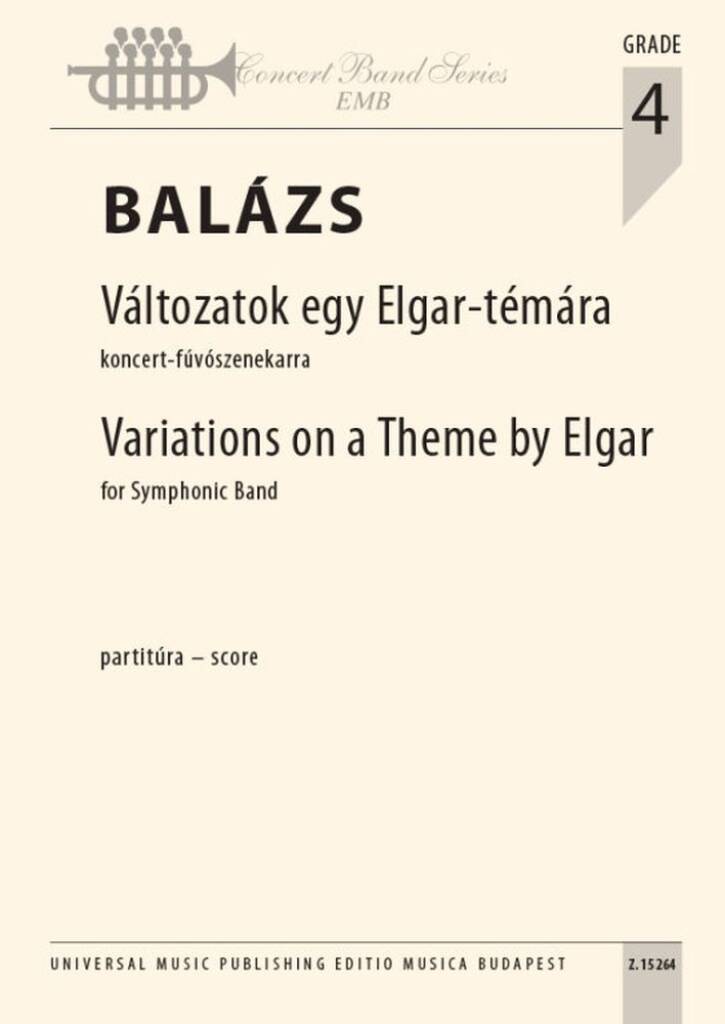
Variations on a Theme by Elgar - Árpád Balázs
In rpd Balzs's diverse and varied oeuvre, works for wind orchestra play a prominent role alongside choral music. He composed the Elgar Variations in 2022 on the theme of one of Edward Elgar's (1857-1934) short early works (Love's Greetings, 1888). As rpd Balzs writes ''The theme I used as the starting point for my work may already be considered a variation, since I 'peeled off' the dense ornamentation and the tonicisations from it, and what remained was the melody, beautiful in its own place. What come back from time to time from the theme in the variations are: the arched structure, the double peak point, and mostly the major sixth leaping downwards, then upwards. The modest, transparent orchestration, which then is amplified at the repetition of the theme is also a defining feature. There is a personal family secret hidden in the third variation: a late compliment to a loyal spouse for the past half century... The closing variation is calm and quiet - similarly to the chorale-like slow movement in Bla Bartk's 3rd Piano Concerto. It is like a message from an old composer to the Future.'' The Elgar Variations together with the Concertino (1992, Z. 14909) and the Rhapsody (2015-2021, Z. 15167) form an ambitious, emotionally wide-range trilogy for a concert band.
Estimated dispatch 7-14 working days
 View Music