
Results
-
 £199.99
Fanfare No. 1 - Wataru Hokoyama
Fanfare No. 1 (1995) In the summer of 1995 before his departure to the United States, a request from his high school band friends for a good concert opener sparked 19 year old Hokoyama to write his very first wind band composition.To capture the excitement of the rising curtain, the piece begins with magnificent brass ascending in 4th and 5th intervals. This is followed by the energetic entrance of the full ensemble like celebratory cannon fire. The following melody has many notes, yet is still simple. Do not overestimate it, just perform with driving momentum.In the slower middle section, utilize an instinctive vision of a scorching midsummer sun shimmering on the horizon. (Likely this shimmering sunset image was scored unconsciously, being composed in midsummer. A more applicable mood might be "Indian sunset". Perhaps this Indian style came from a capricious feeling of youthfulness.)The bright tempo and melody return for the last section. The climactic volley of musical display is like explosive fireworks as the last sounds echo throughout the concert hall.The composer wishes for performers to play from their hearts and not be limited by an analytic approach to the score-absolute accuracy is not required. Above all, the deepest pleasure for the composer is to know that teachers and students share the joy of music making with the intention of sharing it with others all over the world.With deepest gratitude, thank you for performing this work.
Estimated dispatch 7-14 working days
-
 £248.99
Three Movements - André Waignein
These three movements for piano and band depict three stages of a musical journey. We set off on a long journey through the world of musical virtuosity in the style of Liszt : grand, lustrous and lyrical. The second stage is a peaceful stroll, the start of a dream. The colours are like a tender caress and the piano sketches transparent arabesques. This splendid impressionistic journey ends in two bright pink drops which evapore just in time before the third and last movement explodes.The last movement is driven forward by a raging rhythm, as relentless as a war-dance. In a confrontation between the soloist and the orchestra all the inner strength of the composer comes to thesurface so that the musicians in the end are breathless... but all the same, no less satisfied.
Estimated dispatch 7-14 working days
-
 £159.99
Nostradamus - Otto M. Schwarz
Nostradamus is probably the best-known prophet of the last 1000 years. He lived at the time of the Inquisition and his predictions and medical therapies as a physician caused him to face the wrath of the church forcing him to flee many times. Following the loss of his family to the plague he devoted himself to clairvoyancy. He predicted many events in history in coded form and although there are many ways to interpret these, many are believed to be accurate and Nostradamus is still considered to be a unique personality. Whether he is denounced as a charlatan or promoted as a myth he has surely moved humankind with his prophecies.Otto M. Schwarz, soundtrack composer since2001, wrote a cinematographic work about this man, who is probably the best-known prohet of the last 1000 years.
Estimated dispatch 7-14 working days
-
 £137.99
An English Sea Song Suite - Philip Sparke
The four tunes used in this suite have been made universally popular in Sir Henry Wood?s Fantasia on British Sea Songs, which is an ever-present ingredient in The Last Night of the Proms.He introduced this colourful suite into the Proms in 1905,to celebrate the centenary of Nelson?s brilliant victory at Trafalgar, when ?Britannia? really did ?rule the waves?. Bring the excitement of The Last Night of The Proms to any concert with this stirring new edition.
Estimated dispatch 7-14 working days
-
£332.99
Tales & Legends - Etienne Crausaz
This three-movement work by the Swiss composer Etienne Crausaz reflects three true stories and fascinating legends from the Middle Ages. The first movement tells the dramatic story of the 'witch' Catherine 'Catillon' Repond (1662-1731). She was the last woman ever to be executed for sorcery. In the second movement, the famous court jester Girard Chalamala occupies centre stage. This jester, the last one at the castle of Count Greyerz, could make everyone laugh. The third movement tells the story of Count Michael. He went down in history as a spendthrift bon-vivant. His burden of debt became so high that he did a moonlight flit and never came back!
Estimated dispatch 7-14 working days
-
 £101.20
Duat - Alex Poelman
When an Egyptian hero fell on the battlefield he entered the underworld named Duat. There he had to fulfill his last task: pass through all the gates guarded by monstrous creatures and enter Aaru (paradise). The composition starts with the killing blow dealt to the hero. On his journey through Duat he travels through large halls with pillars of jade and lakes of steaming lava. At the last gate his heart is placed on a balance next to a feather (symbolizing Justice). One whose heart balances the feather may enter Aaru.
Estimated dispatch 7-14 working days
-
 £141.99
Concerto for Wind Ensemble - Karel Husa
Commissioned by the Michigan State University Alumni Band, this three movement work by Karel Husa was the winner of the first Louis Sudler International Wind Band Composition Competition in 1983. A note from thecomposer: 'Divided into three movements, this work is a display of virtuoso passages given to solo instruments as well as to the groups of the ensemble. In the Fanfare of the first movement, the Brass section concertises in groupsof four Brass quintets (2 Trumpets, Horn, Trombone and Tuba or Baritone), spread from left to right in back. The Saxophones (SATB) are placed in front of the Brass quintets, and the Woodwinds occupy the front of the stage, withPercussion on the left and right side. These groups, like the Brass quintets, play in the concertante style, particularly in the first and last movements. 'At the same time, each movement contains individual solo passages(for example, Timpani and Flute in Movement I - Drum Ceremony and English Horn and other low Woodwinds in Movement II - Elegy). The composition of this piece was prompted by the excellence of Wind and Percussion players today, andby the incredible growth of Wind ensembles, orchestras, and bands in the last 25 years. It is intended for their enjoyment.'
Estimated dispatch 7-14 working days
-
 £179.99
Spartacus - Jan Van der Roost
Spartacus is a "Symphonic Tone Poem" with 3 joints. Each section has its own melodical materials, however: in the final movement the main theme from the second section returns in a 'grandioso'-tutti. The last bar but one recaptures the 'oriental' atmosphere of the very beginning. The first section (= from the beginning till J) builds up a climax by repeating and accumulating some melodical and rhythmical stuctures. The oriental character of the melodical fragments refers to the origin of the Roman slaves. The second section evokes the love between Spartacus and his loveby giving a peaceful atmosphere. The mean theme (presented the first time at letter L) has a broad andwide character and refers slightly to filmmusic. In this part of the composition, a special attention is given to the orchestration. The final section is more agressive and martial and refers to the revolt of the slaves against the Roman oppressors. In the middle of this movement, an accumulation of the 12 tones symbolizes the crucifixion of the slaves: the english horn resumes partly the cadenza of the flute (at letter J), as if he wants to show again the eternal love between Spartacus and his love a very last time ... The theme at the third bar of letter T is actually based on the 2nd theme of this section (which starts at the fifth bar of letter R), but has been worked out rhytmically.
Estimated dispatch 7-14 working days
-
 £106.99
Sambezi - Philip Sparke
Sambezi is the last movement of Philip Sparke's Trombone Concerto. It starts in a joyful and outgoing mood with the soloist playing a carefree samba tune. A jazz-influenced central tune explores the higher ranges of the trombone before the samba rhythms set up a 'contest' between the soloist and the band's trombone section. The soloist is the eventual 'winner' and he celebrates by reintroducing the samba melody before bringing the work to a virtuosic close. A real treat for your trombone soloist.
Estimated dispatch 7-14 working days
-
 £106.00
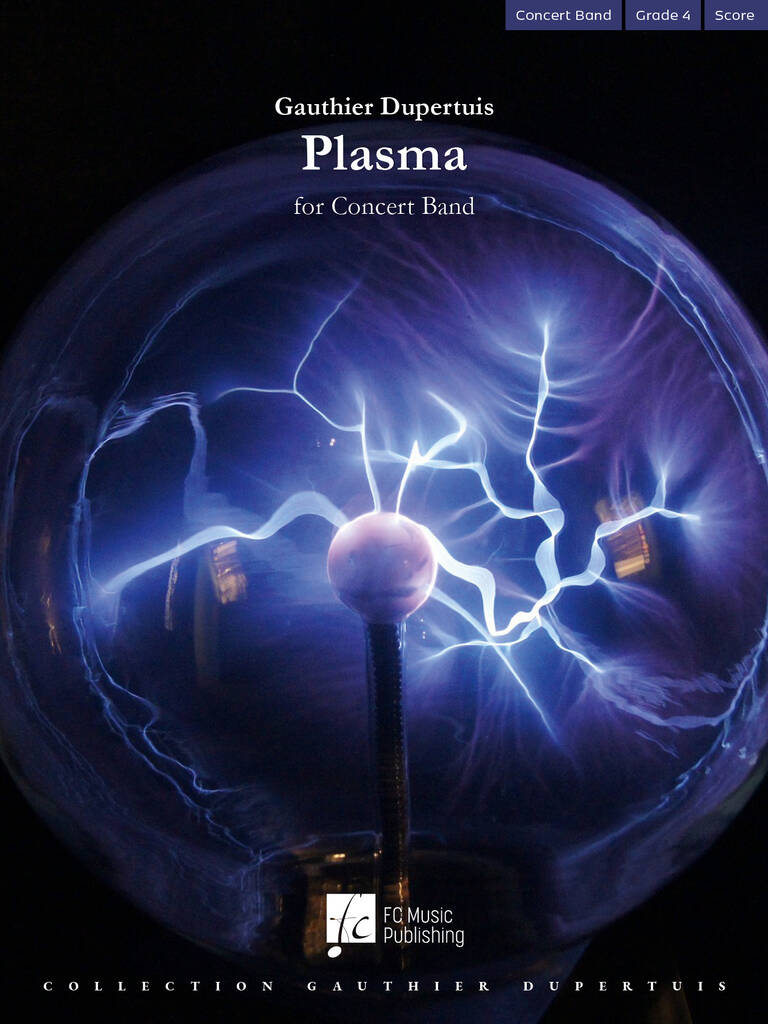
Plasma - Gauthier Dupertuis
When asked by the city of Biberist (Switzerland), to compose a piece for its 150th anniversary, Gauthier Dupertuis thought of a frenetic work, possessed with energy and a constant pulsation from the first to the last note. In this sense the composer was inspired by "plasma", the fourth state of matter (after the solid, liquid, and gaseous states) which makes up, for example, lightning or the sun. Like a plasma ball, whose colors and shapes constantly vary, the musical material of the work is gradually transformed, both in the rhythmic signatures and harmonies and in its atmospheres: it is the same material, but always under a different shape. Sometimes rhythmic and dancing, sometimes solemn and majestic, or soft and lyrical, the work finds its unity in the omnipresence of an ostinato and similar rhythmic and melodic structure. Plasma was premiered in September 2024.
Estimated dispatch 7-14 working days
 View Music