
Results
-
 £157.50
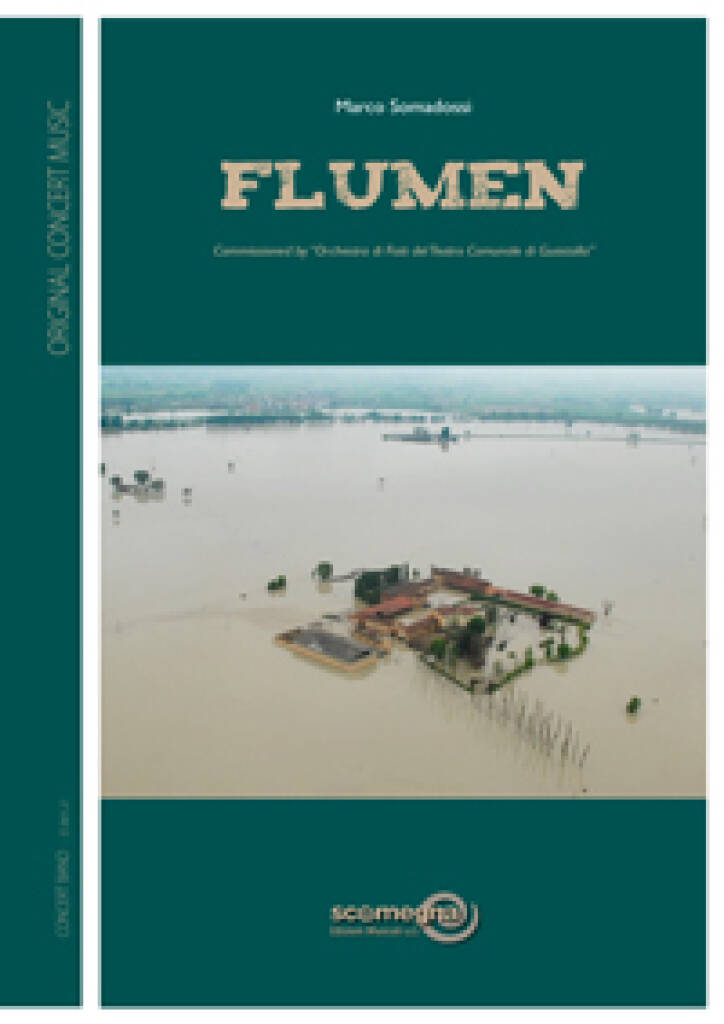
Flumen - Marco Somadossi
In October 2000, the River Po produced its highest flood waters in the last hundred years, provoking a natural disaster of dramatic dimensions. To the thousands of valiant men and women committed to defending their villages against the threat of the flood is dedicated the symphonic poem entitled "Flumen" (river, in Latin), inspired by the thematic material in the Gregorian sequence, "Victimae paschali laudes". The main melody is elaborated and its essence is transfigured in an alchemy of modern sounds from which, at times, archaic echoes emerge. The composition is structured in two parts: the first ("The River") is sullen and menacing, with sounds that portray the turbulent water and the inexorable and frightening rise of the flood;this contrasts with a second section ("The People"), with its primitive rhythms and vaguely multiethnic character (expressed through modal harmonies). Here the work evokes man's ancestral struggle against the forces of nature: the strenuous defence of the Po riverside communities to against the threat of flooding. In the finale, the two themes interweave and overlap, re-establishing a symbolic and primordial equilibrium where man and nature are again in harmony with each other.
Estimated dispatch 7-14 working days
-
 £113.30
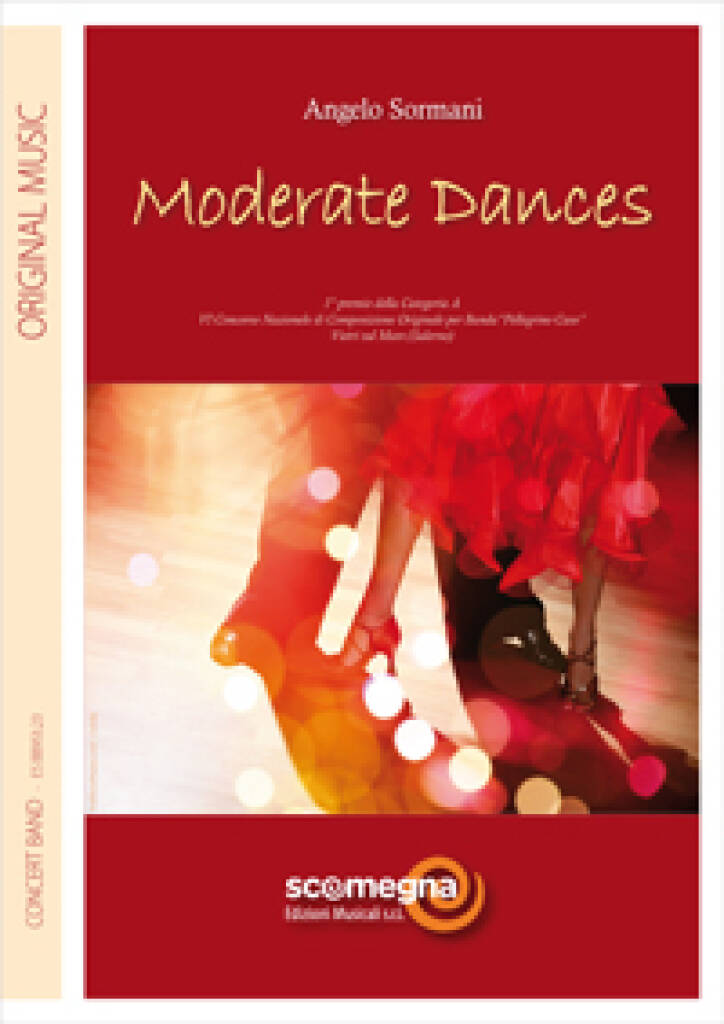
Moderate Dances - Angelo Sormani
This piece is a tribute to dance music, especially passionate, intense and meditative dance music. "Moderate Dances" is divided into three movements: a "Tango", a "Slow Waltz" and a "Bossa Nova". Each movement and each dance has its own particular characteristics but, when combined, these different rhythmic beats and times give the piece a feeling of completeness and uniformity. The Tango started to flourish in the suburbs of Buenos Aires in around 1880. There is still some doubt as to its origins, which may be Cuban (Habanera) but are probably African. It was most popular in Argentina and Brazil: here the male protagonist was originally the "gaucho" with his inseparable guitar, later to be replaced by the proud, elegant "compadre". By around 1910 the Tango had spread to Italy and France. New clubs opened, where the upper classes could watch and dance the Tango. Here the dance also underwent some rapid transformations. The exaggerated and extravagant gestures and body movements disappeared. Slow, gliding steps replaced the old rotational movements. The women's red ankle-boots and the partners "staring into each other's eyes" accentuated the erotic nature and sensuality of this dance. So much so that, in 1913, the German government banned soldiers from dancing the Tango. Those who broke the law were immediately discharged from the army. From a strictly musical perspective, the basic instruments were a flute, a harp (the diatonic harp typically played by the Indians of Paraguay) and a violin, or flute, guitar and violin or even clarinet, guitar and violin. These instruments were easy to transport, ideal for playing at parties, in the streets and in courtyards. The musicians played by ear, frequently improvising: there were no scores, no records, which is the main reason why it is impossible to trace the Tango back to its exact origins. However, the Tango's evolution (and growing popularity) was once again fostered by its fundamental ability to absorb "other" cultures, languages and sounds. And it was the arrival of the "bandoneon" (an accordion-like instrument that was invented in Germany and brought to Rio de la Plata by some immigrant), which replaced the flute, that marked the beginning of the Tango's huge success outside Argentina. A number of talented composers, above all the great Astor Piazzola (1921-1992), transformed the bandoneon from a simple accompanying instrument to a solo instrument that was to become the distinguishing feature of the 20th century Tango. The Slow Waltz originated from the Waltz, the typical dance of the Bavarian and Tyrolese peasants in the 1700s. It was composers like Johann Strauss, father and son, who carried the Waltz to its zenith in the 1800s, creating the sensual and melancholy yet joyful and charming dance we are all familiar with. When the Waltz first became popular in Germany, the members of respectable society were shocked at the closeness of the dancing partners, who had always previously danced apart. The main difference between the Waltz and Slow Waltz is that the latter has a slower, more expressive rhythm: the men wear tails and the women wear ball gowns decorated with beads and feathers and couples dance in graceful rotational movements. "Bossa Nova" is the title of the last movement in the piece. Jobim, the great Brazilian musician, described this musical genre as a combination of modern Jazz and Samba. Bossa Nova means "new wave". This was the name of the artistic and musical movement that evolved in Brazil in the late Fifties and was extremely popular throughout the Sixties. The songs are usually about love or social matters, drawing inspiration from the slums of Rio De Janeiro and the lives of their inhabitants. Bossa Nova, with its original compositions and the artistic talent of its musicians, also became hugely popular in the United States and Europe, and top Jazz musicians (Ella Fitzgerald, Stan Getz, Bob Cooper, Charlie Bird, Sonny Rollins, Dexter Gordon, Dizzy Gillespie) started to include Bossa in their repertoires.
Estimated dispatch 7-14 working days
-
 £68.50
Eagle Spirit March - Bene Davis
"Eagle Spirit March" captures the heart of traditional marches. With thoughtful scoring and manageable ranges, it strikes the perfect balance between challenge and accessibility - allowing every player to get either a melody or countermelody. Its engaging form, from the dogfight to the full-band finale, ensures players and audiences stay hooked until the last note.
Estimated dispatch 7-14 working days
-
 £82.50
An English Yuletide - Nancy H. Seward
This is the last composition from the pen of the talented composer and music educator, Nancy Seward. It is based on traditional English Christmas carols.
Estimated dispatch 7-14 working days
-
 £104.50
Shock Wave - Gary D. Ziek
Shock Wave is a high-energy piece, driven by a constant sense of propulsion and rippling waves of motion. The initial shock wave is provided by percussion, leading into a tension-filled section with multiple layers of sound scattered throughout. Each new entrance or wave is accompanied by solo percussion which builds to a frenzied, swirling state. Layer upon layer of musical pressure builds until the final resolution with the percussion getting the last word, providing one final "aftershock" for a decisive finish.
Estimated dispatch 7-14 working days
-
 £104.50
A Golden Legacy - Scott Watson
The music of A Golden Legacy reflects both the joy and reverence many of us feel in our role as transmitters of the band tradition. The legacy in the title refers to the long-lasting impact directors have on students lives. This piece alternates between two themes - the first is a majestic fanfare that develops into a purposeful and resolute march; the second theme is a reverent hymnlike chorale that undergoes several variations, with the last one erupting into a festive musical celebration for an exuberant finish.
Estimated dispatch 7-14 working days
-
 £82.50
Detonation - Gary D. Ziek
This intense and volatile piece lights the fuse with a one-bar introduction that leads to and ignites the impact of the full band. A unifying four-note motif makes several expanded appearances. A brief period of calm is underpinned by a series of pulsating ostinati which maintain a constant state of agitation. In the explosive conclusion, the percussion section provides the last word with one final detonation.
Estimated dispatch 7-14 working days
-
 £116.40
Torre Bermeja - Isaac Albéniz
Although he was born in Catalonia, Albniz was strongly attracted by the music of Southern Spain, Andalusia and especially Granada. He told his friends this was due to the fact he had 'Moorish blood' in his veins. 'Torre Bermeja' (the vermilion tower) is the last of a set of twelve characteristic pieces and is a passionate and fiery representation of an old Moorish prison tower located in the city of Granada. It was made famous by some guitar arrangements, such as those by Antonio Lozano and Andres Segovia. It is a typical serenade with an 'Andalusian touch' which boasts a splendid tune floating between guitar accompaniment elements.
Estimated dispatch 7-14 working days
-
 £90.30
Upside Down - Manfred Schneider
The title of this overture betrays its high-spirited character; it keeps the listener in suspence up to the last strains. The quick and virtuoso introduction Allegro Vivace is followed by a quite melodious Con Moto e Cantabile (written for two parts and in sixths). A Molto Maestoso interludium is followed by two parts Allegro con Fuoco and Moderat, and then the works reaches its only pause with a slowly movement lasting for sixteen bars. The initial tempo Allegro Vivace returns so that the overture can end with the same high-spirited character.
Estimated dispatch 7-14 working days
-
 £159.60
Suite Acadienne - Bernhard Bogisch
1. La belle Franoise.This song tells the story of the beautiful Franoise, who is visited by her lover on the eve of his departure. She helps him prepare for his voyage and they talk for the last time at the foot of a rock, which has been their trysting place. The next day, when he has left the harbour, he hears the sound of a bell. It is the bell that tolls for Franoise, who is being carried to her grave.2. Le Prince Eugne.At least two versions of this song are in existence, both of which are represented here. It tells of the prince Eugne, who, on his way to Paris, encounters twenty of his worst enemies. He manages to kill fourteen of them before his sword breaks. He then asks his page to get him another sword, but the lad is too afraid for his own life. This being the case the prince tells him to tell his wife to take care of his son, who 'will have his revenge by lighting a candle in Paris'.3. Pinson et Cendrouille.This song deals with the marriage of two not further specified animals, who have nothing with which to prepare a wedding feast, and need help from the other animals. But when the rat comes in carrying a fiddle, he is chased away.4. Le Dpart de l'Amant.At least two versions of this song are known, both of which are represented here. It is one of many songs dealing with departure, and is of Canadian origin. The lover is warned of the charms of the pretty 'canadiennes' which among Acadiens refers to French Canadians from Qubec. 'Be true to me save your heart. When I return from my voyage I will make you happy'.5. Le Remde son Talon.This, like many children's/folk songs is a bit of a nonsense song. Marguerite has trouble with the heel of her shoe, and asks her mother for help. Mom suggests various things, such as an onion (too round), a tomato (too flat) etc. In the end it turns out that a bachelor is her best bet.
Estimated dispatch 7-14 working days
 View Music