
Results
-
 £115.60
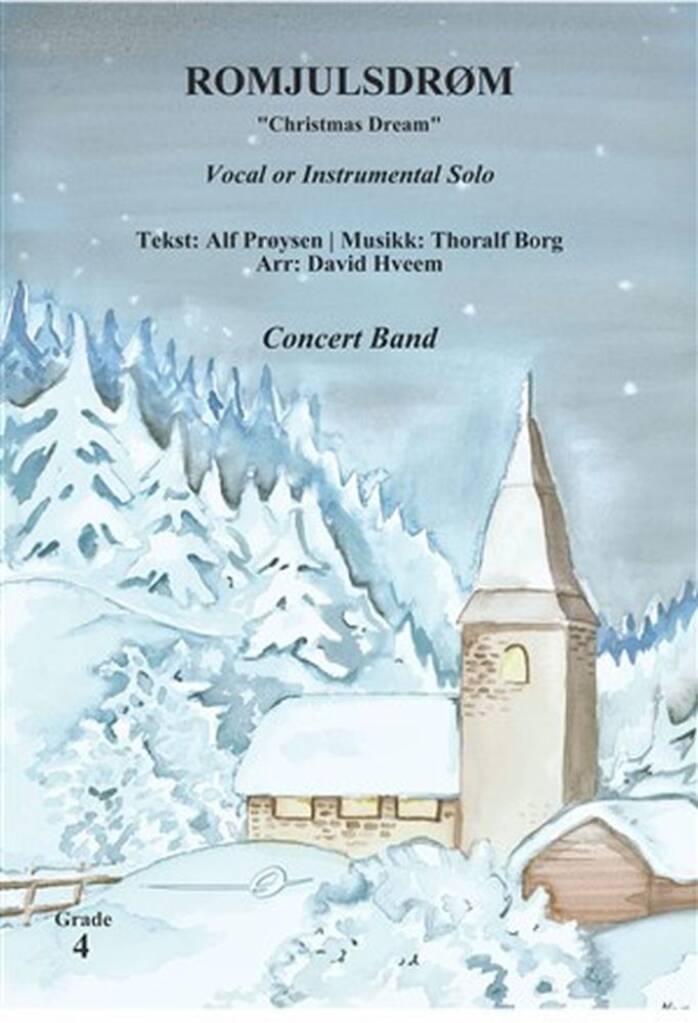
Romjulsdrm - Thoralf Borg
The poem Romjulsdrm ("Christmas Dream") was first published in Arbeiderbladet on January 3rd 1959, and became known when Thoralf Borg set a melody to it in 1968. Up until this, Alf Prysen had used a melody quite similar to the song Lijan uti dalen, when he sang the song in the TV program Ei vise vil jeg synge in 1964. At the same time that Borg's melody was written, the last four lines of text were also added to the poem, and the song took on the form we know today.The form and structure of this arrangement originates from a version for big band and vocals commissioned by stre Toten Storband, written in 2018 for one of their traditional midnight concerts on the day before Christmas. In an attempt to give the arrangement a nice calm and the text a lot of room, as is often the case in songs like this, it ended up in a relatively narrative style where the variation in tempo and the shifts between swing and straight eighth notes are particularly central.The song is about family, friendship and the quiet days of the Christmas holidays, which hopefully is something most people can recognise. The arrangement for the aforementioned midnight concert was ordered because my sister was to be the soloist for the concert, and since my father also played lead trombone - as he has done in this big band for as long as I can remember - it was natural to add a small trombone solo as well. It's always special to write and arrange music for people I know and appreciate, but it's extra special when it's also for two of my great role models.- David Stre Hveem -
Estimated dispatch 7-14 working days
-
 £115.60
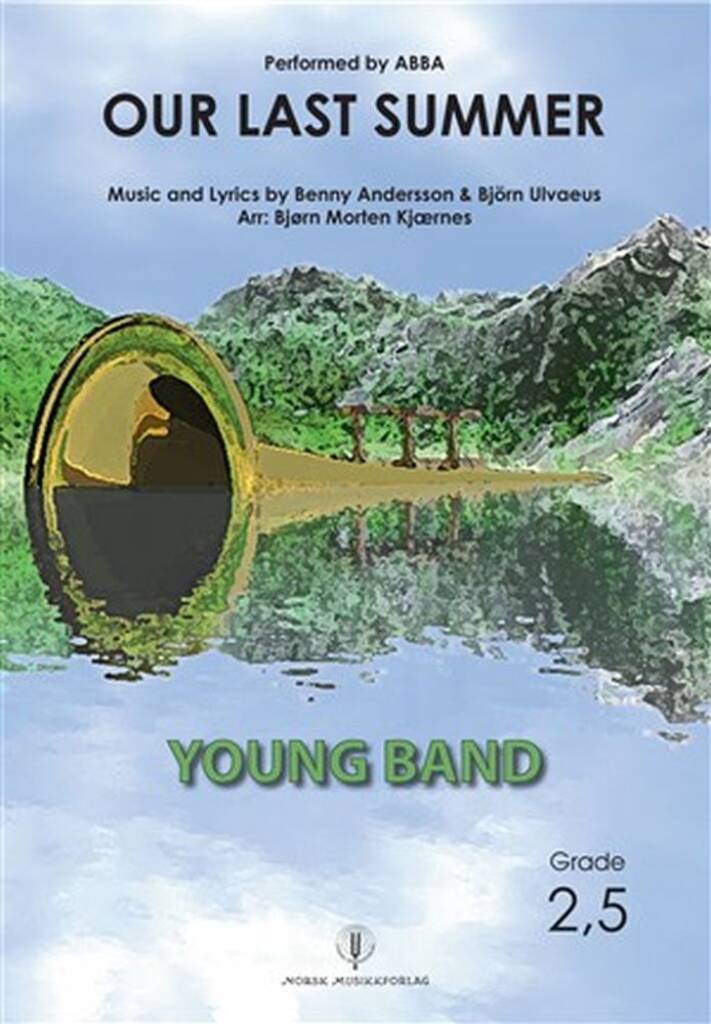
Our Last Summer - Benny Andersson
An exciting arrangement where almost all players have a bit of the melody line. There are many opportunities to give individual musicians soloistic challenges. Any bandmember should find something interesting in this piece. It will be possible to add vocals to the arrangement. A lovely melody with great expressions.Our Last Summer" is a song by the Swedish pop group ABBA from their seventh studio album, "Super Trouper," released in 1980. The song is indeed featured in the musical "Mamma Mia!", a little bit shortened and with small changes in the lyrics. The musical premiered in London's West End in 1999 and is a duet performed by the characters Harry Bright and Donna Sheridan, reflecting on their past romance during a summer spent in Paris.The song is primarily sung by Bjrn Ulvaeus, with backing vocals provided by Agnetha Fltskog and Anni-Frid Lyngstad, the female members of ABBA. Their harmonies contribute to the song's nostalgic and wistful atmosphere. The lyrics vividly describe the memories of the summer spent together, including scenes of walking along the Seine River in Paris and listening to French songs. The song also touches on the passage of time and the realization that the summer romance has ended.While not released as an official single in most countries, "Our Last Summer" still received considerable airplay and became a fan favorite. It charted in some European countries and has remained popular among ABBA fans over the years.
Estimated dispatch 7-14 working days
-
 £139.00
Me and Mrs. Jones - Kenneth Gamble
Me and Mrs. Jones was written by Kenny Gamble, Leon Huff and Cary Gilbert in 1972, and was first recorded by Billy Paul on the album 360 Degrees of Billy Paul. The song is about a man who has an affair with Mrs. Jones, and how the two secretly meet every day in the same cafe, even though they may know it's not quite right: "We got a thing going on/we both know that it's wrong/but it's much too strong/to let it go now." Paul has stated that he was sure the song was going to be a hit even before it was released, as "it's a song everyone can relate to", but already from the start the lyrics were considered somewhat controversial and the song were banned from several radio stations. Nevertheless, it became one of the best-selling singles of 1972 and Paul received a Grammy for Best Male R&B Vocal Performance.Well known is also Michael Bubl's version of the song, released on the album Call Me Irresponsible in 2007. It is his version that has been the inspiration for this arrangement, which brings out even more of the jazz elements Bubl has found in the song. The arrangement is quite demanding for the ensemble, and requires great rhythmic precision in particular.
Estimated dispatch 7-14 working days
-
 £122.50
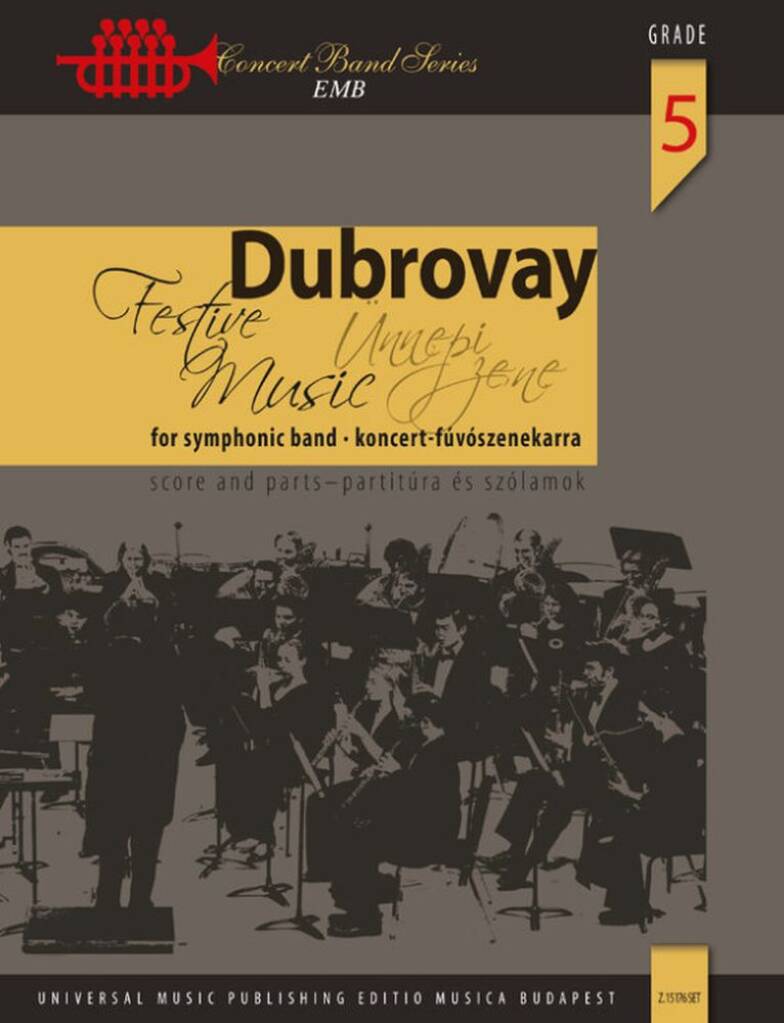
Festive Music
This work of festive atmosphere was written in 2000 for symphonic band, then the composer arranged it for symphony orchestra. In this piece, Lszl Dubrovay (*1943) parts with his special, hallmark concert band effects; rather, lively vibrations enriched with colliding seconds and distant overtones are brought to the foreground. The special sound is coloured by ornamental trills, appearing even in batches, and vibrating collisions in the high registers. The performance is rendered even more unique by the outer trumpets on both sides of the space. The trumpets and the flugelhorns can be divided into ten parts altogether, thus, the piece can be played by one ensemble or several bands together, as it is usual at the conclusion of large-scale festivals. This composition may be a great choice for festive concerts, since it is a solemn, innovative, and - by virtue of the free arrangement of the performing space - special work at the same time.
Estimated dispatch 7-14 working days
-
 £118.99
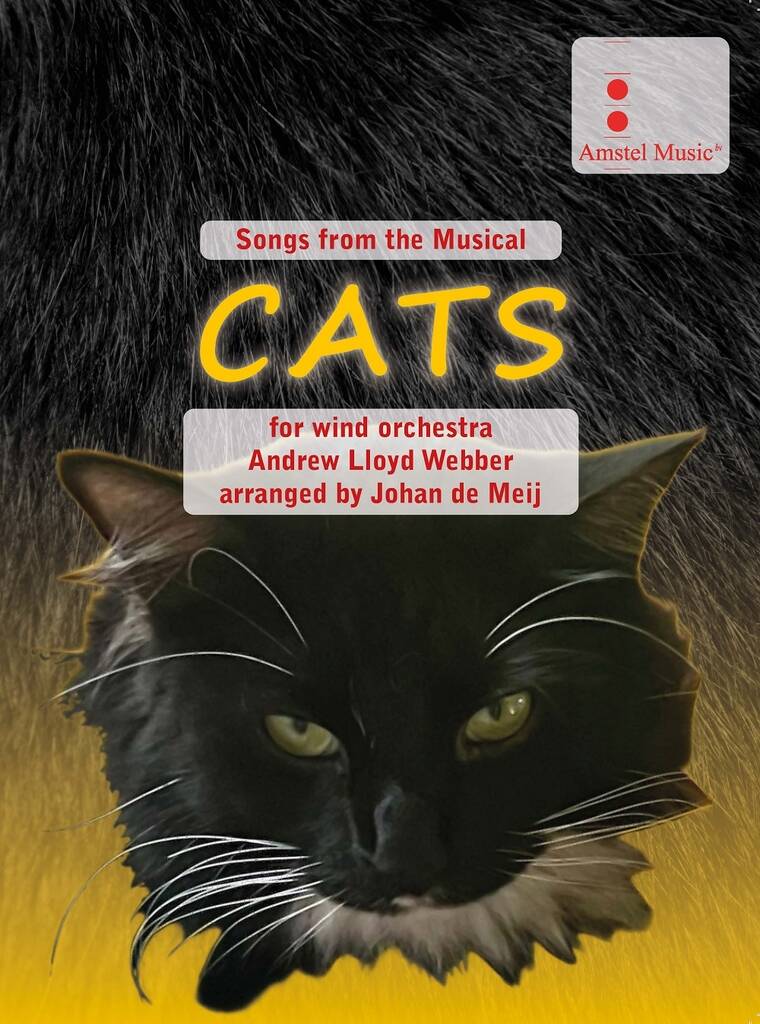
Cats - Andrew Lloyd Webber
The Musical CATS, with music by Andrew Lloyd Webber is based on the 1939 poetry collection Old Possum's Book of Practical Cats by T. S. Eliot. It became Lloyd Webber's third great success, after the musicals Jesus Christ Superstar and Evita. He began setting Eliot's poems to music in 1977, and the compositions were first presented as a song cycle in 1980. Producer Cameron Mackintosh then recruited director Trevor Nunn and choreographer Gillian Lynne to turn the songs into a complete musical. CATS became one of the longest-running shows in West End and Broadway history. It received its world premiere at the New London Theatre in 1981, where it played for 21 record-breaking years and almost 9,000 performances. The following year, CATS opened at New York's Winter Garden Theatre, its home for the next 18 years, garnering seven 1983 Tony Awards, including Best Musical. The show returned to Broadway in 2016, where it had a successful pre-tour run at the Neil Simon Theatre. CATS has been presented in over 30 countries, translated into 16 languages, and seen by more than 73 million people worldwide. Lloyd Webber's magnificent musical score includes the poignant hit song Memory, which has been recorded by over 150 artists, from Barbra Streisand to Liberace to Barry Manilow. It took 7,486 chandelier crashes for Lloyd Webber's The Phantom of the Opera to take over from CATS as the longest-running show in Broadway history in January 2006.
Estimated dispatch 7-14 working days
-
 £193.20
CASTRVM - Lionel Beltrán-Cecilia
CASTRVM is a symphonic episode inspired by four of the main civilizations that have coexisted over time in Ulldecona's Castle. With its melodies and sound effects, the composer tries to transport the listener through a trip to four uninterrupted movements, from the beginnings of this small settlement, creating a natural atmosphere recreated by the voice and the singing of birds to take us into the history with the first inhabitants, the Iberians, giving strength to the introduction of the composition, to move on to the time of the Andalusians, which with a melody in the form of a dance marked by percussion will transport us to take a walk in the surroundings of its circular tower. Next, and with strength, we arrive at the medieval and Christian period, marked in the score by the brass instruments, in this fragment we find moments that take us into the church of "Santa Mara de los ngeles", with melodies that evoke resonance and pomposity, continuing until we find the immense square tower, symbol of the fortress and homage, finally used as a prison and arsenal of those times. Then, there is a small slow march that will move us to some measures of strong stridency to finish with the whole section of low brass having its great moment of prominence, down to we reach the last part, Qna, a name that is recited during the musical piece and one of the names given in the past to the area that could be seen from the castle, where the change of location of the new town is recreated leaving the castle site, but always looking at it with respect and admiration as at the beginning of what is now the current Ulldecona, in this part, the composer plays a bit with a very well-known and significant melody for the inhabitants of Ulldecona, the "Jota Vieja", first making a reflex effect of all its melody and then only with the first six notes of this one, which builds a bridge until reaching the march and, later, the grand finale of this symphonic episode. The work was commissioned by Ulldecona Town Council and the Ulldecona Music Band, led by its conductor Joan Nadal i Girona, to commemorate the 800th anniversary of the donation of the Town Charter of Ulldecona "the old" (1222-2022), as part of the PATRIMONIUM 20.22 programme, "La Banda (Sonora) del Castell" (The soundtrack of the Castle).CASTRVM consists of: I.Iberians: stone and ironII.AndalusiansIII.The square tower: fortress and homageIV.Qna
Estimated dispatch 7-14 working days
-
 £105.80
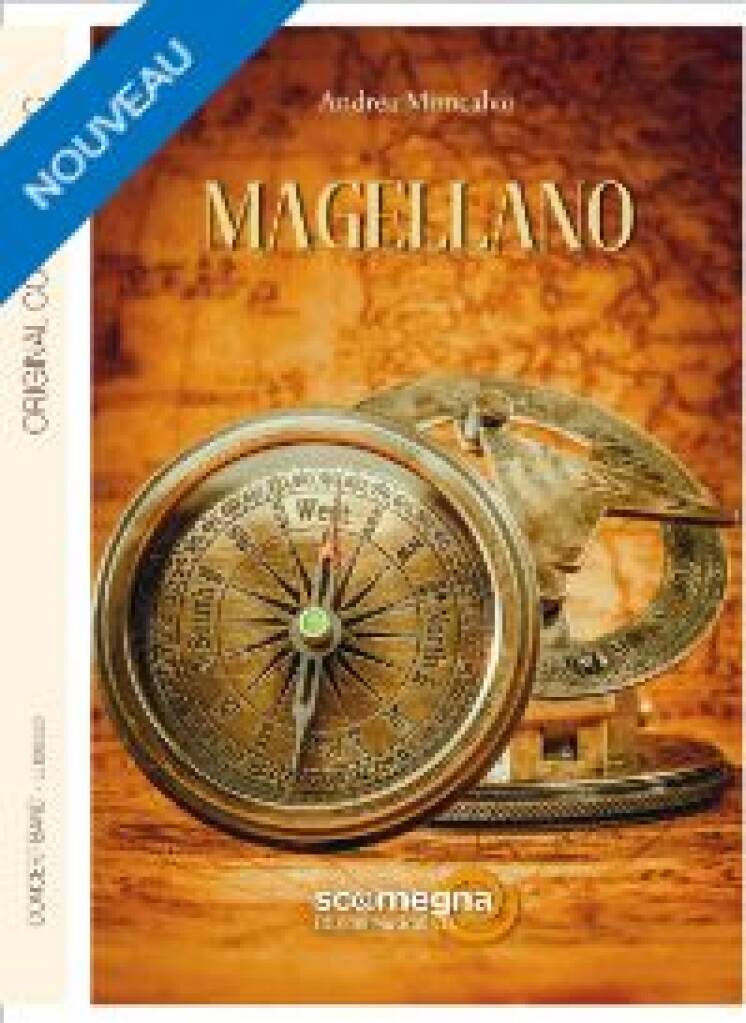
Magellano - Andrea Moncalvo
This composition was written on the occasion of the 500th anniversary of the death of Ferdinand Magellan, a Portuguese explorer (1480 - 1521), who embarked on what would have become the first circumnavigation of the globe. Unfortunately, he did not complete it because, in 1521, he was killed in the region that is today the Philippines. This adventure triggered various images in the author's mind; evocations that the composer elaborated in this piece, which is in a tripartite form (A B A) and is introduced and concluded by a solemn fanfare evoking the departure of the expedition, consisting of 5 ships with a total of 234 crewmen. The first part (Allegro) presents a main theme with a cantabile character that describes the fleet that, intrepid, plows the ocean. This initial melody is then contrasted by a more rhythmic and syncopated theme in a minor key, which instead refers to the indigenous peoples they have encountered during the journey. The central section (Adagio) is an oasis of reflection because, as in other great adventures, this too has tragic aspects: mutinies, shipwrecks, clashes with indigenous peoples, up to the disappearance of those who had desired and planned this enterprise. The last part proposes the themes of the first section but in reverse order, to describe the return to the homeland. The solemn fanfare welcomes the arrival of the Victoria, the only surviving ship with only 18 men on board, which returns to the port of departure after completing the circumnavigation of the earth in 2 years, 11 months, and 17 days.
Estimated dispatch 7-14 working days
-
 £90.00
Bright Dawn Overture, Op. 59 - Franco Cesarini
Bright Dawn Overture was commissioned to Franco Cesarini by the Swiss Band Association as part of a project for the renewal and expansion of the artistic repertoire. "There was never a night or a problem that could defeat sunrise or hope.". This sentence by the English philosopher Bernard Williams inspired Franco Cesarini in composing this overture. In fact, even the darkest night is always followed by the sunrise and metaphorically, in every moment of difficulty, man clings to the hope of a better future. Bright Dawn Overture is written in the classic form of an Italian overture (fast-slow-fast). It is intended as a hymn of hope of recovery after a period of great difficulty. A single theme characterizes the composition, passing through the various registers and presents itself in new forms, while constantly being transformed. In the central part the theme takes on an almost mystical character, while in the finale it presents itself in a heroic guise and the composition concludes with a gesture of decisive optimism.A piece accessible to most concert bands, perfect as an opening work!
Estimated dispatch 7-14 working days
-
 £76.99
Lost Lake at Seymour Valley - Danny Choi
Based on the exhilarating bike ride on the Seymour Valley Demonstration Forest trail and a detour into the remote, beautiful Lost Lake, I associate this piece with some great memories. Glistening in a quiet peace, Lost Lake_x001A_also known as Rolf Lake_x001A_is calm and warm in the summer. Not many people know about it, so it is easy to find yourself alone, surrounded by beautiful nature, isolated from humanity. Back in high school, I would bike up to Lost Lake with one of my best friends Masanori Miyanabe, we'd have music playing off a bluetooth speaker as we biked against the cool air under the hot sun. Powering through uphill stretches with the reward of gliding downhill, when we would finally make it to the lake, we would put our bikes down by the bushes_x001A_no locks, no security_x001A_and we would make our way down the rough logs towards the tiny strip of land suitable for basking in the sun, snacking, and maybe even swimming. In order to beat the sunset, reluctantly, we would mount our bicycles once again and find our way back to the Seymour Valley trail, where we would enjoy the evening ride home. -D.I.D. Choi
Estimated dispatch 7-14 working days
-
 £159.99
Guardian Angels - Kevin Houben
Guardian Angels gives a musical expression to the legend of Reverend Louis Henri Bhler referring to the use of Psalm 34.North-west Veluwe and in particular Oldebroek (The Netherlands) has a very rich religious tradition which is demonstrated by its monumental churches. They tell the story of a stirring history in which Reverend Bhler played a crucial role. Inspired by his arrival as a pastor in 1870 in the neighbouring Oosterwolde, two big religious communities came into existence with their characteristic churches but this rivalry also resulted in great social unrest.This composition reflects on this striking personality and in particular on the story of the Angel Guard.'One evening Reverend Bhler has given a sermon in Oldebroek and he walks over the Church path through the pastures to Oosterwolde. On this dark and stormy evening Bhler's opponents are waiting for the pastor in ambush. They want to drown him in a watercourse near the Church path but abandon their plan because Bhler is accompanied by two men. The next day it comes to an encounter between Bhler and his opponents. They repent their, fortunately unexecuted , plan. Bhler firmly believes that on the previous night he walked alone over the Church path, and was not accompanied by two men. It was concluded that it must have been the angels who had protected Bhler.'Psalm 34 is central to this composition and this because of its powerful melody but also because the lyrics of verse 4 of the rhymed version fit in well with the special legend of Reverend Bhler:The Lord's angel gathered round himAn invincible heavenly guard,Who tries God's will, around himSo he's well guard(ed)A second melodious and harmonic cell is a musical transformation of the name 'Bhler'. This cell is varied in major and minor third chords and sometimes used as the main idea or apotheosis, but also serves as an accompanying cell or as a bridge between other melodic and rhythmic constructions.The composition was made possible by contributions of: Mr Evert van de Poll, owner of the Van Gelder Groep, Het Prins Bernhard Cultuurfonds Gelderland en Het Feteris Oosterbaan Fonds.
Estimated dispatch 7-14 working days
 View Music