
Results
-
 £125.00
Dedication for Band (Concert Band - Score and Parts) - Turrin, Joseph
American composer Joseph Turrin is acclaimed for his work with symphony orchestras, classical performers, theater and film as well as his works for school bands. With Dedication for Band he brings a significant addition to the repertoire for mature ensembles. The work is based on five melodic ideas that reoccur throughout the piece, including an opening fanfare that introduces the main theme. With a concentration on climactic tension and expansiveness, this is a masterful and dynamic composition for band. Duration: 9:00
Estimated dispatch 7-14 working days
-
 £240.00
American Suite (Opus 98b) (Concert Band - Score and Parts) - Dvorak, Antonin - De Meij, Johan
This arrangement contains all five movements of this gorgeous orchestra suite, written in the same period as his famous New World Symphony, and containing the same American folk song elements such as pentatonic scales and syncopated rhythms.Duration: 19.45
Estimated dispatch 7-14 working days
-
 £199.50
Sinfonia Espansiva (Movement I, Allegro Espansivo) (Concert Band - Score and Parts) - Nielsen, Carl - De Meij, Johan
The first movement of Nielsen's spectacular 3rd Symphony, skillfully arranged for wind orchestra by Johan de Meij. Duration: 11.15
Estimated dispatch 7-14 working days
-
 £125.00
Frenergy (Concert Band - Score and Parts) - Estacio, John - Linklater, Fraser
Commissioned by the Edmonton Symphony Orchestra in 1998, this dynamic work combines "frantic" and "energy" to form the title, speaking volumes to the nature and verve of the character of the music. Following a heart-pounding opening, this brisk piece is comprised of four short melodic ideas tossed from section to section. Enjoying acclaim and prominent performances in the symphonic arena, this work is authentically transcribed by Fraser Linklater and is certain to become an important addition to the repertoire for winds.Duration: 5:00
Estimated dispatch 7-14 working days
-
 £50.00
The Magic of Mozart (Flexible Ensemble - Score and Parts) - Mozart, Wolfgang Amadeus - Huckeby, Ed
A unique collection of great Mozart themes made playable for bands with limited or less than ideal instrumentation. From the opening theme of the "Magic Flute" to the rousing conclusion of the famous Symphony No.40 in G Minor, this lively, yet very playable, arrangement will keep your audience engaged and give your performers a real sense of accomplishment. Wonderful!Duration: 4.15
Estimated dispatch 7-14 working days
-
 £85.00
Tchaikovskyana (Concert Band - Score and Parts) - Tchaikovsky, Peter Ilyich - Daehn, Larry
Get ready for the applause! A great piece for concerts, festivals and honor bands. Featuring Tchaikovsky's most famous melodies: "Sleeping Beauty," "The Nutcracker," "Swan Lake," and "Symphony 'Pathetique,'" topped off with the "1812 Overture!" A favorite of players and audiences! Duration: 6.15
Estimated dispatch 7-14 working days
-
 £32.95
Trombone Concerto (Trombone Solo with Concert Band - Score only) - Wiffin, Rob
The composer writes:My Trombone Concerto was commissioned by Brett Baker following an earlier piece I had written for him called Shout. The concerto was composed in Spain the summer of 2010. Once I started writing I realised this concerto was, inevitably, going to draw on my own experiences as a trombone player.The first movement was really a matter of getting the right thematic ideas and balancing the tutti and solo passages so, for formal structure, I studied the Gordon Jacob Trombone Concerto. There is a lyrical section preceding the first Allegro that owes much in spirit (but not the actual music) to The Eternal Quest, Ray Steadman-Allen's Salvation Army solo.The slow movement seemed determined to come out in the vein of a Richard Strauss song. I wanted to write ineluctably cantabile as we trombone players rarely get a chance to play the melody! There is a brief allusion to that wonderful moment when the trombone gets to sing above the orchestra in Sibelius' seventh symphony. Arthur Wilson (my teacher at college) died in the summer of 2010 so it seemed appropriate to dedicate this movement to him.The last movement is the lightest of the three in style and is slightly jazz-inflected, hopefully providing some fun for the soloist.While wanting to test the instrument, I did not set out with the intention of making the concerto difficult but there are undoubtedly challenges of technique, range and style to be met by the soloist.Recorded on Polyphonic CD QPRM161D Roman TrilogyDuration: 19:30
Estimated dispatch 7-14 working days
-
£164.95
Trombone Concerto (Trombone Solo with Concert Band - Score and Parts) - Wiffin, Rob
The composer writes:My Trombone Concerto was commissioned by Brett Baker following an earlier piece I had written for him called Shout. The concerto was composed in Spain the summer of 2010. Once I started writing I realised this concerto was, inevitably, going to draw on my own experiences as a trombone player.The first movement was really a matter of getting the right thematic ideas and balancing the tutti and solo passages so, for formal structure, I studied the Gordon Jacob Trombone Concerto. There is a lyrical section preceding the first Allegro that owes much in spirit (but not the actual music) to The Eternal Quest, Ray Steadman-Allen's Salvation Army solo.The slow movement seemed determined to come out in the vein of a Richard Strauss song. I wanted to write ineluctably cantabile as we trombone players rarely get a chance to play the melody! There is a brief allusion to that wonderful moment when the trombone gets to sing above the orchestra in Sibelius' seventh symphony. Arthur Wilson (my teacher at college) died in the summer of 2010 so it seemed appropriate to dedicate this movement to him.The last movement is the lightest of the three in style and is slightly jazz-inflected, hopefully providing some fun for the soloist.While wanting to test the instrument, I did not set out with the intention of making the concerto difficult but there are undoubtedly challenges of technique, range and style to be met by the soloist.Recorded on Polyphonic CD QPRM161D Roman TrilogyDuration: 19:30
Estimated dispatch 7-14 working days
-
 £295.00
Gloria (Concert Band with opt. Choir - Score and Parts) - Rutter, John - Noble, Paul
Gloria is one of Rutter's most ambitious concert works, and its premiere was the occasion for his first visit to the US, in May, 1974. Rutter himself sees this work as analogous to a symphony, with three movements-- allegro vivace, andante, vivace e ritmico--i.e., fast, slow, fast, in common with symphonic practice, and, says Rutter, "exalted, devotional and jubilant by turns". As with many of Noble's arrangements of John Rutter's compositions, this work is written for combined Chorus and Concert Band, but may be performed by Concert Band alone.
Estimated dispatch 7-14 working days
-
 £274.99
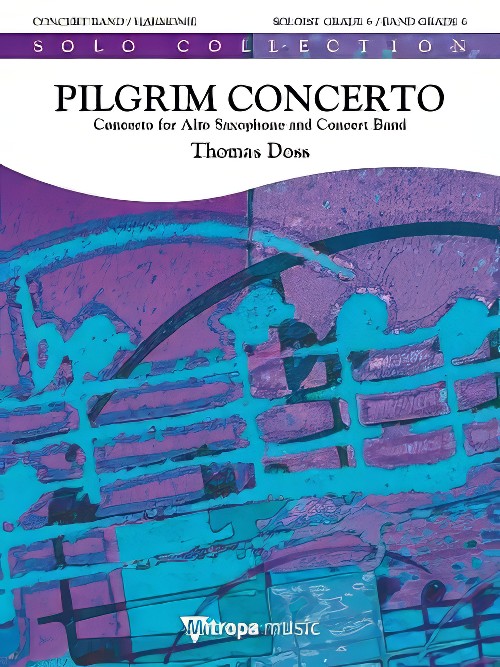
Pilgrim Concerto (Alto Saxophone Solo with Concert Band - Score and Parts) - Doss, Thomas
The Pilgrim Concerto, written for the 2012 World Music Contest Kerkrade, is a highly demanding yet rewarding work for alto saxophone and wind band. It is one of a series of spiritual works by the composer which also includes Symphony in Green. Sometimes minimalistic and at other times romantic, it describes a pilgrim who is at times calmy meditative, but also full of anxious impatience to reach his goal.Duration: 19:00
Estimated dispatch 7-14 working days
 View Music