Results
-
 £35.50
Triglav - Julius Fucik
Julius Fuc k (1872-1916) appreciated life in Sarajevo. First compositions were written, which soon made him become one of the leading representatives of his profession in Austria-Hungary. Among those works also figured his elaborate piece "Austria's Glory and Honor", which unfortunately remains kind of ill-fated up to now. Yet another area of activities, where Fu k was able to demonstrate his talents was to stage the symphony concerts introduced by him in Sarajevo. Late in fall of the year 1900 Fuc k's time had come, when the regiment deployed from Sarajevo to Budapest. He lived in that metropolis on the Danube for the next some ten years, and during that period most of hisworks were composed. At that time his popularity also grew from day to day. The first performances of his works met with general interest, and not only numerous officers most of them were friends of Fuc k attended these events, they rather were attractions for all ranks of the society. It should also not be overlooked that music publishers were anxious to secure almost each one of his works for their publishing company, and most of them were printed immediately after their premieres. In 1899 the "Laban March" was written as his Opus 44. It was dedicated to Major General Rudolf Laban of Vralje, commander of the 3d Mountain Brigade which was stationed in Nevesinje. The title of the march then changed to "Eiserne Brigade" ("Iron Brigade") until it finally became known as "Danubia". It was first printed as late as 1933 by Bohuslav Leopold (Edition Continental). Leopold was a musician in Fuc k's regimental band, and later a successful publisher. He succeeded in securing the best of Fuc k's works for his company. Sketches of "Triglav" date back to 1903. The title alludes to the highest mountain of the province of Slovenia, and this was probably an apt means in the eyes of the composer to demonstrate his "Slavonic patriotism".
Estimated dispatch 7-14 working days
-
 £115.60
Hymne til gleden - Ludwig van Beethoven
Schiller's text of 1785 was partially used by Beethoven in1824 when he did finish the 4th movement of his 9th Symphony. The melody has later been used in very many contexts. As the anthem of the European Union, a lot of movies (A clockwork Orange, Die Hard, etc.), music to video games, as the anthem of Rhodesia, as rebel song in Chile and by FIFA. Therefore, it can be used in most settings This Young Band arrangement focuses on the main melody. In the original, the B part is repeated in each variation, but to get three variations (out of four), this repetition has been cut. The first variation should be played as soft as possible, but still with a nice sound. Crescendo to forte(f) and going back to pp should be as a surprise.
Estimated dispatch 7-14 working days
-
 £207.00
Das Liebesverbot - Richard Wagner
This young, comic opera, composed in 1835 on one of Wagner's own libretti, based on a play by Shakespeare, was unsuccessful at the Magdeburg theatre in 1836 and even the composer considered it a "sin of youth". After attempting in vain to have his first opera, "Le Fate", performed in Germany, Richard Wagner decided that his lack of success was due to the overwhelming competition of Italo-French music. He listened to Bellini, and became aware of the objective reasons for the great success of this music, comparing the warmth of life of Italian music to the frozen and meticulous German style. Hence he composed " Das Liebesverbot " with the sole aim of giving intense pleasure tothe public, without worrying about succumbing to the clichs of French and Italian music. That is why, when we listen to this music without knowing the name of the composer, we find ourselves in an embarrassing situation. We could easily attribute the work to some French composer, Meyerbeer, or Auber, for instance, but then the melodic ease and constructive linearity would bring Rossini to mind. By paying closer attention, however, we notice a boldness, an aggressiveness and a wealth of ideas that, together with clever orchestration, reveal the touch of the great German musician. " Das Liebesverbot " deserves to be performed more often, and we feel sure that the transcription for band will be an excellent vehicle of diffusion for this symphony.
Estimated dispatch 7-14 working days
-
Song of Hope (band version) - Peter Meechan
Song of Hope is dedicated to my good friend Ryan Anthony (principal trumpet with the Dallas Symphony Orchestra) and his charity, Cancer Blows - a foundation set up to raise awareness and money to further the research that has helped give their family a hope for a future following Ryan's diagnosis of Multiple MyelomaUpon hearing the middle movement (simply titled "Song") of my cornet concerto, Milestone, Ryan asked me if I could change the end from its current reflective ending to something more uplifting, and to title it Song of Hope, giving it much more meaning than I could have ever imagined.As well as a wind band scoring without soloist, Song of Hope exists with 1, 2 or 3 soloists, accompanied by either wind band, brass band, brass ensemble or symphony orchestra.For my friend Ryan.
Estimated dispatch 5-14 working days
-
Song of Hope (w/soloist) - Peter Meechan
Song of Hope is dedicated to my good friend Ryan Anthony (principal trumpet with the Dallas Symphony Orchestra) and his charity, Cancer Blows - a foundation set up to raise awareness and money to further the research that has helped give their family a hope for a future following Ryan's diagnosis of Multiple MyelomaUpon hearing the middle movement (simply titled "Song") of my cornet concerto, Milestone, Ryan asked me if I could change the end from its current reflective ending to something more uplifting, and to title it Song of Hope, giving it much more meaning than I could have ever imagined.As well as a wind band scoring without soloist, Song of Hope exists with 1, 2 or 3 soloists, accompanied by either wind band, brass band, brass ensemble or symphony orchestra.For my friend Ryan.Each set comes with the soloist part for 1 soloist. Please download the alternative 2 or 3 soloist parts from the link above.
Estimated dispatch 5-14 working days
-
£13.95
Joy to the World
1Joy to the WorldHandel arr. StirlingThe Central Band of the Royal Air Force2.162A Carol Symphony - I. PreludeHely-Hutchinson/WilliamsThe Central Band of the Royal Air Force4.003Shepherd's HeyPercy GraingerThe Central Band of the Royal Air Force2.104A Fireside Christmasarr. Sammy NesticoThe Central Band of the Royal Air Force8.075Dance of the TumblersRimsky-Korsakov/O'DonnellThe Central Band of the Royal Air Force3.486-9A Joyful ChristmasNeil RichardsonThe Central Band of the Royal Air Force I. Ding Dong Merrily on High 1.57 II. Unto Us a Child is Born 3.09 III. O Little Town of Bethlehem 3.24 IV. Masters in This Hall 1.5010Hallelujah ChorusHandel trs. RichardsThe Central Band of the Royal Air Force3.5811Carols from Olde Englandarr. Duncan StubbsThe Central Band of the Royal Air Force9.1112Jesu, Joy of Man's DesiringBach trs. MorrellThe Central Band of the Royal Air Force3.2913Dance of the Sugar Plum FairyTchaikovsky trs. RichardsThe Central Band of the Royal Air Force1.5014-16A Christmas SuiteDavid BarkerThe Central Band of the Royal Air Force I. Chaconne 1.52 II. Scherzo Variations on We Three Kings of Orient Are 2.53 III. Fanfare and Fugue 4.1017Chrismas-TimeStuart L. StirlingThe Central Band of the Royal Air Force5.23
Estimated dispatch 7-14 working days
-
£79.99
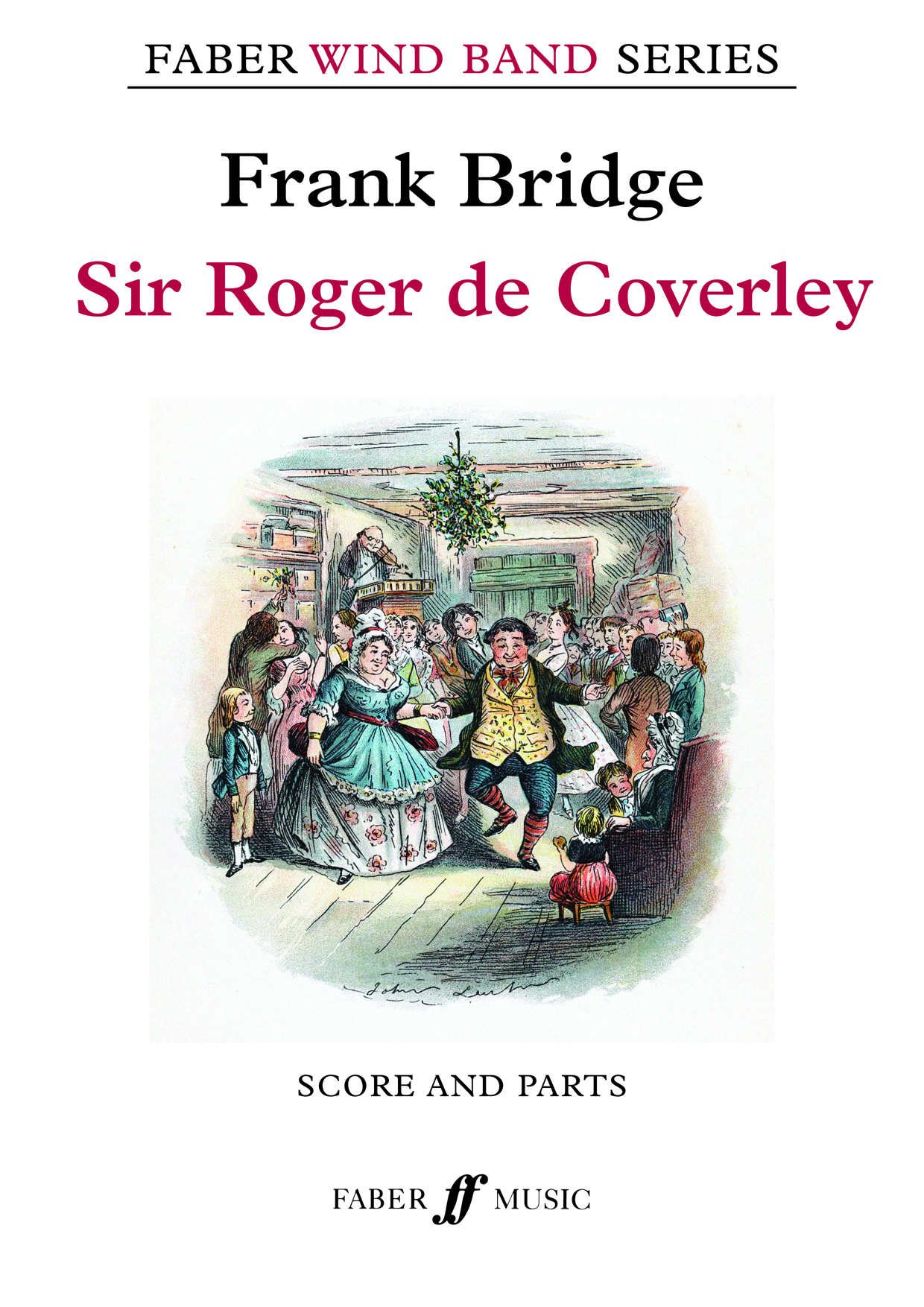
Sir Roger de Coverley - Frank Bridge
Frank Bridge (1879 – 1941) was one of the leading English composers of his time. In October 1922 he adapted his popular string quartet Sir Roger de Coverley for full symphony orchestra and Sir Henry Wood agreed, at the last minute, to include it in the last night of the Queen’s Hall Promenade Concerts at the end of that month. This elaborate and colourful orchestral version has never been widely performed, but has now been brilliantly transcribed by Alastair Wheeler to provide a miniature dance poem for grade 5 level concert band. Bridge’s lively treatment of one of England’s most famous traditional dance melodies will make a fitting end to any concert, with the strains of Auld Lang Syne introduced by Bridge as a nod towards Sir Roger de Coverley’s traditional function as the final dance of a Christmas Ball, as it was in Old Mr. Fezziwig’s party in Dickens’ A Christmas Carol.
Estimated dispatch 7-14 working days
-
Fragile Oasis - Peter Meechan
Fragile Oasis is the name of a collective who describe themselves as "...a grass-roots participatory initiative that connects the shared perspective of astronauts from different countries and cultures with people on Earth, encouraging all to work together so that our planet is not only visibly beautiful, but beautiful for all".Many involved in the project are astronauts on the International Space Station (I.S.S.), who post, on their website (http://www.fragileoasis.org) many different details of their experiments, photos from space, and some incredible video footage of our Earth.One such time lapse video (a video made up many still images) was posted on their website by astronaut Ron Garan (http://www.fragileoasis.org/blog/2011/11/coming-back-down-to-our-fragile-oasis-2/) in 2011. It is made up of images taken from the I.S.S. of what Garan described as "...a couple of laps around our Fragile Oasis before coming back down [to Earth]" and features all kinds of amazing views from space.Each of the five sections of this work relate to an aspect of the video - either something literal or something more metaphorical. The opening section, i: The lights from Above, is a musical description of the view of the Aurora Australis from above the lights. The second section, ii: The Storm from Above (part i), is also a musical portrayal of portions of the video clip - in this case the many lightning storms we see from above. The storms that are so powerful on Earth appear as small bolts of electricity dancing through the clouds.The third section, iii: Freya, has its roots in personal family tragedy. The name Freya derives from a Norse goddess who was associated with both beauty and love, and in this central section I wanted to write music that not only acknowledged how fragile life itself is, but that every day of it counts and should be celebrated.iv: The Storm from Above (part ii) is a again a reference to the lightning storms, but also to the huge hurricanes we see in the video. It leads us to the final section, v: The Oasis from Above - a description of the size and grandeur of Earth, our Fragile Oasis.Fragile Oasis is dedicated to Natalie Youson, in friendship.The original wind orchestra scoring was completed in 2014, and was revised in 2017 with the editorial advice of Robert Ambrose whose support of this work I am eternally grateful for.This wind orchestra scoring was completed in 2014 and was commissioned by a consortium of the following bands:Agrupacin Msico-Cultural "Las Musas" de Guadalupe (Murcia) - Dr. Jos Ibez Barrachina - SpainBand of the Coldstream Guards - Major Darren Wolfendale - UKBorge Musikkorps - Sverre Stakston Olsrud - NorwayThe Brooklyn Wind Symphony - Jeff W. Ball, Artistic Director - USADunshan Symphonic Wind Orchestra - Adrian Schneider - ChinaKoninklijke harmonie Ste. Cecilia Zele - Bart Picqueur - BelgiumMusikgesellschaft Emmen - Manuel Imhof - SwitzerlandUniversity of Saskatchewan Wind Orchestra - Dr. Darrin Oehlerking - Canada
Estimated dispatch 5-14 working days
-
Taking the Fifth - Peter Meechan
Written during the Covid-19 pandemic, originally as an adaptable chart, Taking the Fifth takes its title from both the primary interval of the work as well as from a general British expression that when something is outrageous, remarkable, or the worse of its kind that it "takes the biscuit".Given that the piece was written during the Covid-19, and that even more unpredictable news that followed every day during the pandemic, it seemed an apt title!Upbeat, occasionally dark, but always with drive and a sense of fun, Taking the Fifth was the piece that got my creative juices flowing again, having initially found myself pretty lost for inspiration during the early stages of pandemic.Taking the Fifth is dedicated to my dear friend, Robert Ambrose.Peter Meechan 2021Anthony Reimer, Calgary, CanadaBenedictine College - Tom Davoren, Director of BandsBrandon University - Wendy Zander McCallum, Conductor, Symphonic BandBrooklyn Wind Symphony - Jeff W. Ball, Artistic Director & ConductorDordt University - Onsby C. Rose, Director of Instrumental StudiesGeorgia State University - Robert Ambrose, Director of BandsGlobal Bandroom Podcast - Keith Kelly, HostKansas State University - Frank Tracz, Director of BandsUniversity of Kansas - Matthew Smith, Associate Director of BandsUniversity of Regina - Brent Ghiglione, Director of BandsWinona State University - Melanie Brooks, Director of Bands
Estimated dispatch 5-14 working days
-
£85.00
Sir Roger de Coverley - Frank Bridge
Frank Bridge (1879 - 1941) was one of the leading English composers of his time. In October 1922 he adapted his popular string quartet Sir Roger de Coverley for full symphony orchestra and Sir Henry Wood agreed, at the last minute, to include it in the last night of the Queen's Hall Promenade Concerts at the end of that month. This elaborate and colourful orchestral version has never been widely performed, but has now been brilliantly transcribed by Alastair Wheeler to provide a miniature dance poem for grade 5 level concert band. Bridge's lively treatment of one of England's most famous traditional dance melodies will make a fitting end to any concert, with the strains of Auld Lang Syne introduced by Bridge as a nod towards Sir Roger de Coverley's traditional function as the final dance of a Christmas Ball, as it was in Old Mr. Fezziwig's party in Dickens' A Christmas Carol.
In stock: Estimated delivery 1-3 days
 View Music