
Results
-
 £118.99
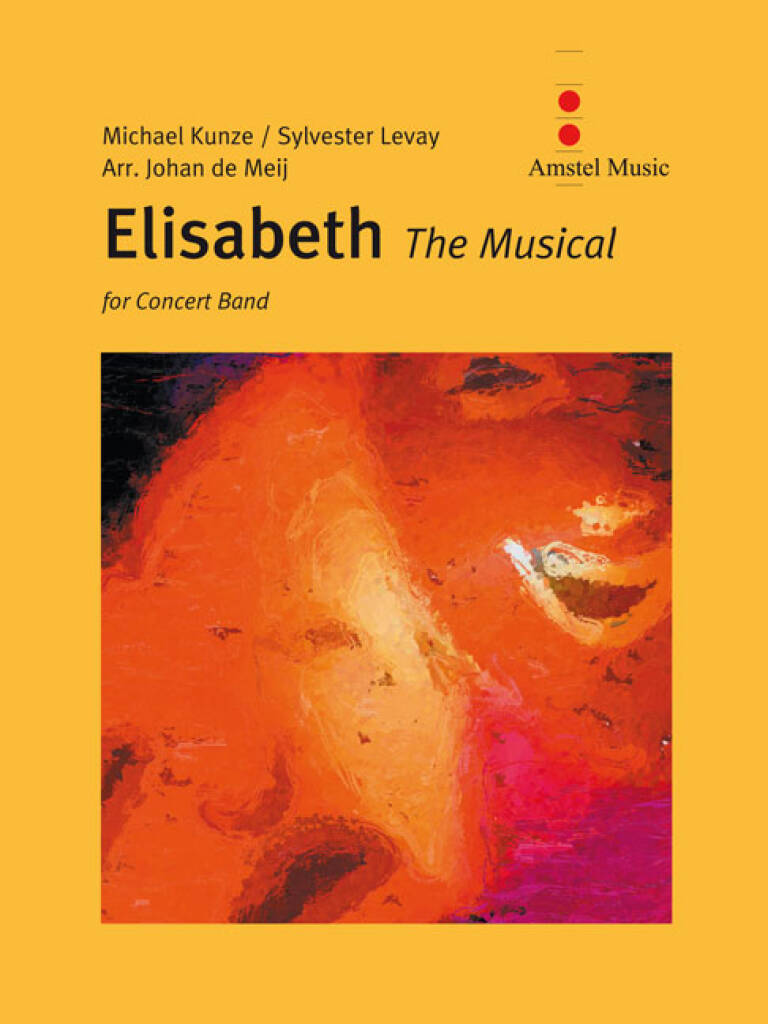
Elisabeth - Sylvester Levay
The world premiere of the musical Elisabeth took place in Vienna on September 3, 1992. From the great acclaim with which the musical was received, it became clear that the life of the Empress of Austria still appeals to the imagination. Although Elisabeth's life (1837-1898) as an Empress has a fairy-tale-like beginning, it takes a gloomy turn. In this production, Luigi Lucheni, the man who finally takes her life, tells her story. Death plays a major role throughout Elisabeth's life. In the musical, an equally mysterious and attractive man portrays the phenomenon of death, seducing her to the realm of death time after time. Elisabeth's life resembles a fairy tale when shemarries the Emperor Franz Joseph at the age of sixteen. Her mother-in-law, Archduchess Sophie, does not make it easy on Elisabeth. But it is life itself that puts the Empress to the test. First, her youngest daughter dies. Then, not long after her son Rudolf is born, her happiness is clouded when her mother-in-law decides she must take pity on him. After her husband's unfaithfulness and Sophie's death, Elisabeth is so disillusioned that she chooses a travelling existence without realizing her husband and her son, Rudolf, miss her. Rudolf's loneliness is one of the reasons he commits suicide. The accumulation of disappointments in Elisabeth's life almost drives her into the arms of Death. In the end, however, it is Lucheni who kills her.
Estimated dispatch 7-14 working days
-
 £83.50
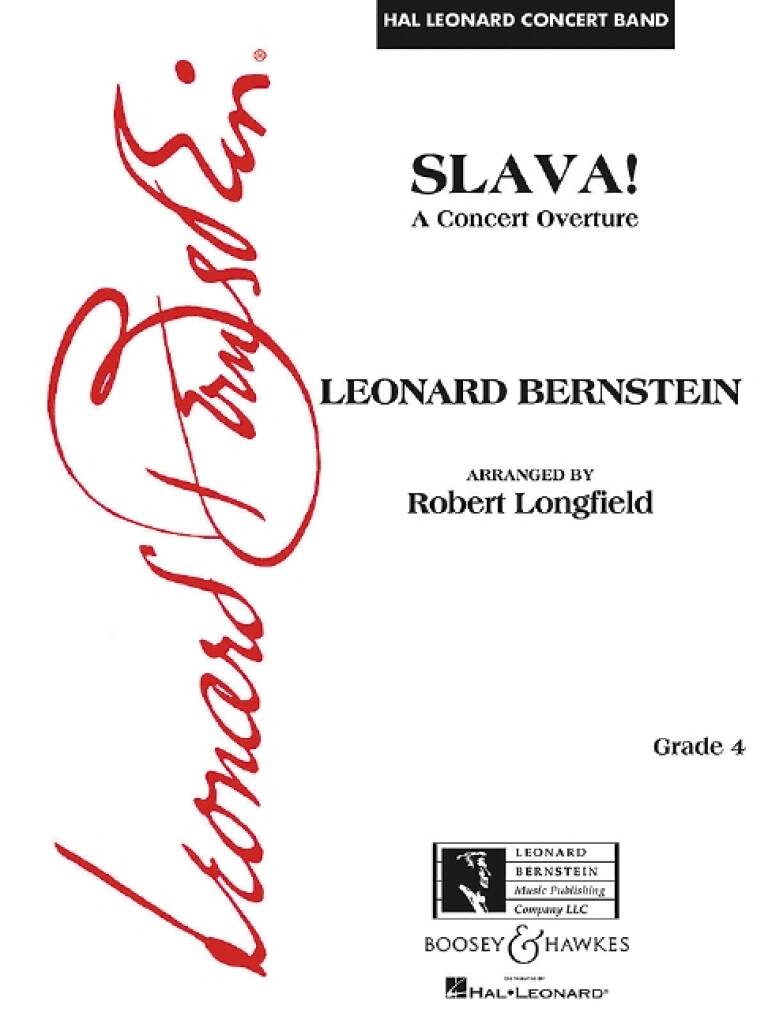
Slava! - Leonard Bernstein
Composed for Mstislav ("Slava") Rostropovich and the National Symphony Orchestra, this exciting, yet brief overture received it's premiere performance in 1977. Constructed using two contrasting themes that are combined near the end, Slava! is adapted here by Robert Longfield with key and range considerations for school ensembles, but still retaining the energy and authenticity of the original.
Estimated dispatch 7-14 working days
-
 £74.10
Casta Diva - Vincenzo Bellini
Casta Diva is possibly the most famous aria by Bellini. This is Norma's prayer to the moon goddess, and shows Bellini's high craftsmanship with melodies. The most famous version of this aria, was sung by Maria Callas in the 1950's, and a recording of this is still available. This is possibly the first arrangement of this tune for wind band, and will no doubt make a good impression.
Estimated dispatch 7-14 working days
-
£122.50
Joe Cocker!
Joe Cocker is considered the most successful white blues singer; he is especially well-known for his rough, striking voice. In 1968, With a Little Help from My Friends became his first number one hit in the UK. With this song he had his great breakthrough at the legendary Woodstock festival in 1969. He can now look back on 40 years of performing and he still is very successful. His records are almost selfselling and his tours easily fill stadiums. Wolfgang Wssner, a true Joe Cocker fan from early childhood, has collected the singer's most beautiful and successful songs and arranged them in a great medley for concert band.
Estimated dispatch 7-14 working days
-
 £110.99
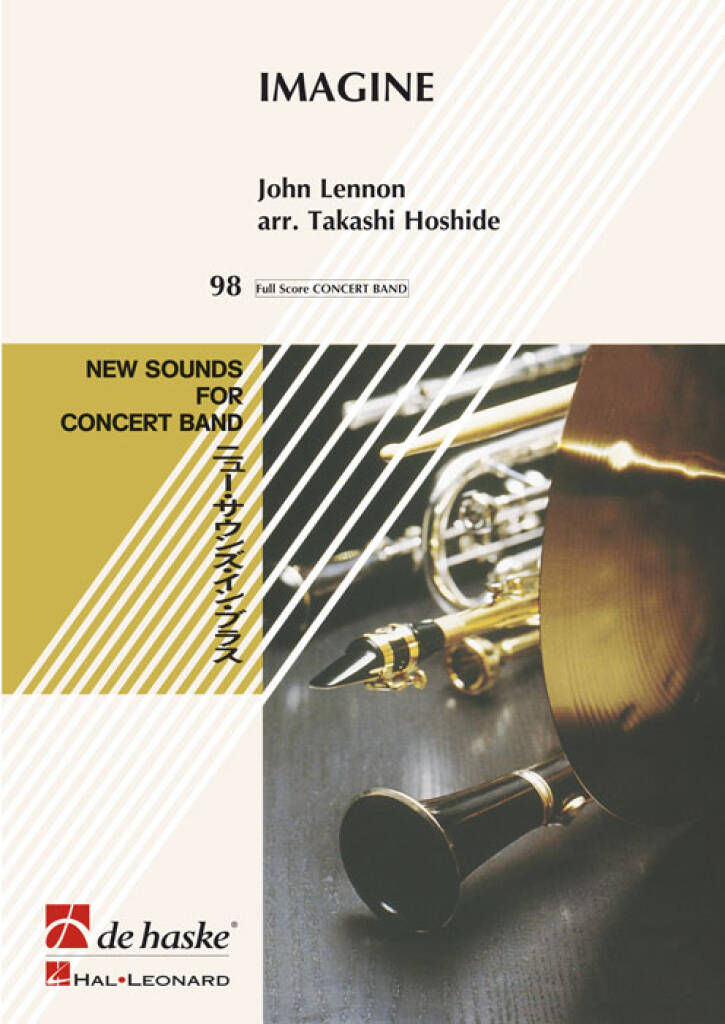
Imagine - John Lennon
John Lennon's career was far from over when in April 1970, following the recording of the album Let It Be, the Beatles split up. This musically gifted and creative composer of many Beatles songs had a number of solo hits before he was tragically killed in 1980. Imagine was one of John Lennon's best songs and it remained in the charts long after his death. It is still not forgotten and is now thought of as a true pop classic. Takashi Hoshide has produced this attractive new arrangement for concert band.
Estimated dispatch 7-14 working days
-
 £76.99
Lngstrump Samba - Jan Johansson
The popular Swedish children's series Pippi Lngstrump (Pippi Longstocking) is about an exceedingly strong and strong-willed little girl with red braids - who is the brainchild of Astrid Lindgren. This series has been broadcasted in many countries. I arranged its cheerful theme tune in samba style. Even with the new rhythm, the original song is still very recognizable. In the exuberant samba style, the percussion plays an important role. Within the Lngstrump Samba, this is especially clear in the ad libitum percussion solo halfway through the arrangement. The solo can go on as long as desired, and offers plenty of freedom because of the free choice of the instruments used.
Estimated dispatch 7-14 working days
-
 £104.99
Famous German Christmas Songs
Most of the German carols that are still popular today date from the period between the 17th and the early 19th centuries. Thus, only very few modern musical approaches to these songs can be found. Stefan Schwalgin has taken the opportunity to give five well-known German Christmas melodies a new sound in this colourful modern arrangement. Contains: Silent Night, Ihr Kinderlein kommet, Zu Bethlehem geboren, Alle Jahre wieder and O du frhliche. At a little bit of German Christmas spirit with this beautiful medley.
Estimated dispatch 7-14 working days
-
 £104.99
The Ultimate EUROPE Collection
The Ultimate "Europe" Collection is an exciting medley of explosive 80s rock! Europe, who originally went under the name of Force, were founded in 1979 in the Swedish town of Uppland Vsby. At the beginning the band wrote progressive rock but soon switched their direction to a more accessible, keyboard-laden rock sound. Their worldwide breakthrough came in 1986 with the snappy The Final Countdown. This infectious rock number occupied the number one slot in the charts the world over. At the end of the 80s Europe had various other hits, of which Rock the Night, Carrie and Superstitious are the best known. The band, which over time has released eightstudio albums, is still going strong and has a loyal fan base. In The Ultimate "Europe" Collection four of the biggest of Europe's hits are brought together: The already-mentioned Rock the Night, Carrie and Superstitious and of course also the megahit The Final Countdown !
Estimated dispatch 7-14 working days
-
 £84.99
Ich steh an deiner Krippen hier - Johann Sebastian Bach
Many of the numerous chorals Johann Sebastian Bach (1685-1750) composed during his lifetime are still very popular today. An example is the melody Ich steh an deiner Krippen her (BWM 469) composed in 1736 and first published in the Schemelli hymn-book.In Jacob de Haan's magnificent instrumental arrangement for band this piece will certainly enrich your Christmas concert programme.
Estimated dispatch 7-14 working days
-
 £134.99
Gulliver's Travels - Bert Appermont
The book Gullivers Travels (1726) by author Jonathan Swift formed the provocation for writing this composition. Even though this composition isnt a literal representation of the original story, a number of elements were still retained. The shipsdoctor Gulliver finds himself in 4 (fictive) areas, each with their own inhabitants and customs. Each part of this suite also received the name of one of these areas:I. Lilliput The enterprising Lilliputians are represented by a playful, common themein the first part.II. BrobdingnagIn the land of "Brobdingnag" Gulliver is carried off by gigantic giants, which you hear approaching with the sounds of the bassinstruments. The same theme is constantly repeated and quickened in order to increase thetension.III. LaputaLaputa is an island that floats in the air; its inhabitants are strange people with slanting heads. The dreamy, special atmosphere is especially well conveyed here.IV. The HouyhnhnmsFinally Gulliver finds himself in the land of theHouyhnhnms, where intelligent and noble horses rule over the primitive, undeveloped people (yahoos). The trumpets in the brilliant opening express the galloping horses; the gallant theme that follows (horns and trombones) symbolises the primitiveyahoos. The whole composition ends with a big finale.I intentionally tried to limit the degree of difficulty of Gullivers Travels. Despite this I think that this work can appeal to many orchestras due to the colourful orchestration (cues areprovided where needed), the simple and clear theme and the highly imaginative breeding ground of a beautiful story around which this composition is built."
Estimated dispatch 7-14 working days
 View Music