
Results
-
 £9.95
£9.95Tunes and Toasts for all Times (Eb Soprano Cornet) - Barsotti, Roger
Titles:ENGLISH AIRSA fine old English GentlemanA-hunting we will goBritish GrenadiersCherry ripeClementineCome, lassies and ladsDrink to me onlyDulce DomumDrunken sailor (The)For he's a jolly good fellowFarmer's boy (The)Floral DanceFrothblowers' AnthemGirl I left behind me (The)Here's a health to all good ladiesHere's a health unto her MajestyHere's to the maidenJohn PeelKeel row (The)Love's old sweet songMarch of the Fire BrigadesMistletoe bough (The)On Ilkla MoorPrincess Royal's Red Cross marchRoast beef of old EnglandSir Roger de CoverleySee the conquering hero comesSoldiers of the QueenThere is a tavern in the townNAUTICALHeart of oakHornpipeLife on the ocean waveShenandoahRed, white and blue (The)Rule, BritanniaSCOTTISH AIRSAnnie LaurieAuld lang syneBonnie banks of LochBonnie DundeeBlue-bells of ScotlandCampbells are coming (The)Charlie is my darlingFlowers of the forestHundred pipers (The)Highland LaddieRobin AdairScotch ReelScots wha haeWill ye no come back againYe banks and braesIRISH AIRSCome back to ErinDanny boy (Londonderry air)Harp that once through Tara's hallIrish Washerwoman (The)KillarneyMinstrel boy (The)Oft in the stilly nightOff to PhiladelphiaSt. Patrick's DayWELSH AIRSAll through the nightAsh grove (The)Bells of AberdoveyDavid of the white rockLand of my fathersMen of HarlechAMERICAN AIRSCarry me back to old VirginnyDixieGood-night (shine, shine, moon)John Brown's bodyMarching thro' GeorgiaOld folks at home (The)Star Spangled BannerTramp, tramp, tramp, the boys are marchingWhen Johnny comes marching homeYankee doodleCANADA AlouetteMaple leaf (The)O CanadaAUSTRALIAWaltzing MatildaSACRED AIRS & CAROLS Abide with meEternal Father strong to saveO God our help in ages pastFirst Nowell (The)Good King WenceslasO come all ya faithfulWhile shepherds watchedJerusalemSupreme sacrifice (The)Dead march in SaulPARADES (All organisations)General saluteSlow march or troop "Scipio"Troop "May-blossom"FANFARES, etcDeclamatory No. 1Occasoinal Fanfare No. 2"Reveille""Retrear""Last Post"Galop from "Orpheus in the Underworld"God save the Queen (in B flat)God save the Queen (in F)
Estimated dispatch 7-14 working days
-
£184.99
Rubicon - Bert Appermont
The Rubicon is a river in Northern Italy which Julius Caesar crossed with his army in 49 BC in defiance of the leaders of Rome, who feared his power. A civil war against rival Pompey ensued, which culminated in Caesar seizing power as the absoluteruler of Rome. The phrase "crossing the Rubicon" therefore refers to any person committing himself irrevocably to a risky, decisive and irrevocable of course of action.The work consists of three parts that deal with this important moment in history.Part 1 (Meditation) symbolises Caesars request to the Gods to assist him in his difficult choice. In a slow introduction we hear the melancholy and beseeching sounds of the duduk (alternatively, this part can be played by a soprano saxophone)and of the soprano solo singer over the bourdon accompaniment. The soprano solo singer then sings "dona tibi pacem" (give him rest) in a melodious and probing theme.In Part 2 (Battle of Pharsalus) trumpets and trombones resound alternately ina stately Roman fanfare, producing a stereophonic effect. This develops into a martial theme in which Caesars impressive army goes to battle against the army of rival Pompey. While the theme of Caesars army fades away, Pompeys theme emerges as anaive dance in six-eight time. His army is definitely in the majority and it believes it can easily defeat the enemy. Suddenly trumpets and trombones clash on two sides of the orchestra: Caesars army advances and attacks. A fierce battle ensues inwhich the two themes are played alternately as well as simultaneously. Thanks to his shrewd battle tactics, Caesar manages to win this legendary battle after all: his theme resounds ever louder in trumpets and horns until everything dies out andchanges into a kind of reconciliation between the soldiers of the two armies. The melancholy "dona tibi pacem" from part 1 now serves as a reconciliation theme.Caesar is now the sole ruler of the New Roman Empire, which would be destined to leave itsmark on our Western civilisation to this day. The third part is a sparkling succession of dance music (Dance) with many Greek and Roman elements in which Caesars victory is praised and celebrated. It is common knowledge that the culture(arts, gods, etc.) of the Romans drew heavily on Greek culture. I have therefore used an authentic Greek theme (the Seikolos song) several times in this part (bar 17 in the euphonium, bar 60 in the base section, bar 68 in the sopranosaxophone) to suggest the music of that era and to evoke the right atmosphere. After a gradual increase in tempo in the entire orchestra, the opening melody gloriously resounds once more, surrounded by virtuoso dance music. The work ends withbombastic brass fanfares in which Caesars theme triumphs once more.NOTE FOR THE CONDUCTOR:The Armenian duduk and the monochord that are used in the introduction give a special tone to the music, but could be substituted (soprano saxophone instead ofthe duduk) or left out (monochord). The soprano solo is also doubled within the orchestra and could therefore also be left out if necessary, although it does provide the work with an extra dimension. The male voices in the introduction and the finalecould possibly be replaced with a synthesizer with choral setting.As a visual and acoustic element in part 2, the trumpets, the e-flat cornet, the small drum and trombones can be stood up and placed at two sides of the orchestra (bar 80).Seen fromthe point of view of the conductor, put the trumpets, the e-flat cornet and the small drum in the left section and the trombones in the right section of the orchestra. This also helps to create a visual contrast between the two themes of the secondpart. The players can be seated again at bar 97 or bar 121. The soprano soloist can be placed in or in front of the orchestra, depending on what gives the best result. For the conclusion of the work the soprano solo can be sung from afar (from thewings) to create additional atmosphere.This work was composed especially for the "St Joseph" brass band from Pey/Echt (Belgium) with conductor Mark Prils.
Estimated dispatch 7-14 working days
-
 £332.99
Cantica de Sancto Benedicto - Jacob de Haan
Cantica de Sancto Benedicto is a three-movement work for mixed choir, soprano solo, concert band and organ ad libitum - on Latin lyrics that relate to the life of Saint Benedict. It was commissioned by the city of Norcia in Italy, whereBenedict was born. The holy Benedict (480-547) is considered the founder of monastic life within the Roman Catholic Church. His enormous influence is especially owing to his monastic rule, the Regula Benedicti.Jacob de Haan has named the movements ofCantica de Sancto Benedicto after the Holy Trinity: the Father (Gloria Patri), the Son (Gloria Filio) and the Holy Spirit (Gloria Spiritui Sancto). The lyrics of thehymn Gemma Caelestis, (which, like the othertexts, were originally used in Gregorian chant) are voiced by the choir. To this purpose, Jacob de Haan composed new, choral-like, homophone music. The sequence Laeta Quies is rendered by the soprano; the verses (divided over the threemovements) are alternated with those of Gemma Caelestis. The work closes with an impressive grand finale, in which texts are used from the proprium of the mass in honor of the saint's day of the holy Benedict (11 July). Notes to the conductor:For this cantata, there are various possibilities for the performance. The first involves a performance in which the choir and soprano parts are only accompanied by organ. Such a performance has several advantages: since the band never soundstogether with the choir and the soprano, no balance problems occur, and even a performance with a large concert band and a small cantata choir is conceivable. A special layout is also possible - with which you can set up a three-dimensionalperformance in a church. For example, the choir can sing in the chancel, accompanied by the choir organ; the soprano can stand on the gallery, accompanied by the main organ; and the band can be seated in another part of the church. The choir couldalso sing from a gallery. With layouts like this, working with two conductors is advisable. Choral parts available separately.
Estimated dispatch 7-14 working days
-
 £118.99
Knoxville: Summer of 1915 - Samuel Barber
(concert band with vocal solo). G. Schirmer Concert Band - Grade 3-5 Samuel Barber's landmark 1948 piece for soprano and orchestra, a setting of poetic, nostalgic prose by James Agee, has been transcribed for soprano and concertband in this new edition, making it accessible to many more performers. This lyrical, warm music is Samuel Barber at his best, evoking the highest aspects of Americana. The soprano part is for an accomplished performer. (Grade 5)(15:00)
Estimated dispatch 7-14 working days
-
 £139.90
Tempo di Marcia from Symphony No. 1 - Einar Englund
Einar Englund (1916-1999) was a major Finnish composer of symphonies, concertos and film music. His first symphony (1946) bears the title "War Symphony", not given by the composer. He preferred to think think of it rather as a euphoric shout of joy at living to survive the hells of war. The first movement Tempo di marcia depicts seemingly never-ending marching through Karelia during the Soviet-Finnish war. Influences from Sibelius and Shostakovich are present.American conductor Robert J. Ambrose's arrangement of Englund's Tempo di Marcia is scored for wind band. The duration is 9 minutes. This product includes the full score and the parts:PiccoloFlute 1-2Oboe 1Oboe 2 doubling English hornBassoon 1-2Clarinet 1-3 B-flatBass Clarinet B-flatSoprano Saxophone (opt.) (part for alto saxophone II provided in lieu of soprano saxophone)Alto SaxophoneTenor SaxophoneBaritone SaxophoneHorn 1-4 FTrumpet 1-3 B-flatTrombone 1-3Euphonium (BC)TubaTimpaniPercussion 1-4Harp (opt.)Double Bass
Estimated dispatch 7-14 working days
-
 £149.40
Sle Jolekveld - Elias Blixt
"Sle Jolekveld" was arranged for Kongelige Norske Marines Musikkorps (The Royal Norwegian Navy Band) for their CD-recording "Julestemning"(2009) featuring Solveig Kringlebotn as soprano soloist and the choir of Oslo Philharmonic Orchestra conducted by Ingar Bergby.The arrangement works very well for a collaborative concert for band and SATB choir and possible soprano soloist. However it will also work well also for concert band alone.
Estimated dispatch 7-14 working days
-
 £79.99
Angelo del Cielo - Giacomo Puccini
The one-act opera Suor Angelica is set in the cloisters of an Italian convent at the end of the seventeenth century. Of noble birth, Angelica has been a nun for seven years, forced there by her family as punishment for an unknown sin. When her aunt visits her, she tells Angelica that her child had died. This terrible news becomes the reason for her only aria, Senza Mamma, a heart-wrenching song of restraint and dignity to her little 'angel in heaven' (Angelo del Cielo). The set contains solo parts, for soprano voice, cello and a duet for soprano and cello. There is also an optional solo part for trombone or euphonium.
Estimated dispatch 7-14 working days
-
 £149.40
Cradle Hymn - Kim André Arnesen
Cradle Hymn, a Christmas lullaby with imagery of Mary and her infant, was written for the Nidaros Cathedral Girl's Choir and conductor Anita Brevik in 2010, and later arranged for SATB and TTBB chorus. The Lyrics were written by Isaac Watts (1674-1748).This arrangement was written by Christian Aftreth Eriksen in 2021, commissioned by Bunberry High School, Australia. It is scored for large concert band, but is playable for smaller forces through clever cross cuing: Eb clarinet, Contrabass Clarinet, Baritone Saxophone, Contrabassson and Double Bass can all be considered ad lib. All Oboes, Bass Clarinet, Bassoons and all Horns are cross cued.A Soprano Saxophone part is provided to cover the Oboe solos, and should only be used if no Oboes are available.The choice of Vibraphone or Marimba is left up do the conductor. Vibraphone will provide more resonance in the ensemble, if needed.
Estimated dispatch 7-14 working days
-
 £171.00
Passacaglia and Fugue in C-minor BWV 582 - Johann Sebastian Bach
The Passacaglia is a set of instrumental variations based on an ostinato bass. Bach's Passacaglia and Fugue in C-minor for organ represents the pinnacle of what had been achieved in this compositional form at that time. In Franco Cesarini's arrangement for large wind orchestra, the particularly careful interpretation of the original piece enables him to exploit all the sound colors at his disposal, and in this sumptuous guise Bach's work also takes on a grandiose dimension, albeit tinged with late-Romanticism. The exposition of the beautiful theme begins in the bass part, immediately creating a solemn and serious atmosphere which is accentuated by the intensely pathetic character of the first variations. Up to the tenth variation it remains confined to the bass, but in subsequent ones it also passes to the soprano and alto register. The integrity of the theme is also embellished with elegant arpeggios, in whose lower and higher extensions the theme can be distinguished. Towards the end it returns to the bass in an impressive thickening of the polyphonic texture that swiftly re-establishes the key of C-minor. The "Thema fugatum" which follows immediately does not constitute a Fugue in its own right, rather it is nothing but the twenty-first and most extensive variation of the Passacaglia. This time Bach uses only the first half of the theme, superimposing a rhythmic countersubject that considerably enlivens the entire development of the composition. The polyphonic discourse becomes increasingly dense, until the building tension peaks in a powerful "Neapolitan sixth" chord, followed by a sudden pause. This culminating moment then leads to the coda and final cadence on a bright C-major chord.
Estimated dispatch 7-14 working days
-
 £244.99
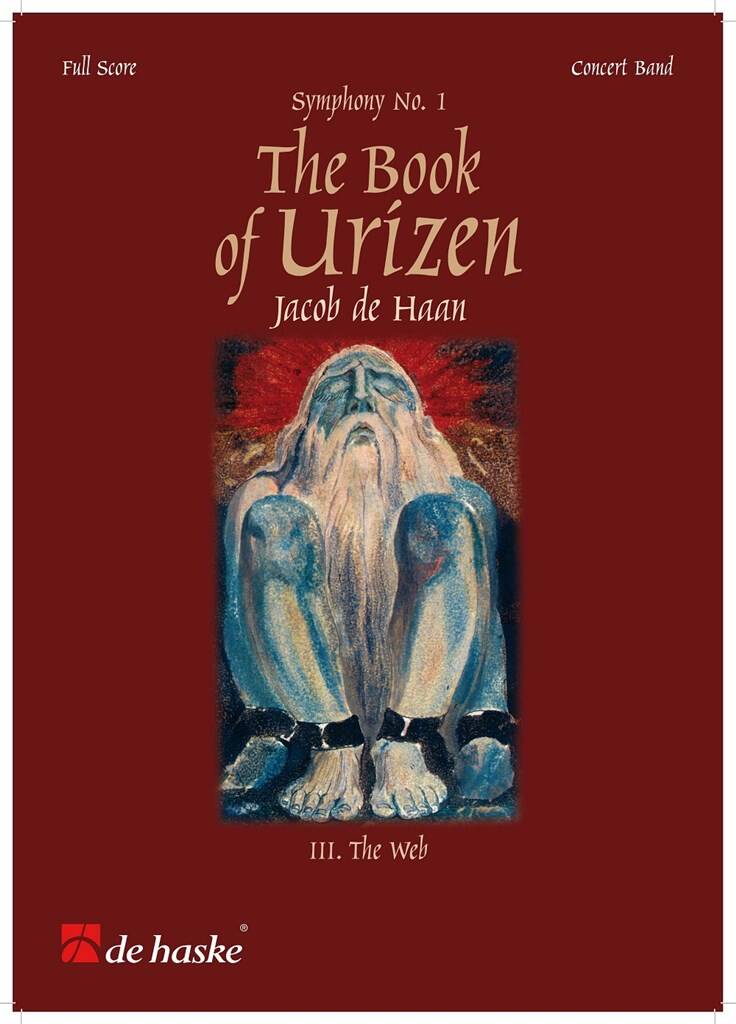
The Book of Urizen III - Jacob de Haan
The Book of Urizen is Jacob de Haan his first Symphony for concert band, solo soprano, and a male narrator in which sound collages of expressions are used. The piece is inspired by the compelling visionary poem of the samename (which the poet illustrated himself) by the Englishman William Blake (1757-1827). The Vision, first movement and The Creation, second movement of The Book of Urizen are available by following editionnumber: DHP 1043551. The Web, the third movement of The Book of Urizen is available by the following edition number: DHP 1125252. Download the audio samples from the 'Attachments'.
Estimated dispatch 7-14 working days
 View Music