
Results
-
 £104.99
ABC (Concert Band - Score and Parts) - Amano, Masamicz
The second single from the Jackson Five, the group that gave megastar Michael Jackson fame during his youth, was the catchy song ABC, which was released in 1970 by the famous recording company Motown. Within three weeks more than two million copies had been sold. ABC will again guarantee success with this wonderful arrangement by Masamicz Amano.Duration: 3:45
Estimated dispatch 7-14 working days
-
 £94.95
Alloway Tales (Concert Band - Score and Parts) - Graham, Peter
Scotland's greatest storyteller, Robert Burns, was born in Alloway, near Ayr in 1759, and died in 1796. This arrangement of three of his best songs includes an optional part for speaker (Scots accent preferred!) The first song is a portrait of Duncan Gray, who rides into the village to woo Maggie. After some initial misgivings on Maggie's part, wedding bells are in the air, and both live happily ever after. The second portrait is of Mary Campbell, who lies asleep by the gently flowing Afton Water. This is one of the most beautiful of Burns' settings, and in this arrangement the flugel horn is featured. The final song, The Devil's awa wi th' Exciseman, sees the scourge of the village, the customs man, spirited away by the Devil in a flurry of dust and hooves. They leave behind some very happy villagers who waste no time in celebrating their good fortune with jigs, drums and fun galore.
Estimated dispatch 7-14 working days
-
 £98.50
La Fiesta Mexicana (Concert Band - Score and Parts) - Reed, Owen
Following a year of studying Mexican folk music, Reed created this work which is subtitled A Mexican Folk Song Symphony for Concert Band. Set in three contrasting movements, the entire work musically portrays a religious festival. The variety of textures is evident from the beginning of the first movement entitled "Prelude and Aztec Dance." The second movement, "Mass," is more sombre and reflective. "Carnival," the last movement, is joyous and invigorating.Duration: 22.00
Estimated dispatch 7-14 working days
-
 £44.95
Two Susato Dances (Concert Band - Score and Parts) - Susato, Tielman - Ellerby, Martin
Around 1540 Tielman Susato, the Belgium trumpet player and composer, established himself in Antwerp as a printer of music. In 1551 he brought out The Third Little Music Book, a collection of instrumental dances. Most of these are arrangements, possible by Susato himself, of popular dance tunes. In keeping with sixteenth-century practice, this book details no specific instrumentation; something to be worked out by the players with whatever available means. Doubtless many of the dances were performed on wind instruments at festive outdoor events. The date of Susato's birth is unknown but estimated to be around 1500. The same applied to his death, which is thought to be somewhere between 1561-64.The third Little Music Book gives several examples of the traditional sixteenth-century genre, the dance pair, a predecessor of the Baroque suite. In such a pair the first dance was often in slow or moderate duple time, the second in quick triple time. This is the case in the pair presented here, which consists of a lively round dance followed by a Hop Up or saltarello.Titles in the Prelude Series are specifically scored for bands with few, if any, bass instruments but will sound well on larger ensembles. The bass line is playable by any combination of bass clarinet, bassoon, baritone saxophone, trombone, euphonium or tuba; in the event that none of these is available, the part for trombone/euphonium (B flat TC) can be played by tenor saxophone. The tuned percussion part is entirely optional and can be played by any available instrument(s). Each piece also includes a preliminary exercise. This is always in the same key as the accompanying piece and consists of a scale and chord progression that can be used for improving ensemble, balance, intonation and instrumental facility by changing tempo, articulation and dynamics.Duration: 2.00
Estimated dispatch 7-14 working days
-
 £48.95
Quintero (Concert Band - Score and Parts) - Hodges, Steve
This exciting new piece from Steve Hodges begins with a chorale-type introduction that leads to a dynamic opening statement by the low brass. The main theme is legato to contrast with the busy percussion section. A secondary theme, introduced by the woodwinds, is followed by the return of the introduction with development. The second theme is then repeated by the woodwinds in a light, jazzy style. This leads to a powerful conclusion where the percussion section drives the full ensemble to a rousing finish. Duration: 3.00
Estimated dispatch 7-14 working days
-
 £267.99
Hymn of the Highlands, Suite from (Concert Band - Score and Parts) - Sparke, Philip
Suite from Hymn of the Highlands draws three expressive musical pictures of the Scottish highlands.The first movement, Ardross Castle, features solo passages for clarinet and bassoon and features a fascinating bagpipe melody.The second movement, Alladale, is a saxophone trio with an accompaniment featuring the percussion section.The final movement, Dundonnell, features two highly contrasting melodies, a wild presto and the bagpipe melody first heard in the first movement.Duration: 17:00
Estimated dispatch 7-14 working days
-
 £70.50
Old Brenton Carol (from Holst Winter Suite) (Concert Band - Score and Part) - Holst, Gustav - Smith, Robert W.
This tender Holst melody has been magnificently scored to be performed independently as a beautiful serence carol or in conjunction with the other movements of The Holst Winter Suite for Band. The first movement, On This Day Earth Shall Ring and the second movement is In the Bleak Midwinter. With this final movement complete, the finished suite is a welcome addition to modern band literature. Duration: 2.00
Estimated dispatch 7-14 working days
-
 £154.99
Greek Folk Song Suite (Concert Band - Score and Parts) - Cesarini, Franco
Greek folk music is characterised by the sound of the 'buzuki' which is often used in combination with the clarinet, the mandolin, the violin and various types of tambourines. In Greek Folk Song Suite, Franco Cesarini has elaborated on three songs belonging to this most ancient tradition. The first, O Haralambis, is in 7/8 time, a characteristic of a popular folk dance called kalamatianos. Originally, the song O Haralambis was sung to 'tease' during weddings with the text of the song refering to a young man who refuses to marry. The second movement, Stu Psiloriti, refers to an ancient song from the island of Crete. The third movement of the suite is based on the song Vasilikos tha gino and is characterised by the sirtaki, probably the most popular Greek dance outside of Greece. This is Greek passion portrayed by a concert band!Duration: 9:00
Estimated dispatch 7-14 working days
-
 £48.95
Spring Island Celebration (Concert Band - Score and Parts) - O'Reilly, John
Visit charming Spring Island, South Carolina with Spring Island Celebration, a piece that depicts three separate locations on the island. The opening fanfare, with its stark harmonies and powerful brass scoring, portrays the noble and majestic Tabby Ruins. They were destroyed by fire long ago, but are still beautiful in a timeless manner. The lovely second movement, with its flowing woodwind and horn melodies, represents the serene Live Oak Forests that dot the island. The final section depicts Bonny Shore, the island's favourite place for crab boils, cookouts and spirited gatherings, with lively percussion and vibrant folk-style tunes to bring this wonderful suite to a rousing conclusion.Duration: 5.30
Estimated dispatch 7-14 working days
-
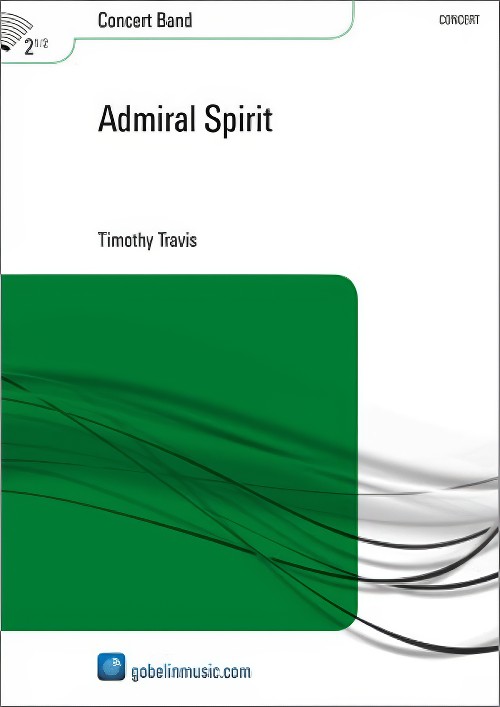 £118.99
Admiral Spirit (Concert Band - Score and Parts) - Travis, Timothy
The 'Admiral Spirit' is the pride of the Navy. The ship is at sea, there is no wind, the sun is shining. The crew are busy piloting the ship into port in prime condition. The admiral himself will inspect the vessel.The first movement (Allegro Con Spirito) gives musical expression to the majestic ship and its toiling crew.In the second movement (Andante), the ship sails into port. It has been polished and technically everything is in order. The admiral will be proud when he inspects the ship.Third movement (Allegro Molto): the captain and his crew are nervous (modulations) while working at the 'finishing touch'. The Navy Band is ready to receive the admiral !. He may be proud of his flagship.Duration: 6:30
Estimated dispatch 7-14 working days
 View Music