
Results
-
 £13.17
Suzuki Cello School, Volume 2: Cello Book
Teach cello with the popular . The Suzuki Method of Talent Education is based on Shinichi Suzuki's view that every child is born with ability, and that people are the product of their environment. According to Shinichi Suzuki, a world-renowned violinist and teacher, the greatest joy an adult can know comes from developing a child's potential so he/she can express all that is harmonious and best in human beings. Students are taught using the "mother-tongue" approach. Each series of books for a particular instrument in the Suzuki Method is considered a Suzuki music school, such as the Suzuki Cello School. Suzuki lessons are generally given in a private studio setting with additional group lessons. The student listens to the recordings and works with their Suzuki cello teacher to develop their potential as a musician and as a person. This Suzuki Book is integral for Suzuki cello lessons. Titles: Long, Long Ago (T. H. Bayly) * May Time, Komm Lieber Mai (Longing for Spring) from , K. 96 (W. A. Mozart) * Minuet No. 1, Minuett III from , BWV 822 (J. S. Bach) * Minuet No. 3, Minuet in C, BWV Anh. II (J. S. Bach) * Chorus from (G. F. Handel) * Hunters' Chorus from 3rd Act of the Opera (C. M. von Weber) * Musette in G, Gavotte II or the Musette from , BWV 808 (J. S. Bach) * March in G (J. S. Bach) * Theme from (N. Paganini) * Tonalization: The Moon over the Ruined Castle (R. Taki) * The Two Grenadiers, Die Beiden Grenadier, Op. 49, No. 1 for Voice and Piano (R. Schumann) * Gavotte (F. J. Gossec) * Bourre from , HHA IV/18, No. 8-EZ (G. F. Handel). This title is available in MakeMusic Cloud. For a complete list of the most recent printings by AMPV number, go to alfred.com/suzuki. The International editions include an updated title page that designates the book as the International Edition. A Federation Festivals 2020-2024 selection.
Estimated dispatch 3-5 working days
-
 £110.00
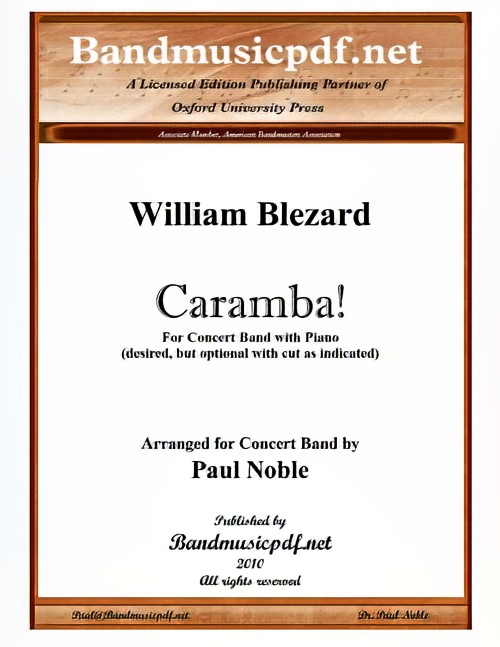
Caramba! (Concert Band - Score and Parts) - Blezard, William - Noble, Paul
William Blezard began writing Caramba! during a tour of New Zealand. Yet the musical basis of this work is about as far away from Kiwi culture as one can get. The word Caramba has several translations from the Spanish, including Dear Me!, or Goodness Me!, or perhaps more colloquially, Golly, or even Holy cow!. The entire work has an exotic feel to it that is so suggestive of things Spanish or Latin American. This is helped by the extensive use of percussion, and of course the brass is pure Latin American dance style. The demanding piano part is featured as almost a 'concertante'. In the Concert Band arrangement, the piano is highly desirable to replicate the original score, but the arrangement includes enough doubling and a short cut to make the piece entirely playable without the piano. Caramba! has all the hallmarks of a great piece of concert music that pleases as well as excites. For bands that want a challenge that is sure to bring an audience to its feet, Caramba! is the piece!
Estimated dispatch 7-14 working days
-
 £128.00
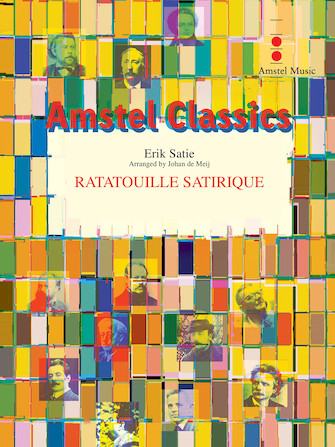
Ratatouille Satirique (Concert Band - Score and Parts) - Satie, Erik - De Meij, Johan
Erik Satie, born in Honfleur in Normandy (France) in 1866 is undoubtedly one of the most striking personalities in the history of French music. He composed in various, often quite divergent, styles. Besides light-hearted, entertaining works he also wrote several serious compositions, among which the three ballets: Parade, Rel che and Les Aventures de Mercure. However his piano pieces, such as Trois Gymnopedies or Gnossiennes will remain his most popular compositions. Satie co-operated with almost all great artists of his time: Pablo Picasso, Jean Cocteau, Sergej Diaghilev and Georges Braque and the composers Darius Milhaud (Le Groupe des Six) and Claude Debussy. Johan de Meij made an orchestration of three short pieces by Erik Satie: I. Prelude (from: Jack in the Box) II. Reverie (from: Trois petites pieces montees) III. Marche: Le Piccadilly (1904) It was only after Satie's death in 1925 that the manuscript of the piano piece Jack in the Box was recovered. Satie himself thought he had lost the manuscript in a bus. When his flat in Arceuil was cleaned out, a small notebook was discovered behind his piano and it contained the manuscript which was assumed to be lost forever. The R?verie (De l'Enfance de Pantagruel) is an extract from Trois petites pieces montees, originally composed for small symphony orchestra. In this suite it is meant as a restful intermezzo. It is clear that, as with Milhaud (La Creation du Monde) and Debussy (Golliwogg's Cakewalk; Le Petit Negre), it is hard to deny obvious influences of jazz music in Erik Satie's compositions. Le Piccadilly, dating from 1904, displays a lot of similarities with the compositions of Scott Joplin. Duration: 7.00
Estimated dispatch 7-14 working days
-
 £295.00
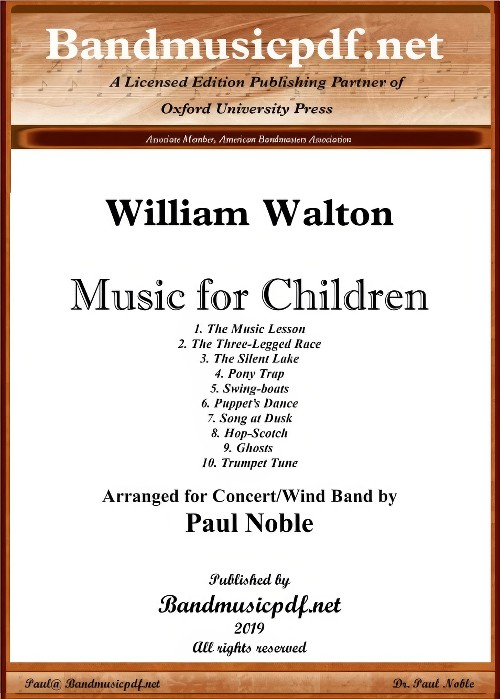
Music for Children (Concert Band - Score and Parts) - Walton, William - Noble, Paul
Music for Children, 1940-1, was originally written as piano duets, and arranged for orchestra by the composer from the Duets for Children (1940). There are ten short movements with depictive titles. Nine of the numbers originally existed in versions for piano solo, entitled Tunes for My Niece. The scoring for band is sometimes characteristically thin, capturing the intimate childlike musical descriptions, and occasionally full, showing absolute excitement and youthful delight.
Estimated dispatch 7-14 working days
-
 £47.50
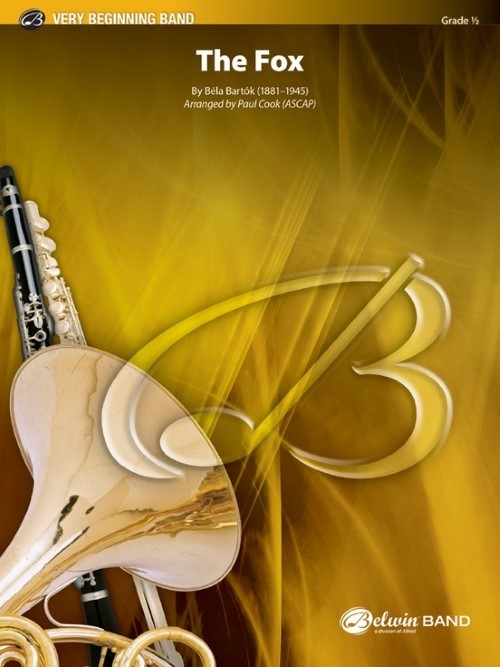
The Fox (Concert Band - Score and Parts) - Bartok, Bela - Cook, Paul
One of the numerous short piano pieces for children that Bela Bartok completed in a four-volume piano collection in 1909. This arrangement for early band students remains faithful to Bartok's intent while comfortably accommodating the skills for first year players. Light and whimsical, you can hear the playful nature of "The Fox" in this solid scoring for your beginners.Duration: 1:45
Estimated dispatch 7-14 working days
-
 £520.99
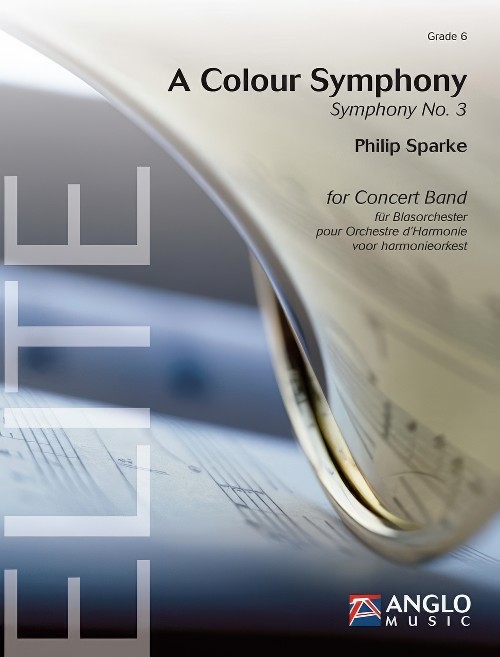
A Colour Symphony (Concert Band - Score and Parts) - Sparke, Philip
Philip Sparke's third symphony, A Colour Symphony, was commissioned by "sinfonischen blasorchester wehdel" conducted by Thomas Ratzek. In the four movements (white, yellow, blue and red) the composer creates links between the instrumentation and harmonic elements and the actual colour of the spectrum the movement stands for. In order to create the greatest richness possible, Philip Sparke used a very large instrumentation including low woodwinds, harp, piano and celli. A Colour Symphony is an impressive and iconic addition to the standard repertoire for large symphonic bands. Philip Sparke's third symphony, A Colour Symphony, was commissioned by "sinfonischen blasorchester wehdel" conducted by Thomas Ratzek. In the five movements (white, yellow, blue, red and green) the composer creates links between the instrumentation and harmonic elements and the actual colour of the spectrum the movement stands for. In order to create the greatest richness possible, Philip Sparke used a very large instrumentation including low woodwinds, harp, piano and celli. A Colour Symphony is an impressive and iconic addition to the standard repertoire for large symphonic bands.Duration: 26:00
Estimated dispatch 7-14 working days
-
 £52.95
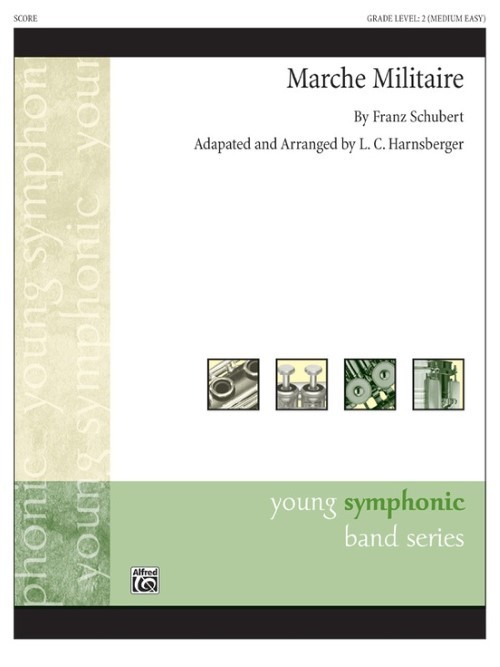
Marche Militaire (Concert Band - Score and Parts) - Schubert, Franz - Harnsberger, L. C.
One of the most familiar and popular marches ever written is Franz Schubert's Military March No.1. Schubert (1797--1828) was one of the most prolific composers of all time, having written symphonies, chamber music, piano works, and over 600 songs, yet he only lived to the age of 32. The march was originally written for piano four-hands, however, this arrangement for young band sounds as if it was first written for military band. Woodwinds, brass, and percussion all shine with fun and interesting parts that work well together. This arrangement is perfect for an opener or closer to any concert.Duration: 2.15
Estimated dispatch 7-14 working days
-
 £84.99
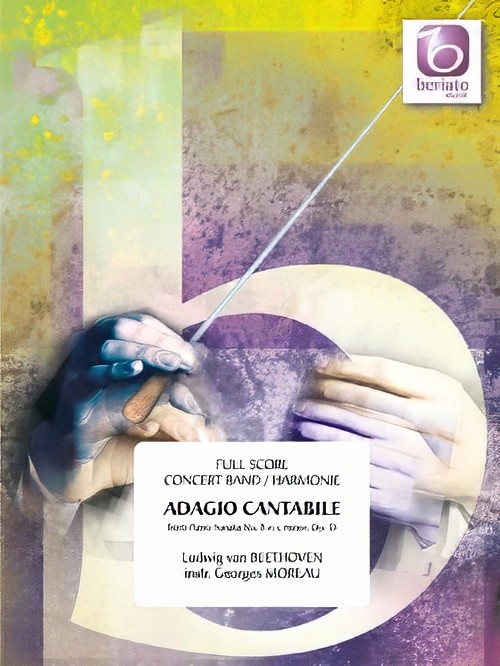
Adagio Cantabile (Concert Band - Score and Parts) - Beethoven, Ludwig van - Moreau, Georges
The beautiful 2nd movement from the Grande Sonate Pathetique (Piano Sonata No. 8 in C minor, Op. 13) de Beethoven may well be one of the most delightful solo piano pieces ever and, over the years, has been arranged for many line-ups. In this arrangement, Georges Moreau wanted to stay as close to the original as possible by giving the passionate aspect of the melody absolute priority. The very discreet accompaniment enhances this effect beautifully.Duration: 3:20
Estimated dispatch 7-14 working days
-
 £74.99
Two Norwegian Folk Tunes (Concert Band - Score and Parts) - Grieg, Edvard - Sparke, Philip
The melodies, harmonies, moods and rhythms of Norwegian folk songs and dance (even the sounds of Norwegian folk instruments) permeate the music of Edvard Grieg (1843-1907). After studying in Leipzig and Copenhagen he returned to Norway and a chance meeting with Norwegian nationalist Rikard Nordraak ignited his interest in folk music and laid the foundation for his compositional style. His most famous orchestral works are the Piano Concerto (1868) and the incidental music to Ibsen's play Peer Gynt (1875). He wrote many collections of folk music for piano and these two tunes come from his 25 Norwegian Folk Songs and Dances, Op.17.Duration: 2:10
Estimated dispatch 7-14 working days
-
 £148.00
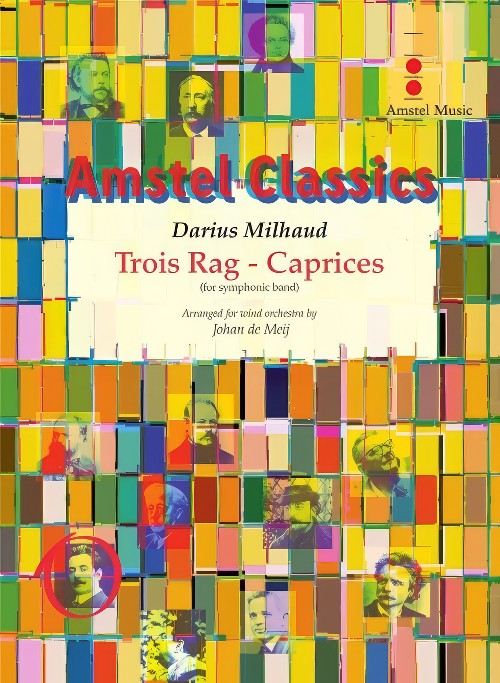
Trois Rag - Caprices (Concert Band - Score and Parts) - Milhaud, Darius - De Meij, Johan
The French composer Darius Milhaud (1892-1974) was a member of the Groupe des Six. This group of six composers gathering Honegger, Poulence, Auric, Durey, Tailleferre and Milhaud, imitated Erik Satie by revolting against the deeply rooted traditional conventions of that time. They reacted against impressionism (Debussy) and romanticism (Wagner, Mahler) and felt very strongly about the music of Satie and Stravinsky. Milhaud's most popular work is undoubtedly the ballet La Creation du Monde, one of the most striking examples of jazz influences in classical music. The premiere at the Theatre des Champs Elysees in October 1923 caused a real scandal with the Paris public. The Trois Rag-Caprices for piano were composed one year earlier, in the summer of 1922, and could be considered as a kind of preliminary sketch for La Creation du Monde. There are indeed clear similarities between both compositions as to the rhythmical and harmonic aspects. The Trois Rag-Caprices were orchestrated for symphony orchestra by Milhaud himself some time later. The same happened to Saudades do Brasil (1920), a piano composition punctuated with Latin-American influences, which was written after his stay in Rio de Janeiro (1917-18) exactly as his ballet Le Boeuf sur le Toit. Johan de Meij's orchestration of Trois Rag-Caprices for symphonic band is a most welcome addition next to the original band works of Milhaud, such as Suite Francaise (1945) and West Point Suite (1951).Duration: 8.00
Estimated dispatch 7-14 working days
 View Music