
Results
-
£109.99
From Russia with Love
A characteristic of many Russian folksongs is the emotion that they contain - sometimes exceptionally fierce, sometimes, in contrast, resigned and melancholic. This makes the music captivating and gives it its special, distinctive atmosphere. The same can also be said for From Russia with Love, in which Roland Kernen has made use of three beautiful Russian love songs. In the cheerful and stirring Kalinka, the singer tells of a girl whom he fell head over heals in love with, so much so that she is always on his mind. Lutshje Bulo is the story of a man who wants to break up with his girlfriend and in Otschi Tschornije attention is focused on a dangerous woman who can seduce many menwith her piercing black eyes.
Estimated dispatch 7-14 working days
-
 £144.99
Pierius Magnus - Jan de Haan
Pierius Magnus is a historical figure from the Friesland area of Holland. He was a farmer who became a resistance fighter against Dutch oppressors in around 1500. Whether Magnus was a hero or barbarian is still debatable, but composer Jan de Haan was fascinated by the exciting story and let it fuel his imagination. The protagonist is introduced with a capricious theme which is followed by "De Arumer Swarte Heap," the troops who took to the battlefields against the Dutch. An eerie calm takes over moments before Pier and his troops let their battle cries sound. The work ends as the disillusioned Pier retreats. A concert work overflowing with excitement!
Estimated dispatch 7-14 working days
-
£58.50
Incantation And Ritual - Brian Balmages
This fantastic work conjures images of an ancient tribal gathering. The opening's mysterious Incantation uses a soft, chant-like melody with slight intrusions by the percussion, foreshadowing the intense ritual to follow. As theopening builds, the driving beat of the ritual takes over with great fire. Percussion infuses this work with relentless energy as the piece draws to a powerful conclusion. Do not miss this one!
Estimated dispatch 7-14 working days
-
£50.50
Kilauea - Brian Balmages
Simple aleatoric passages help recreate the effect of an erupting volcano in this powerful yet extremely playable composition. Using bass drum to suggest the groaning of the volcano, the lyrical opening foreshadows the wildness of the eruption, and in transition, students play any notes and rhythms desired. As the lava begins to flow, a cacophonous ostinato appears over a menacing theme in the trumpets and low voices. In addition to the regular part, an optional advanced snare drum part is included for accomplished percussionists. The combination of styles along with exciting new sounds for young band make this a must for your next concert! (2:40)
Estimated dispatch 7-14 working days
-
£82.95
An American Spectacular
Treat your audience to this unique and incredible salute to America that provides a thorough musical history of the United States. Featuring a multitude of well-known tunes in a musical anthology, there are plenty of ways to tie this into other curriculums. Included are God Save the Queen; Chester; Hail, Columbia; Columbia, Gem of the Ocean; Shenandoah; When Johnny Comes Marching Home; The Battle Cry of Freedom; Over There and many more! The grand finale features the beloved anthem America, the Beautiful. Americana at its best!
Estimated dispatch 7-14 working days
-
 £104.99
Invocation - Marc van Delft
In this work the Dutch composer Marc van Delft attempts to bring together two parties (former friends), after they have grown inexplicably apart. For this reason he calls in the help (Invocation) from the medium of music.At first, 'Invocation' radiates a sense of serene calme, from which the composer gradually creates an atmosphere resembling a conversation.Half-way there is an increase of suspense, ending once again in calm.The listener remains uncertain, however, regarding the finish. In dit werk probeert de Nederlandse componist Marc van Delft twee partijen samen te brengen (vroegere vrienden), nadat ze op onverklaarbare wijze uit elkaar zijn gegroeid. Daaromroept hij de hulp in (Invocation) van het medium muziek. In het begin straalt 'Invocation' een gevoel van serene rust uit, waaruit de componist geleidelijk een sfeer creert die lijkt op een gesprek. Halverwege is er een toename van de spanning, die weer in rust eindigt. De luisteraar blijft echter onzeker over de afloop.
Estimated dispatch 7-14 working days
-
 £76.80
Dutch Treat - Paul Yoder
Paul Yoder is one of the big names in the history of American wind band music. He was a pioneer in teaching the developing youth bands in the USA and by spreading the modern wind band music repertoire throughout Japan. He wrote over 200 works for symphonic band. 'Dutch Treat' was composed in the early seventies and immediately published in 1971 by Molenaar, a personal friend of Paul Yoder. It is an original arrangement of a traditional tune.
Estimated dispatch 7-14 working days
-
 £245.50
Symphonie de l'Eau - Serge Lancen
This symphony was composed in 1984 and is dedicated to the great French composer Ida Gotkovsky a good friend of the Lancen family. It was the test piece in the Seccion Primera of the famous Spanish wind band contest Certamen International de Bandes de Msica Ciudad de Valncia and was recorded by the Symphonic Band of the Maastricht Conservatory of Music conducted by Sef Pijpers. Serge Lancen himself related the genesis of this symphony as follows:When I was twelve years old I had started composing a piece which described the cycle of the water. The project was however abandoned and only some themes were left unused. In July 1983, I went by boat to the WASBE conference in Skien, Norway and was seduced by the North Sea. During the travel a musical theme was born and was the trigger for the realisation of my ancient project which I still fancied'. The 'Symphonie de l'Eau' is in fact a musical description of the cycle of the water which the composer defines as follows:'A slight mist rises and turns into a cloud. Water drops fall on the mountain. A brooklet rises and clears a way throughout the alpine pastures. Soon other small watercourses join the original brook that is now reinforced as to become a real roaring mountain river falling in a lake amidst a quiet and poetic surrounding. The water turns again into a river when leaving the lake and gradually becomes a big stream which majestically flows towards the sea. A slight mist is rising from the huge surface and so the cycle of the water starts all over again.
Estimated dispatch 7-14 working days
-
 £61.00
Salve Maria - Saverio Mercadente
The Italian composer Saverio Mercadante (1795-1870) was highly estimated by his contemporaries, even Liszt and Rossini praised him much. He wrote over 60 operas and was one of the 19th century operacomposers whose works were most often performed. 'Salve Maria' was originally a religious song dating from 1864. Mercadante was also fascinated by instrumental music and so he arranged a lot of his opera arias and several songs for solo instruments with orchestral accompaniment.
Estimated dispatch 7-14 working days
-
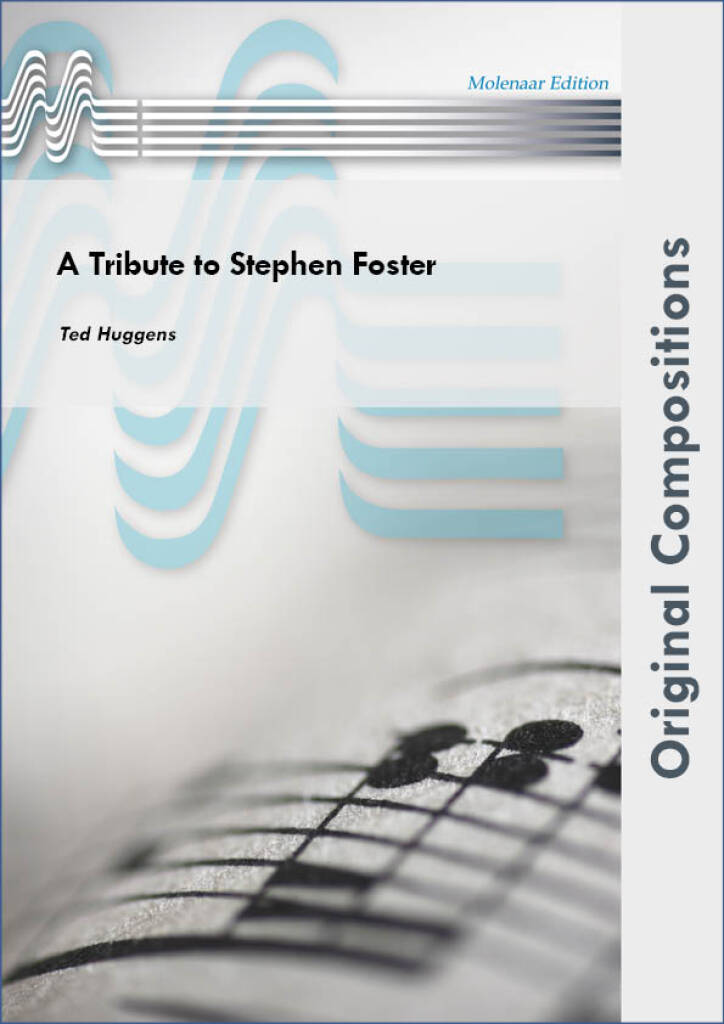 £113.50
A Tribute to Stephen Foster - Ted Huggens
The songs composed by the American composer Stephen Foster have been 'evergreens' for over a hundred years now. In this selection we can hear successively: 'Jeannie with the light brown hair', 'Oh, Susanna', 'My old Kentucky home', 'Old folks at home', 'Beautiful Dreamer' and 'Campton Races'.
Estimated dispatch 7-14 working days
 View Music