
Results
-
£16.50
Stai si, defenda! (Stand Up and Defend) - Score only
Stai si, defenda romontsch, tiu vegl lungatg (Stand up, defend your old Romansh language): This composition was named after a quotation from a poem by famous Romansh poet Giachen Casper Muoth. The arrangement deals with various well known songs for male choir such as A Trun sut igl ischi (In Trun under the malpe tree), Si sededesta Rezia (Wake up, land of Raetia), Il pur suveran (The independent farmer) or Il paun palus (The rosted bread). An atmospheric beginning over a pedal point uses quotations from these songs and leads eventually into a dark but warmly orchestrated section on Nossa viarva (Our language) by H. Erni. The piece ends, once more quoting A Trun sut igl ischi by J. Heim, a dedication to struggle for freedom and independence.
Estimated dispatch 7-14 working days
-
 £8.78
£8.78Alfred's Basic Piano Library: Lesson Book 2: Piano Book - Willard A. Palmer, Morton Manus, and Amanda Vick Lethco
This easy step-by-step method emphasizes correct playing habits and note reading through interval recognition. Lesson Book 2 continues where Level 1B finishes. This book introduces dotted half notes and dotted quarter notes, plus intervals of 6ths, 7ths and octaves. Teaches greater movement of the hands, including crossing two over one and scalework. Students will also learn more about triads, primary chords, and blocked and broken chords. Songs Include: 18th Century Dance * Alouette * Blue Scales * Calypso Carnival * The Can-Can * Cockles and Mussels * The Galway Piper * Get Away! * Got Lotsa Rhythm * Kum-ba-yah! * Lavender's Blue * London Bridge * Lone Star Waltz * Malaguena * Nick Nack Paddy Wack * Ode to Joy * Oh! Susanna! * On the Bridge at Avignon * Our Special Waltz * Prelude * Red River Valley * Sarasponda * Square Dance * When You Grow Up * Why Am I Blue?
Estimated dispatch 3-5 working days
-
 £37.78
Adoration (Trumpet Solo with Wind Band) Florence Price trs. John Hanchett
Florence Price was an American classical composer, pianist, organist and music teacher. She is noted as the first African-American woman to be recognised as a symphonic composer, and the first to have a composition played by a major orchestra. Price composed over 300 works: four symphonies, four concertos, as well as choral works, art songs, chamber music and music for solo instruments. In 2009, a substantial collection of her works and papers that had been previously considered lost was found in her abandoned summer home. Amongst these was this delightful work, Adoration, which had been composed in the 1950s for organ. According to IMSLP.org, the piece "failed to meet notice or renewal requirements to secure statutory copyright with no 'restoration' under the GATT amendments" and therefore is in the public domain. A version for violin and piano by Elaine Fine has become popular. This setting for trumpet soloist with wind band has been arranged by John Hanchett. Also available as: Bb Solo with Piano Cornet Solo with Brass Band To view a video of Andrew Roe performing the work (brass band version), please visit: www.youtube.com/watch?v=_7UYlz8Fzxo Difficulty Level: Medium Easy (Grade 3) Length: 3.15 minutes Sheet music available from: UK - www.wind-band-music.co.uk USA - https://satradecentral.org
In stock: Estimated dispatch 1-3 days
-
£125.00
Shakespeare Pictures - Nigel Hess
While Music Director and House Composer for the Royal Shakespeare Company, Nigel Hess wrote music for over twenty productions. Hess has taken music from three works to form a 12-minute suite called Shakespeare Pictures. It begins with the boisterous overture to Much Ado About Nothing, followed by a contrasting slow movement depicting the beautiful statue from A Winter's Tale before displaying huge pomp of Caesar's Rome with The Entry to the Senate. This work is ideal for bands that have played and enjoyed Hess's work East Coast Pictures. This wind band suite was commissioned in 2008 by Birmingham Symphonic Winds. The original music is now expanded and re-orchestrated to form a new three-movement suite for symphonic wind orchestra.
In stock: Estimated delivery 1-3 days
-
£90.00
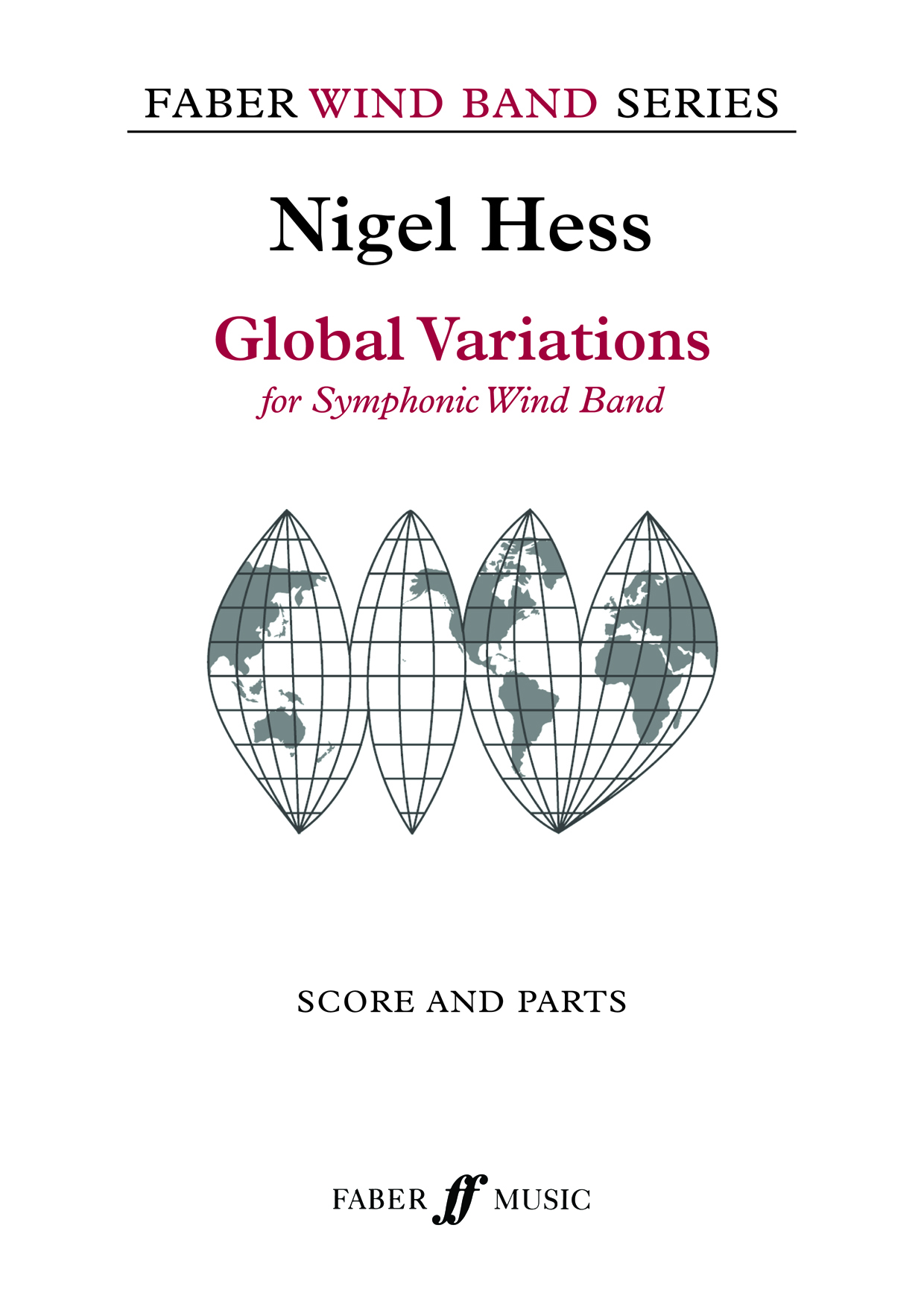
Global Variations - Nigel Hess
Around the world in just over eight minutes! Although commissioned for a Youth Band, no concessions are made here for lack of technical ability, particularly in the percussion department. The chimes of Big Ben herald the start of a whistle-stop global journey, calling in turn at France, Spain, South Africa, Egypt, Russia, India, China, Australia, South America, and the USA, with a final detour through Ireland and Scotland before hearing Big Ben once more as we arrive home!
In stock: Estimated delivery 1-3 days
-
 £48.95
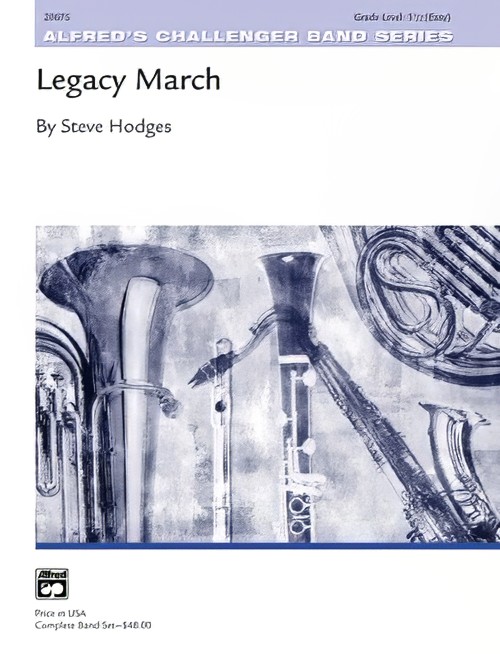
Legacy March (Concert Band - Score and Parts) - Hodges, Steve
You'll find yourself humming this catchy march over and over! Beginning with a fanfare in the trumpets, horns, and saxophones, the low brass soon enters followed by the woodwinds playing a countermelody. The march tune is introduced by the trumpets and saxes, then turned over to the winds. The B section brings a quieter mood, followed by a return of the A theme with a brief coda that brings the piece to a grandiose conclusion. A fantastic addition to the march repertoire. Duration: 2.45
Estimated dispatch 7-14 working days
-
 £179.90
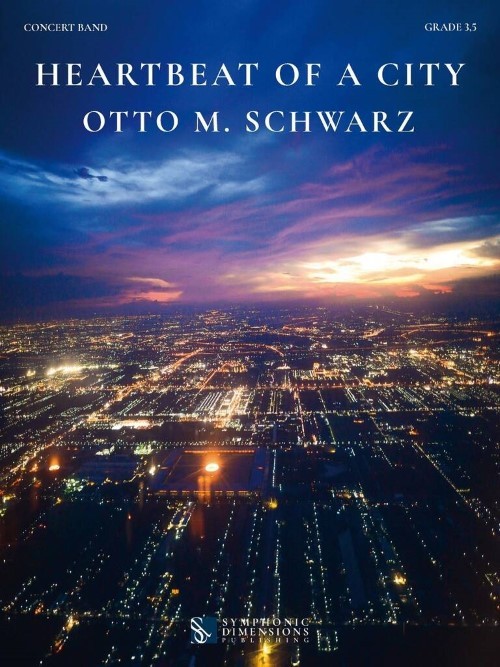
Heartbeat of a City (Concert Band - Score and Parts) - Schwarz, Otto M.
A city is founded, it has a heart that beats. But visible achievements such as buildings and infrastructure merely bear witness to what its true heart is made of, the people who have lived, and still live, in the city. The pulse of the city, brought to life by its heartbeat, changes over time. Who hasn't seen those time-lapse images showing twinkling lines of car lights as people make their way to work, while others stand at traffic lights, only moving as if at the push of a button? These are like life flowing in the veins, driven by a strong heart. Leonardo da Vinci had already imagined the rivers as the blood vessels of the Earth. In any city, though, it's not the rivers but the movement and activities of the people who live there. The heart doesn't always beat steadily, however, but its rhythm can be influenced by joy, fear, and many other things. Every city has its own pulse. This is also true of the university city of Marburg, where people from over 100 nations now live together in a cosmopolitan and tolerant community. This work describes the city from its founding in 1222, and the charity of Saint Elizabeth, all the way to the present day.Duration: 9.15
Estimated dispatch 7-14 working days
-
 £141.99
Pulcinella (Euphonium Solo with Concert Band - Score and Parts) - Sparke, Philip
Pulcinella was commissioned by the Taiwanese euphonium player Tzu-Hsiang Lin. Lin is a renowned soloist and teacher and a Besson Euphonium Artist. He teaches euphonium at Taipei National University of the Arts, National Taiwan University of Arts, Shih Chien University and National Kaohsiung Normal University. Lin gave the premiere of Pulcinella in both its concert band and brass band versions in January 2021. Pulcinella continues Sparke's series of euphonium solos named after characters of the Italian commedia dell'arte and opens with a long and expressive minor melody for the soloist over a brooding accompaniment. This is taken up briefly by the full band and is extended by the soloist after a change of key. A cadenza, accompanied by fragments of the main melody leads to a complete change of mood, tempo and tonality, introducing a Vivo section starting with a perky syncopated tune for the soloist. The band then uses elements of this new tune to introduce a change of key, where the soloist introduces a more lyrical second subject over a pulsing accompaniment. The band then takes this up and changes key to reintroduce the original Vivo melody, which leads to a short and acrobatic coda to bring the work to a spectacular close. Duration: 6.45
Estimated dispatch 7-14 working days
-
 £109.99
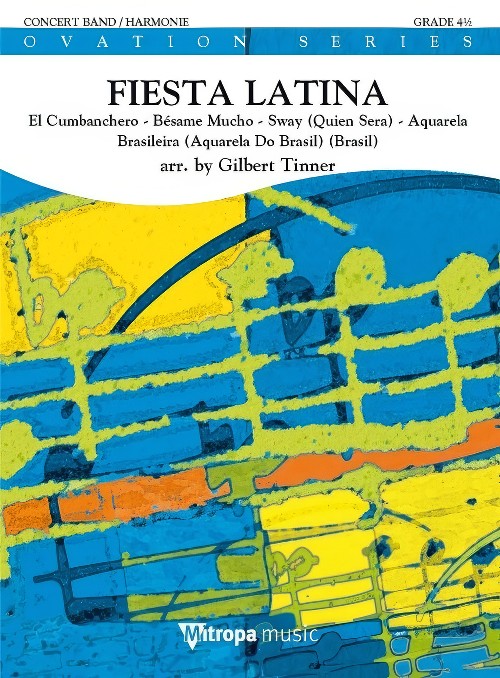
Fiesta Latina (Concert Band - Score and Parts) - Tinner, Gilbert
Over and over, Gilbert Tinner has proven himself to be a top arranger and once again he has managed to create a medley in Latin style that will thrill both young and old alike. The tunes El Cumbanchero, B?same Mucho, Sway (Quien Sera) and Aquarela Brasileira (Aquarela Do Brasil) (Brasil) evoke a sultry, tropical atmosphere, and form the ideal basis for an unforgettable musical fiesta! Duration: 7.15
Estimated dispatch 7-14 working days
-
 £45.00
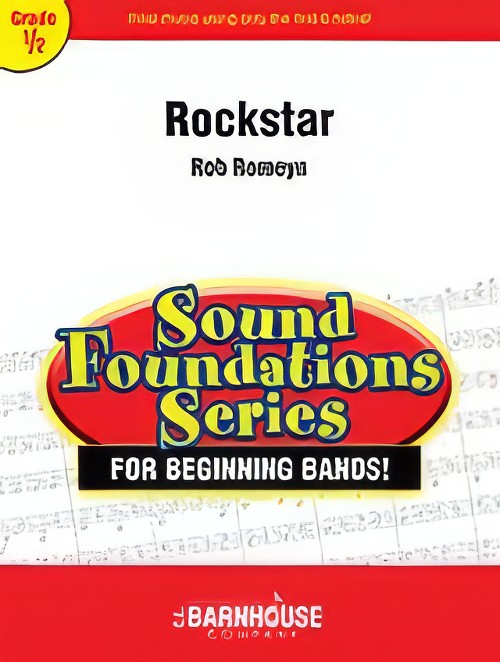
Rockstar (Concert Band - Score and Parts) - Romeyn, Rob
Your beginning band will really shine with this fun and engaging tune! "Rockstar" has it all: a fun drum groove, catchy melody, and a harmonic accompaniment that provides the drive to keep it all together - all this while using only the first six notes learned in band instruction. You'll want to save this one for the end of rehearsal, as students will want to play it over and over. Perfect for school assemblies and pep rallies. Rock on!! Duration: 1.50
Estimated dispatch 7-14 working days
 View Music