
Results
-
 £149.40
The Battle of the Hats - Øystein Sjøvaag Heimdal
The word svimesltt, which is the title of this piece in Norwegian, has two meanings. One meaning is "knocked out", whilst the other, "sltt", means a folk melody/dance.Svimesltt is one of several folk dances, all of them with humorous titles, originally written by ystein Olsen Vadsten. Norwegian culture is the basis for these dances, both rhythmically and melodically. The accompaniment has brought this funpiece into the 21st Century.When it comes to Svimesltt, it is the traditional dance "halling" that is the inspiration. Halling is a rather wild dance, where the man tries to win the heart of a lady by attempting to kick a hat off a stick,held up in the air. This iswhere "The Battle of the Hats" gets its distinctive name A truly Norwegian tradition.The composer wanted to write a "crazy" melody, which highlights how "knocked out" a man can be by love, as he tries to win the chosen ones heart.
Estimated dispatch 7-14 working days
-
 £137.99
Theme Park Fun! - Wilco Moerman
In Theme Park Fun! your orchestra pays a visit to an amusement park. During your visit, you will experience some spectacular rides and attractions this theme park offers. The uniqueness of Theme Park Fun! is the interplay between music and(moving) images. Animations and illustrations support the visual composition.Part 1: The Entrance & Parade [with animation]The opening of the park is a fact. A day full of fun and pleasure awaits! You and the other visitors willbe confronted with all the rides, attractions and adventures the theme park has to offer. Which ride shall we do first?! There is so much to do and experience on this day in the park! A parade of colorful floats and park figures is passing by.Letthe fun begin!Part 2: The Haunted House [with animation]The only ride in the park that is not related to fun, is the Haunted House. Here visitors will be challenged to visit a house full of ghosts, creepy figures and otherominous things. The clock strikes twelve, there is no turning back. Ghosts are whispering, yelling, screaming... Fortunately it is almost one oclock, so we can leave this creepy place quickly.Part 3: The Swinging Galleon [withillustrations]What a huge pirate ship! Each time you swing back and forth, you will feel that weird feeling in your stomach. When you are thrown completely into the top you will have a fantastic view over the park, but you can not enjoy itfor long. Before you know the ship swings back the other way.Part 4: The Fairy Tale Ride [with illustrations]After all those exciting and spectacular rides and attractions, it is time for a peaceful tour in The Fairy Tale Ride.Surrounded by a fairytale setting, you will discover fable figures, talking animals and colorful designs. Such a beauty and tranquility. Having had this experience, we are ready again for the big rides in the park!Part 5: The Bumper Cars[with illustrations]Now its time to crawl behind the wheel of the Bumper Cars! Shall we all chase the conductor?! Before you know you are hit by another visitor or you will bump against someone else. In this tough ride you can prove yourselfas a real driver, or perhaps as a really bad one.Part 6: The Roller Coaster [with illustrations]The largest, fastest and scariest ride in the park ... we should definitely do the Roller Coaster! All together in the train, theover-the-shoulder restraints are lowering... be ready to ride. The train leaves the station and is heading for the big lift hill. It will be very scary when the train reaches the top and the train will be plunged down the first drop! Loops,corkscrews and other spectacular coaster elements will follow... Before you know it, the ride of your life is over. Shall we ride it again?!Part 7: Leaving the Park [with animation]Unfortunately everything comes to an end. Thisday in the theme park is over, but we have a lot new experiences to talk about! The memories of all the funny and spectacular rides will come up when we walk through the park to the exit. Just one look over the shoulder, the amusement park figuresare waving at us. Hopefully we will come back again soon!
Estimated dispatch 7-14 working days
-
 £75.50
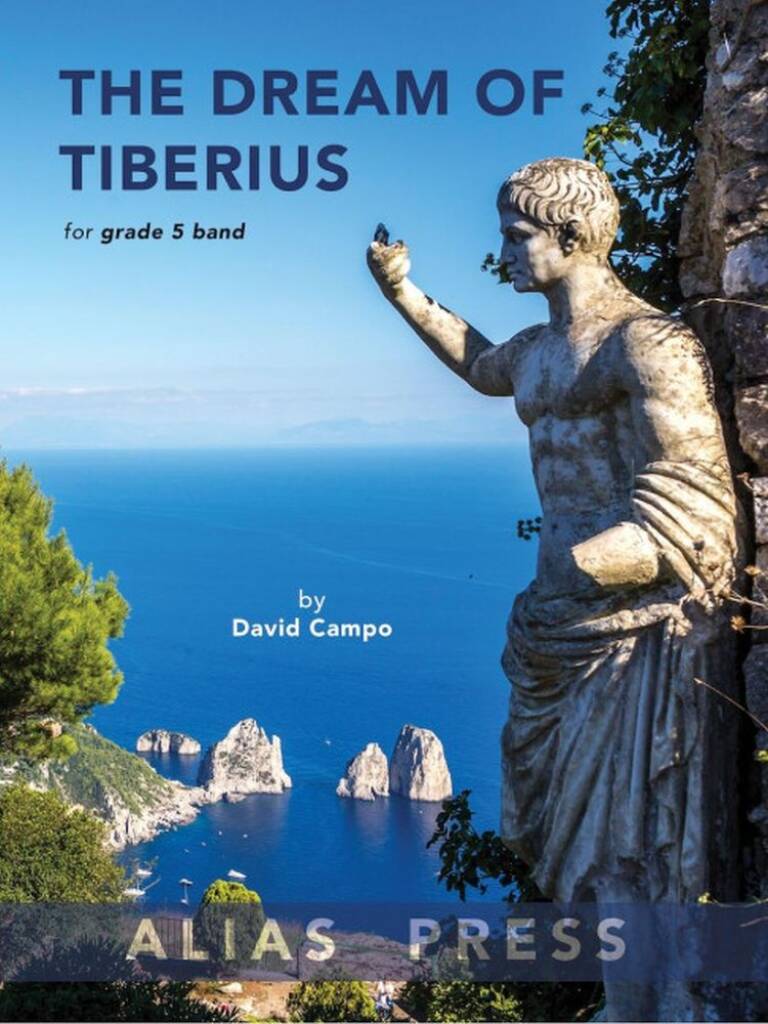
The Dream of Tiberius - David Campo
The Roman Emperor Tiberius was born in 42 BCE to Tiberius Claudius Nero and Livia Drusilla, both descendants of prestigious political families, at a time when Rome was undergoing significant political upheaval. Julius Caesar had begun a brutal civil war in 49 BCE to end Rome's rule as a Republic and consolidate his power as supreme ruler. Following Caeser's assassination in 44 BCE, Tiberius' father backed the forces wishing to return Rome to a Republic, but they were defeated by Caesarian loyalists led by Caeser's heir Octavian. As a result, Tiberius' early life was spent on the run and in political exile with his parents. In 27 BCE, Octavian would become the first Emporer of Rome and assume the name Augustus. Augustus forced Tiberius' parents to divorce and took Tiberius' mother as his new bride, separating the family and forcing Tiberius to live with his father. Upon his father's death, Tiberius went to live with his mother and Emporer Augustus, a situation Tiberius found extremely uncomfortable but one over which he had no control. Having been adopted by the Emperor, Tiberius assumed the military and political life thrust upon him. He proved to be an outstanding military and political leader, and with his marriage to Vipsania Agrippina his life took on a heretofore unknown stability. However, Augustus would intervene in Tiberius' life once more, forcing him to abandon his happy marriage and take Augustus' daughter Julia (Tiberius' step sister) as his new wife. This arrangement, while securing Tiberius' place as Augustus' heir and ensuring he would one day be Emperor of Rome, was disastrous. Julia's drunken licentiousness was a constant source of scandal and embarrassment for Tiberius (and her father, the Emperor) and she was eventually exiled by her father Augustus. Tiberius was named Emperor of Rome upon the death of Augustus in AD 14, assuming his position as the most powerful man on Earth. However, no matter how powerful he had become, Tiberius never felt as if he had ever had any control over his life, having been manipulated from childhood through adulthood by the whims of Augustus. As Emperor, he soon became disgusted with the political intrigue of the Roman Senate and by AD 26 left Rome and took up residence on the island of Capri, where he lived out the rest of his life. History does not regard Tiberius fondly and by all accounts towards the end of his reclusive life on Capri, he had become a miserable, sick and mentally unstable old man reveling in debauchery and cruelty. It is also informative to note that he was Emperor of Rome when Jesus of Nazareth was crucified, and while there is no indication that Tiberius was even aware of the existence of Jesus, as Emperor he was responsible for the appointment of Pontius Pilate as Governor of Judea. Even considering this, it is difficult to look on the life of the Emperor Tiberius and not feel some sympathy and pity. It's in this spirit that I composed "The Dream of Tiberius." I imagine the man sitting in thoughtful seclusion on the beautiful island of Capri imagining what his life might have happily been had not power been thrust upon him: husband, father and humble servant of the people.
Estimated dispatch 7-14 working days
-
 £149.99
Moses and Ramses - Satoshi Yagisawa
This piece was commissioned by Matsudo Citizen Wind Orchestra for their 30th anniversary concert and premired by the band conducted by Kenichiro Hasunuma in July 2009. This piece is typical of Satoshi Yagisawa in that it depicts a magnificent spectacle. This one is set in ancient Egypt and is based on the story depicted in the famous film "The Ten Commandments" (1956, directed by Cecil B. DeMille). One day Moses, who was raised by the rich royal family, found out that he was originally Hebrew. The Hebrews had been forced to live as slaves. Ramses, the prince directly descended from the Pharaoh, envied Moses' strength and popularity. After internal argument Moses decides todeliver the Hebrew from the Pharaoh's tyranny and escape from Egypt with them.The music starts with brilliant royal fanfare and depicts magnificent architecture, the Hebrew people forced into hard labour, and the slaves escaping from the Pharaoh's tyranny. At the climax they are at crisis point, trapped by the sea. Moses waves his staff and the miracle happens; the sea parts and Hebrew people successfully escape. Following on from Perseus - A Hero's Quest in the Heavens, this work Moses and Ramses is another piece written in the dramatic style favoured by Satoshi Yagisawa.
Estimated dispatch 7-14 working days
-
 £140.80
Belvedere Suite - Wilhelm Koenen
Part One: 'Danse mditerranenne'This part is composed of stylized folkmusic elements from several regions of Mediterra-nean countries. If this music recalls memories of your holidays on the sunny beaches, the composer will have reached his goal.Part Two: 'Impression'This part is meant as a contrast with the first and the third parts. The conductor should not stick to the metronome tempo, but he can express his own interpretation by means of 'rubato playing'. This 'impression' was inspired by the Provence landscape.Part Three: 'Marche grotesque'We deliberately used non-typical characteristics of the traditional march. The underlying idea is: A band starts playing a march at the ordinary marching tempo. There is already a mistake at measure 4 when some musicians play the wrong bar which causes the fifers to start too early with the drum and fife signals. A grumpy 'Stop' brings and end to the false start by means of a pathetic quaver (eighth note). The drummers however continue to play their drum beats, so the fifers start again and play very quickly in order to catch up with the drummers. They even manage to do so, thanks to that late quaver (eighth note). The band now also starts to play again and reacts to this chaos by laughter. The march that comes next does not match the metric characteristics of the usual march. The woodwinds, dreaming of holidays, get caught in a Tarantella. A compelling signal by the trumpets and the horns, soon joined by all band registers, leads the band back to reality. We deliberately chose well-known 'secondary parts' in order to make the audience accept the 'out-of-tune playing'. Original themes would not have had the same effect. The whole composition is just one great musical joke. If the audiance chuckles the composer will have achieved his aim. The third part is extremely well suited to end a concert or to be used as encore.
Estimated dispatch 7-14 working days
-
 £110.00
Mount Everest - Kees Vlak
This composition basically consists of three fragments and an epilogue (conclusion):1) Plateaux, 2) Sherpas, 3) Climb. The piece starts with a musical depiction of the deserted plateauxs and mountain peaks of the Himalayas. The mysteriousness of theTibetan country was caused by its inaccessibility to other nations. One even believed that there was a paradise behind the huge mountains; the land of Shangra La. 1) After the sound of a gong, the Asian-like theme arises extremely softly from thedecay of the percussion. In bars 4 and 5 the syllables of Hi-ma-la-ya echo. Then a second theme appears; it symbolises the enchantment of the mountaineers by seeing the Mount Everest. 2) Eastern percussion, very evenly without emotion, sound from thedeserted village of the sherpas. The phrasing is prescribed by the number 'three'. From measure 56 Tibetian monks sing a chant, also with the religious background of the number 'three'. 3) The third part starts of with the sight of the giant MountEverest with an entirely new theme, that is played impressively by the strong low brass instruments of the band, immediately followed by the excited big climbing. The many surprises are depicted by the changing time signatures. Two themes are inconstant battle; the binary Himalaya theme and the ternary Mount Everest theme. Only once there is a steely composure. The registers in which the piece is played increase. The tension rises...Then the peak is reached. A long pause follows before onerealises that one is on top of the world. Slowly the emotions of joy grow and lead to an enormous climax. The first enchanted theme sounds again in total glory.
Estimated dispatch 7-14 working days
-
 £435.40
Goldberg 2012 - Svein H. Giske
The first time I heard Bach's Goldberg Variations was in the movie Silence of the lambs, in the early 1990s. I noticed the beautiful background music in one of the scenes, but at that time I didn't know what it was. A few years later, when I was studiying at the Grieg Academy, I got to know the entire piece. For me, this is a piece of music which I can listen to countless times. I think it sounds as fresh today as it did more than 15 years ago and it never ceases to inspire me. Both Bach's composition and Glenn Gould's famous 1955 recording (which was the first one I heard) still makes a great impression on me. Before Gould recorded it at age 22, it wasn't a highly ranked piece amongst pianists and Bach was by many viewed as a bit old-fashioned. The young Canadian turned all this around. He managed to portray Bach in a reformed way, producing fine nuances in phrasing and making the many layers in Bach's music more transparent than anyone before him. Thus he plunged both himself and Bach (back) onto the international music scene. When The Norwegian Band Federation (NMF) asked me to write the test piece for NM in 2012, it was only natural for me to use the Goldberg Variations as a starting point and inspiration for my work. Since I was a teenager at NMF's summer courses in the mid eighties I've always listened to many different styles of music. Growing up in Sunnmre with the Brazz Brothers as teachers and mentors, jazz-, pop/rock- and folk music were early on a natural part of my musical background. I also have my classical education from the Grieg Academy on trumpet. As the title of my piece implies, I've wanted to bring Bach to the present and put his music into various modern musical landscapes. I think you can bring about a special kind of energy when music from different genres are mixed and I've tried to do this by mixing Bach with artists and musical styles from the present. In Goldberg 2012, the music is often constructed by several layers, which in a way are living parallel musical lives. They are seemingly moving or floating freely, almost unaware of each other, but bound together by the same basic pulse. The rythms, however, are often notated on a different rythmic subdivision level than the usual 8th- or 16th note levels. By doing this, I hope to achieve transparent sounds that rythmically are perceived as more free and detached from each other. In large sections of the piece, pop/jazz is fusioned with elements from Bach. I guess you could have this little scene as a synopsis for the piece: picture a group of musicians meeting: some are classical performers, some are jazz. They start to improvise together, each in their own voice or musical dialect and I'm sort of in the middle, trying to write down what they are playing. This is what I feel much of Goldberg 2012 is about. The foundation of the piece, in addition to Bach and references from pop/jazz music, lies also in my own material. This material, basically two chords, is heard in it's purest form in the 1st movement. I use these chords to create scales, new chords and different motifs which contribute to blend together the different moods of the piece. It has not been my intention to copy Bach's form (theme and 30 variations), but rather to use the bits and pieces that I like the most as an inspiration for my own variations. The 1st movement, Aria 2, is for my 3rd son, Olav, who was born on the 21st of April 2011, and the 5th movement, From long ago, is dedicated to the memory of my father, Svein J. Giske, who passed away on the 6th of June 2011. -Svein H. Giske, January 2012-
Estimated dispatch 7-14 working days
-
 £138.00
The Saints And the Royal - Eric Swiggers
The Saints and the Royal was composed on behalf of Royal brass band St. Willibrord Heeswijk on the occasion of its 200th anniversary in 2023.When the marching band was founded in 1823, it was given the name "Harmonie Sint Cecilia," referring to Saint Cecilia, the patron saint of music. Around 1904, the name was changed to 'Kerkelijke fanfare Willibrord', strongly emphasizing the connection with the church in Heeswijk, of which Saint Willibrord is the patron saint. In 1973, at its 150th anniversary, the band received the predicate 'royal'. From that time on one speaks of the Royal brass band Saint Willibrord.The composition musically depicts both Saints Saint Cecilia and Saint Willibrord and the jubilee royal brass band. Although one of the oldest musical societies in the Netherlands, this fanfare is alive and kicking and will celebrate its 200th anniversary in 2023. The composition therefore opens festively and energetically. The alto saxophone plays a recitative, the Gregorian "Cantantibus organis Caecilia virgo in corde suo soli domino decantabat" from the vespers of the feast day of Saint Caecilia, the patron saint of music. This is taken over by the full wood and soft brass group. After a brief, playful interlude, this chant is played by the full orchestra, like an organ, larded with circumambulations.St. Willibord was born in England but made the crossing to the Netherlands in 690 to preach the gospel as a missionary. This was far from harmless and he faced frequent uprisings. After his death he was buried in Echternach in Luxembourg. In this place he is commemorated to this day with the annual "Spring Procession" or "Dance Procession". This procession of Echternach went as follows until 1947: 3 steps forward, 2 steps backward. Hence we hear this procession back in a 5/8 measure: 3 + 2.After this procession, the Gregorian vesper of Sint Caecilia sounds one more time, leading the composition to a reprise of the opening: The jubilee Royal Fanfare Sint Willibord Heeswijk.
Estimated dispatch 7-14 working days
-
 £134.99
Cleopatra - Thierry Deleruyelle
Queen Cleopatra ruled Egypt for over 20 years. She is one of antiquity's best-known women, in particular because of her relationships with Julius Caesar and, above all, Mark-Anthony, but also because the cause of her death remains a mystery. The work is split into three parts and performed without breaks. The first section begins with a bright introduction representing Mark-Anthony. Dynamic in nature and reminiscent of military music, this characterises the Roman general. But soon after, another theme emerges, softer and more melodic, symbolising Cleopatra's femininity. The two characters then combine on a faster tempo. The middle section of the work depicts the love that Mark-Anthony and Cleopatra feel for each other. This passionate relationship lasted ten years and produced three children. This is expressed by a warm and intense theme, just like the beauty of the Egyptian queen. The third and last section opens in a determined and military mood. Mark-Anthony and Cleopatra were often apart, the Roman general was often away on a campaign. They met up in Alexandria to celebrate their triumph. But, as the targets of the jealousy and ambition of Octavius, Julius Caesar's son, the lovers are trapped and await the inevitable conquest of Egypt by the Romans. When Mark-Anthony heard the false news that Cleopatra had committed suicide, he ended his own life. The Queen of Egypt, for her part, was imprisoned shortly afterwards. The two lovers remain one of History's most famous couples. This piece was commissioned by the Wind Orchestra of the town of Antony, near Paris, directed by Philippe Rossignol, to mark its 90th anniversary.
Estimated dispatch 7-14 working days
-
 £100.00
The Pageant of London - Frank Bridge
Frank Bridge was one of the finest English composers of the first half of the 20th century. The Pageant of London is his only work for wind band, comprising of two marches, one scored from Bridge's best known organ piece and including the chimes ofBig Ben, plus three short renaissance pastiche items, one arranged from Playford (later used by Peter Warlock in Capriol Suite). The music is tuneful, approachable and, in the words of wind band 'legend' Timothy Reynish makes a fine alternative toHolst's two suites, which were composed around the same time. Reynish has introduced this work to concert bands right across the world. It has been performed in USA and the Far East, recorded by the celebrated Kosei Wind Orchestra of Japan and alsoby the BBC National Orchestra of Wales in the Chandos edition of Bridge Orchestral Music.
Estimated dispatch 7-14 working days
 View Music