
Results
-
 £104.50
March For A Pageant - Rex Mitchell
This ceremonial march was commissioned by the North Hills High School Band of Pittsburgh, PA. The work opens with the customary percussion and brass marcato, which leads into the theme played by the cornets. Interesting lyrical counter-melodies are written for the woodwinds with the entire band concluding the work in an exciting fanfare ending. An outstanding choice for processionals, pageants or contests.
Estimated dispatch 7-14 working days
-
£82.50
A Soldiers March - Robert Cronin
The winner of the first National Band Association/Merrill Jones Composition Award in 1992, this exceptional work is in a traditional, through-composed, dignified march style.
Estimated dispatch 7-14 working days
-
 £71.50
Processional March - David Gorham
This stately processional march is reminiscent of the great coronation marches in band and orchestra repertoire. (2:25)
Estimated dispatch 7-14 working days
-
 £82.50
Lawrence Sesquicentennial March - Robert E. Foster
Written to commemorate the 150th birthday for the city of Lawrence, Kansas, this is a new march in a traditional style. (2:45)
Estimated dispatch 7-14 working days
-
 £121.00
Prologue and March (From Ballet Music) - Walter S. Hartley
Transcribed for concert band from Hartleys earlier Ballet Music. A brief prologue moves into a bright, flashy march that allows each section of the ensemble to have a moment in the sun.
Estimated dispatch 7-14 working days
-
 £204.00
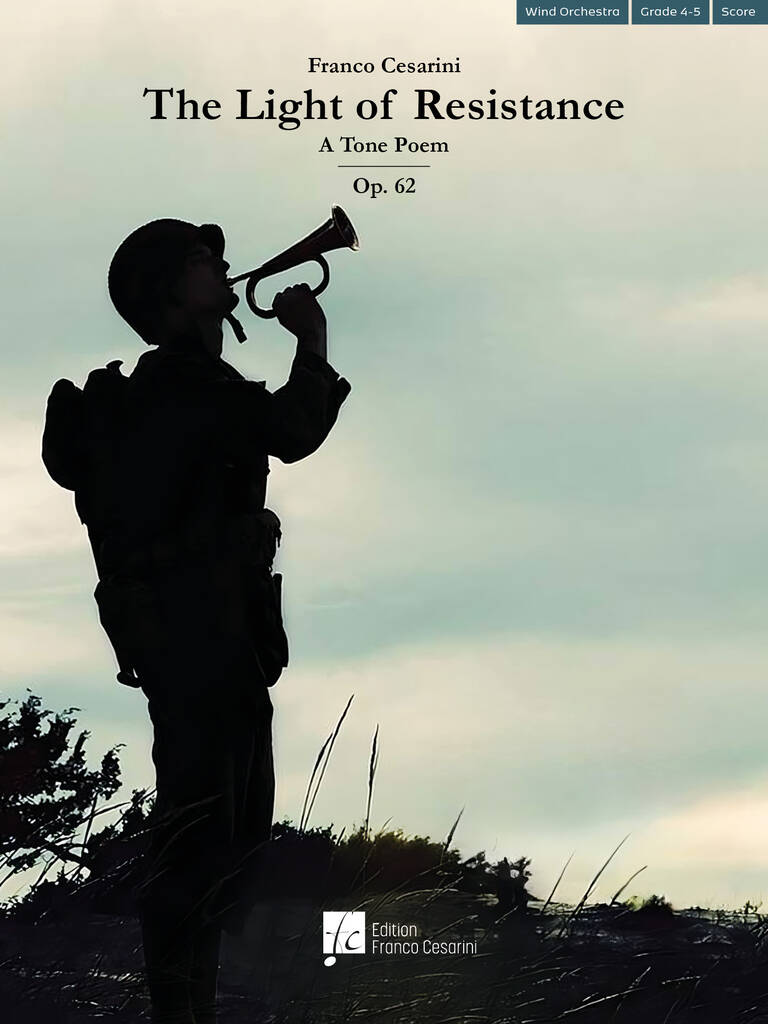
The Light of Resistance - Franco Cesarini
Franco Cesarini was commissioned to write The Light of Resistance by the Filarmonica di Villadossola APS (Piedmont, Italy) for its 125th anniversary. The Villadossola revolt was an uprising that took place in November 1943 in the homonymous municipality during World War II. The partisans, with the support of local workers, managed to temporarily liberate the town from nazi-fascist forces. It was one of the first acts of armed resistance against the German occupation in Italy but was harshly repressed by nazi-fascist troops who regained control of the territory. Although it was suppressed, the uprising remained a symbol of courage and determination.The slow introduction of the composition creates an atmosphere of latent tension, which gradually intensifies until it explodes in a rapid movement, symbolizing the struggle. Two contrasting musical themes collide, embodying the conflict between opposing forces. In the central section, a prayer rises delicately, then evolves into a heroic parade celebrating the temporary triumph of the revolt. However, this victory is fleeting; dissonant harmonies interrupt the scene, representing the brutal repression of the insurrection. In the finale, the heroic theme reemerges, evoking sacrifice as a spark of unshakeable hope. A moment of contemplation closes the composition, honouring the lives broken and reaffirming hope for a future of peace and regained freedom.The premiere of The Light of Resistance took place on 30th March, 2025 in Villadossola, performed by the Filarmonica di Villadossola, Franco Cesarini conductor.
Estimated dispatch 7-14 working days
-
 £76.80
Dance of the Clowns - Pyotr Ilyich Tchaikovsky
After the overwhelming success of his 'Second Symphony' Pjotr Tschaikowsky (Votkinsk 1840 - Saint-Petersburg 1893) got a request of the Imperial Theatre in Moscow early in 1873 to compose the stage music to the play 'Snegourotchka' (translated as 'The Snow Maiden', 'Snow White' or 'Snowflakes') which was to be written by Alexander Ostrovski, the greatest Russian playwright of that period. The wage of 350 rubles was particularly welcome to the young composer who completed the work in only three weeks time (between the middle of March and the 6th of April) before Ostrovsky finished his libretto. The first performance was given at the Moscow Bolshoi Theatre on 23rd May, 1873 was very successful and since then the work remained on the Russian orchestral repertoire as a concert suite. The suite consists of 19 parts that incorporate twelve authentic Russian folksongs. The 'Dance of the Jesters' (sometimes called 'Dance of the Buffoons') is number 13 and appears in Act 3 as part of the carnival music; it suggests the joyful atmosphere of popular festivals.
Estimated dispatch 7-14 working days
-
 £91.99
Guardians of the Waves - Philip Sparke
Guardians of the Waves was commissioned by the Japan Coast Guard Band to celebrate their 30th anniversary in 2018. They gave the premiere as part of a 30th anniversary concert on November 8th that year. Set in traditional march form, Guardians of the Waves opens with a short introduction, which leads to the main theme, played initially by the brass and then repeated with a florid woodwind descant. The theme is extended and morphs into a second theme, first played tutti and then quietly repeated by bassoon, tenor sax and euphonium. This leads to a conventional 'bass strain', played twice with varying accompaniments. A quieter trio section follows, delicately scored and featuring the tenor instruments of the band. Taken up by the full band, this leads back to a recall of the introduction and a return to the main two themes, which lead to a triumphal close.Recorded by the Kobe College Wind Orchestra and its conductor Osama Matsuura
Estimated dispatch 7-14 working days
-
 £85.50
Bonds of Unity - Karl L. King
A must have of James Swearingen's arrangement of King's classic "Bonds of Unity" March. While not difficult, this is one of King's nicest marches and is an excellent selection for concert, festival, or contest use by bands of all levels. This James Swearingen arrangement of "Bonds of Unity" is one of the best.
Estimated dispatch 7-14 working days
-
£78.99
Battle Of The Winds - Duble
If you've been looking for a march challenge, this is it! "Battle of the Winds" is a classic circus "screamer" that wails from start to finish! Low brass and woodwinds get a workout from top to bottom, and the upper voices squeal in "battle" with the lower voices. Everyone will thrill to the gaudy fun of this vintage circus tune. Not for the faint of heart, and while it's a technical workout, it's well worth the effort. One of the most challenging and exciting marches you'll ever hear!
Estimated dispatch 7-14 working days
 View Music