
Results
-
 £85.00
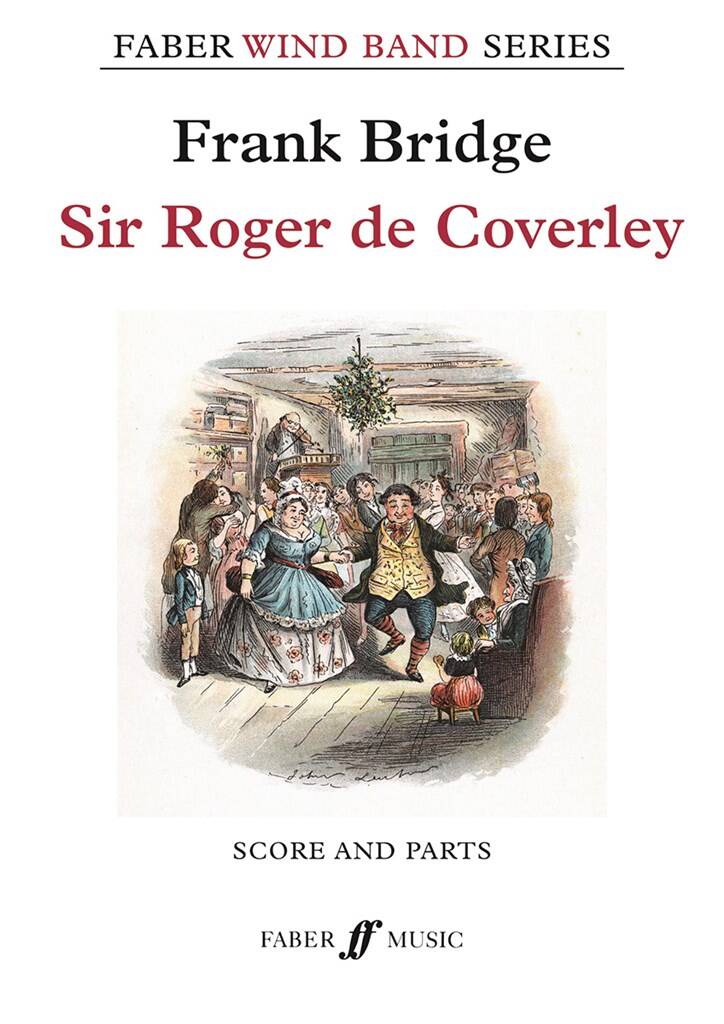
Sir Roger de Coverley - Frank Bridge
Frank Bridge (1879 - 1941) was one of the leading English composers of his time. In October 1922 he adapted his popular string quartet Sir Roger de Coverley for full symphony orchestra and Sir Henry Wood agreed, at the last minute, to include it in the last night of the Queen's Hall Promenade Concerts at the end of that month.This elaborate and colourful orchestral version has never been widely performed, but has now been brilliantly transcribed by Alastair Wheeler to provide a miniature dance poem for grade 5 level concert band.Bridge's lively treatment of one of England's most famous traditional dance melodies willmake a fitting end to any concert, with the strains of Auld Lang Syne introduced by Bridge as a nod towards Sir Roger de Coverley's traditional function as the final dance of a Christmas Ball, as it was in Old Mr. Fezziwig's party in Dickens' A Christmas Carol.
Estimated dispatch 7-14 working days
-
£233.99
Transfiguration - James Curnow
James Curnow explores many domains of sound with this wonderful piece. Four extensive variations, based on the melody of the hymn All Praise to You, Oh Lord, together form a beautiful piece of music for use in church services. The composer has a fresh view of the theme in the various fragments of the melody, from ethereal reflections to passionate joy. The last variation starts softly but energetically, and keeps developing using the last phrase of the melody - until the majestic highlight of this glorious hymn begins.
Estimated dispatch 7-14 working days
-
£69.99
Mondo Glissando - Mike Hannickel
Slip-slidin' trombone smears in this rip-snortin' ragtime setting are sure to tickle your ears and put some tap in your toes. The trombone glissando is the happiest sound around! Dedicated to, and premiered by, the Westchester Middle School Band of Westchester, Illinois, Mr. Jason Kluge, director, MONDO GLISSANDO targets that most critical of wind sections. When was the last time you featured your trombones? When was the last time they felt like STARS? Section feature pieces are one of the most important techniques available for keeping a section strong and well represented. MONDO GLISSANDO can even be used as a trombone SOLO piece, by having the non-solo trombones play from thetechnically simpler euphonium part.Either way, section or solo, there's nothing like an exposed part on an upcoming performance to reinvigorate a musician's interest and encourage that all-important PRACTICE!
Estimated dispatch 7-14 working days
-
 £116.40
Cordoba - Isaac Albéniz
CORDOBAThis piece is an extract from the five part piano work 'Cantos de Espaa' (Songs from Spain) opus 232 which consists of 'Preludio' (Asturias), 'Oriental', 'Bajo la Palmera' (Cuba), 'Cordba' and 'Seguidillas' (Castilla); some of these parts are also to be found in the 'Suite Espaola'. 'Cordoba', the last part but one, seems to announce the grandeur and serenity of the composer's last works; it is as if he was preparing to retire from the hectic dynamic world. The introduction has a subdued, almost liturgical character, whereas the next dance sounds rather very solemn. Cordba is as an island in the restless stream. It is an Andalusian dance with a majestic character similar to that of the city which inspired the work. This very harmonious composition is one of Albniz's finest.
Estimated dispatch 7-14 working days
-
 £199.99
Fanfare No. 1 - Wataru Hokoyama
Fanfare No. 1 (1995) In the summer of 1995 before his departure to the United States, a request from his high school band friends for a good concert opener sparked 19 year old Hokoyama to write his very first wind band composition.To capture the excitement of the rising curtain, the piece begins with magnificent brass ascending in 4th and 5th intervals. This is followed by the energetic entrance of the full ensemble like celebratory cannon fire. The following melody has many notes, yet is still simple. Do not overestimate it, just perform with driving momentum.In the slower middle section, utilize an instinctive vision of a scorching midsummer sun shimmering on the horizon. (Likely this shimmering sunset image was scored unconsciously, being composed in midsummer. A more applicable mood might be "Indian sunset". Perhaps this Indian style came from a capricious feeling of youthfulness.)The bright tempo and melody return for the last section. The climactic volley of musical display is like explosive fireworks as the last sounds echo throughout the concert hall.The composer wishes for performers to play from their hearts and not be limited by an analytic approach to the score-absolute accuracy is not required. Above all, the deepest pleasure for the composer is to know that teachers and students share the joy of music making with the intention of sharing it with others all over the world.With deepest gratitude, thank you for performing this work.
Estimated dispatch 7-14 working days
-
 £248.99
Three Movements - André Waignein
These three movements for piano and band depict three stages of a musical journey. We set off on a long journey through the world of musical virtuosity in the style of Liszt : grand, lustrous and lyrical. The second stage is a peaceful stroll, the start of a dream. The colours are like a tender caress and the piano sketches transparent arabesques. This splendid impressionistic journey ends in two bright pink drops which evapore just in time before the third and last movement explodes.The last movement is driven forward by a raging rhythm, as relentless as a war-dance. In a confrontation between the soloist and the orchestra all the inner strength of the composer comes to thesurface so that the musicians in the end are breathless... but all the same, no less satisfied.
Estimated dispatch 7-14 working days
-
 £159.99
Nostradamus - Otto M. Schwarz
Nostradamus is probably the best-known prophet of the last 1000 years. He lived at the time of the Inquisition and his predictions and medical therapies as a physician caused him to face the wrath of the church forcing him to flee many times. Following the loss of his family to the plague he devoted himself to clairvoyancy. He predicted many events in history in coded form and although there are many ways to interpret these, many are believed to be accurate and Nostradamus is still considered to be a unique personality. Whether he is denounced as a charlatan or promoted as a myth he has surely moved humankind with his prophecies.Otto M. Schwarz, soundtrack composer since2001, wrote a cinematographic work about this man, who is probably the best-known prohet of the last 1000 years.
Estimated dispatch 7-14 working days
-
 £137.99
An English Sea Song Suite - Philip Sparke
The four tunes used in this suite have been made universally popular in Sir Henry Wood?s Fantasia on British Sea Songs, which is an ever-present ingredient in The Last Night of the Proms.He introduced this colourful suite into the Proms in 1905,to celebrate the centenary of Nelson?s brilliant victory at Trafalgar, when ?Britannia? really did ?rule the waves?. Bring the excitement of The Last Night of The Proms to any concert with this stirring new edition.
Estimated dispatch 7-14 working days
-
£332.99
Tales & Legends - Etienne Crausaz
This three-movement work by the Swiss composer Etienne Crausaz reflects three true stories and fascinating legends from the Middle Ages. The first movement tells the dramatic story of the 'witch' Catherine 'Catillon' Repond (1662-1731). She was the last woman ever to be executed for sorcery. In the second movement, the famous court jester Girard Chalamala occupies centre stage. This jester, the last one at the castle of Count Greyerz, could make everyone laugh. The third movement tells the story of Count Michael. He went down in history as a spendthrift bon-vivant. His burden of debt became so high that he did a moonlight flit and never came back!
Estimated dispatch 7-14 working days
-
 £149.99
Jericho - Bert Appermont
Jericho is the musical translation of the well-known story from the book of Joshua about the capture of the city of Jericho by the Israelites.Part 1 depicts the cruel journey through the desert to Canaan, the promised land. An emotional lamentation for the yearning for a home, for the end of a roaming existence.The capture of Jericho is the theme of part 2. The city cannot be captured immediately and Jehovah orders an impressive army to march around the city for six days. On the seventh day, they marched around the city seven times and the priests blew their trumpets and the people cried so loud that the walls of Jericho came tumbling down. The Jews stormed the city and drove theinhabitants away. The music clearly reveals the marching army and you can hear the walls falling down with a tremendous noise. However, there is quite some artistic freedom in the actual story.A majestic and grand melody subsequently evokes the triumphant emotions that emerged as the fortified city fell (part 3).Following a personal and romantic interpretation, the scene ultimately ends in a typical Jewish feast (part 4) whereby the virtuosity of melodies played by the woodwinds and the passionate rhythms refer to traditional Jewish music. All themes are repeated in this last part in various forms, often simultaneous and in duelling counterpoint. The piece ends with fragments from the main theme of part 1 in major: peace and quiet return at last.
Estimated dispatch 7-14 working days
 View Music