
Results
-
 £69.99
Cowboy Suite - Alan Laken
In the tripartite 'Cowboy Suite' Alan Laken takes us to the Wild West, the domain of cowboys, indians, trappers and other fortune hunters. Around 1890 the west coast of America was reached, which in effect meant the end of the Wild West. Its stories, however, survived and have been a source of inspiration for many books, films, and, of course, music. Some characters, such as Jesse James, Billy the Kid, and Buffalo Bill are forever linked to these tales. In the 'Cowboy Suite' we first hear the 'Hoedown'. At the end of an exhausting workday the labourers used to lay down their tools, among others the 'hoes' and spontaneously began to play music on the instruments which they then possessed (guitars, fiddles, and banjos) and to dance. After being jolted on the 'Wagon Trail' we reach the third part, the 'Cowboy Roundup'. In this last part it becomes clear that as a cattle driver it is imperative to stay firmly seated in the saddle. As the cattle are rounded up, i.e. driven together, spectacular things happen.
Estimated dispatch 7-14 working days
-
 £286.40
Poeme du Feu - Ida Gotkovsky
Major Albert Fasce, head of the musical department of the French Army, wrote about Pome du Feu:The Pome du Feu by Madame Ida Gotkovski is probably one of the original compostitions for symphonic band which has been most successful in recent years. I have had to conduct this work at concerts with different orchestras, and in particular at Budapest, and each performance was greeted by enthusiastic ovations. Moreover, it is quite rare in contemporary music to achieve, at the same time, the satisfaction of the musicians and success with the public. This is significant. This magnificent work is written remakably for wind instruments. There is no major technical difficulty, but the character of this work calls for meticulous placing and a certain orchestral glow. There is a "key" to be found in the first movement, which is in some way the rhythmic genesis of the work. The metronome marking of the first movement should be absolutely respected, and proper interpretation of the accents and the articulations are imperative. The fortissimi and rallentandi should not be exaggerated. As far as the little "trick" is concerned, this lies in the execution of the double crochets which should be considered in two ways: the first, a rhythmical one for those which arise from the rhythmic genesis, and the second more melodic for those arising in passages.Finally, to unseal the rhythmic origin of the double crochets, it is necessary to proceed by recurrence, starting from the four double crochets of the finale.These four double crochets must be executed very rhythmically in the different times. For the first, they arise:1: from the second bar of the first movement2: from the bar three bars before A for the second3: from the bar from G to the fourth time for the third.These double crochets must be played rhythmcally, while diminishing, however, those three bars before A.All this is of great importance, otherwise the whole execution will be in contradition with the spirit and the rhythmic inspiration of the work. Moreover, this beautiful work could very well support a ballet.As Head of Broadcast Music I must express all our gratitude to Madame Gotkovski for her contribution to constituting a real repertoire for wind ensemble. This articular and sometimes unappreceated band possesses unsuspected riches. This magnificent work is now in the repertoire of Musique de l'Air de France.
Estimated dispatch 7-14 working days
-
 £245.50
Concerto - Ida Gotkovsky
A harmonic orchestra, a living source of inspiration with eloquent possibilities, has always inspired the composer. The "Concerto for a full Harmonie Orchestra" (Concerto pour grand orchestre d'harmonie), is a work of instrumental virtuosity. Both solo and concerted instruments lead up to and end the work with strength, power and force.This work is written in three movements. "Lyrique" is a movement of sonorous volumes where all the instruments are concerting by orchestral masses. "Expressif" is a movement of solos which are bound by the thematic form and "Obstin": the movement we shall hear-full of virtuosity in which the instruments are concerting by families.
Estimated dispatch 7-14 working days
-
 £96.00
Overture La Poupe de Nuremberg - Adolphe Charles Adam
Adolphe Adam earned his living as a music critic and a composer, though he himself considered composing as mere pastime. He is still famous because of his ballet music and he was said to find his inspiration while looking attentively at the young female dancers' legs. His comic opera La Poupe de Nuremberg was most successful in Paris in the nineteenth century. The splendid overture is a highlight of the French opera and a real asset for any orchestra.
Estimated dispatch 7-14 working days
-
 £86.70
Mr. Bojangles - Jerry Jeff Walker
'Mr. Bojangles' is a popular song written and initially recorded by Jerry Jeff Walker in 1968 and covered since by many other artists. The song was inspired by an encounter with a street performer in the New Orleans first precinct jail. Although this man could tap dance, the inspiration for the song was the famous stage and movie dancer Bill 'Bojangles' Robinson. Robbie Williams recorded it on it's bigband CD 'Swing When You're Winning'.
Estimated dispatch 7-14 working days
-
 £175.30
Tetis - Luís Cardoso
Tethys was the sister (and wife!) of the Oceanus, and the last of the Titaness, the goddess of the waters according to Greek mythology. This goddess was the inspiration for this work for symphonic band, which is derived from a three note melodic fragment, heard in the opening 2 bars.
Estimated dispatch 7-14 working days
-
 £163.70
From Both Sides Now - Joni Mitchell
"From Both Sides Now", written in 1967, is one of the most famous songs by Canadian singer/songwriter Joni Mitchell. A novel by Saul Bellow, "Henderson the Rain King", was her inspiration to write the song. She has recorded the song twice: first in 1969 on the album "Clouds" and again in 2000 on the album "Both Sides Now". The latest recording feature a more orchestrated, jazz-inspired version of the song. This arrangement is written in "quasi-tango" style. There are three solo-options included: Bb-Inatruments, Eb-Instruments and C-Instruments (Bass Clef).
Estimated dispatch 7-14 working days
-
 £84.99
A Copland Portrait - David Conte
Originally commissioned by maestro Neal Gittleman, A Copland Portrait was premiered by the Dayton Philharmonic Orchestra in January 2000. In March of 2015, First Lieutenant Ryan Nowlin's transcription of this work for band was premiered by "The President's Own" United States Marine Band under the direction of Lieutenant Colonel Jason Fettig. ECS Publishing is proud to offer both the band and the orchestra version. Conte on the creation of this overture: "I set out quite consciously to evoke various aspects of Copland's work by combining and recombining them within the terms of my own musical personality. For example, the first theme of A Copland Portrait combines the character of a theme from The Red Pony with the rhythmic texture of the scherzo of the Third Symphony. While composing the piece I was conscious of drawing inspiration from many of Copland's works; a melodic shape here, a harmonic gesture there, until I arrived at something that felt fresh and new to me. A Copland Portrait is cast in a traditional Sonata-Allegro form. After a vigorous, syncopated orchestral tutti, the first theme is announced in the solo oboe, accompanied by a steady eighth-note ostinato. Playful interjections are stated in the flute and bassoon. The syncopated tutti returns; the first theme is stated again, this time in the low winds. This theme builds to a colorful climax, leading into a more dissonant transition section, which gradually slows and gives way to a lilting, more lyrical second theme in the clarinet. After some modest development of the second theme, a more plaintive theme stated in the muted trumpet brings the exposition to a close. A scherzando development section follows; the first four notes of the first theme are inverted and subjected to various contrapuntal treatments. This development section ends with a return of the opening syncopated motive, leading into a recapitulation of the first theme, this time in canon, and the second theme and closing theme, broadly sung. A brilliant toccata-style coda brings A Copland Portrait to a brisk conclusion."
Estimated dispatch 7-14 working days
-
 £55.50
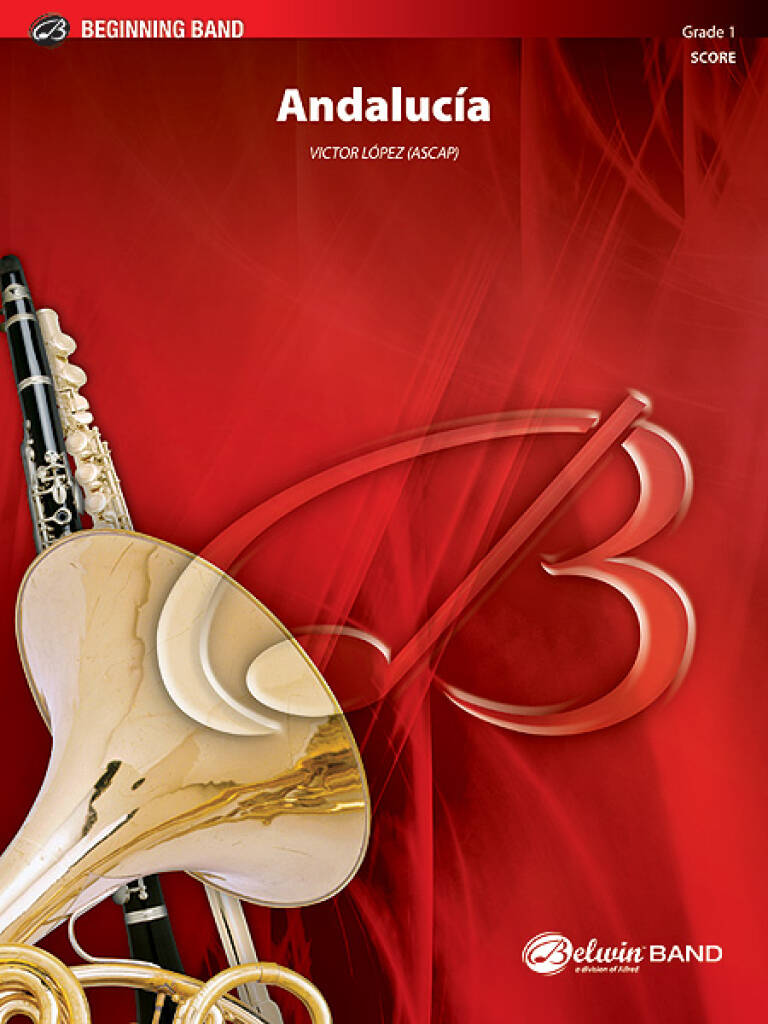
Andaluca - Victor Lopez
Andaluca has always been a very musical land, and the Moors that occupied Andaluca for nearly 800 years have contributed greatly to its unique music and exotic dances. Victor Lpez has utilized Andaluca as his inspiration to provide us with an original composition that blends both the flamenco and traditional march styles. Full of fire and energy!
Estimated dispatch 7-14 working days
-
 £99.99
Ukrainian Bell Carol - Mykola D. Leontovich
The Ukrainian Bell Carol is part of a large choral work entitled Shchedryk by the Ukrainian composer Mykola Dmytrovich Leontovych (1877-1921). It was first performed by students of Kiev University in December 1916. The tune is an adaptation of an old 'shchedrivka', a song traditionally sung on Ukrainian New Year's Eve (January 13th) which hopes for good fortune in the year to come. In Shchedryk, Leontovych added his own the lyrics which concern the legend claiming that when Jesus was born, all the bells on earth started ringing in his honour.The tune has since been the inspiration of at least four different Christmas carols, but Philip Sparke has sourcedthe original Ukrainian melody to create this stirring arrangement.
Estimated dispatch 7-14 working days
 View Music