
Results
-
 £164.99
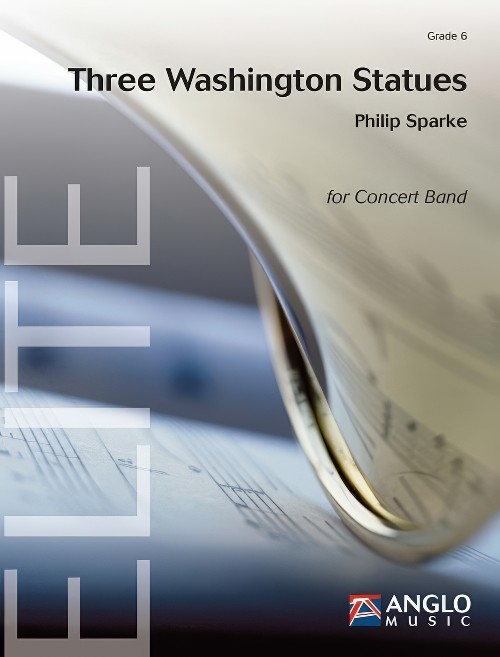
Three Washington Statues (Concert Band - Score and Parts) - Sparke, Philip
Three Washington Statues was commissioned by the United States Army Band "Pershing's Own", led by Colonel Thomas H. Palmatier. Washington D.C. contains some of the world's most iconic monuments, memorials and statues. Philip Sparke has chosen three of these as the inspiration for this piece: 'The Lincoln Memorial' in the form of a Greek Doric temple in which the composer depicts the grandeur of this monument; 'The Martin Luther King, Jr. Memorial' on which steps the iconic speech 'I have a dream' was given - the music is both reverential as well as powerful referring to Martin Luther Kings' speech; and the 'Encore' statue in memory of the world famous African-American composer, pianist and bandleader Duke Ellington. In this final movement, Philip Sparke catches the virtuosic, energetic and unique dynamism of Ellington's' music. Three Washington Statues was commissioned by the United States Army Band "Pershing's Own", led by Colonel Thomas H. Palmatier. Washington D.C. contains some of the world's most iconic monuments, memorials and statues. Philip Sparke has chosen three of these as the inspiration for this piece: 'The Lincoln Memorial' in the form of a Greek Doric temple in which the composer depicts the grandeur of this monument; 'The Martin Luther King, Jr. Memorial' on which steps the iconic speech 'I have a dream' was given - the music is both reverential as well as powerful referring to Martin Luther Kings' speech; and the 'Encore' statue in memory of the world famous African-American composer, pianist and bandleader Duke Ellington. In this final movement, Philip Sparke catches the virtuosic, energetic and unique dynamism of Ellington's' music.Duration: 8:45
Estimated dispatch 7-14 working days
-
 £94.99
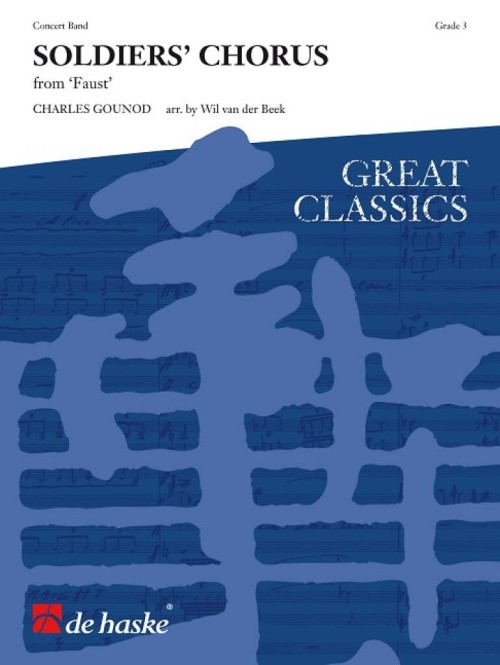
Soldiers' Chorus (Concert Band - Score and Parts) - Gounod, Charles - Van der Beek, Wil
The tale of Faust, who sold his soul to the devil in exchange for knowledge and power, has been a source of inspiration for many authors, poets, film directors and composers. Among these is the French composer Charles Gounod whose opera Faust was first performed in 1859. This charming Soldiers' Chorus is one of the most famous melodies from the opera. Its musical simplicity and beauty fits any concert programme that needs a well-known classical arrangement. The tale of Faust, who sold his soul to the devil in exchange for knowledge and power, has been a source of inspiration for many authors, poets, film directors and composers. Among these is the French composer Charles Gounod whose opera Faust was first performed in 1859. This charming Soldiers' Chorus is one of the most famous melodies from the opera. Its musical simplicity and beauty fits any concert programme that needs a well-known classical arrangement.Duration: 3.15
Estimated dispatch 7-14 working days
-
 £139.99
Cobra Wind Band Set (Score & Parts)
Shortly after the Second World War, a combative movement of Danish, Belgian and Dutch artists chose the cobra snake - extremely dangerous yet considered sacred - as a symbol of their resistance to strict guideliness of form. The name "Cobra" also happens to contain the first letters of the cities Copenhagen, Brussels ans Amsterdam, from where most of the movement's members came. The Cobra movement, which existed from November 1948 until November 1951, can with some justicication be called the last major avant-garde movement of the 20th century.The source of inspiration for the composition Cobra comes from four paintings: "Obhobning" by the Dane Egill Jacobsen; "La jeune fille et la mort" by the Belgian Pierre Alechinsky; "Orgeldraaier" and "Le rythme joyeux de la ville" by the Dutch artists Karel Appel and Corneille. Obhobning means "pile-up", which is represented musically in the first part by a melodic and harmonic pilling up of perfect fourth's. The first part is also characterized by a rhythmic feeling, which the painting gives through its use of numerous black stripes. In the painting La jeune fille et la mort, Pierre Alechinsky places a young girl opposite Death. The second part features the constantly pulsating motion of live while a creeping, dark, melodic line develops. The tension between life and death is tangible as a battle reveals itself. In part three, one hears the Orgeldraaier by Karel Appel, as cheerful and playful as an organ grinder's music. The painting Le rythme joyeux de la ville by Corneille is busy and extremely dynamic, a perfect source of inspiration for a powerful, rhythmic ending to this composition. 0:09:57
Estimated dispatch 7-14 working days
-
 £79.95
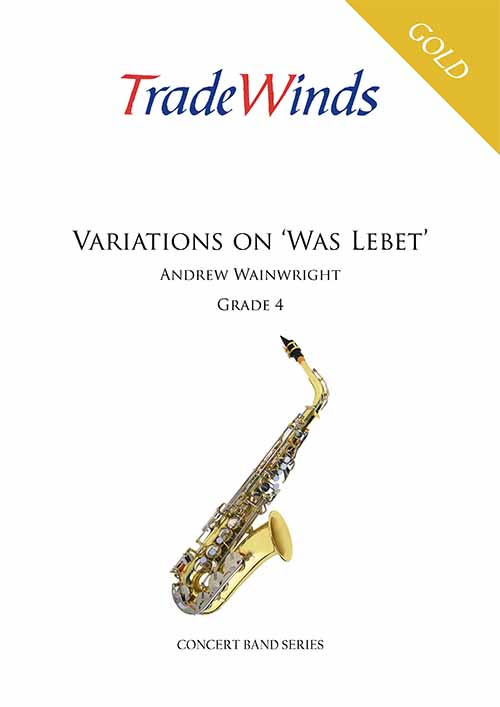
Variations on 'Was Lebet' (Concert Band - Score and Parts) - Wainwright, Andrew
Variations on 'Was Lebet' is based on the German chorale of the same name, the first line of which translates as 'O worship the Lord in the beauty of holiness!' The opening fanfare figure in the Trumpets should be supported by bold, organ-like sostenuto chords in the lower band. Ensure that the fanfare in the Trumpets and Trombones from bars 25 to 28 is given equal articulation and volume in the antiphonal parts. After this majestic introductory section, the first of five contrasting variations is presented, although the tune is never realised in full form until the final variation, with fragments gradually being revealed as the piece progresses.Variation I is somewhat classical in approach, with its energy coming from a regular contrast between cantabile references to the theme, set against lively staccato figures. Ensuring a lightness of touch will be important here; the music should be poised and never sound frantic. As a result, careful attention should be paid to the tempo marking, being no quicker than 136 beats per minute. Snippets of the chorale come and go, with the last phrase of the hymn completing the movement. This final statement, at bar 95, should be an immediate change in tempo and a separate statement to the music that comes before.Variation II is plaintive in mood, giving the listener the chance to reflect on the following words, which form part of the second verse: 'Comfort thy sorrows and answer thy prayerfulness, Guiding thy steps as may best for thee be.' There is opportunity for rubato in this movement, at the discretion of the conductor.Variation III is somewhat quirky and volatile in nature, and takes its inspiration from the 3rd and 4th verses which describe the fearful times in life that we must entrust to the Lord. Driven by the Percussion section in particular, there are references here to Variation I with its chorale-like figures and hurtling scalic figures, and there is a feeling of a lack of resolution. A somewhat abrupt ending suggests that our sense of completeness in Christ is yet to be resolved. It is important that clarity and tempo are maintained in the bass line between sections L and M. Aim for consistency of line in the bass parts, particularly with the trade-offs between players here.There is a French romantic feel to the waltz in Variation IV, with the opportunity for various soloists to display their musicianship. A sense of ironic humour pervades throughout. The Clarinet and Bassoon duet from section U should be playful and display a lightness of touch, with that sense of style continued throughout the movement.Variation V is fugal in nature, with each section of the band being handed the theme at various points. Again it is important that a steady tempo is set at Y in order to maintain control. The sense of momentum gradually increases to a grandiose presentation of the full theme, beginning at section CC, affirming our completeness in the Lord, with the words of the first and last verses reiterated: O worship the Lord in the beauty of holiness! Bow down before him, his glory proclaim; With gold of obedience and incense of lowliness, Kneel and adore him, the Lord is his name.Duration: 11.45
Estimated dispatch 7-14 working days
-
 £15.95
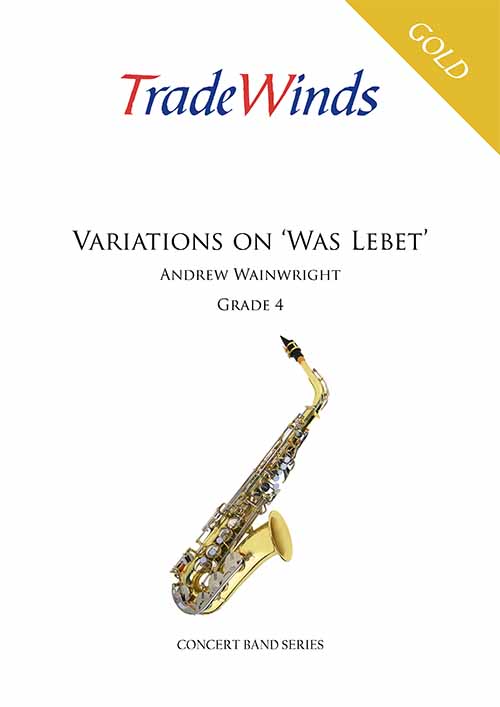
Variations on 'Was Lebet' (Concert Band - Score only) - Wainwright, Andrew
Variations on 'Was Lebet' is based on the German chorale of the same name, the first line of which translates as 'O worship the Lord in the beauty of holiness!' The opening fanfare figure in the Trumpets should be supported by bold, organ-like sostenuto chords in the lower band. Ensure that the fanfare in the Trumpets and Trombones from bars 25 to 28 is given equal articulation and volume in the antiphonal parts. After this majestic introductory section, the first of five contrasting variations is presented, although the tune is never realised in full form until the final variation, with fragments gradually being revealed as the piece progresses.Variation I is somewhat classical in approach, with its energy coming from a regular contrast between cantabile references to the theme, set against lively staccato figures. Ensuring a lightness of touch will be important here; the music should be poised and never sound frantic. As a result, careful attention should be paid to the tempo marking, being no quicker than 136 beats per minute. Snippets of the chorale come and go, with the last phrase of the hymn completing the movement. This final statement, at bar 95, should be an immediate change in tempo and a separate statement to the music that comes before.Variation II is plaintive in mood, giving the listener the chance to reflect on the following words, which form part of the second verse: 'Comfort thy sorrows and answer thy prayerfulness, Guiding thy steps as may best for thee be.' There is opportunity for rubato in this movement, at the discretion of the conductor.Variation III is somewhat quirky and volatile in nature, and takes its inspiration from the 3rd and 4th verses which describe the fearful times in life that we must entrust to the Lord. Driven by the Percussion section in particular, there are references here to Variation I with its chorale-like figures and hurtling scalic figures, and there is a feeling of a lack of resolution. A somewhat abrupt ending suggests that our sense of completeness in Christ is yet to be resolved. It is important that clarity and tempo are maintained in the bass line between sections L and M. Aim for consistency of line in the bass parts, particularly with the trade-offs between players here.There is a French romantic feel to the waltz in Variation IV, with the opportunity for various soloists to display their musicianship. A sense of ironic humour pervades throughout. The Clarinet and Bassoon duet from section U should be playful and display a lightness of touch, with that sense of style continued throughout the movement.Variation V is fugal in nature, with each section of the band being handed the theme at various points. Again it is important that a steady tempo is set at Y in order to maintain control. The sense of momentum gradually increases to a grandiose presentation of the full theme, beginning at section CC, affirming our completeness in the Lord, with the words of the first and last verses reiterated: O worship the Lord in the beauty of holiness! Bow down before him, his glory proclaim; With gold of obedience and incense of lowliness, Kneel and adore him, the Lord is his name.Duration: 11.45
Estimated dispatch 7-14 working days
-
 £179.99
The Planetarium (Concert Band - Score and Parts) - Sparke, Philip
The Planetarium was commissioned by CMV Advendo Franeker to celebrate their 100th Anniversary in 2022. The inspiration for the work is the world-famous Royal Eise Eisinga Planetarium in the orchestra's home town of Franeker in the Netherlands. In this continuous seven-movement work, the composer pictures the sun as well as the planets Mercury, Venus, Earth, Mars, Jupiter and Saturn. Also featured throughout the work is a brief quotation from the chorale 'Psalm 150'. A work that rises above the mundane!Duration: 15.30
Estimated dispatch 7-14 working days
-
 £84.99
Vibes (Concert Band - Score and Parts) - Ceunen, Filip
Vibes will instantly raise the spirits of your musicians and listeners. With this work, composer Filip Ceunen shows he has another side to him, finding his inspiration in music of a lighter genre. And the result? A sparkling original composition full of elements of funk, Latin and heavy metal, it is ideal as a conclusion to a concert. Can you feel the vibe?Duration: 5.15
Estimated dispatch 7-14 working days
-
 £279.99
Van Gogh (Concert Band - Score and Parts) - Doss, Thomas
This composition is not a work inspired by the life of the famous painter, but rather an attempt at a pictorial immersion into his world. In addition to Van Gogh's character and tragic life, the technique he employed to create his works, the bright colours of his paintings and his view of nature served as inspiration for this musical work. Point by point, stroke by stroke, Van Gogh brought his own world to life on canvas.On the life of Van Gogh: The Dutch artist Vincent van Gogh was one of the most important pioneers of Modernism, despite being relatively unknown during his own lifetime. As an artist, he chose a life of poverty and seclusion. From today's perspective, his important woks were created from 1880 onwards, when he had already more or less succumbed to madness. While his earlier works could still be classed as contemporary, he matured into a pioneer of Expressionism with his later work indicating an increasing self-awareness. He was just 37 years old when he died but he created over 750 paintings and 1600 drawings in the last ten years of his life.The structure of the work:Start: Brushes and Paints: Van Gogh retired to Arles in southern France where he found his artistic home. The colours and flowering gardens of this landscape awakened in him an unbelievably great creative power.A: A Picture Comes into Being: Van Gogh's psychotic episodes and bouts of depression did not stop him from painting wonderful pictures. Hardly anyone recognised his genius during his lifetime, on the contrary, he often felt misunderstood.C: Paris - Arles: In Paris (from 1886), Van Gogh became inspired by the French art scene. His works found few takers, however. He met and befriended the painter Paul Gauguin, but the lack of success made Van Gogh short tempered, and he began to drink. Eventually, he moved from Paris to Arles in the south of France to establish an artists' collective with Gaugin. Within a few weeks, the two got into such a violent argument that Van Gogh attacked his friend with a knife. The friends parted ways and afterwards Van Gogh cut off his right ear. In 1889 he voluntarily admitted himself into a mental hospital at St. Remy, suffering from hallucinations and fearing that he would lose his mind.G: The Starry Night One of his most famous paintings, created in 1898.H: Death and Brotherly Love Vincent van Gogh accepted an invitation to Auver-sur-Oise in 1890. This was one of his most intensive creative periods. He also went there for treatment, but his mental state hardly improved. After an extended walk, he injured himself fatally with a pistol under mysterious circumstances. Not even to his beloved brother Theo, who had supported him all his life, did he reveal on his deathbed how the accident had occurred.J: Art Market Today, Van Gogh's paintings are among the most expensive paintings on the art market. How ironic, given that he could hardly sell a painting during his lifetime. "I put my heart and soul into my work and lost my mind in the process." (Vincent van Gogh)Duration: 13.15
Estimated dispatch 7-14 working days
-
 £57.00
American River Medley (Concert Band - Score and Parts) - Wagner, Douglas E.
The major rivers which flow through the United States of America have centuries-long been prime vehicles for exploration, trade, inspiration, life, and general enjoyment for millions of people. Folk songs from the mid-nineteenth century chronicle their stories of love and courage, with three of the most beloved of these tunes incorporated into the fabric of this arrangement by Douglas E. Wagner. Opening with a gently flowing treatment of "Shenandoah," also known as "Across the Wide Missouri," the work transitions to a spirited rendition of "The Glendy Burk." A more sedate feeling for "Red River Valley" follows, with "Shenandoah" returning again in the upper winds in direct and effective counterpoint. A rousing coda, based on previously heard musical material, brings to a close this celebration of our most treasured American resources. Duration: 3.00
Estimated dispatch 7-14 working days
-
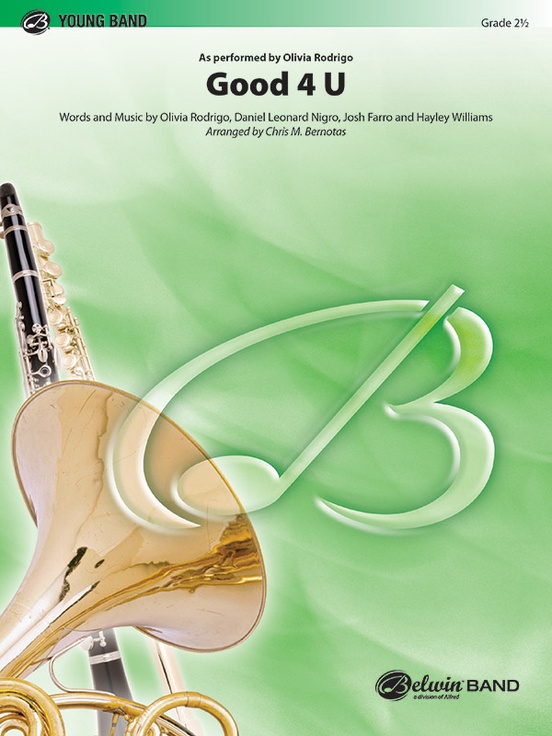 £68.00
Good 4 U (Concert Band - Score and Parts) - Bernotas, Chris M.
Good 4 U, the popular and upbeat song by superstar songwriter and performer Olivia Rodrigo, has topped the Billboard charts and appears on the artist's debut album Sour. She has been active as a professional singer and songwriter since she was 12 years old and can serve as an inspiration to young musicians. Like many pop songs, the care in performing syncopation and various articulations will provide a more authentic sound. Arranged by Chris M. Bernotas, the energetic music, powerful infectious chorus, and pure emotion will permeate the concert hall. Duration: 3.15
Estimated dispatch 7-14 working days
 View Music