
Results
-
 £174.99
Et in terra Pax - Jan Van der Roost
This piece was commissioned by the 'Concert Band Vlamertinge' and is a plea for peace: the title translates as 'Peace on Earth'. This is expressed by means of the vocal contribution expected from the performers. In various places of the piece you can recognize, the words 'Et In Terra Pax' - an appeal for peace - at first jumbled together but later more rhythmically structured, developing into synchronized massed voices.The work starts with a pentatonic theme based on the notes D, E, G, A and C (taken from 'ConCErtbAnD VlAmErtinGE' and the name of the conductor, NiCk VAnDEnDriessChe). A somewhat sad melody is developed during an orchestral climax which leads to the firstexplosion of sound (measure 62 onwards). Suddenly the opening measures are recaptured, albeit with a differently colored sound: the words 'Et In Terra Pax' bring the first movement to a close. A restless Allegro follows which abruptly stops and is replaced by a calming cho-rale-like passage. A narrator reads aloud the poem 'Sonnet' by the young poet Charles Hamilton Sorley, who was killed during World War I. This poem fittingly puts into words the cruelty and senselessness of war. After the expanded recapitulation of the allegro, the broad, almost infinite atmosphere of the beginning returns. Clarinet and English horn play the pentatonic opening theme once more, this time broadly, while the words 'Et In Terra... Pax' are repeated again and again by the rest of the orchestra.The composer has purposely avoided all forms of aggression and bombastic sounds regularly used in works about war. Fear of violence and destruction can be heard and felt during the allegro passages. The charged opening makes way in the end for hope: May peacefulness replace cruelty in everyday life, too.
Estimated dispatch 7-14 working days
-
 £109.99
Spanish Dance - Carl Wittrock
Experience the Spanish temperament with this solo work for English Horn or Alto Saxophone. Alternating between passion and introversion, the Spanish beauty moves over the dance floor. In his own, unique way, composer Carl Wittrock has translated this image into a dazzling, well-balanced piece that treats listeners to exquisite harmony between soloist and band.
Estimated dispatch 7-14 working days
-
 £224.99
Les Marteaux de la Marine - Rob Goorhuis
Les Marteaux de La Marine was composed in 1999 as a commission by the Marine Band of the Royal Netherlands Navy. The composition contains three static elements which interchange. Static in this case means that development of the material isnot pursued (by the composer). The first element with which the piece begins is tranquil and colourful. The second element is sharp and incisive, while the third expresses energy. In all elements a repeated tone is the starting point whichexplains the hammers in the works title.The instrumentation is richly variegated with a harp also determining the palette of colours in the slower movements. The composition opens with an atmospheric Larghetto containing fine harmonies in thesoft and subtly moving wood-winds. The introduction breathes an impressionistic atmosphere in which expressive cantilenas and soloistic agile motifs stand out. A strong setting is followed by an Allegro virtuoso containing fast motifs contrasted withshort and rhythmic stars of the various instrumental sections. Trumpets and horns add a virtuoso bugle-call motif. After a short stringendosection, the transparent Larghetto returns with a varied setting of the opening elements. The beautifulleading roles in this section are reserved for cornet (trumpet) and horn. Subsequently, the flashing Vivo starts with continuous movements in triplets from both wood-winds and brass. Next, the opening Allegro re-appears once again and thus LesMarteaux de la Marine ends with a fast and virtuoso climax. Les Marteaux de La Marine was selected as a compulsory grade 6 contest piece for symphonic bands in the Netherlands.
Estimated dispatch 7-14 working days
-
 £102.99
The Maid of the Moor - Goff Richards
This work by Goff Richards was written in the eighties and is best known under the name Demelza in a version for Tenor horn. Marten van der Wal made an arrangement for solo instrument and band (there are different transpositions of the solo part included). The melody is very special and processes in a beautiful way in the composition .
Estimated dispatch 7-14 working days
-
£74.99
Concertino Op.26 - Weber
Published in 1962, this adaptation of the exciting classic takes full advantage of modern symphonic band instrumentation to achieve an artistic performance of the solo with band accompaniment. Beautifully arranged by Alfred Reed, each set includes detailed notes for the conductor and a superb Master Lesson by clarinetist Don McCathren (Duquesne University) to aid soloists in their preparation of the piece. Abundant cross-cues are also provided in the band parts to ensure that exposed bassoon, alto/bass clarinet and F horn passages are clearly heard. Duration 9:00.
Estimated dispatch 7-14 working days
-
 £186.20
Mascarade for Brassquintet - Serge Lancen
This is a very special work, written as it is for brass quintet (trumpets I and II, horn, trombone, bass-tuba) and symphonic band, but also available in a version for brass quintet only, which enlarges the practical possibilities for performance enormously. Lancen has certainly exceeded himself in this brilliant work. Following its premiere during the W.A.S.B.E. Congress in Boston in 1987, the 'Boston Globe' wrote: 'Far simpler but its own way more original was the 'Maskerade for Brass Quintet and Band' by Serge Lancen. Its eight movements are unabashedly tonal, throughout a cheerful carnival of simple, sincere ideas worked out with skill and good humor'. The premiere was given by the Dutch National Youth Symphonic Band conducted by Jan Cober.
Estimated dispatch 7-14 working days
-
 £140.80
Symphonie Iberique - Serge Lancen
Symphonie Ibrique (Iberian Symphony) was composed in 1989. As the title suggests the composer evokes in this three part composition some Spanish atmospheres. The melodic structure and the typical musical ornaments, used in a quite personal way, succeed in making this symphony sound as Spanish as could be. The first part is quite solemn and so colourful that it immediately betrays Lancen's personal touch. The central part is full of atmosphere and boasts a splendid dialogue between the English horn and the bassoon. In the third part the composer uses several Spanish dance rhythms in an exhuberant way and with a lot of metrical changes.
Estimated dispatch 7-14 working days
-
 £245.50
Seven Wonders of the Ancient World - Alex Poelman
In the Ancient World the seven most beautiful monuments were called 'The seven Wonders of the World'. In his Symphony nr.1, The Seven Wonders of the Ancient World' the young Dutch composer Alex Poelman has made a musical portrait of these splendid human realizations which are now, but for one, all destroyed. The symphony is masterly and lavishly orchestrated and portrays both the power of the sovereigns of ancient times and the splendour of the most beautiful buildings and works of art they have had built. Moreover, neither the seducing Eastern charm nor the mysterious exotic atmosphere are failing.Alex Poelman (Arnhem, 1981) studied informatics at the Twente University and plays French horn in several top amateur bands. Under the guidance of David Rowland he wrote his first composition for wind band 'Volcano'. This was followed by 'Theseus', 'Symphony nr. 1 'The Seven Wonders of the Ancient World', 'D-Day' and 'Aquila Chrysaetos'. This symphony was premiered on 28 May 2004 at Enschede. One year later, it was recorded on CD by the new Dutch military band KMKJWF conducted by Norbert Nozy.I. THE TEMPLE OF ARTEMIS.The Greek goddess Artemis, daughter of Zeus and Leto and twin sister of Apollo, was the goddess of the hunt and was especially worshipped in Arcadia. In the town of Ephesus, an Ionic colony in Asia Minor, a splendid temple was built in honour of Artemis which was destroyed in 356 B.C. when Herostratos set fire to it. Some years later it was reconstructed.II. THE GREAT PYRAMID OF CHEOPSCheops, the second pharaoh of the 4th Dynasty of Ancient Egypt (3rd century B.C.) had the big pyramid built at Gizeh on the left bank of the Nile, next to Cairo. The technical perfection and the huge dimensions of this magnificent 137 m high building were never equalled. It is the only one of the Seven Wonders of the Ancient World that was not destroyed and is kept undamaged up to this day. III. THE STATUE OF ZEUS Zeus, son of Chronos and Rhea, was the leading god of the Greek pantheon and, according to Homer 'the father of all gods and all humans'. He was the god of the celestial light and controlled all physical phenomena. In the Greek town of Olympia, birthplace of the Olympic Games, there was a splendid statue representing the Olympic Zeus. It had been sculptured about 433 B.C. by the great Athenian sculptor Phobias (ca 490 - ca 430 B.C.) and was considered as the nicest statue of the ancient Greek world. IV. THE MAUSOLEUM AT HALICARNASSOS. Halikarnassos (the actual Bodrum in Turkey) was at one time the capital of Asia Minor. When king Mausolos died in 353 B.C., his wife and sister Artemisa ordered to build a huge funeral monument (Mausoleum) for her deceased husband. It gave its name to all large funeral monuments in the world.
Estimated dispatch 7-14 working days
-
 £149.40
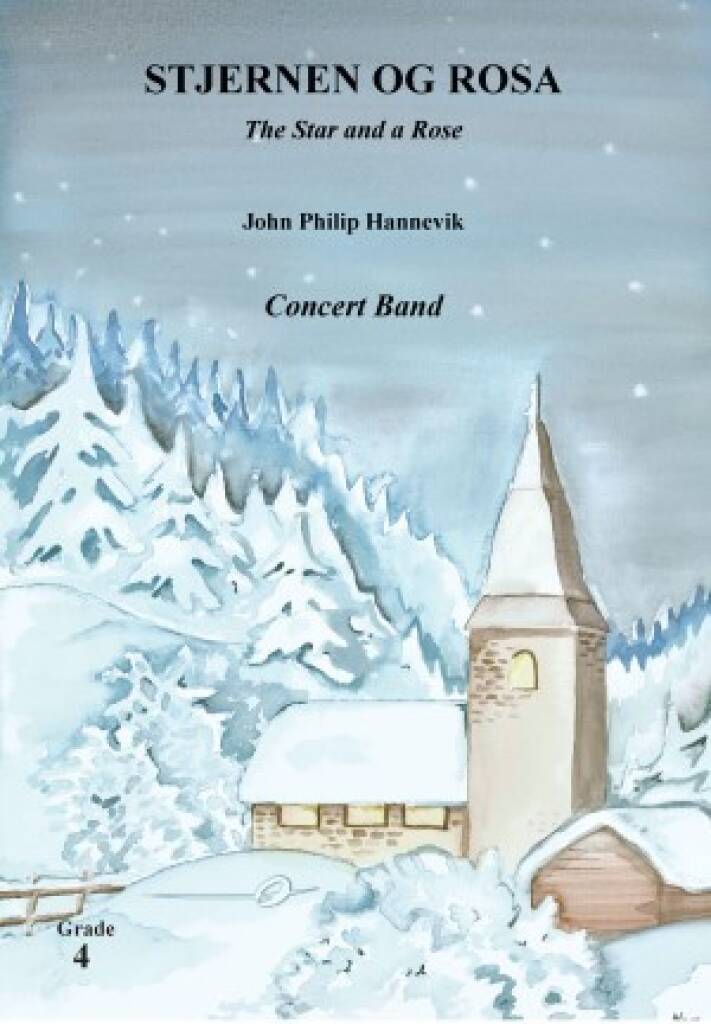
Stjernen og Rosa - John Philip Hannevik
The Star and a Rose is a big-scale Christmas piece for band, featuring four seasonal chorales.The first is a Gregorian-like chant Hodie Christus natus est.In this section of the piece, a soloist can be placed away from the band, maybe on a gallery. The soloist can be a tenor instrument, maybe trombone, or you can feature a vocal soloist.After this, the music leads us on to the old German Christmas chorale Lo, how a rose e'er blooming. This song is given a fairly rhythmical treatment, but make sure that the melody is presented in a cantabile style.An interlude follows, before the piece presents one of the most used and loved Scandinavian Christmas chorales, Mitt hjerte alltid vanker (My Heart will always wander), composed by the Danish bishop Hans Adolph Brorson around 1732. This song is building towards a climax, before the solo horn brings it all down to the Stable view described in the lyrics.Then comes a transition that brings us in to the final section of the piece, which presents the international Christmas Carol Adeste Fideles. As many will notice, I have borrowed a section from David Wilcocks majestic harmonization towards the end.The title of the piece has its background form the lyrics in My heart will always wander, where the text speaks about the stars in the sky. But also in the latin text for Adeste Fideles:Stella duce, Magi, Christum adorantesThe Rose is of course from the lyrics in the chorale Lo, how a Rose.
Estimated dispatch 7-14 working days
-
£113.30
Rumanian Folk Dances - Béla Bartók
Bla Bartk (1888 - 1945) showed from the beginning of his career an interest in popular music. He began studying music at the age of five and eventually focused on composition and piano. He collected a lot of popular songs, especially during his studies in Hungary, but also music from Romania and Slovakia. This had a lot of influence on his style. In his compositions, Bartk uses many Hungarian popular themes and rhythms, and even his own original works always refer to the same rhythmic and melodic folk character. At the beginning of the twentieth century, Bartk detached himself from romanticism and began to delineate his style on harmonic procedures based on diminished and augmented intervals, on bitonality, and on marked percussiveness, characteristics that are at the core of popular music.The Romanian Dances are a collection of seven folk dances, originally composed for piano (1915, the first six) and then transcribed for a small symphonic orchestra (1917). Of purely modal language, like almost all Bartk's music, each dance comes from a different area of Romania (Stick Dance, Sash Dance, In One Spot, Horn Dance, Romanian Polka, Fast Dance of Belnyes, and Fast Dance of Nygra).
Estimated dispatch 7-14 working days
 View Music