
Results
-
 £89.99
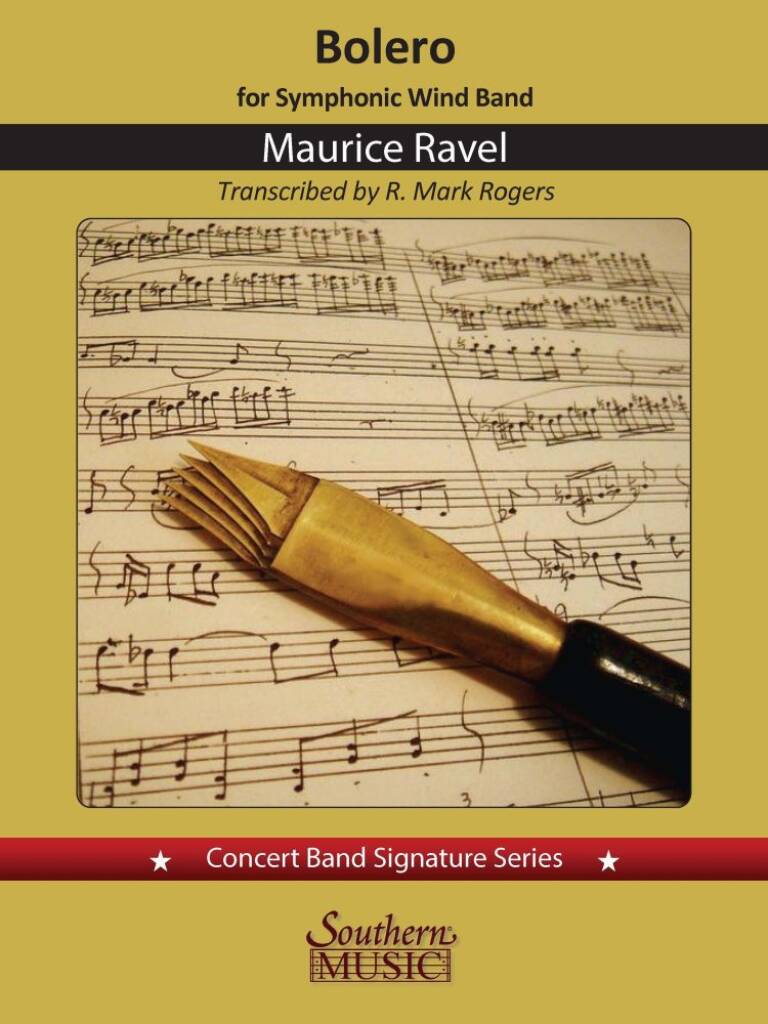
Bolero For Band - Maurice Ravel
Initially commissioned by Ida Rubenstein as a ballet work initially, Maurice Ravel's BOLERO has become his most popular and often-performed orchestra composition, which was a surprise to the composer who described it as seventeen minutes of orchestra without any music. With a structure that is simplicity itself, BOLERO uses two alternating melodies in what Ravel described as a crescendo on commonplace melod[ies]. Mark Rogers' transcription of BOLERO is an entirely complete wind band version of the piece; omitting not a single note or exotic instrument, thereby transferring the brilliance of Ravel_x001A_s orchestral score to the symphonic wind band with as much fidelity to the original as possible. Ravel calls for a very large orchestra (triple woodwinds, saxophones, large brass section, harp, celesta and percussion). Consequently, this transcription of BOLERO contains a large amount of divisi writing. It goes without saying that this transcription will be most successfully performed by large symphonic wind band.
Estimated dispatch 7-14 working days
-
 £53.95
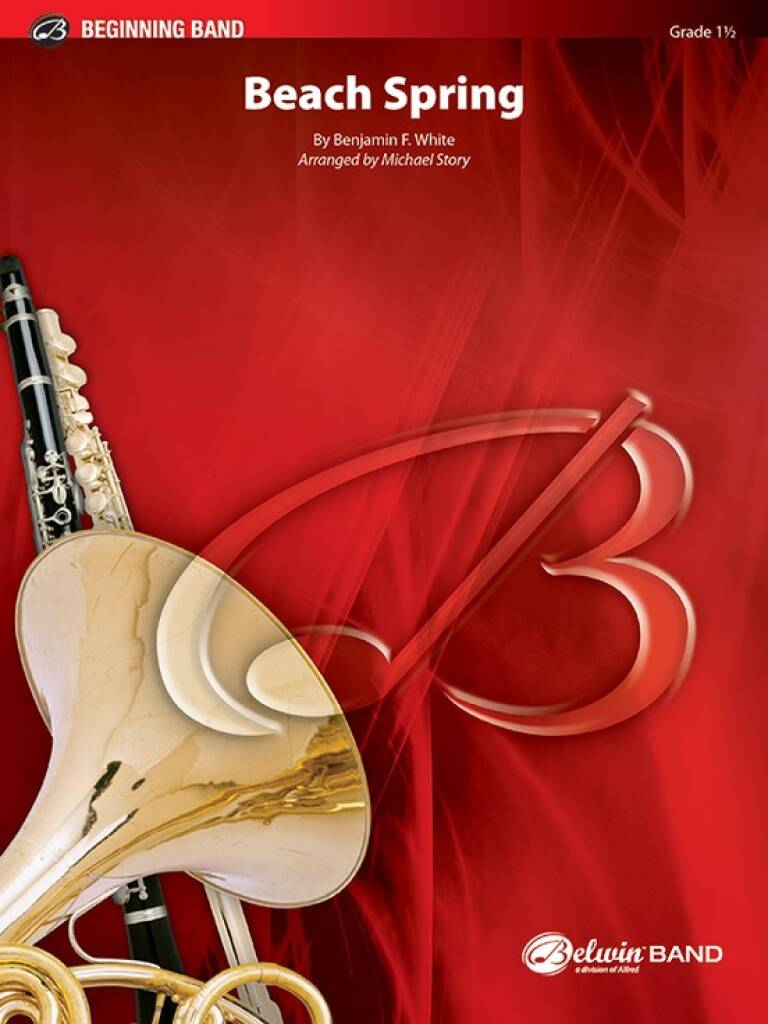
Beach Spring
Originating from The Sacred Harp songbook, the folk-like pentatonic melody of Beach Spring has inspired numerous hymns since 1844. Now expertly arranged for beginning band, this setting captures the song's timeless spirit. It is the perfect vehicle for students to gain experience performing beautiful music in 3/4 meter, with varied musical textures, dynamics, and articulations. (2:00)
Estimated dispatch 7-14 working days
-
 £139.90
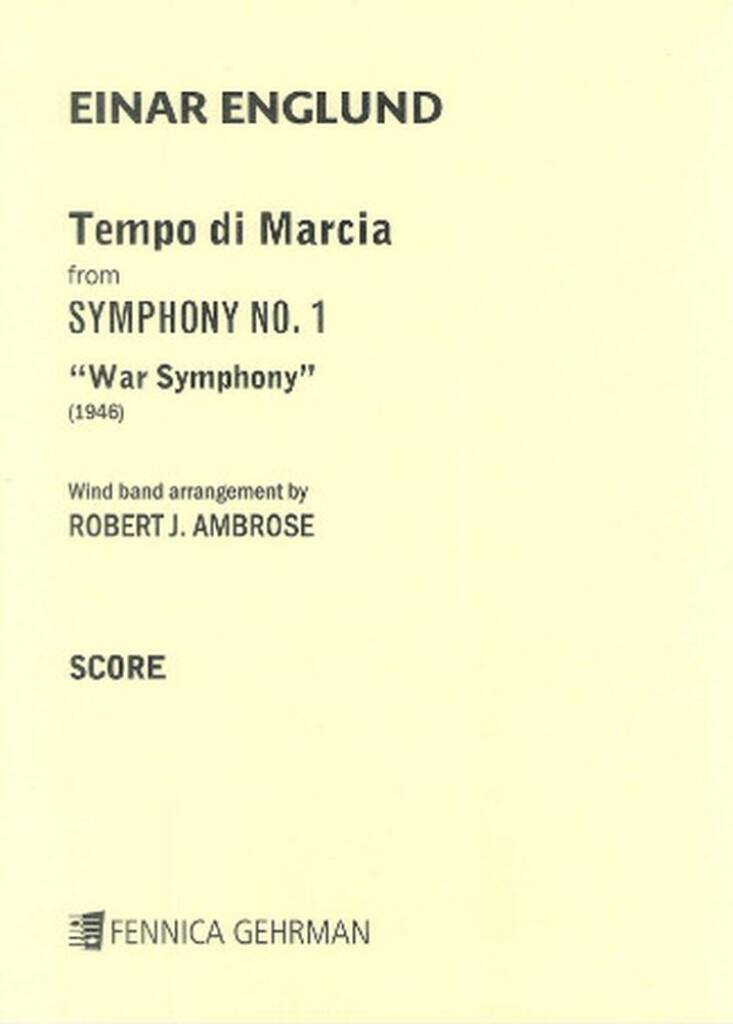
Tempo di Marcia from Symphony No. 1 - Einar Englund
Einar Englund (1916-1999) was a major Finnish composer of symphonies, concertos and film music. His first symphony (1946) bears the title "War Symphony", not given by the composer. He preferred to think think of it rather as a euphoric shout of joy at living to survive the hells of war. The first movement Tempo di marcia depicts seemingly never-ending marching through Karelia during the Soviet-Finnish war. Influences from Sibelius and Shostakovich are present.American conductor Robert J. Ambrose's arrangement of Englund's Tempo di Marcia is scored for wind band. The duration is 9 minutes. This product includes the full score and the parts:PiccoloFlute 1-2Oboe 1Oboe 2 doubling English hornBassoon 1-2Clarinet 1-3 B-flatBass Clarinet B-flatSoprano Saxophone (opt.) (part for alto saxophone II provided in lieu of soprano saxophone)Alto SaxophoneTenor SaxophoneBaritone SaxophoneHorn 1-4 FTrumpet 1-3 B-flatTrombone 1-3Euphonium (BC)TubaTimpaniPercussion 1-4Harp (opt.)Double Bass
Estimated dispatch 7-14 working days
-
 £184.00
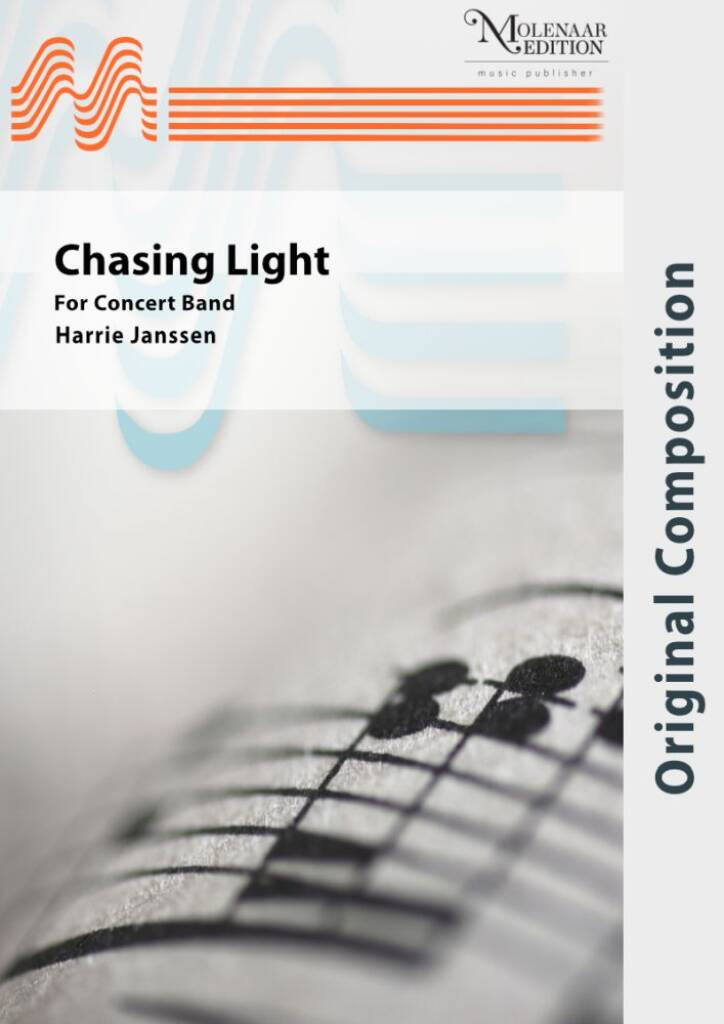
Chasing Light - Harrie Janssen
Chasing Light is a one-part composition in 3 movements. The work opens with a slow introduction, dark in atmosphere, in which the main thematic ingredients are exhibited. This is followed by a fast movement, Chasing Light, in which previously heard thematic material is incorporated. Characteristic of this middle movement is the driving motoric movement that galvanises the aforementioned hunt. An extended Euphonium solo bridges the gap to the final movement. Here ethereal sounds dominate. Harp and Mallets dominate the soundscape, symbolising the light that has finally been achieved.The title Chasing Light can be seen as a metaphor for striving to solve major problems facing the world today, such as the Corona pandemic and the climate problem, among others.Chasing Light was composed on behalf of Stadsfanfaren Izegem, conducted by Hans Demeurisse for the World Music Contest 2022 in Kerkrade.
Estimated dispatch 7-14 working days
-
 £79.99
Hope Arises - James Barnes
Hope Arises is one of two new works requested in 2021 of composer James Barnes by Colonel Donald Schofield, to be written for the United States Air Force Band. It is a short piece intended to be used as an opener for AFB's tour concerts. It opens with a dramatic brass fanfare, based on consecutive perfect fourths first introduced by horns and euphoniums, followed by a short oboe solo. An ascending line in mallets and woodwind provide a rather celestial transition, taking the listener to a lively, melodic allegro, which is based on the same opening fourths. This allegro theme is developed until a return to the opening fanfare is powerfully re-announced in brass. The work concludes quite dramatically, and includes a return of the ascending line in woodwinds, mallets, harp and piano.
Estimated dispatch 7-14 working days
-
 £118.99
Goodnight Moon - Eric Whitacre
Over the past few years I must have read Goodnight Moon to my son a thousand times - maybe more. Somewhere around reading number 500, I began hearing little musical fragments as I read, and over time those fragments began toblossom into a simple, sweet lullaby. I knew it was a long shot, but I asked my manager, Claire Long, to contact HarperCollins and see if they would allow the text to be set to music. To my surprise and delight they agreed - thefirst time they had ever allowed Goodnight Moon to be used in such a way. I composed the piece relatively quickly, originally setting the text for harp, string orchestra, and my son's mother, soprano Hila Plitmann. I laterarranged Goodnight Moon for SATB choir and piano. More recently, my dear friend Verena Msenbichler-Bryant arranged the piece for wind ensemble and soloist. The melody of Goodnight Moon will forever make me think of those quietnights, reading my son to sleep. -Eric Whitacre
Estimated dispatch 7-14 working days
-
 £105.00
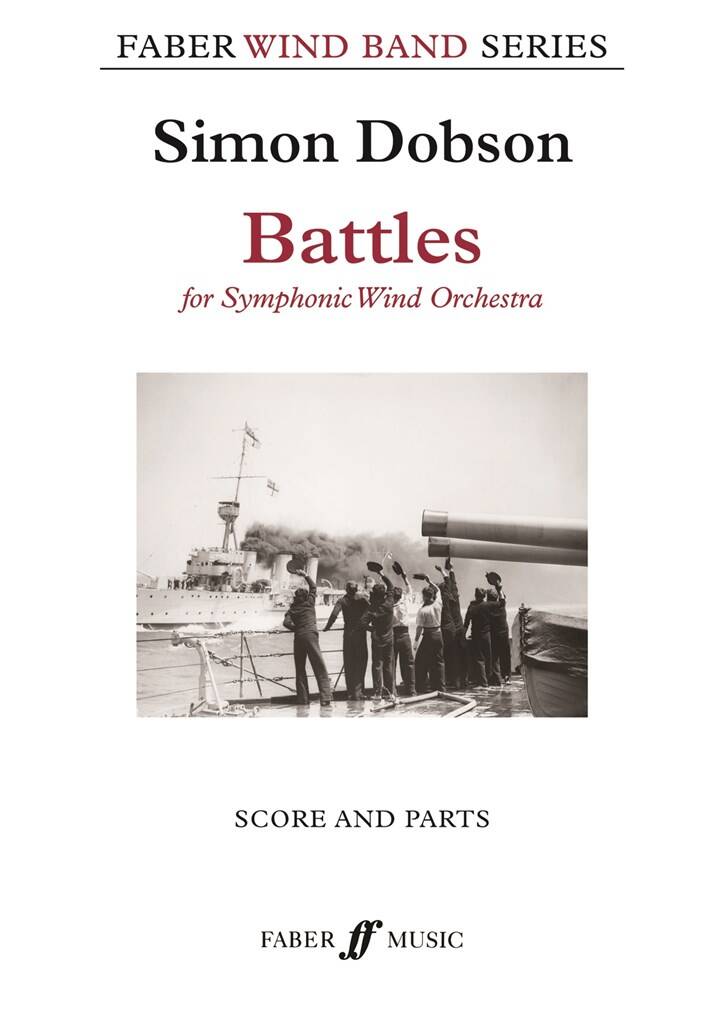
Battles - Simon Dobson
Battles was written for the restoration of the epic 1927 silent film The Battles of Coronel and Falkland Islands, and was commissioned by the British Film Institute (BFI) in 2013. The work presents eight contrasting scenes as a continuous sequence: War, Introduction of Admiral von Spee, German Banquet, Building Steam/Preparing, Islanders, Call to Arms, Great Battle at Sea and Victory. The original score was written for a small chamber orchestra, symphonic brass and a substantial batterie of tuned and untuned percussion. Battles has been edited for symphonic wind orchestra with percussion and harp.Composer Simon Dobson says of hiscolourful score, "I wanted to keep things simple and clear, so there is a British theme, a fanfare march idea, often heard on trumpet, and a German naval theme, which is a more angular motif."
Estimated dispatch 7-14 working days
-
 £84.99
A Golden Jubilation - Satoshi Yagisawa
This work was composed as a commission by the Aikodai Meiden High School Symphonic Band, for the 50th anniversary of their annual concert; the title A Golden Jubilation is a reference to this. The close friendship between Hiroki Ito, theconductor of the band, and Satoshi Yagisawa resulted in this brilliant and exhilarating fanfare of approximately two minutes in length; the piece is ideal to use as a concert opener. The original composition was arranged for an extremely wide rangeof instruments and a band of 200 musicians, including a separate 'banda', harp and a variety of special instruments. This new version has been rescored for standard band instrumentation by the composer himself.
Estimated dispatch 7-14 working days
-
 £520.99
A Colour Symphony - Philip Sparke
Philip Sparke's third symphony, A Colour Symphony, was commissioned by "sinfonischen blasorchester wehdel" conducted by Thomas Ratzek. In the five movements (white, yellow, blue, red and green) the composer creates links betweenthe instrumentation and harmonic elements and the actual colour of the spectrum the movement stands for. In order to create the greatest richness possible, Philip Sparke used a very large instrumentation including low woodwinds, harp, piano andcelli. A Colour Symphony is an impressive and iconic addition to the standard repertoire for large symphonic bands.
Estimated dispatch 7-14 working days
-
 £137.99
Odyssee - Jan Bosveld
The Odyssee tells the story of Odysseus, the undaunted hero. In times long ago the blind poet Homer wrote this famous epic. The "Odyssey" follows the "Iliad", the story of the bloody war between the Greek and the Trojans. This battle endsafter ten years thanks to the Odysseys famous trick. the Trojan Horse. The Odyssey is not a war epic, but a story about perseverance, loyalty, adventure, and the survival instinct of its ingenious hero. In The Odyssey, Homer describes howOdysseus, the king of Ithaca, had to endure another ten years of affliction after the ten years of war in Troy before he could finally return to his home land. During those years, his wife, Penelope, had to try and keep her many admirers away.These men not only wanted het hand but also the kingship. To prove her husbands worth, she played a trick: "As soon as I have finished weaving this shroud for my father-in-law, Laertes, I will choose one of you to become my husband", she promisedthem. But during the night, she secretly loosened what she had woven during the day, prolonging the time until Odysseus would finally return. After twenty long years, when he finally stood at the door, she wondered: Is this really my husband? Ishe an imposter? Cunningly, she asked him to move the bed, because only she and her husband know that the bed was immovable and was build around an old three trunk! Odysseus was deeply moved: this really was his wife, his Penelope! Nearly threethousands years later, the loyalty and strength of this character, and all the dangerous adventures that Odysseus survived thanks to courage and intelligence, still moves us today. Odyssee by Jan Bosveld is not just an adventure story, butrather a characteristic piece in which memories of Homers story can be heard. The composition opens with a firm, stirring theme describing our hero, Odysseus, in detail: This man is not to be taken lightly. The further development of thisshort introduction completes this character sketch: trustworthy, perseverant, and a genius. After that we can picture Odysseus on the lonely beach of Ogygia. Do the trumpets depict his memories of the war of Troy? Does he think of his wife, as werecognise the weaving loom of Penelope in the murmuring eighth? In the solemn, plaintive part that follows, we can imagine Penelope feeling lonely, sitting in the womens room with her servants.One of the girls plays the harp, but that does notclear the sombre atmosphere. Then we can imagine seeing the sorceress Circe, who changed Odysseus men into swine. After she gives a simple magic sign something follows that reminds us of the sound of pigs grunting. Then the Odysseus theme resounds:the hero comes to savi his comrades. Assisted by Hermes, he forces Circe to lift the spell. The piece ends the same way as it began, with an animated theme: Odysseus is still the same, undefeated and not to be taken lighty!
Estimated dispatch 7-14 working days
 View Music