
Results
-
 £157.50
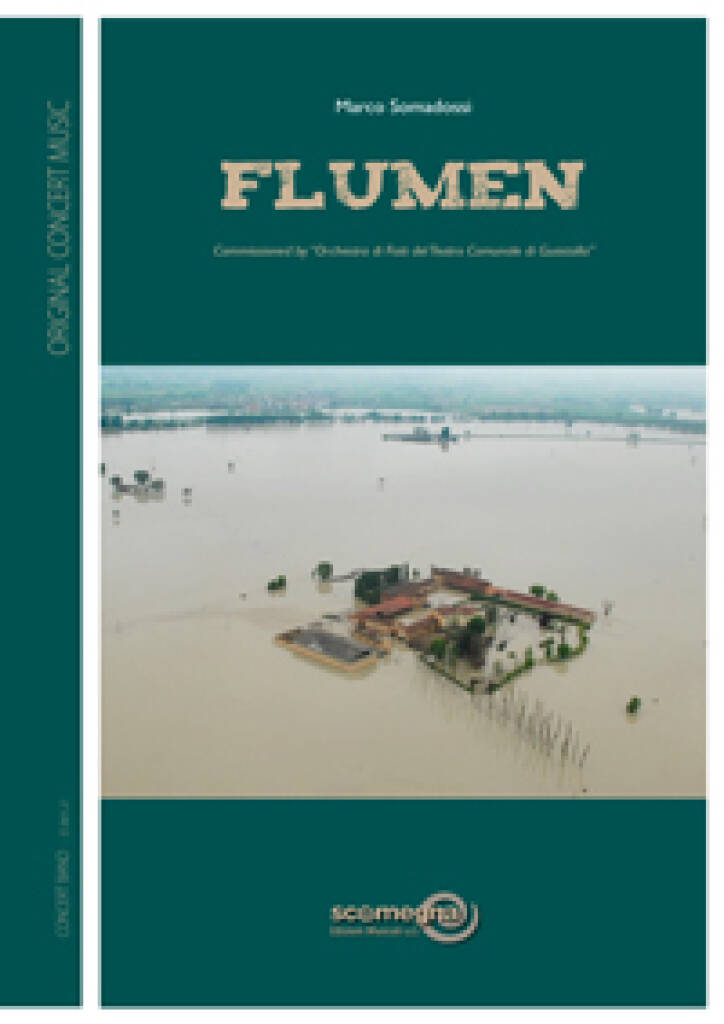
Flumen - Marco Somadossi
In October 2000, the River Po produced its highest flood waters in the last hundred years, provoking a natural disaster of dramatic dimensions. To the thousands of valiant men and women committed to defending their villages against the threat of the flood is dedicated the symphonic poem entitled "Flumen" (river, in Latin), inspired by the thematic material in the Gregorian sequence, "Victimae paschali laudes". The main melody is elaborated and its essence is transfigured in an alchemy of modern sounds from which, at times, archaic echoes emerge. The composition is structured in two parts: the first ("The River") is sullen and menacing, with sounds that portray the turbulent water and the inexorable and frightening rise of the flood;this contrasts with a second section ("The People"), with its primitive rhythms and vaguely multiethnic character (expressed through modal harmonies). Here the work evokes man's ancestral struggle against the forces of nature: the strenuous defence of the Po riverside communities to against the threat of flooding. In the finale, the two themes interweave and overlap, re-establishing a symbolic and primordial equilibrium where man and nature are again in harmony with each other.
Estimated dispatch 7-14 working days
-
 £113.30
Moderate Dances - Angelo Sormani
This piece is a tribute to dance music, especially passionate, intense and meditative dance music. "Moderate Dances" is divided into three movements: a "Tango", a "Slow Waltz" and a "Bossa Nova". Each movement and each dance has its own particular characteristics but, when combined, these different rhythmic beats and times give the piece a feeling of completeness and uniformity. The Tango started to flourish in the suburbs of Buenos Aires in around 1880. There is still some doubt as to its origins, which may be Cuban (Habanera) but are probably African. It was most popular in Argentina and Brazil: here the male protagonist was originally the "gaucho" with his inseparable guitar, later to be replaced by the proud, elegant "compadre". By around 1910 the Tango had spread to Italy and France. New clubs opened, where the upper classes could watch and dance the Tango. Here the dance also underwent some rapid transformations. The exaggerated and extravagant gestures and body movements disappeared. Slow, gliding steps replaced the old rotational movements. The women's red ankle-boots and the partners "staring into each other's eyes" accentuated the erotic nature and sensuality of this dance. So much so that, in 1913, the German government banned soldiers from dancing the Tango. Those who broke the law were immediately discharged from the army. From a strictly musical perspective, the basic instruments were a flute, a harp (the diatonic harp typically played by the Indians of Paraguay) and a violin, or flute, guitar and violin or even clarinet, guitar and violin. These instruments were easy to transport, ideal for playing at parties, in the streets and in courtyards. The musicians played by ear, frequently improvising: there were no scores, no records, which is the main reason why it is impossible to trace the Tango back to its exact origins. However, the Tango's evolution (and growing popularity) was once again fostered by its fundamental ability to absorb "other" cultures, languages and sounds. And it was the arrival of the "bandoneon" (an accordion-like instrument that was invented in Germany and brought to Rio de la Plata by some immigrant), which replaced the flute, that marked the beginning of the Tango's huge success outside Argentina. A number of talented composers, above all the great Astor Piazzola (1921-1992), transformed the bandoneon from a simple accompanying instrument to a solo instrument that was to become the distinguishing feature of the 20th century Tango. The Slow Waltz originated from the Waltz, the typical dance of the Bavarian and Tyrolese peasants in the 1700s. It was composers like Johann Strauss, father and son, who carried the Waltz to its zenith in the 1800s, creating the sensual and melancholy yet joyful and charming dance we are all familiar with. When the Waltz first became popular in Germany, the members of respectable society were shocked at the closeness of the dancing partners, who had always previously danced apart. The main difference between the Waltz and Slow Waltz is that the latter has a slower, more expressive rhythm: the men wear tails and the women wear ball gowns decorated with beads and feathers and couples dance in graceful rotational movements. "Bossa Nova" is the title of the last movement in the piece. Jobim, the great Brazilian musician, described this musical genre as a combination of modern Jazz and Samba. Bossa Nova means "new wave". This was the name of the artistic and musical movement that evolved in Brazil in the late Fifties and was extremely popular throughout the Sixties. The songs are usually about love or social matters, drawing inspiration from the slums of Rio De Janeiro and the lives of their inhabitants. Bossa Nova, with its original compositions and the artistic talent of its musicians, also became hugely popular in the United States and Europe, and top Jazz musicians (Ella Fitzgerald, Stan Getz, Bob Cooper, Charlie Bird, Sonny Rollins, Dexter Gordon, Dizzy Gillespie) started to include Bossa in their repertoires.
Estimated dispatch 7-14 working days
-
 £110.00
Mount Everest - Kees Vlak
This composition basically consists of three fragments and an epilogue (conclusion):1) Plateaux, 2) Sherpas, 3) Climb. The piece starts with a musical depiction of the deserted plateauxs and mountain peaks of the Himalayas. The mysteriousness of theTibetan country was caused by its inaccessibility to other nations. One even believed that there was a paradise behind the huge mountains; the land of Shangra La. 1) After the sound of a gong, the Asian-like theme arises extremely softly from thedecay of the percussion. In bars 4 and 5 the syllables of Hi-ma-la-ya echo. Then a second theme appears; it symbolises the enchantment of the mountaineers by seeing the Mount Everest. 2) Eastern percussion, very evenly without emotion, sound from thedeserted village of the sherpas. The phrasing is prescribed by the number 'three'. From measure 56 Tibetian monks sing a chant, also with the religious background of the number 'three'. 3) The third part starts of with the sight of the giant MountEverest with an entirely new theme, that is played impressively by the strong low brass instruments of the band, immediately followed by the excited big climbing. The many surprises are depicted by the changing time signatures. Two themes are inconstant battle; the binary Himalaya theme and the ternary Mount Everest theme. Only once there is a steely composure. The registers in which the piece is played increase. The tension rises...Then the peak is reached. A long pause follows before onerealises that one is on top of the world. Slowly the emotions of joy grow and lead to an enormous climax. The first enchanted theme sounds again in total glory.
Estimated dispatch 7-14 working days
-
 £104.50
Florentiner March - Julius Fucik
A classic "Grande marcia" in the Italian style, The Florentiner is now available in an edition for modern concert bands. Conductors, musicians, scholars and audiences will enjoy this march in the first American edition that is faithful to the original Fucik manuscript.
Estimated dispatch 7-14 working days
-
 £104.50
Danse Saltarelle - David Gorham
A highly rhythmic contemporary work in the style of the traditional Italian Saltarella, this selection was first presented at the Midwest International Band and Orchestra Clinic in 1999 by the Owasso High School Band from Tulsa, Oklahoma, under the direction of their conductor and the composer, David Gorham. This pieces was an instant success and, with its driving rhythms and great energy, is sure to delight bands and audiences alike.
Estimated dispatch 7-14 working days
-
 £82.50
Cowboys - Daniel Bukvich
Cowboys is a piece in five movements, each of which makes use of the resources of the pentatonic scale. The first movement conjures up western or cowboy images, while the following movements offer a 5/8 dance-like work, called Hop-a-long, a Waltz, a Ghost Town Hoe-Down and Shoot-out and the finale, Stampede.
Estimated dispatch 7-14 working days
-
 £104.50
Marching Along - John Philip Sousa
This popular medley of marches by the "March King" has been a part of the repertoire of the U.S. Marine Band tour concerts for many years. Now available for the first time, bands everywhere can bring a touch of class and this great American musical tradition to their concerts and their audiences.
Estimated dispatch 7-14 working days
-
 £121.00
Concerto #2 For Piano and Wind Ensemble - Walter S. Hartley
A major work for virtuoso soloist and virtuoso wind ensemble. This work by a master craftsman shows the musical integrity and compositional skills that have earned him a position in the first rank of American composers. One of the best works ever written for this combination, this concerto provides the serious conductor and the mature wind ensemble with a brilliant work for exciting results.
Estimated dispatch 7-14 working days
-
 £71.50
Ancient Ritual - Elliot Del Borgo
This programmatic work depicts a primitive rite in sound. Cast in three sections, the piece uses contemporary harmonies and colorful percussion to display the moods and energies of a long-ago ceremony. This is the first addition to this series by the prominent American composer Elliot Del Borgo, and adds a new dimension. (3 minutes)
Estimated dispatch 7-14 working days
-
 £104.50
Honey Boys On Parade - Edward Victor Cupero
This is the best known of the many works written by E.V. "Honey Boy" Cupero during his successful career as a cornetist, band leader, music director, arranger, and composer. First published in 1914, it is a classic example of marches from this era, and it was very popular with American minstrels and circuses.
Estimated dispatch 7-14 working days
 View Music