
Results
-
 £108.50
Matt Bianco Medley - Mark Reilly
Do you remember this one? In the 80's the British pop group Matt Bianco had a number of big hits, three of which have been incorporated into this medley. After an easy More Than I Can Bear, we go to the samba groove of Half A Minute, swinging out with Get Out Of Your Lazy Bed.
Estimated dispatch 7-14 working days
-
 £64.40
Heroes of the Air - Rui Silva
Heroes of the Air (Bravos do Ar) is a musical work that was written to celebrate the 100th Anniversary of the Military Aviation in Portugal. It was premiered on May 14, 2014 at the opening ceremony for the occasion of the inauguration of the evocative monument at Air Base n.1, Sintra. The author imbued by the spirit of the pioneers of Portuguese aviation, builds this work with elements where the bravery, courage, and perseverance mark the character of this festive fanfare.
Estimated dispatch 7-14 working days
-
 £92.00
Medieval Hymn Variations - Naoya Wada
Guido d'Arezzo(992 - 1050) was an Italian music theorist of the Medieval era. He developed new techniques for teaching, such as staff notation and the use of ut-re-mi-fa-so-la (later, ut became do). The original monophonic melody is written in organum in the first part, then developed in 3 modern variations, to end with a passionate finale. After the premire in 2015, the piece was revised drastically, and was performed in its final edition in 2016.
Estimated dispatch 7-14 working days
-
 £59.80
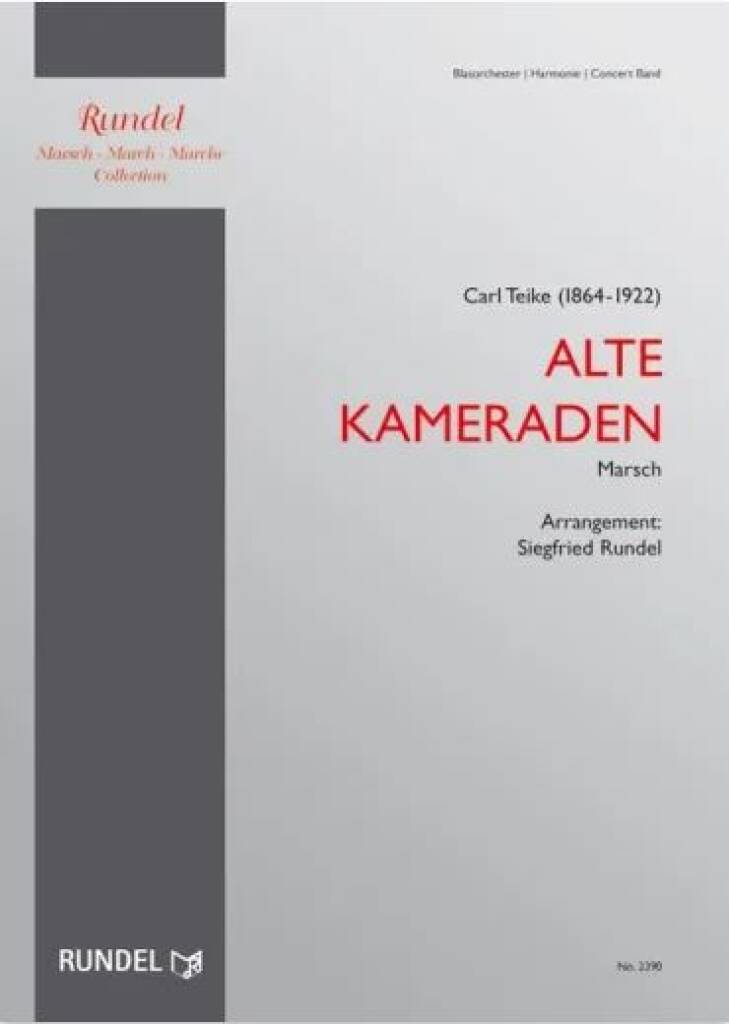
Alte Kameraden - Carl Teike
It is the greatest tragedy in the life of a young composer if he happens to write his most successful piece at the beginning of his musical career. This holds true for Carl Teike, as the unsurpassed success at the beginning of his musical life was his march "Old Comrades". It is a sparkling piece that may well be labeled to be the German "march of marches". Carl Teike was born on Feb. 05, 1864 in Altdamm. After his parents had moved to Stettin, he had early contacts with military music as a youngster. The enthusiasm for this kind of music never left him throughout his life. He began a musical apprenticeship with City Music Director Bttcher in Wollin and already played in the spa orchestra of Bad Misdroy, which Bttcher conducted. Upon completing his apprenticeship, he enlisted as a volunteer in the band of the (5th Wrttemberg) King Karl Grenadiers No. 123 in Ulm. The musical and military environment there proved to be ideal for the ambitious young musician, who hoped to eventually study band music at the University of Music in Berlin. Above all, his military superior, bandmaster Julius Schreck supported young Teike wherever he could. Unfortunately the time in Ulm took a very unhappy turn, as Schreck's successor was extremely resentful towards Teike, and musical support was replaced by sheer harassment. On account of this, Teike retired from the military towards the end of 1889. Short employments in Ravensburg and Ulm evidently did not suit Teike, who was of northern German descent. This is why he applied for the Royal Police Force in Potsdam. Teike was accepted and entered service in 1895. The royal capital of the Hohenzollerns obviously stirred Teike to write a number of brilliant marches. He even became known abroad as the "musical policeman". Unfortunately he contracted a severe pneumonia while on duty, which eventually forced him to retire from the Royal Police Force in Potsdam. On February 01, 1909 he and his family moved to the prosperous provincial city of Landsberg on the Warthe (which is located east of Berlin in present-day Poland). There, Count Clairon d'Haussonville proved to be an understanding superior who paved the way for modest Carl Teike to continue composing, as his creativity had not suffered from this move. The disease which he had caught in Potsdam evidently was more severe than he was inclined to accept. In spring 1922, his state of health became worse, and in May of that year he passed away. Much too early - as many people felt. Teike's marches constitute an enrichment of the German concert march, as he never composed any street marches. Clear structures, musical ingenuity and a multitude of tone colors distinguish his works and shape them into something really new. It is this type of the march in particular that became the bedrock of the universal appeal of the German march. Even today Teike's marches stand unrivaled for musical quality and content - and they never are aggressive. Toward the end of his tour of duty in Ulm, Teike handed a new march to his superior, which, at the time, did not have a title yet. He in turn told Teike to "put it in a stove and burn it". As we know today, this was a classic misappraisal, as Teike subsequently named his march "Old Comrades" in view of his impending retirement. We do not even need to discuss the acceptance the march has met and still meets all over the world, as "Old Comrades" simply always has been a march of universal appeal. In his new arrangement, Siegfried Rundel did not change the essence of Teike's music, he rather sensitively adapted it to modern musical practice and to the instrumentation of the symphonic band on the basis of his deep respect for the works of Carl Teike.
Estimated dispatch 7-14 working days
-
 £67.95
Primal Dance - Andrew Poor
Andy Poor always writes fun music for beginners. While playing an easy melody, the students get to clap and stomp their feet. The shortest valued rhythms are eighth notes. Clarinets do not cross the break. 1st trumpet's highest note is A.
Estimated dispatch 7-14 working days
-
 £67.95
March of the Wandering Wnderpus Octopus - Amy Webb
This is a fun march that audience and students alike will love! It is very easy with very easy syncopation which makes it such a fun rhythm to play. Clarinets do not cross the break. 1st trumpet's highest note is C.
Estimated dispatch 7-14 working days
-
 £67.95
Asian Folk Song Medley - Gerald Sebesky
This medley combines two songs, The Shepherd, from China, and Sakura, from Japan. It is very easy and a great cultural addition to your concert. Clarinets do not cross the break. 1st trumpet's highest note is C.
Estimated dispatch 7-14 working days
-
 £67.95
Appalachian Serenade - Gerald Sebesky
The original title of this folksong is "Every Night When The Sun Goes In." It is a very pretty song and very easy for beginner band. Clarinets do not cross the break. 1st trumpet's highest note is C.
Estimated dispatch 7-14 working days
-
 £67.95
A Cool Jazz Groove - Randy Navarre
In this composition, the young students get to experience real jazz harmonies. While being a very beginner piece, it sounds like a song any band will want to play. 1st trumpets highest note is B flat. Clarinets do not cross the break.
Estimated dispatch 7-14 working days
-
 £67.95
S'Vivon - Andrew Yozviak
"S'vivon" is a popular Hanukah song. The word means "dreidel" (a spinning top) and this celebratory song reminds us of the traditions of the holiday. They rhythm involves easy eighth/quarter note/eighth note syncopation. It is an easy song to play. Clarinets do not cross the break. 1st Trumpet's highest note is C.
Estimated dispatch 7-14 working days
 View Music