
Results
-
 £186.20
Ricercare Harmonie
The original 16th century Ricercare was actually a vocal work without words.Instrumental music is in search of its independence: the content was so to say a musical invocation.The Ricercare in this case is an invocation of the various themes - seemingly contradictory - yet forming a symphonic unity, which is attained by their contrast and their dialogue in counterpoint.One of these themes is formed by the tones B - A - C - H (B = German for B-flat; H = German for B-natural).This Ricercare has nothing to do with the old Motet character.
Estimated dispatch 7-14 working days
-
 £92.00
The Supreme Diana Ross - Pi Scheffer
The American singer and actress Diana Ross was soloist with the popular female group 'The Supremes' from 1964 to 1969. With the song 'You keep me hanging on' the group was number one in the hitparade for twelve consecutive weeks. In 1970 Ross started a solo career both as singer and actress (Lady sings the Blues 1972). Many of her songs, such as Touch me in the Morning (1972), Love Hangover (1976) and Endless Love (1982) became extremely popular. The famous Dutch bandleader, composer and arranger Pi Scheffer made this splendid arrangement combining some of Ross's successful songs. The hits in this arrangements are: Do You Know, Reach out and Touch, Stop in the name of love
Estimated dispatch 7-14 working days
-
 £159.60
Sculptures Of An Exhibition - Kees Vlak
This composition was commissioned by the village of Midden-Beemster to commemorate the 375th anniversary of the polder of the same name. It was premiered in august 1987 by the Beemster Fanfare Band. On this occasion some twenty sculptors were invited to create a work of art. Those sculptures were set up at the most picturesque areas of the polder. On a 40 km long bicycle route one can admire the curious statues wile enjoying the beautiful scenery as well. The compostition is based on two themes: a main theme and the promenade theme.1.Introduction: After the grandiose presentation of the main theme, on the dominant, we leave the village to the sound of some pretty music.2.Promenade and Watchman: After some time, we discover a dark statue hidden in the bushes; it is shaped like a square standing on one of its corners. It is called "Watchman". We hear the promenade theme as a solo and all next themes will be variations.3.A Building of Willow-trees: Far away on a dike, we discover the huge skeleton of a kind of house. It is a construction of skilfully interwoven willow-branches. The musical themes are also interwoven. The sculpture is called "Construction of wood used by the farmers".4."Die Flsse, ah die Flsse"and Promenade: We continue our trip and see now a horn of plenty, made of brown ceramics and set up on the green slope of an old fortress. The sun shines on the sheep being at pasture under the willow-trees. No doubt, this scene will have something to do with abundance.5.Cardplayers in front of the Nightingale: A statue in cast iron, representing two carplayers, has been erected in front of the windmill called "The Nightingale". This sculpture suggests a rather animate atmosphere. The opponents with the trumpets and the trombones suggest the cardgame. The trumpets are constantly changing from players. At a certain moment the trumpet gets hold of the decisive trick and starts a victorious blow. The trombone, however, repeats this shout of joy with quite some perverse delight and in a completely wrong pitch. The game continues and after a climax all cards are finally thrown on the table.6.Autumn and Promenade: The trip now brings us a white sculpture in ceramics, decorated with some autumn leaves. Is this a seated man or a chair? Anyway, it looks very nostalgic. This is the time for a moment of reflection with the oboe or the saxophone. It is called "Autumn".7. The Powerlifter: Somewhat hidden in a ditch, we discover a small statue in cast iron, representing a powerlifter who is going to give way under the weight. The music uses the main theme with powerlifting euphoniums, saxophones and clarinets.8.The Bull: Here we have another cast iron sculpture, but this time it is a really powerful figure. This "Bull" statue uses the same theme as that of the powerlifter, but it gets a stronger foundation from the bass insturments.9.Mirror and Promenade: While strolling alongside the channel we suddenly see four mirrors. They not only reflect themselves, but also mirror in the water of the channel. These reflections are suggested by the use of tuned percussion. The promenade theme is also used in mirror image.10.Reflictions or...?: On top of the dike we have a nice view on a farmyard with its orchard. A very big net, coverd with sparkling tin plates, has been stretched between the trees. This sculpture is called "Reflections of ...?. Of what? Yes, of course, reflections of the times when the polder was a lake and the sun was reflecting in the wild waves.11.Willpower: Finally we discover a big statue in cast iron. It is not clear whether it is a man or a woman. Anyway the enormous bundles of muscles in the legs and the thighs are striking. This sculpture is called "Willpower". The idea of determination is musically suggested by a very long preamble to the promenade theme in one great stringendo, leading to the conclusion of the trip.12.The beautiful country: Here we have the most beautiful picture. The magnificent Beemster Polder in bloom. We see a nice windmill with decorated wings. We hear the main theme, now on the tonic.
Estimated dispatch 7-14 working days
-
 £90.30
Suite on Russian Dances - Terry Kenny
Since the Soviet Union no longer seems to be that far away from our Western World, we are eager to know Russian music better. Of course, we do prefer the music by Russian composers (such as Salnikov's Children's Symphony). Though many Westeuropean composers now get inspired by the penetrating Russian folk music. Terry Kenny's suite has got three parts: Rondo, Romance and Trepak.
Estimated dispatch 7-14 working days
-
 £186.20
Ballet Dreams - Coby Lankester
The script for Ballet Dreams: A young ballerina is dancing for some time already in a ballet company. She is part of the Corps de Ballet but still hopes for better. When the company studies a new ballet she is granted a small solo part. This will be the fulfillment of a long cherished dream.On the day of the premiere she goes to the theatre in the early morning. As the solo performance is so near she feels very nervous and wonders whether everything will be all right that night. She starts making exercises with the orther girls. When the dancers leave she continues to exercise by herself and tries out her solo part. She does not do well and feels very tired. She sits down on a bench in the corner of the ballet room and thinks she needs some rest; so she lies down and falls asleep.She dreams she is standing in the ballet room, trying to rehearse her solo dance performance. But she does not succeed to dance as she wants and she gets more and more nervous. Suddenly she makes a wrong movement and falls down; her ankle is bruised and so she cannot dance at all.She is desperate and quite lonely because her dream goes up in smoke. She is now surrounded by a group of doctors, who examine her ankle, put on a bandage and tell her to rest. When the doctors disappear a gang of little devils come into the ballet room; they tease our poor dancer and threaten her with little arrows, while they keep dancing and stamping. The ballerina tries to get rid of the little monsters, but in vain. This looks like a real nightmare!All of a sudden the devils and the pain disappear. She tries to get up and awakes little by little. She now realizes it was only a bad dream. She feels relieved and goes to the dressing room in order to dress for the premiere performance. Her solo performance in the finale of the ballet is a real big success. Her most precious dream has been fulfilled, in spite of or thanks to the nightmare.
Estimated dispatch 7-14 working days
-
 £186.20
Fin de Siecle - Henk Alkema
About his composition 'Fin de Sicle', completed in 1995, Alkema writes: 'At the end of each century 'everything is allowed' for some time. Everything is being summarized and eventually leads to a last climax. I felt that same feeling of freedom when I started composing 'Fin de Sicle'. Everything is allowed. I did not want to summarize all musical expressions of the twentieth century; I only wanted to summarize my own experiences. To me, this music is the very end and yet also the beginning of something else. I do believe in evolution and growth.'
Estimated dispatch 7-14 working days
-
 £140.80
Belvedere Suite - Wilhelm Koenen
Part One: 'Danse mditerranenne'This part is composed of stylized folkmusic elements from several regions of Mediterra-nean countries. If this music recalls memories of your holidays on the sunny beaches, the composer will have reached his goal.Part Two: 'Impression'This part is meant as a contrast with the first and the third parts. The conductor should not stick to the metronome tempo, but he can express his own interpretation by means of 'rubato playing'. This 'impression' was inspired by the Provence landscape.Part Three: 'Marche grotesque'We deliberately used non-typical characteristics of the traditional march. The underlying idea is: A band starts playing a march at the ordinary marching tempo. There is already a mistake at measure 4 when some musicians play the wrong bar which causes the fifers to start too early with the drum and fife signals. A grumpy 'Stop' brings and end to the false start by means of a pathetic quaver (eighth note). The drummers however continue to play their drum beats, so the fifers start again and play very quickly in order to catch up with the drummers. They even manage to do so, thanks to that late quaver (eighth note). The band now also starts to play again and reacts to this chaos by laughter. The march that comes next does not match the metric characteristics of the usual march. The woodwinds, dreaming of holidays, get caught in a Tarantella. A compelling signal by the trumpets and the horns, soon joined by all band registers, leads the band back to reality. We deliberately chose well-known 'secondary parts' in order to make the audience accept the 'out-of-tune playing'. Original themes would not have had the same effect. The whole composition is just one great musical joke. If the audiance chuckles the composer will have achieved his aim. The third part is extremely well suited to end a concert or to be used as encore.
Estimated dispatch 7-14 working days
-
 £186.20
Overture for a Summer Afternoon - Georgy Salnikov
We still do not understand why the excellent Russian composer Georgi Salnikov did not yet completely break through as band music composer in Western Europe. His exquisite music for symphonic band boasts all ingredients to appeal to large audiences. Molenaar Edition already published several of his compositions, such as Burleske, Children's Suite, Poem for French Horn and Symphonic Band and Russischer Reigen. The merry Overture for a Summer Afternoon opus 51 is a most welcome addition to this specific original repertoire. As always, Salnikov's signature guarantees a composition of high quality.
Estimated dispatch 7-14 working days
-
 £74.10
Funny Girls - Patrick Millstone
Funny Fay', 'Dixie Trix' and 'Swinging Sarah' are the names of the 'girls' in this new exciting piece by Patrick Millstone. Do invite those girls to join you on the dance floor.
Estimated dispatch 7-14 working days
-
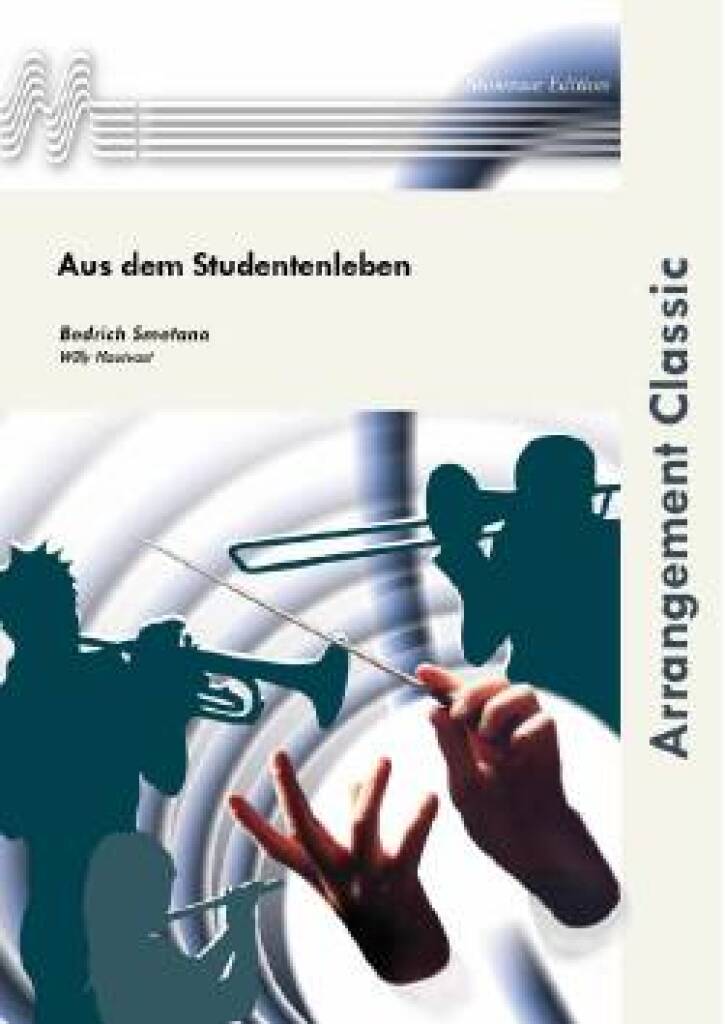 £53.30
Aus dem Studentenleben - Bedrich Smetana
For Bedrich Smetana, the polka was the source of typical Czech music par excellence. We do not only find it in his operas, symphonic works and chamber music, but he also wrote single or separate polkas. Smetana's first polkas were written when he was still a student and they were composed for dancing. This is also the case for this polka 'Aus dem Studentenleben' (Pictures of a student's life). It was originally written for piano. It is cheerful music with a lot of variety and, above all, a typical Czech character.
Estimated dispatch 7-14 working days
 View Music