
Results
-
 £76.99
You'll Never Walk Alone (Concert Band - Score and Parts) - Hammerstein & Rodgers - Foster, Larry
This great football anthem, made famous worldwide when sung against the background of the Eiffel Tower to close the 1998 World Cup, can now be played and enjoyed by your brass band. An ideal piece to close any concert with.Duration: 3:15
Estimated dispatch 7-14 working days
-
 £137.95
Sinfonietta No.1 (Concert Band - Score and Parts) - Sparke, Philip
Sinfonietta No.1 was commissioned by the Foundation of Friends of the Marine Band of the Royal Netherlands Navy. It was first performed by them in 'De Doelen', Rotterdam on the 13th November 1990 (in a joint concert with the Royal Marines Band from Great Britain) which celebrated the 325th anniversary of the Netherlands Marine Corps and coincided with the 45th anniversary of the band and the 175th anniversary of naval music in the Netherlands.The work is in three, linked movements:I: OvertureSeveral contrasting motivic ideas open the work, but none manage to develop into a theme of any sort. Eventually a short theme appears on clarinet, alto saxophone and horn but it is swept away by runs of triplets from the woodwinds. The theme returns, accompanied by the triplets from the woodwinds. The theme returns, accompanied by the triplets, and this leads to a return of the opening material to close the movement.II: AriaThe second movement opens with violent outbursts from the timpani until a simple, mournful tune is presented by flute and bassoon over a sparse accompaniment by the lower brass. Trumpets introduce a quicker, turbulent central section but this leads back to a brief repeat of the original tune, bringing the movement to a peaceful close.III. ScherzoThe final movement is a fast and furious scherzo which bursts into life with a flurry of notes. The vivacious main (woodwind) theme is first played by the flutes and then by the whole woodwind section. A cornet then takes centre stage with a fanfare-like theme which is then taken up by the brass. A bridge passage then leads to a version of this theme for full band. The original flute tune is then developed until the horns introduce a chorale tune which is taken up by saxes and then full band until the opening material reappears. The woodwind and brass themes are then combined and lead to a forceful version of the chorale which becomes more and more dissonant until the opening of the Overture returns to bring the work to a rousing finish.Recorded on QPRM134D THE KINGS GO FORTH, Central Band of the Royal Air Force
Estimated dispatch 7-14 working days
-
£27.95
Sinfonietta No.1 (Concert Band - Score only) - Sparke, Philip
Sinfonietta No.1 was commissioned by the Foundation of Friends of the Marine Band of the Royal Netherlands Navy. It was first performed by them in 'De Doelen', Rotterdam on the 13th November 1990 (in a joint concert with the Royal Marines Band from Great Britain) which celebrated the 325th anniversary of the Netherlands Marine Corps and coincided with the 45th anniversary of the band and the 175th anniversary of naval music in the Netherlands.The work is in three, linked movements:I: OvertureSeveral contrasting motivic ideas open the work, but none manage to develop into a theme of any sort. Eventually a short theme appears on clarinet, alto saxophone and horn but it is swept away by runs of triplets from the woodwinds. The theme returns, accompanied by the triplets from the woodwinds. The theme returns, accompanied by the triplets, and this leads to a return of the opening material to close the movement.II: AriaThe second movement opens with violent outbursts from the timpani until a simple, mournful tune is presented by flute and bassoon over a sparse accompaniment by the lower brass. Trumpets introduce a quicker, turbulent central section but this leads back to a brief repeat of the original tune, bringing the movement to a peaceful close.III. ScherzoThe final movement is a fast and furious scherzo which bursts into life with a flurry of notes. The vivacious main (woodwind) theme is first played by the flutes and then by the whole woodwind section. A cornet then takes centre stage with a fanfare-like theme which is then taken up by the brass. A bridge passage then leads to a version of this theme for full band. The original flute tune is then developed until the horns introduce a chorale tune which is taken up by saxes and then full band until the opening material reappears. The woodwind and brass themes are then combined and lead to a forceful version of the chorale which becomes more and more dissonant until the opening of the Overture returns to bring the work to a rousing finish.Recorded on QPRM134D THE KINGS GO FORTH, Central Band of the Royal Air Force
Estimated dispatch 7-14 working days
-
 £67.50
You'll Never Walk Alone (Concert Band - Score and Parts) - Hammerstein & Rodgers - Oud, Thijs
This great football anthem is now infamous as the song sung by 'the kop' at Liverpool Football Club. It was however made famous worldwide when it was sung against the background of the Eiffel Tower to close the 1998 World Cup. It can now be played and enjoyed by your concert band with this great arrangement. An ideal piece to close any concert.Duration: 2:10
Estimated dispatch 7-14 working days
-
 £164.95
Euphonium Concerto (Concert Band - Score and Parts) - Ellerby, Martin
This Euphonium Concerto was written between late 1994 and early 1995 in response to a commission from Steven Mead to whom the work is dedicated. It is cast in four movements and lasts a little over 22 mins:I. Fantasy: After the briefest of introductions, the solo euphonium enters with the key melodic phrase of the movement in a fast 'Tempo I'. This idea is developed up to the point where a slower 'Tempo II' breaks the argument - here the mood is reflective but it is only to be a brief interruption as 'Tempo I' returns very quickly. The opening material is then subjected to further transformation with 'Tempo II' making occasional returns en route, the distances between the contrasting tempi becoming ever closer, and the movement closes in a rather soft though definite manner.II. Capriccio: This relatively short presto movement forms a bridge between the first movement and the work's slow movement. The majority of the band parts are bright and muted with the percussion players enhancing the texture with contributions from xylophone, glockenspiel and vibraphone. Again the initial solo euphonium phrase provides the basis for almost all the movement's material. This is extremely virtuosic for the soloist and band alike and makes great play of the rhythmic possibilities of combining simple and compound music either in close proximity or together.III. Rhapsody (for Luis): A Lento movement, sitting between two different but essentially rapid ones, this provides the work's emotional core exploiting the soloist's cantabile qualities in an almost seamless fashion. Again, as will all the work's movements, the initial idea paves the way for subsequent development, eventually culminating in a passionate climax; thereafter it winds down with an affectionate backward glance towards the close of the the slow movement of the Euphonium Concerto of Joseph Horovitz, whose mark had been made indelibly on the euphonium repertoire. This movement is dedicated to Luis Maldonado who set the full score of the brass version before his untimely death.IV. Diversions: The work's variation finale is cast in 3/4 throughout though the barline is often a guideline and was seen by the composer as a challenge of metrical restraint! There is an obvious jazz feel to this movement (both rhythmically and harmonically) with a swaggering ritornello theme first announced by the solo euphonium. Thereafter follows a series of interludes and 'adjusted' returns of the main theme. A lyrical idea is allowed to enter but the underlying momentum is ever present. The band also contributes to the interludes and eventually the tempo increases towards a 'wild' and absolute conclusion.Duration: 22.30Recorded on QPRM143D Dreamscapes, Royal Northern College of Music Wind Orchestra
Estimated dispatch 7-14 working days
-
£32.95
Euphonium Concerto (Concert Band - Score only) - Ellerby, Martin
This Euphonium Concerto was written between late 1994 and early 1995 in response to a commission from Steven Mead to whom the work is dedicated. It is cast in four movements and lasts a little over 22 mins:I. Fantasy: After the briefest of introductions, the solo euphonium enters with the key melodic phrase of the movement in a fast 'Tempo I'. This idea is developed up to the point where a slower 'Tempo II' breaks the argument - here the mood is reflective but it is only to be a brief interruption as 'Tempo I' returns very quickly. The opening material is then subjected to further transformation with 'Tempo II' making occasional returns en route, the distances between the contrasting tempi becoming ever closer, and the movement closes in a rather soft though definite manner.II. Capriccio: This relatively short presto movement forms a bridge between the first movement and the work's slow movement. The majority of the band parts are bright and muted with the percussion players enhancing the texture with contributions from xylophone, glockenspiel and vibraphone. Again the initial solo euphonium phrase provides the basis for almost all the movement's material. This is extremely virtuosic for the soloist and band alike and makes great play of the rhythmic possibilities of combining simple and compound music either in close proximity or together.III. Rhapsody (for Luis): A Lento movement, sitting between two different but essentially rapid ones, this provides the work's emotional core exploiting the soloist's cantabile qualities in an almost seamless fashion. Again, as will all the work's movements, the initial idea paves the way for subsequent development, eventually culminating in a passionate climax; thereafter it winds down with an affectionate backward glance towards the close of the the slow movement of the Euphonium Concerto of Joseph Horovitz, whose mark had been made indelibly on the euphonium repertoire. This movement is dedicated to Luis Maldonado who set the full score of the brass version before his untimely death.IV. Diversions: The work's variation finale is cast in 3/4 throughout though the barline is often a guideline and was seen by the composer as a challenge of metrical restraint! There is an obvious jazz feel to this movement (both rhythmically and harmonically) with a swaggering ritornello theme first announced by the solo euphonium. Thereafter follows a series of interludes and 'adjusted' returns of the main theme. A lyrical idea is allowed to enter but the underlying momentum is ever present. The band also contributes to the interludes and eventually the tempo increases towards a 'wild' and absolute conclusion.Duration: 22.30Recorded on QPRM143D Dreamscapes, Royal Northern College of Music Wind Orchestra
Estimated dispatch 7-14 working days
-
 £139.99
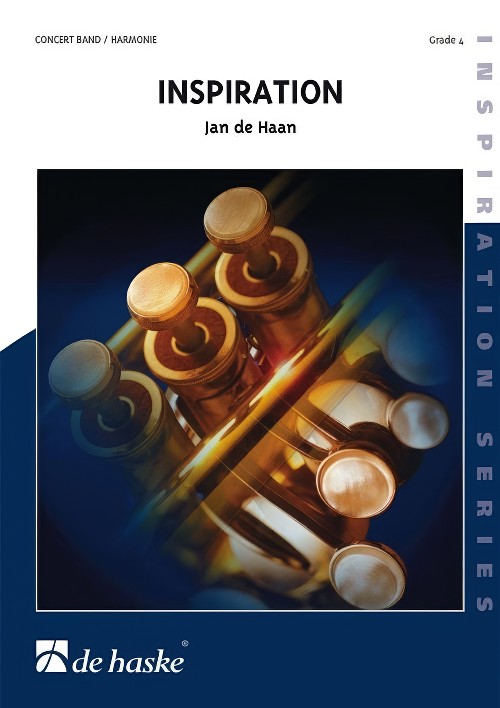
Inspiration (Concert Band - Score and Parts) - De Haan, Jan
Inspiration was commissioned by the Solothurnischer Kanotonal Musikverband in Switzerland in 1993. The composition begins with an A-theme written in a Phrygian tonality and, after an enormous climax, moves on into a quicker B-section, characterized by the use of wide interval jumps. Then follows the development in which both themes return individually and together. Peace and quiet is restored in the slow middle movement, based on the B-theme. The movement comes to a close with a tutti B-theme, brutally interrupted by fragments from the A-theme. Without a break, the final movement of this contrastive piece develops from these fragments. The theme of this extremely rhythmical closing movement is built up of elements from the A-theme, whilst the B-theme (from the slow middle movement) returns in full once more. Before the piece comes to a close in a resounding fortissimo, the cornet soloist performs the A-theme from the back of the auditorium, to special effect.Duration: 10:00
Estimated dispatch 7-14 working days
-
 £154.99
Deux Mouvements (Alto Saxophone Solo with Concert Band - Score and Parts) - Waignein, Andre
Early in 1989 Jean Baily, director of the Royal Conservatoire in Bruxelles, asked his very close friend Andre Waignein to compose a piece which could be performed by the conservatoire's saxophone class. Andre Waignein was readily agreeable. Not only was his father a saxophone player, but himself felt strongly attracted to the instrument and he was further encouraged into accepting the commission by his friend Alain Crepin, saxophone teacher at the Bruxelles Conservatoire.The piece he composed consists of two movements, hence the title. An elegy is expressed by means of a melody which is full with pronounced magnanimity, full of spectacular musical freedom enabling the soloist to express himself to the full. In this movement the melodic element is of the utmost importance.The capriccio, the second movement is musically disconcerting. The band's accompaniment is particularly important. Due to the high notes, the soloist brings this capriccio to a close with enthusiastic virtuosity.Duration: 9:15
Estimated dispatch 7-14 working days
-
 £64.35
A Quiet Journey Home
Based on the well known spiritual, "His Eye Is On The Sparrow", this Grainger-esque setting is an outstanding programming choice for better bands. Pitched in the key of Db, the close harmonies require mature legato phrasing and close attention to dynamics at a slow tempo. Challenging, but well worth the effort, "A Quiet Journey Home" is an eloquent composition that will allow your group to expand its musical horizons. Very highly recommended!
Estimated dispatch 7-14 working days
-
 £87.95
St. Francis Variations (Concert Band - Score and Parts) - Wheeler, Alastair
Variations on St Francis is a set of four contrasting movements based on the sturdy 17th century hymn tune Lasst uns erfreuen, best known as St Francis after its composer with associated words "All creatures of our God and King". Although often notated in various metres, the tune's original unbarred freedom and Vaughan Williams' later 3/2 setting both inform this work's flexible approach to rhythm and stress.The piece is built from three ideas: the bold opening line of the tune, descending peals of Alleluia, and the answering response phrase.A grand March opens the work, with open-fifth fanfares and flowing Alleluia countermelodies. The Dance that follows shifts the response into a minor key, driven by syncopation and playful overlapping lines. A lyrical Cantabile / Intermezzo, led by cor anglais (or alto saxophone), offers contrast before a Rondo Scherzo reimagines the tune in a quirky modal style, featuring falling thirds and bright harmonic colour. A confident Coda brings the work to a close with chorale statements launched from the percussion section.Duration: 7.30
Estimated dispatch 7-14 working days
 View Music