
Results
-
 £102.80
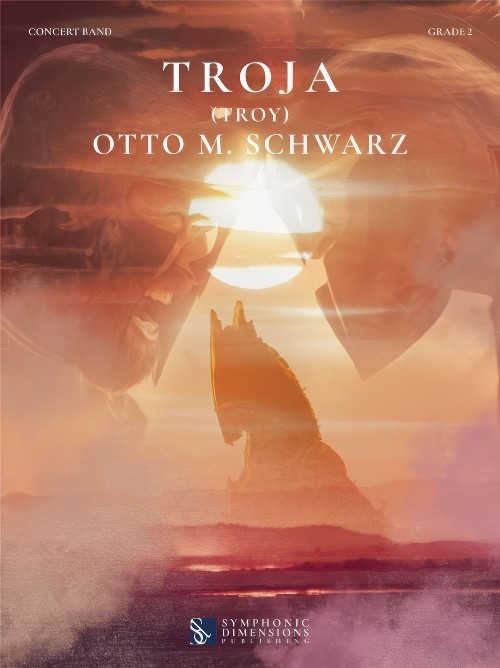
Troja (Troy) (Concert Band - Score and Parts) - Schwarz, Otto M.
The Greek poet Homer wrote about Troy and the Trojan War, which probably took place in what is now Asia Minor, in his Iliad in the 8th century B.C. Nowadays, the term Trojan generally refers to a malware program that is used to gain unauthorised access to computers. This use comes from the legendary Trojan Horse, which saw the turning point in the battle between Greeks and Trojans through the cunning of Odysseus. Let us return to the beginning of the story: Paris, son of the king of Troy, is tasked by Zeus with judging the beauty of the three goddesses Aphrodite, Pallas Athena, and Hera. Aphrodite, the goddess of love, flatters Paris by promising him the most beautiful woman in the world. Soon afterwards, on a journey to Greece, Paris meets the beautiful Helen, who immediately falls in love with him. Since however she is the wife of Spartan king Menelaus, she eventually lets herself be kidnapped by Paris voluntarily. The Greeks then form a large army and go to war against Troy to retrieve Helen, leading to a ten-year siege of the city. The city is eventually conquered not through combat, however, but through Odysseus' cunning ploy. He has the idea of building an enormous wooden horse with warriors hidden inside. The horse is placed at the gates of the city. Thus, the Trojans are tricked into giving up the siege when, despite various warnings, they bring the horse into the city to dedicate it to the goddess Athena. At night, the soldiers climb out of the horse and open the gate for the Greek army. The troops storm the city and burn it to the ground. The royal family and all the Trojan warriors are killed, only Aeneas, the son of Aphrodite, escapes. Later, following many years' wanderings he and his acolytes will become known as the founders of the Roman people. There are various accounts of the fate of the beautiful Helen. She is said to have returned to Sparta with Menelaus and to have ruled there until the end of her life. Or maybe not...Duration: 6.00
Estimated dispatch 7-14 working days
-
 £104.00
A Future Celebration (Concert Band - Score and Parts) - Houben, Kevin
Future Celebration was composed on the occasion of the 125th anniversary of the Royal Socialist Wind Band 'De Toekomst' from Sint-Niklaas (Belgium). In this colourful compostion Kevin Houben succeeds in evoking the bustling textile and cigar industry of the nineteenth and twentieth century in this East Flemish city Sint-Niklaas. After all, these crafts were characteristic for the wealth they brought to the city. Still testimony of this are the 2 unique (niche)museums in Sint-Niklaas: the Knitwear museum and the Pipe and Tobacco museum. Even in times of great crises eg. during the Interbellum the city continued flourishing proving the unique collection of classified art deco houses, amongst others the former People's House, in which the Royal Socialist Wind Band still rehearse. This historic background of Sint-Niklaas and of the Wind Band in particular has been musically presented by Kevin Houben in Future Celebration. The brief, but energetic and powerful opening of the work by the brass instruments gives musical expression to Sint-Niklaas as a prosperous city. After the presentation of a majestic and lyrical theme by the woodwinds an allegro with a cheerful theme takes a look at the future, hopefully looking at the next milestones/ celebrations the city and its orchestra are still expecting in the future. Duration: 6.00
Estimated dispatch 7-14 working days
-
 £224.99
Lux Futura (Concert Band - Score and Parts) - Houben, Kevin
Lux Futura (Light of the Future) was commissioned by the Royal Wind Orchestra Delft and is inspired by the letters 'D-E-L-F-T' using the letter notation system by B?la Bart?k. In this 'Delft' cell, there is referral to the 'Trinitas', the bourdon bell of the Old Church in Delft, that only tolls during a funeral of a member of the Dutch Royal Family. The Delft melody switches to the 'Agneta March', which is a reference to the history of the Royal Wind Orchestra Delft. Further on the love theme, played by the bass instruments represents the love of the inhabitants for their city throughout space and time. In the middle movement, the beauty of the city is depicted by the cor anglais (English horn) solo, as an ode to the lovely city of Delft. When performed, one can choose to use sound city samples recorded in Delft to create a truly magnificent spectacle. Duration: 17.00
Estimated dispatch 7-14 working days
-
 £60.99
Postcard from Pittsburgh (Concert Band - Score and Parts) - Buckley, Robert
Here is an impressive-sounding musical snapshot portraying the sights and sounds of this beautiful, artistic and historic city. The opening, metallic Steel City theme reflects its industrial heritage. This section builds to the majestic City of Bridges theme representing the grandeur of the surrounding rivers and 446 bridges. These themes develop and intertwine becoming the driving, urban City of Champions section culminating in the dramatic final strains. Powerful and descriptive writing for band!Duration: 5:00
Estimated dispatch 7-14 working days
-
 £148.50
Promising Skies
In late August of 2005, the normally festive skies over the city of New Orleans began to change. As Hurricane Katrina approached the city, the skies promised a weather event of unprecedented proportions. Composer Robert W. Smith was commissioned by the United State Marine Forces Reserve Band of New Orleans to create this symphonic tone poem recreating and commemorating the Katrina experience. Beginning with "Blue Sky," the jazz of the historic city provides the musical inspiration. Soon, the "Threatening Sky" arrives giving way to the "Raging Sky." Finally, the "Dawn of a New Sky" brings hope as the city is reborn to share its musical gifts once again. "Promising Skies" is large work for concert band at the medium advanced level. Using the American art form of jazz as its base along with unusual percussive effects, the piece is a unique and welcome contribution to the repertoire.
Estimated dispatch 7-14 working days
-
 £137.99
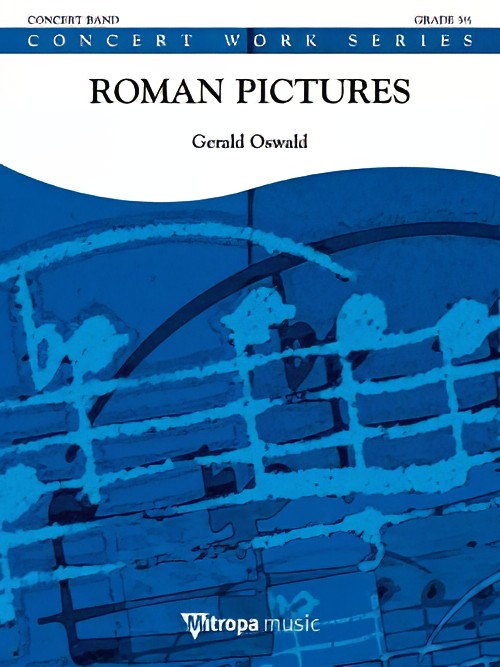
Roman Pictures (Concert Band - Score and Parts) - Oswald, Gerald
This programmatic composition depicts the history and events around the former Roman city of Flavia Solva. It was situated in the southeast province Noricum, the current region of Southern Styria, Austria. In this work, the composer portrays the grandness of the city, the beauty of its surrounding landscape, the hustle and bustle of the market place, the dangers therein and eventually the destruction by the Germanic people in the 2nd century AD. Flavia Solva was rebuilt to become a flourishing city again, but in the 5th century, its decline became a permanent reality, a fate that it shared with other cities of the Roman empire. A captivating work about a fascinating place!Duration: 8.45
Estimated dispatch 7-14 working days
-
 £134.99
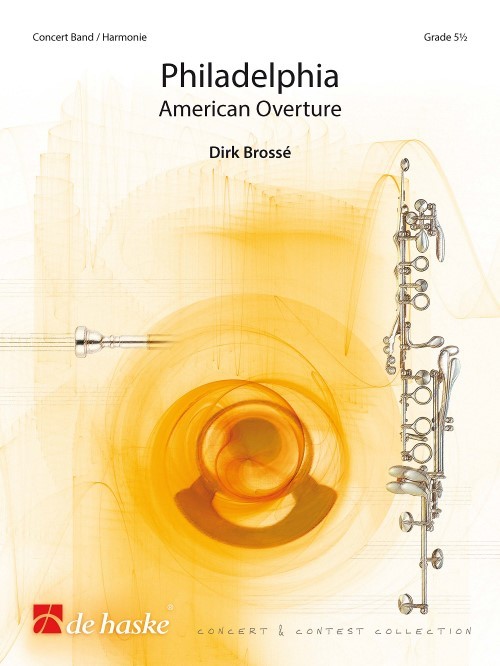
Philadelphia (Concert Band - Score and Parts) - Brosse, Dirk
In the summer of 2010 Dirk Bross? was appointed music director of The Chamber Orchestra of Philadelphia. During his inauguration concert in September that year he brought a musical surprise to the city in which he would work for the next ten years. Philadelphia, an American Overture is dedicated to the people of America's first capital city. We hear the energy, the power, the freedom and the vitality of the multi-ethnic City of Brotherly Love.
Estimated dispatch 7-14 working days
-
 £225.00
Amsterdam Suite (Concert Band - Score and Parts) - Curtis, Matthew - Noble, Paul
The Amsterdam Suite, written in 1995 and first performed by the Slaithwaite Philharmonic Orchestra the following year, seeks to convey some impressions of a city I have visited several times. It opens with the waltz sequence, Barrel Organs, recalling the hurdy-gurdies positioned at strategic points in the city with the aim of parting tourists with their loose change. The tunes, however, are mine rather than an attempt to reproduce the real thing. Amsterdam takes its Saturday nights seriously, with the result that those who get up (or are still up) early on Sunday morning will find themselves in eerily deserted streets, whose atmosphere to me suggests one instrument above all, the saxophone, which plays a prominent part in Lonely City. The Saturday nights themselves are depicted in Trams and Crowds. I have taken liberties with the chronology for the obvious musical reason of wanting to go out with a bang rather than a whimper. The basic structure is very much that used by Eric Coates for similar piece, a bustling outer section with a quick march trio, presented in a fuller and more embellished orchestration on each of its three appearances. - Matthew Curtis.
Estimated dispatch 7-14 working days
-
 £85.00
Amsterdam Suite, 1st Movement (Concert Band - Score and Parts) - Curtis, Matthew - Noble, Paul
The Amsterdam Suite, written in 1995 and first performed by the Slaithwaite Philharmonic Orchestra the following year, seeks to convey some impressions of a city I have visited several times. It opens with the waltz sequence, Barrel Organs, recalling the hurdy-gurdies positioned at strategic points in the city with the aim of parting tourists with their loose change. The tunes, however, are mine rather than an attempt to reproduce the real thing. Amsterdam takes its Saturday nights seriously, with the result that those who get up (or are still up) early on Sunday morning will find themselves in eerily deserted streets, whose atmosphere to me suggests one instrument above all, the saxophone, which plays a prominent part in Lonely City. The Saturday nights themselves are depicted in Trams and Crowds. I have taken liberties with the chronology for the obvious musical reason of wanting to go out with a bang rather than a whimper. The basic structure is very much that used by Eric Coates for similar piece, a bustling outer section with a quick march trio, presented in a fuller and more embellished orchestration on each of its three appearances. - Matthew Curtis.
Estimated dispatch 7-14 working days
-
 £85.00
Amsterdam Suite, 2nd Movement (Concert Band - Score and Parts) - Curtis, Matthew - Noble, Paul
The Amsterdam Suite, written in 1995 and first performed by the Slaithwaite Philharmonic Orchestra the following year, seeks to convey some impressions of a city I have visited several times. It opens with the waltz sequence, Barrel Organs, recalling the hurdy-gurdies positioned at strategic points in the city with the aim of parting tourists with their loose change. The tunes, however, are mine rather than an attempt to reproduce the real thing. Amsterdam takes its Saturday nights seriously, with the result that those who get up (or are still up) early on Sunday morning will find themselves in eerily deserted streets, whose atmosphere to me suggests one instrument above all, the saxophone, which plays a prominent part in Lonely City. The Saturday nights themselves are depicted in Trams and Crowds. I have taken liberties with the chronology for the obvious musical reason of wanting to go out with a bang rather than a whimper. The basic structure is very much that used by Eric Coates for similar piece, a bustling outer section with a quick march trio, presented in a fuller and more embellished orchestration on each of its three appearances. - Matthew Curtis.
Estimated dispatch 7-14 working days
 View Music