
Results
-
 £271.60
Cerebral Vortex - Øyvind Moe
Cerebral Vortex was composed for Musikkforeningen Nidarholm for their participation in the 2009 World Music Contest in Kerkrade, The Netherlands. Tthe first performance was given at this contest conducted by Espen Andersen, with the composer in thesaxophone section.The title is meant to describe a from of writer's block caused not by lack of ideas, but rather a lack of ability to channel and form the madness swirling around inside the head of someone with a great desire to express something. In this respect,the piece can be said to be an exercise in keeping focus from the composer's side. A limited amount of material is repeated and treated to create a development that always has a solid anchor point. This is emphasized by the return to the openingtheme towards the end.
Estimated dispatch 7-14 working days
-
 £65.00
Firefly - Simon Dobson
Firefly was composed by award-winning composer Simon Dobson (b.1981) to provide an entertaining up-tempo concert work for community and youth bands. Composed in funk-rock style, and is based on the groove beat with which it opens. Dobson says,"Firefly was written as a break from my more serious music and as a 'hat tip' to the various types of beat orientated music I listen to." It was first performed by Oslofjord Brass in Norway and in its wind version by Harmonie Shostakovich,Switzerland.Duration: 5-6 minutes.INSTRUMENTATION:Pic, fl1 (2), fl.2 (2), ob, bsn, Eflat cl., cl. 1 (2), cl.2 (2), cl. 3(2), bass cl. - alto sax (2), tenor sax, bar. Sax 5 tpts in B flat (5), 4horns in F (2 optional) (4), 3tbns, euph (2), tuba)2) double bass timp and kit
Estimated dispatch 7-14 working days
-
 £63.99
It Is Well
First published in 1876, "It Is Well With My Soul" was written by Horatio Spafford following several challenging events in his life. The beautiful lyrics were set to music by composer Philip Bliss. This setting by Robert W. Smith is scored for the developing band and written well within the capabilities of bands in the second year of instruction. Simple, reflective and poignant, "It Is Well" will be a valued part of your concert or festival program.
Estimated dispatch 7-14 working days
-
 £89.99
The Last Centaur - Rossano Galante
Composed in the style of a grand and descriptive film score, The Last Centaur is a musical depiction of a centaur who is separated from his family by war, the ensuing adventures, and ultimate reunion with hisfamily and friends. The music begins with a stately, lyrical theme in the horns followed by solo Oboe. This main theme is then woven throughout the work as it develops and grows with intensity. Sweeping woodwind lines and majesticBrass fanfares capture the excitement of the drama and ultimate joyous resolution. Powerful and evocative writing! Dur: 6:00 (Recorded by the West Genesee (NY) High School Wind Ensemble - Andrew Perry, conductor)
Estimated dispatch 7-14 working days
-
 £149.40
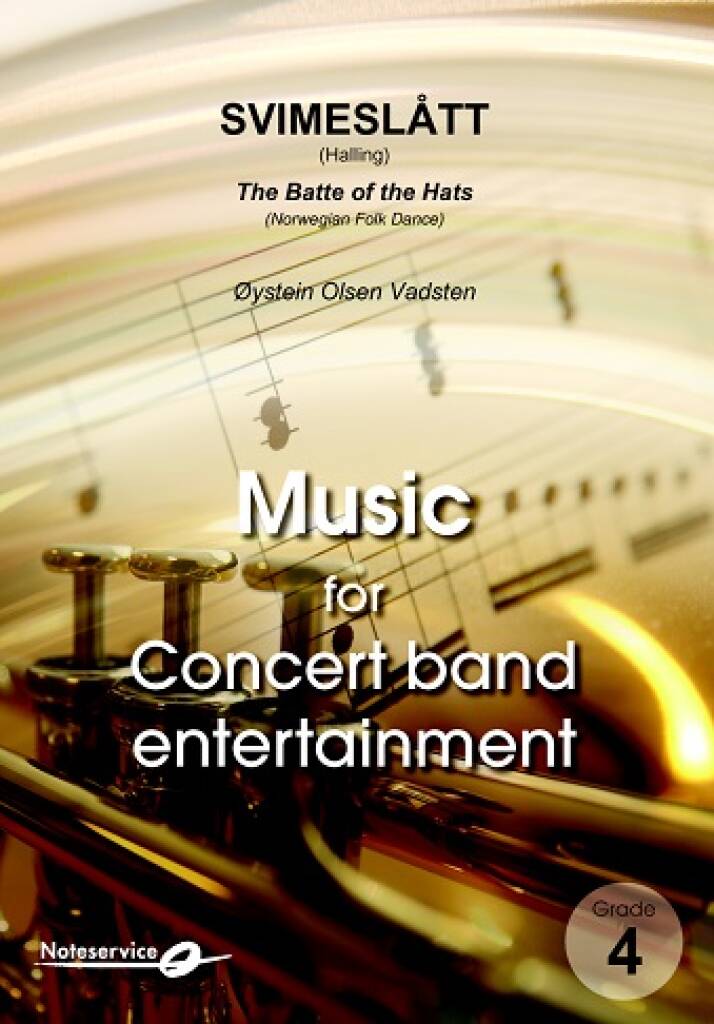
The Battle of the Hats - Øystein Sjøvaag Heimdal
The word svimesltt, which is the title of this piece in Norwegian, has two meanings. One meaning is "knocked out", whilst the other, "sltt", means a folk melody/dance.Svimesltt is one of several folk dances, all of them with humorous titles, originally written by ystein Olsen Vadsten. Norwegian culture is the basis for these dances, both rhythmically and melodically. The accompaniment has brought this funpiece into the 21st Century.When it comes to Svimesltt, it is the traditional dance "halling" that is the inspiration. Halling is a rather wild dance, where the man tries to win the heart of a lady by attempting to kick a hat off a stick,held up in the air. This iswhere "The Battle of the Hats" gets its distinctive name A truly Norwegian tradition.The composer wanted to write a "crazy" melody, which highlights how "knocked out" a man can be by love, as he tries to win the chosen ones heart.
Estimated dispatch 7-14 working days
-
 £76.99
Drums of the Saamis - Samuel R. Hazo
Drums of the Saamis was commissioned by the Medicine Hat Concert Band Society of Medicine Hat, Alberta, Canada. The piece chronicles the merger of the First Nation (first natives) and modern Albertan cultures.The opening tribal drums followed by the haunting melody simulating the traditional wooden flute comprise two themes that are the foundation for the entire piece. Both elements are developed, varied and enhanced throughout as the listener senses the increasing influence of modern day Alberta through the use of modern sounding chords and rhythms.By the end, the marriage of the old and the new is complete. This powerful work closesas it began; a restatement of themes representing the musical and historical foundation of the region. Dur: 5:00
Estimated dispatch 7-14 working days
-
 £79.99
The Four Winds - Evan Hause
The Four Winds by Evan Hause for Concert Band. The Four Winds is an homage by the composer to some of the well-known band composers, such as Clifton Williams and John Barnes Chance, as well as earlier wind masters like Holst and Mahler. Evan Hause was a student of William Bolcom, and his more advanced band work, Tango Variations, has been performed and recorded by some of the top university ensembles. This fantasy-overture is appropriate for the intermediate high school band, contrasting brisk fanfare music with variations on a Romantic theme. (Grade 4) Dur: 6:00.
Estimated dispatch 7-14 working days
-
 £184.99
Nulli Secundus - James Curnow
Commissioned by the Michigan School Band and Orchestra Association, this major work by James Curnow honors the memory and legacy of renowned conductor and educator Harry Begian. In consideration of Dr. Begian's Armenian heritage,Nulli Secundus (second to none) is a suite of three variations based on the Armenian folk song Cilicia (My Homeland). Movements include: I. March Caprice (concert march in fantasy variation form), II. In Memoriam (honoring victimsof the 1915-18 Armenian Genocide), and III. Finale (rapid paced set of variations). Recorded by the Michigan State University Wind Symphony. Dur: 10:00
Estimated dispatch 7-14 working days
-
£57.50
A Child's Embrace - Charles Young
A Child's Embrace was written to commemorate the birth of the composer's first child, Katherine Anne Young, who was born on January 18, 2000. It has been scored in such a way as to permit performances by bands with less than complete instrumentation. (The oboe and bassoon parts may be omitted if players are not available, and the vibraphone part may be substituted by bells with rubber mallets.) It was commissioned by the Traverse City East Junior High School Band.
Estimated dispatch 7-14 working days
-
 £57.50
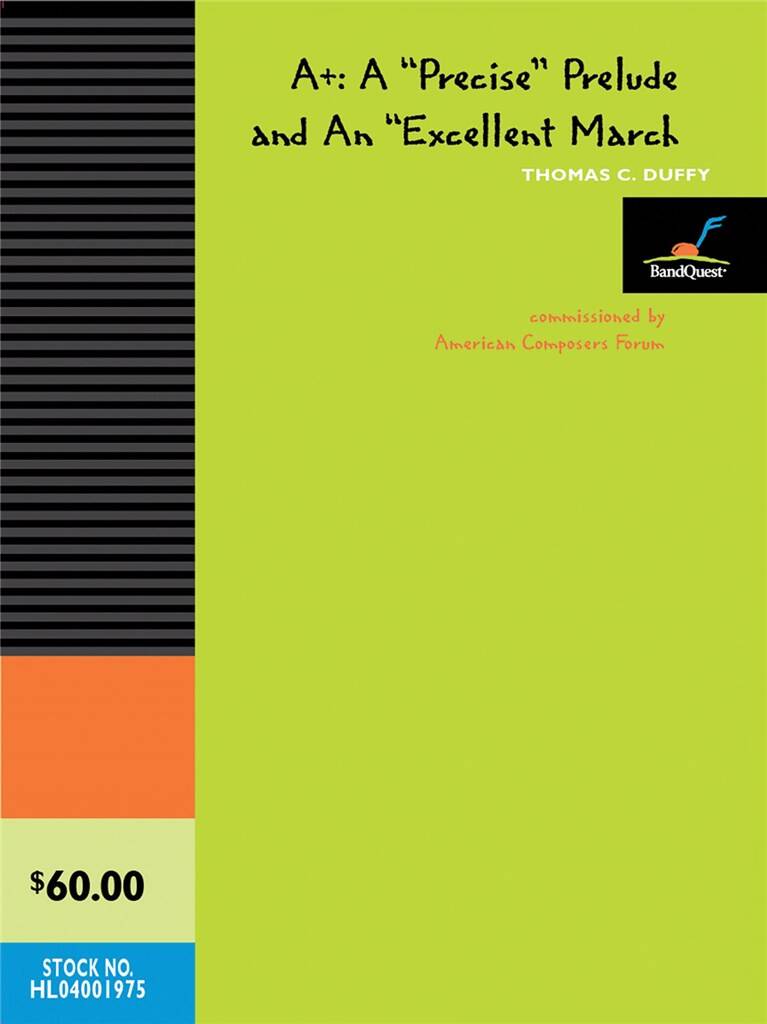
A Precixe Prelude And an Excellent March - Thomas Duffy
Playing one wrong note can ruin the performance of a piece, right? Well, composer Thomas Duffy actually wants the performers to make mistakes in this clever composition! The precise imprecision comes to life as students are asked to intentionally play wrong notes in various parts of the march. After performing this work, you and your students will never look at perfection the same way again! Free interdisciplinary curriculum for the piece is available for download at www.BandQuest.org. BandQuest, an exciting series of new music and accompanying curricula for band, is a program published by the American Composers Forum. The series was started as a response to feedback from music educators that there is a pressing need for new, fresh band music. The heart of this program is new works written by a diverse group of leading American composers who have created challenging pieces that are a true departure from standard middle school repertoire. Every BandQuest project includes a residency component in which the composer works collaboratively with a middle school as they create their new piece. Many BandQuest pieces are accompanied by an interdisciplinary curriculum designed to assist students as they learn the music and to integrate each piece with non-music studies. Visit www.bandquest.org to learn more about this innovative series, and email [email protected] to request a free downloadable audio catalog.
Estimated dispatch 7-14 working days
 View Music