
Results
-
 £89.95
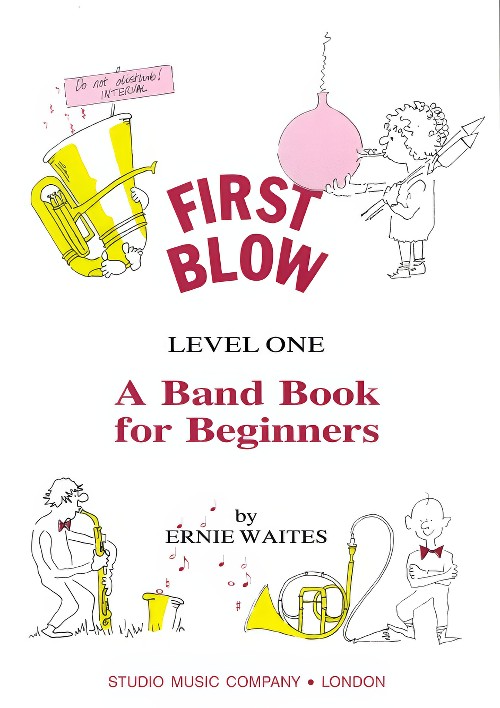
First Blow - Level 1 (Value Set - Score and Parts) - Waites, Ernie
The Value Set includes a score and 1 of each part.The aim of the book is to encourage group-playing in the early stages of learning. To this end, all the parts are deliberately simple and stick strictly to the four parts in the score. In addition there is percussion part (for which instruments should be chosen for each piece) and two learner parts (flute and trombone) for players who have learned only a handful of notes.Dynamics are not given - teachers should allow the players to try the pieces at different levels.The book is suitable for wind of brass bands (of a mixture of both!) and so far as possible, an equal number of players should be allocated to each part. If there is a lack of one of the parts, this part can be reinforced on piano, playing from the score.If clarinet players of a higher standard are available, they may prefer to play the 'upper octave' parts as this will brighten the overall sound of the band.Voices:Part 1 in C, Bb, Bb Upper Octave, EbPart 2 in Bb, Bb Upper Octave, Eb, FPart 3 in Bb, Bb Upper Octave, Eb, F, C BC, Bb BCPart 4 in Bb, Eb, C BC, Bb BC, Eb BCPercussionLerner FluteLerner TrombonePieces include:MarchPolkaShipsHymnCzardasStudy No.1NightfallStudy No.2CharlestonWaltzSlapstick
Estimated dispatch 7-14 working days
-
£19.95
First Blow - Level 1 (Piano Conductor Score) - Waites, Ernie
The aim of the book is to encourage group-playing in the early stages of learning. To this end, all the parts are deliberately simple and stick strictly to the four parts in the score. In addition there is percussion part (for which instruments should be chosen for each piece) and two learner parts (flute and trombone) for players who have learned only a handful of notes.Dynamics are not given - teachers should allow the players to try the pieces at different levels.The book is suitable for wind of brass bands (of a mixture of both!) and so far as possible, an equal number of players should be allocated to each part. If there is a lack of one of the parts, this part can be reinforced on piano, playing from the score.If clarinet players of a higher standard are available, they may prefer to play the 'upper octave' parts as this will brighten the overall sound of the band.Voices:Part 1 in C, Bb, Bb Upper Octave, EbPart 2 in Bb, Bb Upper Octave, Eb, FPart 3 in Bb, Bb Upper Octave, Eb, F, C BC, Bb BCPart 4 in Bb, Eb, C BC, Bb BC, Eb BCPercussionLerner FluteLerner TrombonePieces include:MarchPolkaShipsHymnCzardasStudy No.1NightfallStudy No.2CharlestonWaltzSlapstick
Estimated dispatch 7-14 working days
-
 £154.99
Castellum Wind Band Set (Score & Parts)
This work consists of two movements. The first part is rather quiet and pastoral in character, written in a gently rocking 12/8 time and expressing the tranquillity of the area around the medieval town of Oudenburg in Belgium. After a beautiful orchestral climax the second section, inspired by the Roman past of Oudenburg, begins. A somewhat oppressive and impending introduction leads to the musical reflection of an army parade: Oudenburg was a so-called "castellum," and the remains of the fortress are still visible in the current town plan. A more dynamic passage follows featuring the low brass. After that, the solemn rhythm of the parade is recaptured, culminating in a triumphant ending. 0:09:00
Estimated dispatch 7-14 working days
-
£204.99
Credentium Wind Band Set (Score & Parts)
A spectacular dive via an extended chromatic scale immediately submerges us in a charged and somewhat archaic-feeling atmosphere. Trumpets, horns and trombones resound in rhythmic patterns, buttressed by restless motifs in the percussion. A second theme, in the woodwinds, begins much calmer but is quickly pushed aside by that same brass offensive. This introduction is the musical expression of the sometimes tumultuous early history of the town of Peer in Belgium. It closes with a D scale played over two octaves and repeated three times, symbolizing the church steeples that dominate the townscape. Peer has the credentials of a town, and people should know about it.There follows a rhythmic, turbulent passage: in the course of history, Peer has not been spared the ravages of war, arson, occupation, epidemic and other evils. In contrast, a slow, pastoral, lyrical part expresses the periods of peace and prosperity the town has known, as well as the serene geographic setting that still characterizes the place. Various instruments in groups are developed in solo style while the accompaniment displays vast, painterly images of sound. Now and then an exotic intonation is heard: a variety of peoples and cultures have left their mark on the town.This episode of tranquility and peacefulness comes to a sudden end when, via a surprising, almost chaotic transitional passage, we are in effect transported back to our own time. A hopeful, festive march expresses the confidence in the future that the Royal Concert Band of Peer exudes. This confidence is wholly justified: under the direction of conductor Willy Fransen, the 95 members of the concert band have experienced an extended period of good fortune, and the 75 musicians of the youth band - and the 45 little musicians of the mini-band - are involved in thriving operations. 0:13:15
Estimated dispatch 7-14 working days
-
 £105.00
Danceries (Set I) (Concert Band - Score and Parts) - Hesketh, Kenneth
The term 'Danceries' can be found in a copy of Playford's Dancing Master, an extensive collection of folk and popular tunes of the seventeenth century (and no doubt earlier). This publication was used by master fiddle players to teach the various dance steps of the day to a nobleman's house or a king's court. Whilst this present set of 'Danceries' cannot be said to be an aid to terpsichorean agility, it will at least set feet tapping! The melodies themselves are a mixture of new and old--well, nearly. Where the old occurs it has been adapted in mood and composition and is often interspersed with completely new material. The harmonies and rhythms bring a breath of the new into these themes and add to the drama of the set.Movement 1: Lull me beyond thee. Gentle and lilting, almost a barcarole, this movement is very much a reverie. The original tune had the name 'Poor Robin's Maggot' - a rather disconcerting title; maggot, however, in seventeenth-century parlance meant whim or fancy. This theme can also be found in The Beggar's Opera by John Gay (first performed in 1728) under the title 'Would you have a young lady' (Air 21).Movement 2: Catching of Quails. A colourful, buoyant scherzo on an original melody. The thematic material is shuttled around the band to contrast with full-bodied tuttis. The last few bars fade away to almost nothing before a final surprise!Movement 3: My Lady's Rest. A tender pavane, also on an original theme, with Moorish leanings. Solos for principal winds and brass contrast with warmer tutti passages. The movement culminates with a final presentation of the theme before evaporating in held flute and trumpet chords.Movement 4: Quodling's delight. The final movement to the set combining one of the melodies from Playford's Dancing Master ('Goddesses') with an original contrasting melody. A dramatic and exuberant ending to the set of 'Danceries'.Duration: 12.00
Estimated dispatch 7-14 working days
-
 £115.00
DIVERTIMENTO FOR BAND (Concert Band) - Woolfenden, Guy
Includes:I. ToccataII. AubadeIII. ScherzoMany of the principal musical ideas for Divertimento for Band are derived from music composed for a documentary film called Country Camera, which celebrated the work of the earliest photographers who recorded a way of life which vanished at the outset of the first World War.The three movements are played without a break. The Toccata pits a four-note motif (which always appears with its mirror image) against several other derived ideas, including a sour horn (later trumpet) figure, a tiny lyrical passage initiated by a solo alto saxophone, and a more gentle, but still staccato episode. Many polytonal devices keep the four-note motif active. The Aubade contrasts a lyrical pastorale, initiated by a solo flute, with a more intense central section on the brass. The Scherzo finale has three main ideas; a tune for principal bassoon and euphonium of a playful child-like nature, a rushing figure for the woodwinds later developed by the full band, and a solo for trumpet and clarinet, involving a descending scale and a lyrical wide-leaping recovery. The exuberant coda is derived from themes from the previous two movements.The world premiere of Divertimento for Band was given at the conference of the World Association for Symphonic Bands and Ensembles in Killarney on 13th July 2007 conducted by the composer, and is affectionately dedicated to Keith Allen, Jayne Rollason and Birmingham Symphonic Winds. -GW
Estimated dispatch 7-14 working days
-
 £144.95
FANFARE TO PLANET EARTH and MILLENNIUM MARCH (Prestige Concert Band - Score and Parts) - Fanshawe, David - Sparke, Philip
These two works may be performed individually or, as published, together. Fanfare to Planet Earth - the Fanfare opens dramatically with heraldic trumpets answered by sforzando strikes on deep percussion. The Fanfare embraces the splendour and grandeur of our planet Earth, molto grandioso, and culminates in a chordal cluster - a blaze of brass and percussion in G major, describing feelings of optimism at the start of the 21st century. Performance time 1'50". Millennium March - constructed along classical lines, the theme of Millennium March is catchy and not without humour. Its recurring motif on trumpets, con brio, develops the opening bars of the Fanfare. The March gathers momentum through several dramatic key-changes and ends with a surprise flourish of chromaticism, marked Tempo Apocalyptic. Cannons and fireworks are optional! Performance time 4'10'
Estimated dispatch 7-14 working days
-
£32.95
FANFARE TO PLANET EARTH and MILLENNIUM MARCH (Prestige Concert Band - Score only) - Fanshawe, David - Sparke, Philip
These two works may be performed individually or, as published, together. Fanfare to Planet Earth - the Fanfare opens dramatically with heraldic trumpets answered by sforzando strikes on deep percussion. The Fanfare embraces the splendour and grandeur of our planet Earth, molto grandioso, and culminates in a chordal cluster - a blaze of brass and percussion in G major, describing feelings of optimism at the start of the 21st century. Performance time 1'50". Millennium March - constructed along classical lines, the theme of Millennium March is catchy and not without humour. Its recurring motif on trumpets, con brio, develops the opening bars of the Fanfare. The March gathers momentum through several dramatic key-changes and ends with a surprise flourish of chromaticism, marked Tempo Apocalyptic. Cannons and fireworks are optional! Performance time 4'10'
Estimated dispatch 7-14 working days
-
£109.99
Metalla Wind Band Set (Score & Parts)
Metalla was commissioned by the 'Kreisverband Altenkirchen' of Germany and dedicated to Ottomar Jung. The composer himself conducted the premiere of the piece, which was performed by the 'Jugendorchester Kreisverband Altenkirchen' on 25 March 1999.The region of Altenkirchen is known for its iron mines, which find musical expression in the dark mood of the introduction (andante misterioso). This effect is accomplished with overlapping seventh intervals, orchestral crescendos, a succession of broad chords and the presentation of most themes in the middle register of the band.The dynamic section (allegro energico) that follows the introduction is characterized by concise figures in the brass and a second motif, a kind of rippling motion depicting the Sieg River, an important element in the landscape of the Altenkirchen region.The work closes with a final theme that returns a number of times, albeit in different guises. After a brief repeat of the seventh intervals from the beginning, a last radiant chord signals the end of the piece. 0:05:15
Estimated dispatch 7-14 working days
-
 £115.00
NAME PERPETUAL, A (Concert Band) - Pierce, Eseld
Under the leadership of Michael An Gof and Thomas Flamanck, a Cornish host, sometimes estimated to number as many as 15,000, marched to London in protest against excessive taxation. Arriving at Blackheath, they were attacked by the King's army and defeated, and the two rebel leaders were hung, drawn and quartered. On his way to his death, An Gof stated that he would have "a name perpetual and a fame permanent and immortal". A Name Perpetual tells the story of the Rebellion in four connected scenes. The music includes strong elements of the Celtic music tradition, being structured around an old Cornish folk tune. The first scene introduces fragments of the folk theme and reflects the anguish of the Cornish people. The second scene opens with the folk theme on solo piccolo and, as different instruments enter one by one, the march is depicted with its accumulation of forces en route. The march halts suddenly as the Cornishmen discover the unexpected arrival of the English army and the subsequent music portrays the Blackheath Skirmish. In this scene the orchestra is divided into four parts, each working independently to create a sense of chaos, with the stronger elements of the brass and bass instruments representing the English, while the woodwind and saxophones represent the Cornish, struggling to sustain the folk tune throughout the battle. Eventually all the parts come together and the final section is a lament for the lost Cornishmen, fading away to leave only a haunting off-stage trumpet solo.
Estimated dispatch 7-14 working days
 View Music