
Results
-
 £168.50
60 Warm-up Chorales for Concert Band
During his experience as a band conductor and teacher of wind orchestra conducting at university, Franco Cesarini has dealt with the topic of warm-ups very frequently. Throughout these long years of conducting he has had the opportunity to try many existing methods, evaluating their advantages and disadvantages.After a long time, he has decided to compile a collection of chorales for warm-ups, which are organized according to the criteria that he considers most effective.While working on his60 Warm-up Chorales for Concert Band, Franco Cesarini has always borne in mind that amateur musicians play for pleasure.He feels that it is extremely important that they have satisfaction at every moment of the rehearsal and not to start the rehearsal with needless "punishing" exercises. Nobody is really motivated to start playing with scales, long notes, or tricky rhythmical exercises. There is often a distinguished absentee in band rehearsals, namely music itself!Although this publication does not foresee a specific tempo for the chorales, they should often be performed rather slowly but without dragging.Dynamics are not indicated, so that the conductor has the opportunity to draw the attention of the musicians to his gestures and to make them react according to his indications.Timpani and bell parts have been added with the aim of not leaving the percussionists completely inactive during the warm-up phase, but can also be omitted.The chorales are written in four parts (SATB) and are also playable in smaller groups. The four voices can be played in different combinations of woodwinds or brass quartets or in mixed combinations.The collection includes ten chorales for the following keys: D flat major, A flat major, E flat major, B flat major, F major and C major.With his 60 Warm-up Chorales Franco Cesarini would like to convey the message to play the chorales in a musical way, thus raising the musicians' awareness of phrasing, the right interpretation of cadences, rubato and agogic.Above all, never do anything without putting the musical aspect in the foreground. 60 Warm-up Chorales for Concert Band: A perfect collection to warm-up and improve tuning of a concert band!
Estimated dispatch 7-14 working days
-
£204.99
Credentium - Jan Van der Roost
A spectacular dive via an extended chromatic scale immediately submerges us in a charged and somewhat archaic-feeling atmosphere. Trumpets, horns and trombones resound in rhythmic patterns, buttressed by restless motifs in the percussion. A second theme, in the woodwinds, begins much calmer but is quickly pushed aside by that same brass offensive. This introduction is the musical expression of the sometimes tumultuous early history of the town of Peer in Belgium. It closes with a D scale played over two octaves and repeated three times, symbolizing the church steeples that dominate the townscape. Peer has the credentials of a town, and people should know about it.There followsa rhythmic, turbulent passage: in the course of history, Peer has not been spared the ravages of war, arson, occupation, epidemic and other evils. In contrast, a slow, pastoral, lyrical part expresses the periods of peace and prosperity the town has known, as well as the serene geographic setting that still characterizes the place. Various instruments in groups are developed in solo style while the accompaniment displays vast, painterly images of sound. Now and then an exotic intonation is heard: a variety of peoples and cultures have left their mark on the town.This episode of tranquility and peacefulness comes to a sudden end when, via a surprising, almost chaotic transitional passage, we are in effect transported back to our own time. A hopeful, festive march expresses the confidence in the future that the Royal Concert Band of Peer exudes. This confidence is wholly justified: under the direction of conductor Willy Fransen, the 95 members of the concert band have experienced an extended period of good fortune, and the 75 musicians of the youth band - and the 45 little musicians of the mini-band - are involved in thriving operations.
Estimated dispatch 7-14 working days
-
£109.99
Metalla - Jan Van der Roost
Metalla was commissioned by the 'Kreisverband Altenkirchen' of Germany and dedicated to Ottomar Jung. The composer himself conducted the premiere of the piece, which was performed by the 'Jugendorchester Kreisverband Altenkirchen' on 25 March 1999.The region of Altenkirchen is known for its iron mines, which find musical expression in the dark mood of the introduction (andante misterioso). This effect is accomplished with overlapping seventh intervals, orchestral crescendos, a succession of broad chords and the presentation of most themes in the middle register of the band.The dynamic section (allegro energico) that follows the introduction is characterized by concise figures inthe brass and a second motif, a kind of rippling motion depicting the Sieg River, an important element in the landscape of the Altenkirchen region.The work closes with a final theme that returns a number of times, albeit in different guises. After a brief repeat of the seventh intervals from the beginning, a last radiant chord signals the end of the piece.
Estimated dispatch 7-14 working days
-
 £214.80
Skies - Oliver Waespi
Program notes by Oliver Waespi on his composition Skies:Skies is the plural of Sky. We may wonder are there several skies? Is the sky we all long for not the same for everybody? While travelling on foot and "in the open air" I have observed the firmament often in quite different shapes, so that I can say I have indeed experienced the sky in different ways. Years ago I already wanted to portray "my sky" in music; I finally have been able to realise this long-cherished dream.This composition deals with the sky, more precisely with my sensual and emotional experience of the sky in all its aspects. Two point of views are combined in this composition: one showing the sky as it presents itself to me, the other showing the sky as I observe it. The music was bom simultaneously by intemal and extemal inspiration: it describes nature but also the emotional and spiritual experience of nature. To me, the experience of nature is not abstract, but it is connected with concrete ages, places or people from my neighbourhood. This is why I have combined several parts of this composition with certain landscapes.The sky presents itself in different landscapes in the most varied ways: for the sensual experience, there is no sky as such. The indications of places spread all over the score, are primarily clues for myself; they represent certain atmospheres, which I have experienced especially in England and Scotland. They can however also be useful to the musicians and the audience, providing they know those landscapes and the celestial atmospheres linked to them.The music is independent from the atmospheres described in the subtitles, as those are rather connected to a tragic nature, and so the music is not based on any program. Musically spoken, the composition has a symphonic structure, which means that the complete musical material is derived from three contrasting main themes. In the first part, the description of a noctumal sky ("Night") two themes are developed in an organic way; the first, rather "dusky", is to be found with the horns, the second, "in bright daylight", with the oboe and flute, the third, "more quiet" , with the brass instruments. In the next part, we have clouds and rain over the Isle of Skye (one of the Hebrides islands in Scotland) and here several elements of the first theme are still more developed. Then we get an increasingly dark mood, which is released, in heavy chords. Then suddenly, the sun breaks through and the music gets a majestic character. We have a new shape of the initial theme, first with the French horns and then with the trombones. The music gets a quicker tempo and flows into a quick movement describing the winds and waves at sea ("Wind and Waves"). Three themes are gathering and some variations are developed. The music gets more and more energetic and, after a climax, calms down again. Then we have a kind of "summer pastoral" which suggests summer at the South coast of Cornwall ("South Coast of Penwith Peninsuia in Summer"). This is certainly not the hotte st summer in Europe, but still it is beautiful in this country that is blessed with so much rain. In the "pastoral" , the sea is already sketched in broad outlines in the French horn solo. The magnificence of an aftemoon at the seaside is developed at the end of the composition ("Noon at Treen Cliff', a rock protruding in the sea next to Porthcumo at the South Coast of Cornwall); here the music gets stronger and stronger and after a majestic climax it vanishes completely.
Estimated dispatch 7-14 working days
-
 £253.70
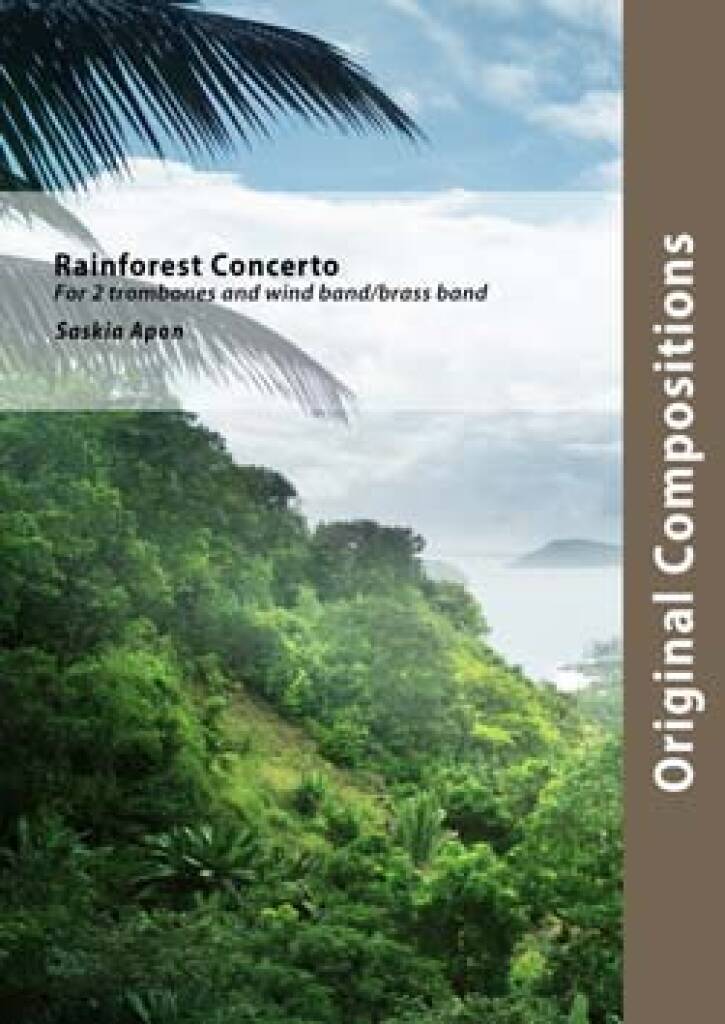
Rainforest Concerto - Saskia Apon
Rainforest Concerto has been commissioned by the Brass Band Rijnmond. This double concerto for two trombones and wind band consists of three parts with the cadenza in the slow niddle movement. Saskia Apon was inspired by the threat of the destruction of the rainforest. In the first part, Creation, we hear an accelerated reproduction of the birth of this impressive natural phenomenon. We hear the first birds, we see the growth of the mangrove trees and we witness the struggle for light and the force necessary to keep the realized equilibrium in a perpetual balance.The second part, Ode, is a tribute to the wonder and splendour of the rainforest. By means of subtle and extremely delicate sonorities we hear how nature adds an inestimable value to the rainforest. However it is also extremely fragile and this engenders a certain melancholy due to the awareness of man's impotence to respect this beautiful nature.In the last part, Contra Demolition, we hear the threatening decline, but also the revolt against this possible ruin. It is a heartfelt cry to leave nuture in peace and to work hard for the preservation of the beauty and the value of the rainforest.
Estimated dispatch 7-14 working days
-
 £110.00
Mount Everest - Kees Vlak
This composition basically consists of three fragments and an epilogue (conclusion):1) Plateaux, 2) Sherpas, 3) Climb. The piece starts with a musical depiction of the deserted plateauxs and mountain peaks of the Himalayas. The mysteriousness of theTibetan country was caused by its inaccessibility to other nations. One even believed that there was a paradise behind the huge mountains; the land of Shangra La. 1) After the sound of a gong, the Asian-like theme arises extremely softly from thedecay of the percussion. In bars 4 and 5 the syllables of Hi-ma-la-ya echo. Then a second theme appears; it symbolises the enchantment of the mountaineers by seeing the Mount Everest. 2) Eastern percussion, very evenly without emotion, sound from thedeserted village of the sherpas. The phrasing is prescribed by the number 'three'. From measure 56 Tibetian monks sing a chant, also with the religious background of the number 'three'. 3) The third part starts of with the sight of the giant MountEverest with an entirely new theme, that is played impressively by the strong low brass instruments of the band, immediately followed by the excited big climbing. The many surprises are depicted by the changing time signatures. Two themes are inconstant battle; the binary Himalaya theme and the ternary Mount Everest theme. Only once there is a steely composure. The registers in which the piece is played increase. The tension rises...Then the peak is reached. A long pause follows before onerealises that one is on top of the world. Slowly the emotions of joy grow and lead to an enormous climax. The first enchanted theme sounds again in total glory.
Estimated dispatch 7-14 working days
-
£72.99
Valse Caprice - Herbert L. Clarke
Herbert L. Clarke was a legendary composer and musician active in the early part of the 20th century, well-known for his solos for cornet, trombone, euphonium and combinations of brass instruments with band accompaniment. What is not as well-known is that Clarke also wrote three works for alto saxophone and band! Helen, Valse Caprice and Lavinia were written between 1918-1922 in Canada for Charles Shaw, saxophonist for the Anglo-Canadian Leather Company Band which Clarke directed at the time. Valse Caprice is a fine example of pure lyric elegance. Written in modified ABA form, the principal theme is followed by a more embellished variation in eighth notes. The contrasting middle section is a pensive meno mosso, which leads into a reprise with cadenza-like figures, building to a rousing conclusion. The historic publication of these three works by Southern Music represents a significant contribution to saxophone solo and band literature that will introduce generations of musicians to some of Herbert Clarke_x001A_s finest hidden gems.
Estimated dispatch 7-14 working days
-
 £79.99
Elegy in the Baroque Style - James Barnes
Cast in G minor, ELEGY IN THE BAROQUE STYLE is a somber work written in memory of the composer_x001A_s mentor and lifelong friend Kenneth Bloomquist. Its emotional introduction eventually eases into a baroque-style chaconne. A chaconne is a set of variations based on a repeated chord progression, as opposed to a passacaglia, which is a set of variations over a ground bass. In this case, the core of the piece is structured over eleven repetitions (variations) of the chord progression that is initially stated in trombones and tubas. Each variation is distinct in structure and scoring. The work concludes with an extended coda, finally settling on a low-voiced g minor chord in low brass and bassoons.
Estimated dispatch 7-14 working days
-
 £89.99
Bolero For Band - Maurice Ravel
Initially commissioned by Ida Rubenstein as a ballet work initially, Maurice Ravel's BOLERO has become his most popular and often-performed orchestra composition, which was a surprise to the composer who described it as seventeen minutes of orchestra without any music. With a structure that is simplicity itself, BOLERO uses two alternating melodies in what Ravel described as a crescendo on commonplace melod[ies]. Mark Rogers' transcription of BOLERO is an entirely complete wind band version of the piece; omitting not a single note or exotic instrument, thereby transferring the brilliance of Ravel_x001A_s orchestral score to the symphonic wind band with as much fidelity to the original as possible. Ravel calls for a very large orchestra (triple woodwinds, saxophones, large brass section, harp, celesta and percussion). Consequently, this transcription of BOLERO contains a large amount of divisi writing. It goes without saying that this transcription will be most successfully performed by large symphonic wind band.
Estimated dispatch 7-14 working days
-
 £59.99
Maximus Fanfare - Thierry Deleruyelle
Maximus Fanfare is a dazzling, energetic work for wind band, conceived as a short, percussive overture in which brass and percussion impose their power from the outset. From the very first bars, an explosion of sound captures attention before giving way to vibrant orchestral development, leading to a triumphal conclusion.This fanfare was inspired by the majestic golden lion that sits atop the belfry in the Place des Hros in Arras, a town with a rich architectural heritage listed by UNESCO. A symbol of strength and grandeur, the lion finds a musical echo in this brilliant work full of panache.Commissioned by the Orchestre d'Harmonie d'Arras, the piece owes its name to Maxime Lavoine, its conductor since 2011, in tribute to his commitment to and passion for wind band music.With Maximus Fanfare, Thierry Deleruyelle has created an intense and luminous work, a musical tribute to the significance of Arras' heritage and the enthusiasm of the musicians who keep it alive.
Estimated dispatch 7-14 working days
 View Music