
Results
-
 £62.95
Once Upon a Time Signature - Vince Gassi
Themes are pliable; they can evolve and exist in more than one time signature. Once Upon a Time Signature is the perfect opportunity for your young musicians to improve their craft by adapting to frequent changes in time. 4/4 to 3/4, and back again, they will rise to the challenge. Count on it!
Estimated dispatch 7-14 working days
-
 £159.99
A Little Stress Music - Thomas Doss
A Little Stress Music was commissioned by the Lenzing Werkskapelle from Austria and comprises of four sections. 'Rush Hour' depicts a Friday evening during which everyone wants to get home after work. Unfortunately, traffic jams and gridlock stand in the way! In 'Promenade Waltz' you can picture an evening walk along the beautiful lakeside, then a glass of wine loosens you up leading to the third movement: 'Romance', which starts with a promising conversation...The funny finale 'Monday Morning' brings you back to reality and the score provides the option of the band applauding itself for a job well done! A humorous and joyful new piece by Thomas Doss!
Estimated dispatch 7-14 working days
-
 £137.99
Eldorado - Thierry Deleruyelle
The myth of El Dorado ("the golden one") stems from the story of a powerful chief who used to cover himself with gold dust before bathing in a sacred lake where he threw precious objects as offerings to the gods. The myth was soon relayed to the Spanish conquistadors and inspired many expeditions, although the invaders didn't bring back nearly as much gold as they expected, if any at all. Eldorado is a mysterious and dynamic work that illustrates the myth of the golden man and the European expeditions that followed. With a touch of exotic influences, the music is varied and rich. This piece was commissioned by the French Cultural Association Lille 3000 as part of theirEldorado-themed festival in 2019.
Estimated dispatch 7-14 working days
-
 £110.99
Highdays and Holidays - Philip Sparke
Highdays and Holidays was commissioned by the South Berks Concert Band to celebrate its 40th anniversary in 2016. The band rehearses in the village of Mortimer, which has a long and fascinating history dating back to, and beyond, the BronzeAge. Mortimer is famous for The Mortimer Revel, an annual event which was apparently a fairly rumbustious and sometimes violent affair. Highdays and Holidays seeks to capture some of this festive event in the form of an energeticoverture, which explores a variety of moods including the somewhat chaotic atmosphere of the Revel.
Estimated dispatch 7-14 working days
-
 £252.10
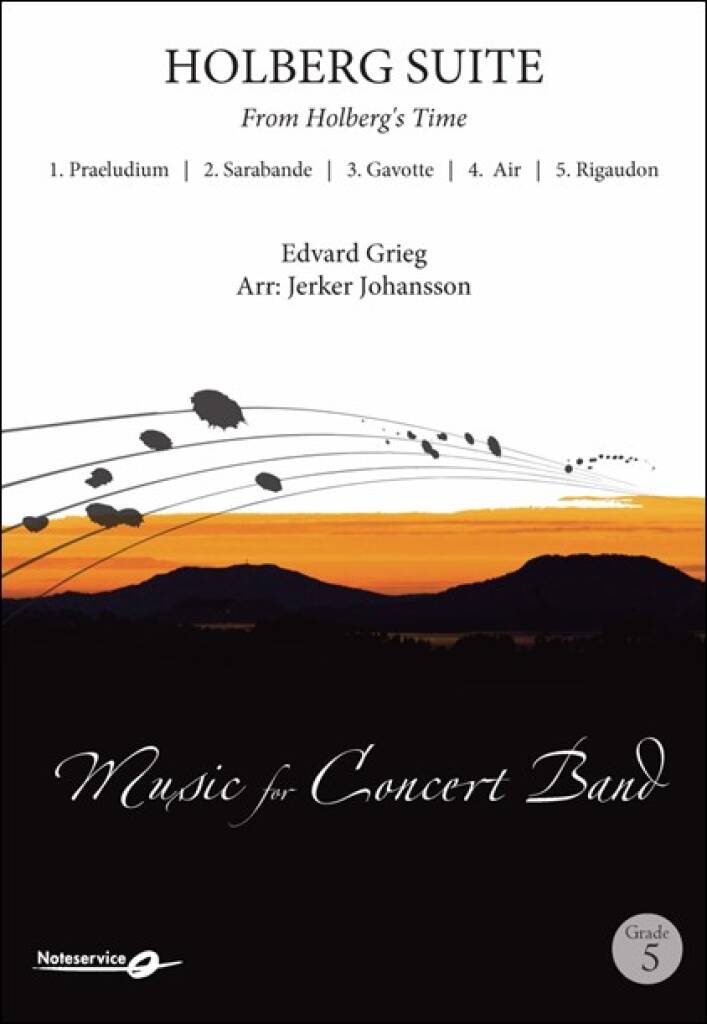
Holberg Suite - Edvard Grieg
Edvard Hagerup Grieg (1843-1907) was a Norwegian composer and pianist. He is widely considered one of the leading Romantic era composers, and his music is part of the standard classical repertoire worldwide. His use and development of Norwegian folkmusic in his own compositions put the music of Norway in the international spectrum, as well as helping to develop a national identity. Grieg is regarded as simultaneously nationalistic and cosmopolitan in his orientation, for although born in Bergenand buried there, he traveled widely throughout Europe, and considered his music to express both the beauty of Norwegian rural life and the culture of Europe as awhole.1884 was the bicentenary year of the birth of Ludvig Holberg (1684-1754)and as a part of the celebrations various Scandinavian composers were commissioned to write commemorative pieces. From Holbergs Time was one of Griegs contributions. It was first written for piano but in 1885 the composer transcribed it for stringorchestra. For his suite Grieg went back to some of the musical forms used by Holbergs contemporaries but although the forms and style may be rococo the contents are unmistakably characteristic of Grieg himself. Grieg gave the first performance ofthe piano version in Bergen, Holbergs birthplace, in December 1884.
Estimated dispatch 7-14 working days
-
 £79.99
Siorai September - Samuel R. Hazo
Translated from Gaelic as Eternal September, this marvelous setting for band is designed to take each listener back to their own vivid fall memories on a college campus. Commissioned by the University of Notre Dame and premieredat their Carnegie Hall performance in 2010, this work is also dedicated to the composer's father, Dr. Samuel J. Hazo, a 1949 graduate of Notre Dame. Additionally, Dr. Hazo's poem Home Are the Sailors is incorporated in the middleof the piece. Rich in musical references and varied textures, this is a dramatic and rewarding work for mature ensembles. Dur: c. 5:30
Estimated dispatch 7-14 working days
-
 £141.99
Concerto for Wind Ensemble - Karel Husa
Commissioned by the Michigan State University Alumni Band, this three movement work by Karel Husa was the winner of the first Louis Sudler International Wind Band Composition Competition in 1983. A note from thecomposer: 'Divided into three movements, this work is a display of virtuoso passages given to solo instruments as well as to the groups of the ensemble. In the Fanfare of the first movement, the Brass section concertises in groupsof four Brass quintets (2 Trumpets, Horn, Trombone and Tuba or Baritone), spread from left to right in back. The Saxophones (SATB) are placed in front of the Brass quintets, and the Woodwinds occupy the front of the stage, withPercussion on the left and right side. These groups, like the Brass quintets, play in the concertante style, particularly in the first and last movements. 'At the same time, each movement contains individual solo passages(for example, Timpani and Flute in Movement I - Drum Ceremony and English Horn and other low Woodwinds in Movement II - Elegy). The composition of this piece was prompted by the excellence of Wind and Percussion players today, andby the incredible growth of Wind ensembles, orchestras, and bands in the last 25 years. It is intended for their enjoyment.'
Estimated dispatch 7-14 working days
-
 £53.95
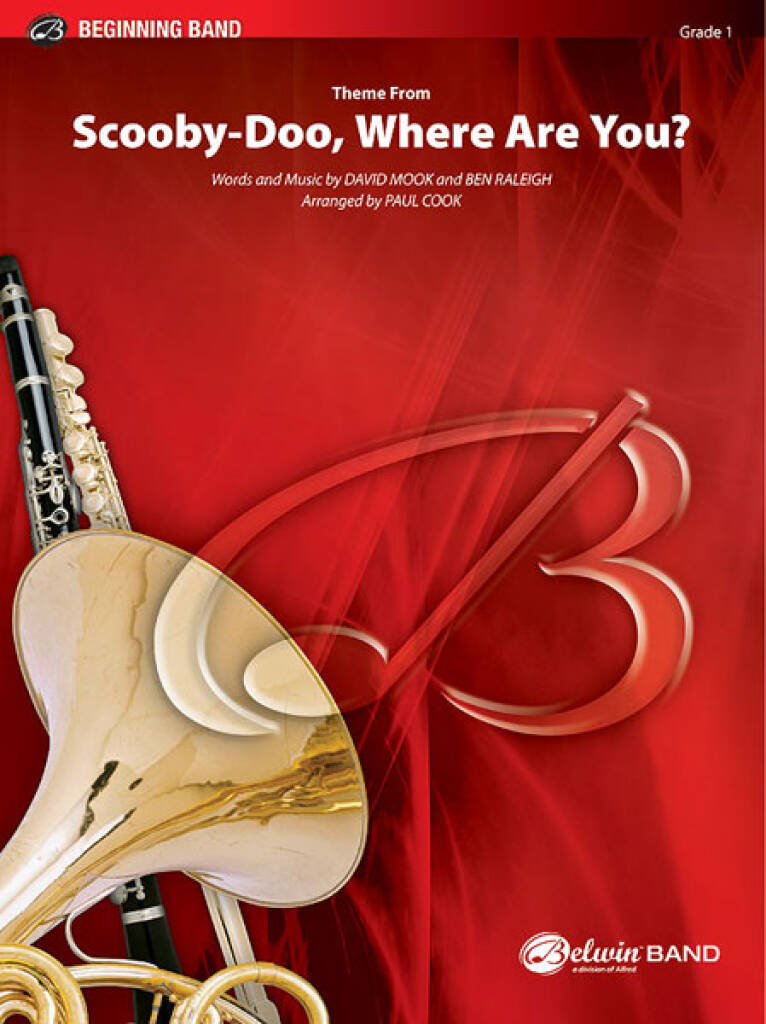
Scooby-Doo, Where Are You?, Theme from - Ben Raleigh
All the energy is there but the difficult syncopations are carefully spelled out for your beginners in this arrangement of "Theme from Scooby-Doo, Where Are You?" arranged by Paul Cook. Sure to bring a smile to the faces of those just familiar with Scooby and to those who remember him "back when." You won't be able to stop your students from practicing this familiar tune. A winner for sure! (1:45)
Estimated dispatch 7-14 working days
-
£91.99
Changes Ahead - Sherburne
What starts out as a fanfare quickly becomes variations on the opening themes. As the title suggests, those themes are musical foreshadowing for the "Changes Ahead". With effective use of mixed meters, changing keys and rhythms there is an excitement that builds off of otherwise simple melodies. In the middle section comes a lyrical contrast with a sense of anticipation that the "changed" themes are coming back to a powerful ending, where all the themes combine. "Changes Ahead" showcases each section of the band, but more importantly it will challenge them to listen to other themes and compliment them. With lots of percussion, dramatic brass, flowing winds this piece creates a bold musical experience for the band and the audience.
Estimated dispatch 7-14 working days
-
 £98.99
Rush Hour - Christopher T. Greco
"Rush Hour" captures the chaos and frustration of being stuck in traffic, transforming the daily grind into an exhilarating musical soundscape. From the long, agonizing wait in a line of cars to the constant noise of construction outside your window, this work brings all the elements of rush hour to life. Performers will have a blast using a variety of percussion toys to mimic the sounds of honking horns, idling engines, and street noises. Fun, creative, and relatable, "Rush Hour" is the perfect choice for any concert, offering a playful and energetic take on the everyday commute.This work is not yet in print. Please check back later to view the conductor score and for purchasing information. In the meantime, please enjoy this recording performed by The Washington Winds, conducted by Edward S. Petersen.
Estimated dispatch 7-14 working days
 View Music