
Results
-
 £54.95
GIMME SOME LOVIN' (Concert Band) - Story, Michael
Classic rock at its best--here's a Michael Story arrangement that will take you back to "The Blues Brothers." Gimme Some Lovin', the hit made famous by Steve Winwood and the Spencer Davis Group, is set in a fast rock style. Carefully scored for your young band, this one will be a certain hit!
Estimated dispatch 7-14 working days
-
 £34.65
Modal Episode (Concert Band - Score and Parts)
Your youngest students can rock & roll clear back to the "stone age" with Tom Molter's clever tune. A great motivator for the students and a sure fire hit with your audiences. Can't Be Beat!
Estimated dispatch 7-14 working days
-
 £64.95
RETROGRADE INVERSION (Programme Concert Band) - Wiffin, Rob
This work is retro! It looks back to the disco era, and although the title suggests a serious work, it is really just a bit of fun!
Estimated dispatch 7-14 working days
-
 £55.00
The Catskills (from East Coast Pictures) (Concert Band - Score and Parts) - Hess, Nigel
In upstate New York lie the Catskills Mountains - an extraordinary combination of tranquillity and power, peace and majesty. Once seen, they call you back again and again.This piece forms the second movement of 'East Coast Pictures.' It is a suite of three short 'pictures' that were inspired by several visits to a small part of the American East Coast, an area that provides great extremes in the geography and the people.Duration: 6.00
Estimated dispatch 7-14 working days
-
 £67.32
Where the River Flows
A suite in 3 parts based on the story of a young boy who was abducted by a Shawnee Indian hunting party in 1771. The first movement, "The New Frontier" is a bold and majestic section containing the patented Swearingen melodic themes which have made his music so popular. "Bring Back My Child" is a solemn section which includes some sorrowful chanting(optional) by members of the band and some very expressive solo spots for the 1st Clarinet and Flute. The third movement, "Great Chief" has a bright and rhythmic character bringing the suite to a dramatic and exciting climax.
Estimated dispatch 7-14 working days
-
£248.99
Odysseia - Maxime Aulio
Washed up on the Phaeacian shore after a shipwreck, Odysseus is introduced to King Alcinous. As he sits in the palace, he tells the Phaeacians of his wanderings since leaving Troy. Odysseus and his men fi rst landed on the island of the Cicones wherethey sacked the city of Ismarus. From there, great storms swept them to the land of the hospitable Lotus Eaters. Then they sailed to the land of the Cyclopes. Odysseus and twelve of his men entered the cave of Polyphemus. After the single-eyed giantmade handfuls of his men into meals, Odysseus fi nally defeated him. He got him drunk and once he had fallen asleep, he and his men stabbed a glowing spike into the Cyclop's single eye, completely blinding him. They escaped by clinging to the belliesof some sheep. Once aboard, Odysseus taunted the Cyclop by revealing him his true identity. Enraged, Polyphemus hurled rocks at the ship, trying to sink it. After leaving the Cyclopes' island, they arrived at the home of Aeolus, ruler of the winds.Aeolus off ered Odysseus a bag trapping all the strong winds within except one - the one which would take him straight back to Ithaca. As the ship came within sight of Ithaca, the crewmen, curious about the bag, decided to open it. The winds escapedand stirred up a storm. Odysseus and his crew came to the land of the cannibalistic Laestrygonians, who sank all but one of the ships. The survivors went next to Aeaea, the island of the witch-goddess Circe. Odysseus sent out a scouting party butCirce turned them into pigs. With the help of an antidote the god Hermes had given him, Odysseus managed to overpower the goddess and forced her to change his men back to human form. When it was time for Odysseus to leave, Circe told him to sail tothe realm of the dead to speak with the spirit of the seer Tiresias. One day's sailing took them to the land of the Cimmerians. There, he performed sacrifi ces to attract the souls of the dead. Tiresias told him what would happen to him next. He thengot to talk with his mother, Anticleia, and met the spirits of Agamemnon, Achilles, Patroclus, Antilochus, Ajax and others. He then saw the souls of the damned Tityos, Tantalus, and Sisyphus. Odysseus soon found himself mobbed by souls. He becamefrightened, ran back to his ship, and sailed away. While back at Aeaea, Circe told him about the dangers he would have to face on his way back home. She advised him to avoid hearing the song of the Sirens; but if he really felt he had to hear, thenhe should be tied to the mast of the ship, which he did. Odysseus then successfully steered his crew past Charybdis (a violent whirlpool) and Scylla (a multiple-headed monster), but Scylla managed to devour six of his men. Finally, Odysseus and hissurviving crew approached the island where the Sun god kept sacred cattle. Odysseus wanted to sail past, but the crewmen persuaded him to let them rest there. Odysseus passed Circe's counsel on to his men. Once he had fallen asleep, his men impiouslykilled and ate some of the cattle. When the Sun god found out, he asked Zeus to punish them. Shortly after they set sail from the island, Zeus destroyed the ship and all the men died except for Odysseus. After ten days, Odysseus was washed up on theisland of the nymph Calypso.
Estimated dispatch 7-14 working days
-
 £137.99
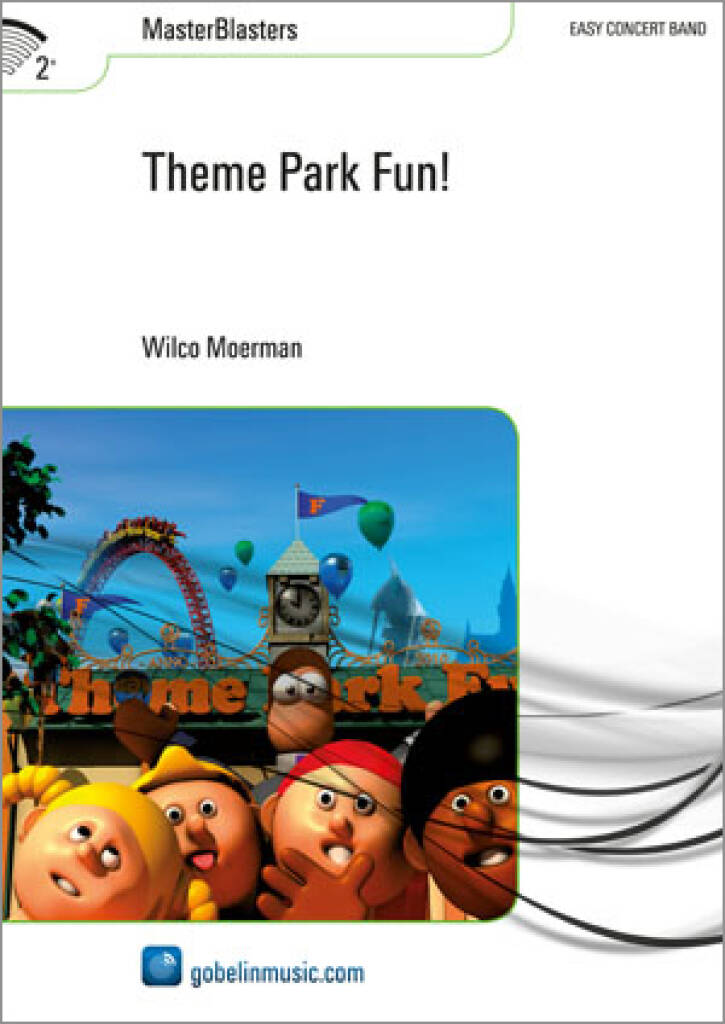
Theme Park Fun! - Wilco Moerman
In Theme Park Fun! your orchestra pays a visit to an amusement park. During your visit, you will experience some spectacular rides and attractions this theme park offers. The uniqueness of Theme Park Fun! is the interplay between music and(moving) images. Animations and illustrations support the visual composition.Part 1: The Entrance & Parade [with animation]The opening of the park is a fact. A day full of fun and pleasure awaits! You and the other visitors willbe confronted with all the rides, attractions and adventures the theme park has to offer. Which ride shall we do first?! There is so much to do and experience on this day in the park! A parade of colorful floats and park figures is passing by.Letthe fun begin!Part 2: The Haunted House [with animation]The only ride in the park that is not related to fun, is the Haunted House. Here visitors will be challenged to visit a house full of ghosts, creepy figures and otherominous things. The clock strikes twelve, there is no turning back. Ghosts are whispering, yelling, screaming... Fortunately it is almost one oclock, so we can leave this creepy place quickly.Part 3: The Swinging Galleon [withillustrations]What a huge pirate ship! Each time you swing back and forth, you will feel that weird feeling in your stomach. When you are thrown completely into the top you will have a fantastic view over the park, but you can not enjoy itfor long. Before you know the ship swings back the other way.Part 4: The Fairy Tale Ride [with illustrations]After all those exciting and spectacular rides and attractions, it is time for a peaceful tour in The Fairy Tale Ride.Surrounded by a fairytale setting, you will discover fable figures, talking animals and colorful designs. Such a beauty and tranquility. Having had this experience, we are ready again for the big rides in the park!Part 5: The Bumper Cars[with illustrations]Now its time to crawl behind the wheel of the Bumper Cars! Shall we all chase the conductor?! Before you know you are hit by another visitor or you will bump against someone else. In this tough ride you can prove yourselfas a real driver, or perhaps as a really bad one.Part 6: The Roller Coaster [with illustrations]The largest, fastest and scariest ride in the park ... we should definitely do the Roller Coaster! All together in the train, theover-the-shoulder restraints are lowering... be ready to ride. The train leaves the station and is heading for the big lift hill. It will be very scary when the train reaches the top and the train will be plunged down the first drop! Loops,corkscrews and other spectacular coaster elements will follow... Before you know it, the ride of your life is over. Shall we ride it again?!Part 7: Leaving the Park [with animation]Unfortunately everything comes to an end. Thisday in the theme park is over, but we have a lot new experiences to talk about! The memories of all the funny and spectacular rides will come up when we walk through the park to the exit. Just one look over the shoulder, the amusement park figuresare waving at us. Hopefully we will come back again soon!
Estimated dispatch 7-14 working days
-
 £179.99
Outback - Thomas Doss
This work was commissioned by the "-sterreichische Blasmusikjugend" (Austrian Brass Band Association - Young Musicians).The Aboriginal indigenous people of Australia are among the oldest surviving human cultures. The arrival of the Europeans markedtheir decline and endangered their existence. The many secrets the Aborigines hold served as inspiration for this work. Aboriginal SpiritOver many centuries, the Aboriginal people have cultivated a unique ability to live in harmony with theworld around them. Maintaining the delicate balance between their trinity - nature, man, and creation - is an important factor for bliss and happiness.Primeval Sound and Dreamtime The tens of thousands-year-old stories from the era calledDreamtime - the Aborigines' creation myth - play an important role in not only their beliefs, but their everyday lives and laws as well. Ancestral worship and various other rituals and ceremonies are still held in high regard to this veryday.Running HunterThe Aborigines are extremely skilful hunters and are able to run for extended periods of time when chasing their prey. Hunting weapons, such as the boomerang, exemplify their abilities.Uluru (Red Rock)Uluru, also knownas Ayers Rock, is a natural sandstone "inselberg" rising 348m above Australia's plains, and is one of the country's most recognisable icons. Uluru is also a sacred place for the local Aborigines. Its history stretches back to Dreamtime, although itdid not exist in its current state at that time.Encounter with the White MenUnfortunately, the "White Men" did not realize the significance and importance of the Aborigines and their culture until the end of the 20th century. Before then, theywere unaware that the Aborigines were quite possibly one of the oldest known cultures on earth, with a seamless history stretching back to creation itself; Dreamtime. BushfireFire has been present on the Australian continent for millions ofyears. Many of the indigenous flora and fauna have needed to adapt to fire, and evolution has led to unique solutions for survival. Over time, a complex symbiotic relationship has grown between life and the continually returning bushfire.
Estimated dispatch 7-14 working days
-
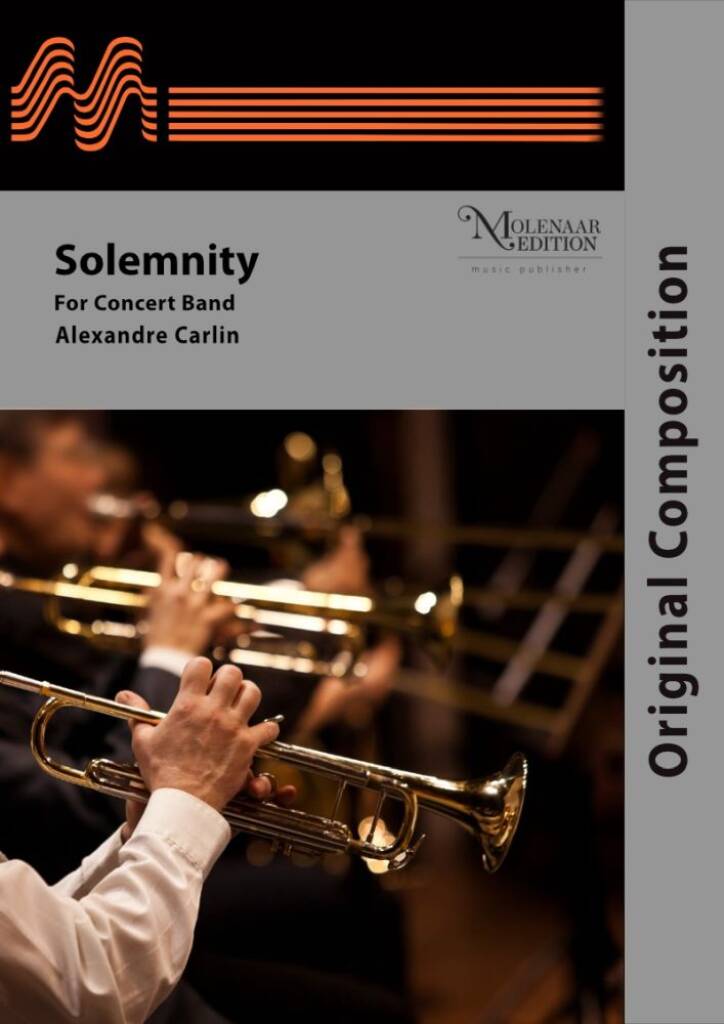 £82.80
Solemnity - Alexandre Carlin
Solemnity was composed when the composer came back from his first Midwest Clinic in Chicago. Inspired by all the concert bands performing there, and all the fellow composers met at this occasion, he decided to write a kind of fanfare work, leading to a fast theme on a driving rhythm.The piece begins like a fanfare with a solemn character which gives the title of the work, the brass here have a nice part to play. Then, a new theme full of energy, using the same rhythmic motive as the fanfare theme, is exposed by the high woodwinds and finally by more instruments. The central part is a slow one, where a melancolic theme is exposed by the oboe, and finally the rest of the band. After a fugato section, the energic theme is back to lead to a brilliant coda.
Estimated dispatch 7-14 working days
-
£67.50
Space Probe - James L. Hosay
Now your band can boldly go where no band has gone before, and bring the "final frontier" to your concert band stage! Here's James L. Hosay's imaginative new tone poem SPACE PROBE. Since the 1970's, NASA has been launching long-range, solar-powered probes into space. Over the past 30 years, the Voyager, Pioneer, and Galileo series' probes have sent back incredible photographs. The data sent to Earth by these probes, along with recent photos and information gathered by the orbital telescope, Hubble, has helped astronomers chart the ever-expanding universe all the way back to its origins. This composition provides excellent opportunities for cross-curriculum teaching withscience. A scintillating musical spacescape ushers in the bold thematic statement in the Trumpets and Alto Saxophones. French Horns join in thrilling variation. A boundless contrasting espressivo theme soars through to the reprise of the initial ideas. Explore SPACE PROBE with your band this year. Inspiring!
Estimated dispatch 7-14 working days
 View Music