
Results
-
 £93.50
Christmas Morning - Gene Milford
Allow arranger Gene Milford to transport you to that wonderful feeling of sitting around the tree on Christmas morning! Christmas Morning (Around the Christmas Tree) is an excellent choice for holiday concerts.
Estimated dispatch 7-14 working days
-
 £52.70
The Goodbye - Paul Voet
We sail the ocean with stubborn, hardworking but weak hearted Flemish fishermen to the Northern parts of the Atlantic. A sailor is leaving his wife or girlfriend not knowing if he is going to come back soon. Leaving for good fishing grounds around Iceland. This sad song(the first line of the text says; The wind that blows from the east, my love, is not going to blow for ever) is a solo for flugelhorn accompanied by the whole lower brass section. In a certain way of counterpoint tenorhorns, baritones and euphoniums are woven around thesoloist. The warmth from these saxhorn section is coloured by some chords from trombones and a quite virtuosi marimba line.
Estimated dispatch 7-14 working days
-
 £228.70
Reflections - Suite on a Norwegian Folk Tune - John Brakstad
The suite is constructed around a Norwegian folk tune. The melody is called "Dark Forebodings", and the words of the song revolve around thoughts and reflections on a future that can take unexpected, insecure, or perhaps dramatic and tragic turns.This is essentially a sad song with a beautiful melody. The folk tune itself is presented in the 2nd movement. In the 1st movement, the folk tune is joined with fleeting themes that indicate the unexpected; as if the music sometimesis confused as to which way to go. There are constant changes in atmosphere and feeling, from the harsh and dissonant, to the harmonious and melodic. The 3rd movement presents a more lively variant of thefolk tune, showing optimism andhappiness, even though the "halting" character of the rhythm underscores the unpredictable. The title "Reflections", therefore, refers to thoughts we can have about life. To the Conductor:The 2nd movement has an alternativeending which is may be used if the movement is played as an independent lyrical piece in a concert.It is advisable to begin first rehersal with the 2nd movement so that the main theme is known, before beginning on the 1st movement with itsmore semi-tonal parts. Intervals and intonation can provide much of the challenge in this movement.The 3rd movement can be more technically challenging, but there is considerable leeway in the tempo marking! It is important to maintain theenergy and intensity of the music through the whole movement.
Estimated dispatch 7-14 working days
-
 £228.70
Celebration for Band - John Brakstad
Many Norwegian bands have grown up around factories, but Norwegian factories are often located in the countrysides - by a fjord or lake, by a river or waterfall that provided power for the factory. The factory was the foundation for the existence of the community, but it was also essential for the community's cultural life, choirs, bands etc. (cp. British brass bands and mining). "Celebration for band" tries to give a picture of the environment and life around a band like this, with both factory noise and the natural world (Pastorale), as well as the challenges and development of the band itself. The composition is built up of five connected episodes: - Fanfare and Prologue (concludes with a feeling of the untamed power of the river) - Pastorale I: " At the river" - Intermezzo: " The Factory" (starts with the opening of water for the turbines: snare drum. Factory whistle and bell call to work, and the spinning and weaving machinery starts up.) - Pastorale II: " Summer evening on the fjord." - Finale: " Challenge and Progress"
Estimated dispatch 7-14 working days
-
 £113.30
Moderate Dances - Angelo Sormani
This piece is a tribute to dance music, especially passionate, intense and meditative dance music. "Moderate Dances" is divided into three movements: a "Tango", a "Slow Waltz" and a "Bossa Nova". Each movement and each dance has its own particular characteristics but, when combined, these different rhythmic beats and times give the piece a feeling of completeness and uniformity. The Tango started to flourish in the suburbs of Buenos Aires in around 1880. There is still some doubt as to its origins, which may be Cuban (Habanera) but are probably African. It was most popular in Argentina and Brazil: here the male protagonist was originally the "gaucho" with his inseparable guitar, later to be replaced by the proud, elegant "compadre". By around 1910 the Tango had spread to Italy and France. New clubs opened, where the upper classes could watch and dance the Tango. Here the dance also underwent some rapid transformations. The exaggerated and extravagant gestures and body movements disappeared. Slow, gliding steps replaced the old rotational movements. The women's red ankle-boots and the partners "staring into each other's eyes" accentuated the erotic nature and sensuality of this dance. So much so that, in 1913, the German government banned soldiers from dancing the Tango. Those who broke the law were immediately discharged from the army. From a strictly musical perspective, the basic instruments were a flute, a harp (the diatonic harp typically played by the Indians of Paraguay) and a violin, or flute, guitar and violin or even clarinet, guitar and violin. These instruments were easy to transport, ideal for playing at parties, in the streets and in courtyards. The musicians played by ear, frequently improvising: there were no scores, no records, which is the main reason why it is impossible to trace the Tango back to its exact origins. However, the Tango's evolution (and growing popularity) was once again fostered by its fundamental ability to absorb "other" cultures, languages and sounds. And it was the arrival of the "bandoneon" (an accordion-like instrument that was invented in Germany and brought to Rio de la Plata by some immigrant), which replaced the flute, that marked the beginning of the Tango's huge success outside Argentina. A number of talented composers, above all the great Astor Piazzola (1921-1992), transformed the bandoneon from a simple accompanying instrument to a solo instrument that was to become the distinguishing feature of the 20th century Tango. The Slow Waltz originated from the Waltz, the typical dance of the Bavarian and Tyrolese peasants in the 1700s. It was composers like Johann Strauss, father and son, who carried the Waltz to its zenith in the 1800s, creating the sensual and melancholy yet joyful and charming dance we are all familiar with. When the Waltz first became popular in Germany, the members of respectable society were shocked at the closeness of the dancing partners, who had always previously danced apart. The main difference between the Waltz and Slow Waltz is that the latter has a slower, more expressive rhythm: the men wear tails and the women wear ball gowns decorated with beads and feathers and couples dance in graceful rotational movements. "Bossa Nova" is the title of the last movement in the piece. Jobim, the great Brazilian musician, described this musical genre as a combination of modern Jazz and Samba. Bossa Nova means "new wave". This was the name of the artistic and musical movement that evolved in Brazil in the late Fifties and was extremely popular throughout the Sixties. The songs are usually about love or social matters, drawing inspiration from the slums of Rio De Janeiro and the lives of their inhabitants. Bossa Nova, with its original compositions and the artistic talent of its musicians, also became hugely popular in the United States and Europe, and top Jazz musicians (Ella Fitzgerald, Stan Getz, Bob Cooper, Charlie Bird, Sonny Rollins, Dexter Gordon, Dizzy Gillespie) started to include Bossa in their repertoires.
Estimated dispatch 7-14 working days
-
 £159.20
Chasing the Mystery - Kevin Houben
Commissioned by KU Leuven on the occasion of the 600th anniversary of KU Leuven.Chasing the MysteryKevin HoubenDedicated to the Wind Orchestra Universitair Harmonieorkest (UHO) of KU Leuven.Chasing the Mystery is the final movement of the triptych Beyond the Horizon of Thought.On the occasion of KU Leuven's 600th anniversary in 2025, the university commissioned Kevin Houben to compose a new work tailored to the Universitair Symfonisch Orkest, the Universitair Harmonieorkest and the Leuvens Universitair Koor. Maud Vanhauwaert, writer-in-residence during the 2023-2024 academic year, provided a poetic libretto.With Beyond the Horizon of Thought, Kevin Houben created not only a unique anniversary composition for more than 250 student musicians. The composition also conveys a universal message that perfectly reflects the spirit of the celebrating university: keep searching, keep developing yourself and keep hoping - even in turbulent times.From a compositional perspective, the work is built around themes and motifs with a clear symbolism. Kevin Houben explains: "I use a technique in which letters are converted into musical notes - a method also used by great masters such as Bach, Bartk and Shostakovich. This musical signature forms the basis of the melodic structure. In this way, 'KUL600' is represented by the notes D - G - E - F (re - sol - mi - fa)."The composition is conceived as a triptych: three movements that flow seamlessly into one another and are performed by different orchestral formations, yet together form a single whole. The work opens with the symphony orchestra, where the thematic 'KUL600' cells are introduced and explored. In this movement, Awakening the Wonder, several highlights establish a musical connection with the following movements.In the second movement, The Urge of Search, the choir sings a cappella to the poem Het is het by Maud Vanhauwaert, in which she reflects on the tireless quest for knowledge that has characterized the university for 600 years. Classical Gregorian techniques and traditional voice leading enter into dialogue with contemporary techniques, as the singers alternately whisper, call out and proclaim.Finally, the wind orchestra introduces the third movement, Chasing the Mystery. With a searching and anticipatory character, the orchestra presents the thematic cells in soloistic fashion, based on the main melody of the choral movement. References once again appear to the rhythmic 'KUL600' cells, which ultimately culminate in a grand apotheosis. A solitary soprano saxophone opens the finale with the 'KUL600' theme in its most intimate and meditative form. The expanded choir then joins the orchestra for an impressive final chord, musically preparing KU Leuven for the next 600 years.Beyond the Horizon of Thought premiered on Wednesday 23 and Thursday 24 April 2025 at LUCA Campus Lemmens, and was also performed on 9 May 2025 at Concertgebouw Brugge on the occasion of the 600th anniversary of KU Leuven. More than 250 musicians from the Universitair Symfonisch Orkest (USO) conducted by Edmond Saveniers, the Leuvens Universitair Koor (LUK) conducted by Kevin Hendrickx, and the Universitair Harmonieorkest (UHO) conducted by Erwin Scheltjens shared the stage.Cover illustration design: Grotezk Studio.
Estimated dispatch 7-14 working days
-
 £65.99
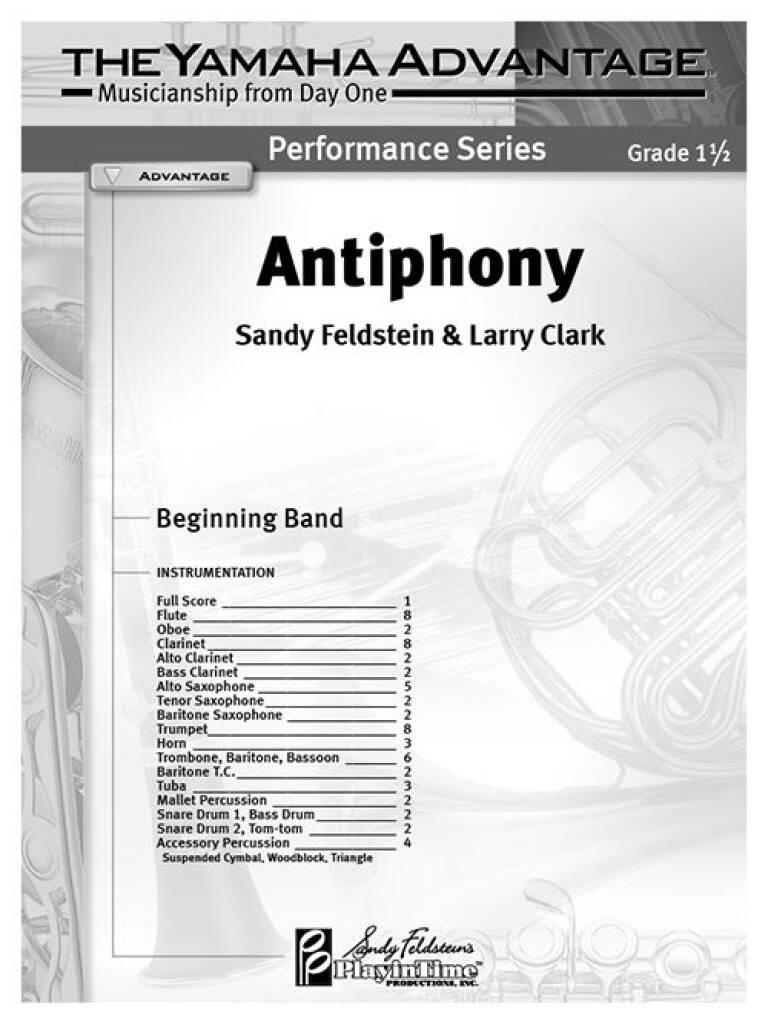
Antiphony - Sandy Feldstein
Antiphony is a serious composition that will highlight your budding percussionists. This bold and harmonically progressive piece has an extensive percussion section that is placed antiphonally around the Band for a stereophonic effect.
Estimated dispatch 7-14 working days
-
 £134.99
Talisman - Thierry Deleruyelle
Talisman tells the story of the "Pierre du Serment", an event that took place in 1639 in the village of Fontenotte, on the border between France and Switzerland. Composed of three brothers and their parents, the Billod family lived peacefully on their farm despite the Thirty Years' War raging around them. When their father was captured by the Swedish mercenaries who plundered the farm, the three brothers vowed to save him, carving their pact in stone according to a Celtic and Viking tradition.Commissioned by the Orchestre d'Harmonie de Montlebon for its centenary, this work pays tribute to a local story that has become a legend. The conductor, Jean-Pierre Frigo, wanted this commission to mark the orchestra's presence within the region.
Estimated dispatch 7-14 working days
-
 £87.99
Cityscape - Jan Hadermann
Cityscape was commissioned by Concertband Antwerp for the 't Stad Geblazen event, which took place during the weekend of European Heritage Days in 2024.This short concert piece describes the impressions given when approaching and visiting the beautiful Belgian city of Antwerp from the north across the river Scheldt. We first pass the busy bustle of the harbour, home to the impressive Port House. Then the old city comes into view: the graceful cathedral tower, surrounded by smaller church spires and modern buildings, dominates the distinctive skyline. After setting foot ashore, we are struck by the beautiful way the medieval buildings here blend harmoniously with modern architecture. Our walk through the city continues: we visit the serene cathedral and are impressed by the picturesque faades of and around the city hall, as well as the Brabo Fountain on the Grote Markt (Large Market Square). Finally, it is time to enjoy the merriment taking place on the many squares of the lively city centre.
Estimated dispatch 7-14 working days
-
 £53.95
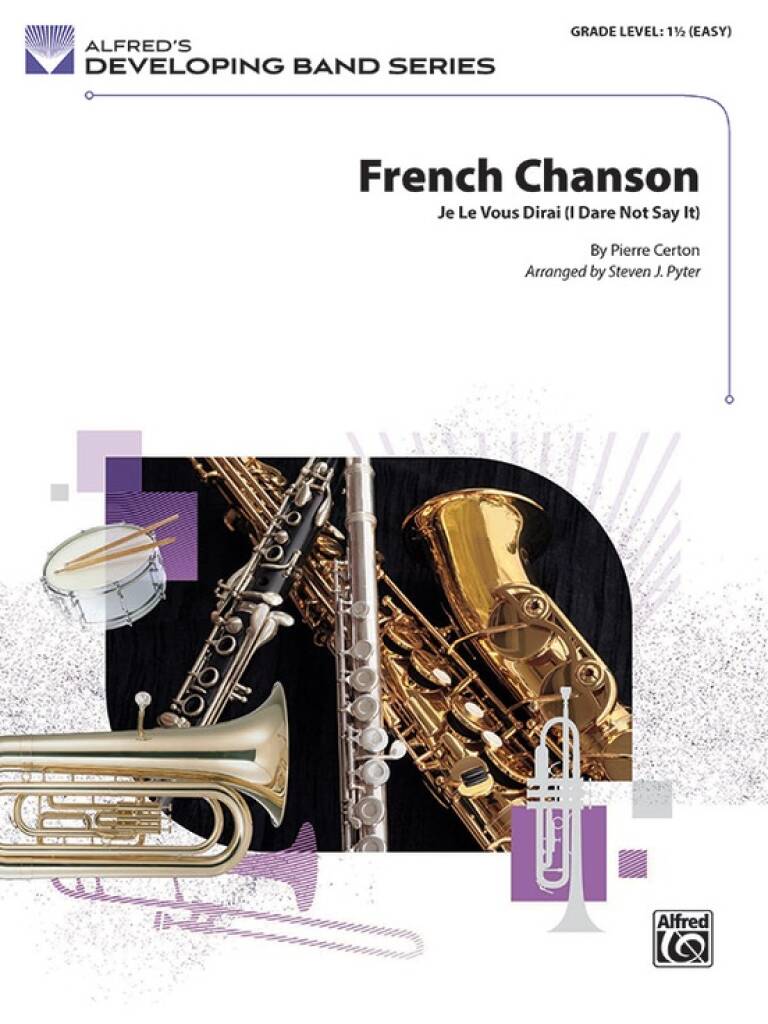
French Chanson - P. Certon
French Chanson, arranged by Steven J. Pyter, is a rousing arrangement of a famous 16th-century choral work. The tuneful Renaissance art song tells a light-hearted story of gossip and rumor, with lyrics roughly translating to "I will tell you!" The story centers around a jealous husband suspicious of his beautiful wife. Like opera, the piece employs dramatic and whimsical characteristics to tell a passionate story. This arrangement alternates between tutti statements and short interludes to feature each instrument family in the band---woodwinds, brass, and percussion. The intensity and playfulness make for a great concert opener! (1:40)
Estimated dispatch 7-14 working days
 View Music