
Results
-
 £143.00
Psych et ros - César Franck
Csar Franck, composer, pianist, organist and music teacher, completed Cupid and Psych, his sixth and last symphonic poem in 1887. It was first performed in Paris in 1888 and was a complete success, but the piece later fell completely into oblivion, and it was only thanks to some meticulous research that it has returned to concert halls. The intricate love affair between Psyche and Cupid is an original story of the Metamorphoseswritten in the 2nd century AD by Apuleius. The tale is about overcoming obstacles in love and their final union. The symphonic poem is divided into three parts and calls for a choir. The movement that is the subject of this arrangement, Psych et rosis positioned at the end of the second part.Franco Cesarini's version for wind orchestra carefully illustrates the nuances of the instrumental colours, and represents a real test aimed at demonstrating the musicality and interpretative skills of orchestras and their conductors.
Estimated dispatch 7-14 working days
-
 £104.99
Solemnitas - Jan Van der Roost
This short but solemn overture was written on the occasion of the 110th jubilee of Harmonie Hautcharage, Luxembourg. It is an homage to Jean-Paul Frisch and his son Grard (the present conductor), who each have been conducting the ensemble for many years. Under their leadership, the band has developed and improved remarkably. The very first musical theme, presented during the introduction of this little overture, is based on the letters hidden in the names Jean-Paul and Grard Frisch (in which h is considered b - as it is in German), thus aiming the spotlight on both key figures in the history of Harmonie Hautcharage. After the rather stately intro, the allegro is more joyful and lighthearted, thus depicting the optimism of the many young players of the band. The end is exciting and energetic: it radiates positivity and belief in the future.
Estimated dispatch 7-14 working days
-
 £137.70
Mammoth Mountain Suite - Haakon Esplo
Mammoths were a family of elephants that, with one exception, died out at the end of the last ice age. Their closest living relative is the Asian elephant. In many places in the world one can find mammoth remains. In Norway (especially in Gudbrandsdalen), 20 discoveries of teeth and skeletal remains have been made after mammoths that lived here between 40,000 and 50,000 years ago. On cave paintings and carvings you can see many pictures of mammoths with other animals. Pictures of killed mammoths have also been found with humans. Mammoth Moutain Suite describes a bunch of hunters looking for mammoths. Imagine the majestic animals, what it felt like to see the herd in themountains and what it sounded like when the 6 ton heavy and 3.5 meter tall mammoths were on the run.
Estimated dispatch 7-14 working days
-
 £60.99
Sumba Samba - Ron Gilmore
The Samba is a Latin American dance, which is mostly associated with parties, as a result of the fast tempo in which it is usually played. 'Sumba Samba' forms an exception to this rule. In order to get this samba to swing it is important to stick to the tempo prescribed. 'Sumba Samba' starts with a motif which will play an important role throughout the piece. This motif can be heard in the first notes of the 'refrain' and, as said before, has been used in the introduction, as well as in the transition after the middle part (letter G). Furthermore, it plays an important role in the middle part itself (letter E), in which the samba has momentarily disappeared and acompletely different atmosphere has been created. At letter H we pick up where we left off with the samba and swing to the end of this composition.
Estimated dispatch 7-14 working days
-
 £104.99
Variations on Shalom Chaverim - Andreas Ludwig Schulte
Shalom Chaverim is an ancient Hebrew (farewell)song, which was originally sung at the end of a celebration or meeting. It was and is mostly sung as a round. Freely translated the words mean "Goodbye, friends, goodbye and see you again!". The varying moods at a parting have been captured very well by Andreas Schulte in his arrangement 'Variations on Shalom Chaverim'. The composer himself says about the song, 'Although the melody is in a minor key, the overall atmosphere in the song is positive. one wishes each other all the best. Saying goodbye, however, also hurts. When you slow down the pace of the melody and add 'blue notes' in the harmonies, this can be sensed immediately.'Schulte refers here to the first variation. The second variation is very intense with possibly even deeper-felt emotions. 'Variations on Shalom Chaverim' ends on a cheerful and positive note, in fast tempo, and with oriental elements in the melody: 'L'hitra'ot, Shalom' (See you again, and farewell!).
Estimated dispatch 7-14 working days
-
 £51.60
Sakura Variations - Kees Vlak
The blooming of the cherry trees each spring is a great event in Japan. In the evening friends meet under the pink and white cherry blossoms for a picnic. It is a striking sight, especially in big cities. Vendors sell Japanese food, entertainers andclowns perform, and the typically cautious Japanese seem to be more relaxed during the cherry blossom, or "Sakura". Kees Vlak captured this atmosphere with his "Sakura Variation"; its theme employs a subtle drum rhythm. The first variation is titled"clowns" and opens with three bass drum strikes. The theme appears in 3/4 time and is repeated several times with surprising changes. An impetuous tempo with dissonant elements suggests a clown's mischievous behaviour. The second variation in a minormode sounds very sad and dramatic. Is this the sadness when thinking of the end of the cherry blossom, as all the petals "snow" down from the trees? The cherry trees will bloom again next year, so the finale celebrates a joyful "Sakura".
Estimated dispatch 7-14 working days
-
 £98.20
Golden suite - Lorenzo Pusceddu
In the Non Valley, during spring when the water of Lake Santa Giustina starts lowering, the old main traffic system and the steep terrain with the Groppello vineyards resurface. The majestic and uncompromising Mount Ozolo dominates this landscape and acts like a guard of the fertile valley. The people who had to walk along the Regiai road to leave their village in search of fortune keep those memories very alive. Their trip started by descending the valley along the Regiai road, walking through the luxuriant vineyards that were supported by dry stone walls, downright mosaics of stones built to help the growth of the vineyard. Those who left and casted a glance at their village for one last time could catch sight of the Ozolo, the mountain of the primordial man, of hunting and friendship. They also had to cross a bold stone bridge that still exists and is jealously safeguarded by the lake water, which has also sunken together with the bridge hectares of vineyards of Groppello, the vine of the traditional and vigorous wine produced in the Non Valley. Its name is said to come from the typical structure of the grapes, which are compact and resemble a thick tangle ("groppo" in local dialect), almost a defense against the shifting temperatures of the fall that gives the grapes a bright color and a honey-like sweetness. The production at the end of the nineteenth century was of circa fifty thousand hectoliters of wine, but today it has reduced to only five hundred hectoliters produced by about thirty courageous farmers who want to preserve an authentic patrimony of taste and flavor. These wine makers have the will to safeguard a vineyard that is at risk of extinction and work the land as they used to do many years ago: with hoe, shovel, and a lot of sweat! The Groppello vineyard extended to the bottom of Mount Ozolo, but on the higher slopes the more rigid temperatures allowed only for the growth of pines, spruces, larches, broad-leaved trees, and pastures. In the course of the years, this typical vegetation of the mountain has provided the population with the raw material to build houses, to keep warm during the winter, and to feed the animals. Mount Ozolo has also been since ancient times the "sacred" mountain of the valley, and today it has become a game preserve and a site of socialization for young people who know how to love and respect nature.
Estimated dispatch 7-14 working days
-
 £159.99
Traversada - Oliver Waespi
The crossing of a mountain pass is called traversada in Romansh. Such a crossing bears uncertainties and dangers, but also hope and new opportunities. Whoever sets out for a traversada is leaving behind what's familiar in the quest for new places and people. The piece Traversada, based on a Romansh song about farewell and uncertain reunion, musically depics such a journey. At the offset, off-stage soloists introduce fragments of the melody after which a dramatic narrative unfolds. An intense musical shift leads to a calm section, featuring the original melody in pulsating, muted sound colours. Towards the end, the whole structure is gradually rebuilt andleads to an exuberant ending, where the vibrant melodic motifs reemerge.
Estimated dispatch 7-14 working days
-
 £183.20
Fest - Polonaise - Johan Svendsen
Johan Svendsen (1840 - 1911) was the first great Norwegian symphonic composer, as well as one of the leading conductors of his time. Next to Edv. Grieg, he was the most prominent figure in Norwegian music life at the end of the 1800's. Although he came from humble beginnings in Chistiania (now Oslo), he was to become a cosmopolitan who felt at home all over Europa. Svendsen spent most of his adult life abroad, living in Copenhagen for 25 years as maestro for the Royal Theatre Orchestra. Nonetheless he retained contact with Norway troughout these years and was a frequent and popular guest in his native country. He wrote his Festival Polonaise for a ball in 1873. This polonaise ina big ABA style
Estimated dispatch 7-14 working days
-
 £271.60
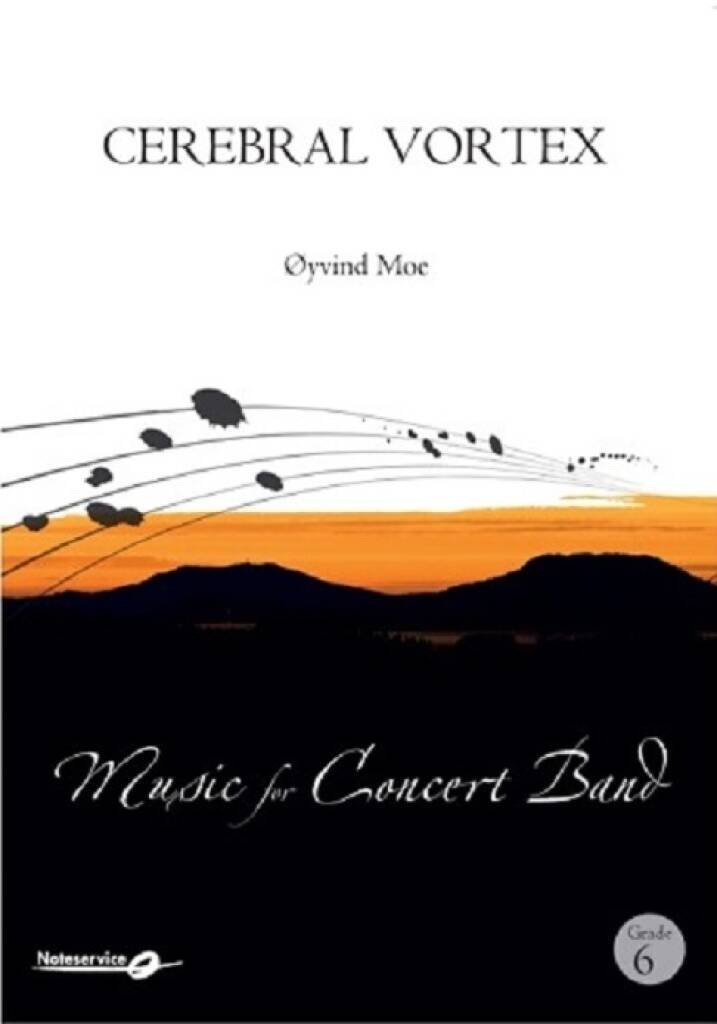
Cerebral Vortex - Øyvind Moe
Cerebral Vortex was composed for Musikkforeningen Nidarholm for their participation in the 2009 World Music Contest in Kerkrade, The Netherlands. Tthe first performance was given at this contest conducted by Espen Andersen, with the composer in thesaxophone section.The title is meant to describe a from of writer's block caused not by lack of ideas, but rather a lack of ability to channel and form the madness swirling around inside the head of someone with a great desire to express something. In this respect,the piece can be said to be an exercise in keeping focus from the composer's side. A limited amount of material is repeated and treated to create a development that always has a solid anchor point. This is emphasized by the return to the openingtheme towards the end.
Estimated dispatch 7-14 working days
 View Music