
Results
-
 £91.99
The Last Typewriter - Jacob de Haan
This work describes the history and development of the typewriter in the newspaper world. The typical typing sound is the connecting thread, while a variety of music styles follow one another. In the end, the old familiar writing device is defeated when it has to make way for the computer. The composition features solos for various instruments that accompany the recurring typewriter. In a theatrical context, offering room for original ideas, the musical narrative will come across even better.
Estimated dispatch 7-14 working days
-
£71.50
Anthem for the Modern Age - William Owens
This hopeful work is certainly one to look to in the modern age! Composer William Owens brings us a bit of style with this slightly syncopated work with a catchy and happy vibe. Each section gets a moment to shine and by the end your heart will be full! A wonderful work for any concert program or event!
Estimated dispatch 7-14 working days
-
 £79.99
At the End of the Rainbow (Concert Band - Score and Parts) - Saucedo, Richard L.
Referring to the ongoing quest in which we all embark when trying to find our place in the world, Richard Saucedo's At the End of the Rainbow takes us on a journey of varied moods and styles. After the stark and dramatic opening unison statements, this imaginative works features a lighthearted and spirited 12/8 section with plenty of rhythmic vitality. This is beautifully paired with a lyric middle section that showcases a solo for horn and flowing melodic lines that build to an emotional climax. The fast 12/8 section returns with an exciting and energised finish.Duration: 4:15
Estimated dispatch 7-14 working days
-
 £79.99
Beyond the Clouds and Into the Heavens! (Concert Band - Score and Parts) - Saucedo, Richard L.
Richard takes the listener and performer on an extended journey through various mood styles in this impressive work for mature ensembles. The stately opening strains gather momentum and intensity, leading to a fast-paced section that features intertwining solo and small group fragments passed throughout the texture. An overall soaring theme adds a tone of triumph and grandeur throughout, and the final push to the end is both exhilarating and rhythmically dynamic.Duration: 7.00
Estimated dispatch 7-14 working days
-
 £75.50
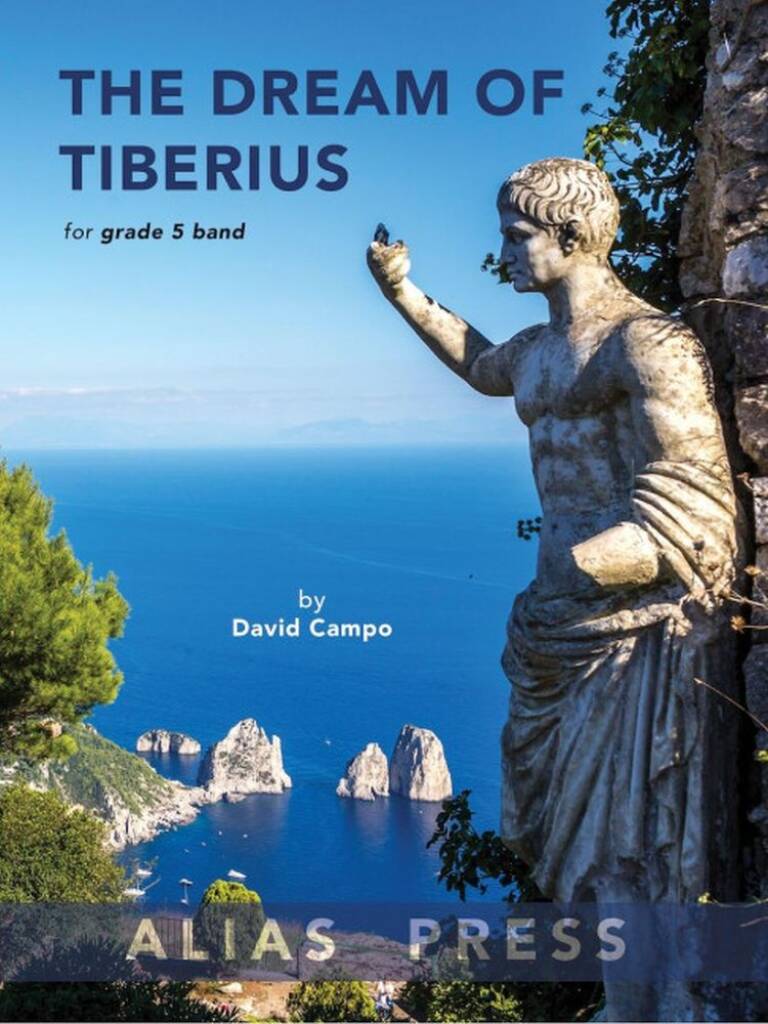
The Dream of Tiberius - David Campo
The Roman Emperor Tiberius was born in 42 BCE to Tiberius Claudius Nero and Livia Drusilla, both descendants of prestigious political families, at a time when Rome was undergoing significant political upheaval. Julius Caesar had begun a brutal civil war in 49 BCE to end Rome's rule as a Republic and consolidate his power as supreme ruler. Following Caeser's assassination in 44 BCE, Tiberius' father backed the forces wishing to return Rome to a Republic, but they were defeated by Caesarian loyalists led by Caeser's heir Octavian. As a result, Tiberius' early life was spent on the run and in political exile with his parents. In 27 BCE, Octavian would become the first Emporer of Rome and assume the name Augustus. Augustus forced Tiberius' parents to divorce and took Tiberius' mother as his new bride, separating the family and forcing Tiberius to live with his father. Upon his father's death, Tiberius went to live with his mother and Emporer Augustus, a situation Tiberius found extremely uncomfortable but one over which he had no control. Having been adopted by the Emperor, Tiberius assumed the military and political life thrust upon him. He proved to be an outstanding military and political leader, and with his marriage to Vipsania Agrippina his life took on a heretofore unknown stability. However, Augustus would intervene in Tiberius' life once more, forcing him to abandon his happy marriage and take Augustus' daughter Julia (Tiberius' step sister) as his new wife. This arrangement, while securing Tiberius' place as Augustus' heir and ensuring he would one day be Emperor of Rome, was disastrous. Julia's drunken licentiousness was a constant source of scandal and embarrassment for Tiberius (and her father, the Emperor) and she was eventually exiled by her father Augustus. Tiberius was named Emperor of Rome upon the death of Augustus in AD 14, assuming his position as the most powerful man on Earth. However, no matter how powerful he had become, Tiberius never felt as if he had ever had any control over his life, having been manipulated from childhood through adulthood by the whims of Augustus. As Emperor, he soon became disgusted with the political intrigue of the Roman Senate and by AD 26 left Rome and took up residence on the island of Capri, where he lived out the rest of his life. History does not regard Tiberius fondly and by all accounts towards the end of his reclusive life on Capri, he had become a miserable, sick and mentally unstable old man reveling in debauchery and cruelty. It is also informative to note that he was Emperor of Rome when Jesus of Nazareth was crucified, and while there is no indication that Tiberius was even aware of the existence of Jesus, as Emperor he was responsible for the appointment of Pontius Pilate as Governor of Judea. Even considering this, it is difficult to look on the life of the Emperor Tiberius and not feel some sympathy and pity. It's in this spirit that I composed "The Dream of Tiberius." I imagine the man sitting in thoughtful seclusion on the beautiful island of Capri imagining what his life might have happily been had not power been thrust upon him: husband, father and humble servant of the people.
Estimated dispatch 7-14 working days
-
 £102.99
Cast Away (End Credits) - Alan Silvestri
In 2000, the movie Cast Away stormed into cinemas and received two Oscar nominations in the process. It follows the story of a man (played by Tom Hanks) who gets stranded on an island after the plane he is traveling on crashes. As the sole survivor, he does his best to keep himself alive while facing a rather bleak situation. An interesting feature about this film is that after hearing an Elvis song and a Russian choir, no music is heard again until the end of the movie, over 100 minutes later! Aidan Thomas creates a moving arrangement of the end credits music.
Estimated dispatch 7-14 working days
-
 £147.20
At World's End - Hans Zimmer
The soundtrack of the movie picture 'Pirates of the Caribbean': 'At World's End', released in May 2007, was composed by one of the 'masters of the soundtrack', Hans Zimmer. Erik Rozendom made a faithful and extremely well sounding arrangement of this fine score which, in the meantime, has become very popular. This arrangement can possibly call on the vocal capacities of the musicians of your band.
Estimated dispatch 7-14 working days
-
 £104.50
The Valley of Darkness - Barry E. Kopetz
The Valley of Darkness . . . eerie . . . overgrown . . . unchartered . . . an echo of an era long past. The music tells the story of an expedition into this heretofore unnoticed valley in an unsettled land. As several imaginary scenes are portrayed, a sense of dread and foreboding permeates as the natives of the valley detect the presence of trespassers upon their land. When the end of the sojourn looms, the speed and urgency of the adventurers increases, and escape through the narrow crevice at the end of the valley is now within their reach. However, the inhabitants of the Valley of Darkness think otherwise . . .
Estimated dispatch 7-14 working days
-
 £171.00
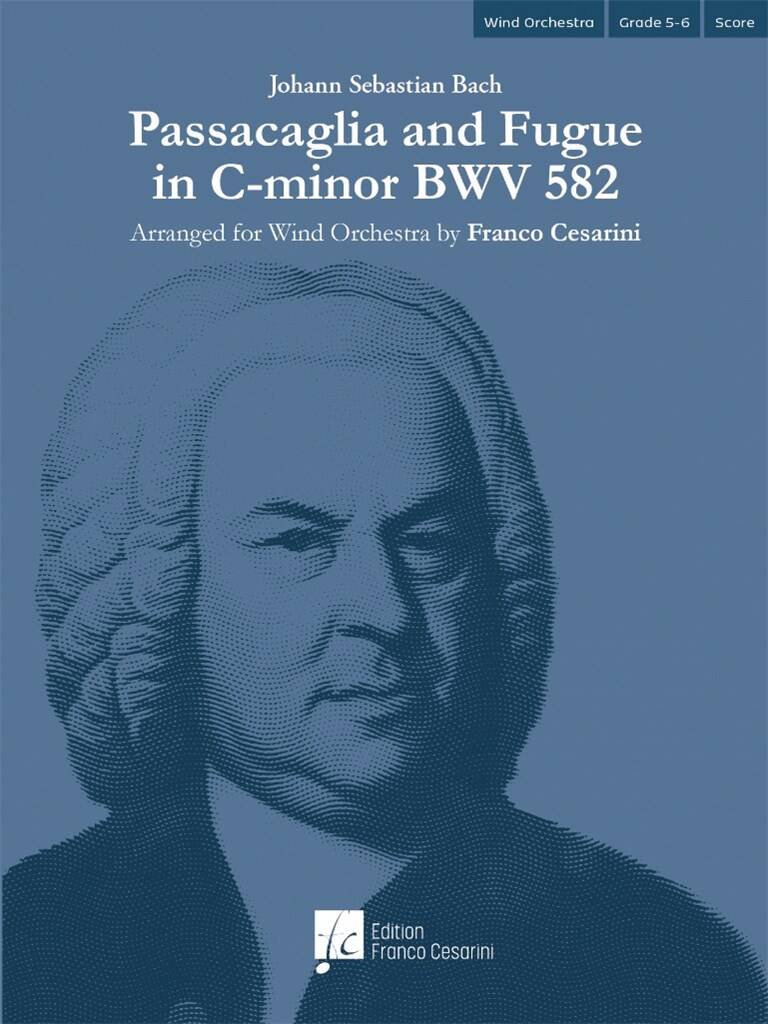
Passacaglia and Fugue in C-minor BWV 582 - Johann Sebastian Bach
The Passacaglia is a set of instrumental variations based on an ostinato bass. Bach's Passacaglia and Fugue in C-minor for organ represents the pinnacle of what had been achieved in this compositional form at that time. In Franco Cesarini's arrangement for large wind orchestra, the particularly careful interpretation of the original piece enables him to exploit all the sound colors at his disposal, and in this sumptuous guise Bach's work also takes on a grandiose dimension, albeit tinged with late-Romanticism. The exposition of the beautiful theme begins in the bass part, immediately creating a solemn and serious atmosphere which is accentuated by the intensely pathetic character of the first variations. Up to the tenth variation it remains confined to the bass, but in subsequent ones it also passes to the soprano and alto register. The integrity of the theme is also embellished with elegant arpeggios, in whose lower and higher extensions the theme can be distinguished. Towards the end it returns to the bass in an impressive thickening of the polyphonic texture that swiftly re-establishes the key of C-minor. The "Thema fugatum" which follows immediately does not constitute a Fugue in its own right, rather it is nothing but the twenty-first and most extensive variation of the Passacaglia. This time Bach uses only the first half of the theme, superimposing a rhythmic countersubject that considerably enlivens the entire development of the composition. The polyphonic discourse becomes increasingly dense, until the building tension peaks in a powerful "Neapolitan sixth" chord, followed by a sudden pause. This culminating moment then leads to the coda and final cadence on a bright C-major chord.
Estimated dispatch 7-14 working days
-
£149.99
Jello, The Colours Of My Soul - Ben Haemhouts
Jello...The Colours of my Soul is an assignment that was written to be a lasting memory of the untimely, dramatic death of a young child. The work came about due to various conversations between the father and the composer whereby the final resultmust be seen as an attempt by the composer to musically translate the feelings of the parents.The first part of the title, "Jello", is a combination of the names of the two children of the commissioner, namely Jelle and Lobcke, and "the Colours of mySoul" are the colours of the soul of the parents who despite the loss of one of their children, continue to cherish their two children. The introduction provides the atmosphere of grieving for the loss, whereby use is made of pure fifths in order toportray the solidarity with nature, as we are familiar with in symphonies by Bruckner. A little later a bit of the first theme is suggested, which develops into a real funeral march.The Dies Irae, as this occurs in Berlioz's Fantastic Symphony (F, E,F, D, E, C, D), forms a leitmotiv through the entire work in order to symbolise the constant battle between life and death.Shortly before the storm-passage, (where a wind machine is used) which announces disaster, fragments from children's songs areplayed to the accompaniment of a rising choir piece from behind the stage, which strengthens the imminent confrontation with death.After the introduction of the two themes in the long introduction, a quick passage follows in which all kinds ofbeautiful memories are recalled. There is story telling, laughing, and dancing. One of the previous children's songs is also cited. The Dies Irea is heard once again, this time short and fast.Bit by bit happy elements are steadily distorted untilseriousness breaks through again, like an unavoidable and unstoppable evil. The entire piece becomes evermore stirring, as if a big climax will follow. At this moment a very long fermata makes a sudden end to the hysterical allegro. The crucialmoment in the work follows...How does one deal with something as tragic as the death of one's own child? Does one mourn for what no longer is and what never will be? Or does one try to cherish the beautiful moments and continue to live with thesecolourful memories?A subdued, dignified choir piece captures the beautiful memories and ends in a positive, hopeful tone.
Estimated dispatch 7-14 working days
 View Music