Searching for Brass Band Music? Visit the Brass Band Music Shop
We've found 1000 matches for your search

Results

  • £244.99

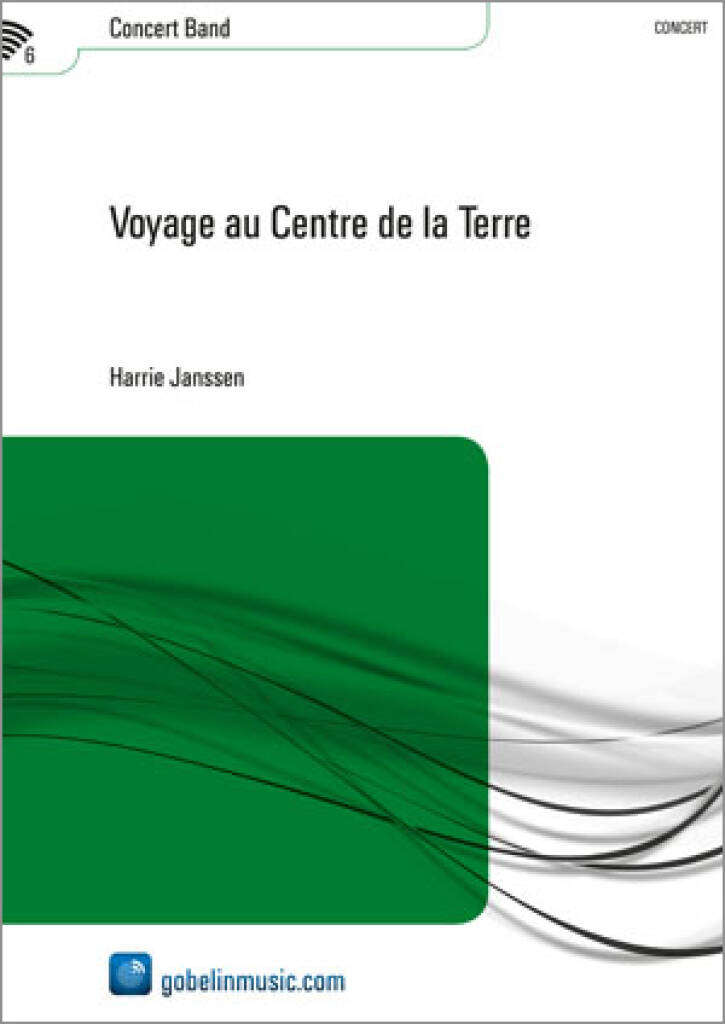
    Journey to the Centre of the Earth - Harrie Janssen

    This composition was based on the world-famous novel by the French author Jules Verne. This novel describes the attempt to reach the centre of the earth. The descent of the crater of the volcano called Snaeffels, situated in Iceland, marks thebeginning of this voyage to the sublunary world. The German geologist, professor Lidenbrock, is accompanied on this trip by his nephew Axel and an Icelandic guide named Hans. The last mentioned will be helpful in many occasions. Dark colors & mist The composer tried in this single work to give a musical expression to various significant moments from this novel. In the introduction he sketches an image of the dismal ambience on the island by using dark colors. Risingfragments of mist reveal the flanks of the monumental mountain Scataris. The composer tries to catch this image in a majestic and broad chorale. Away from Iceland Subsequently the ostinato rhythmicity and virtuosity representthe hectic descent of the crater of the volcano. The party descends ever more and more and travels south, away from Iceland. On the way, they see all kinds of rock formations, fossils and minerals. At a depth of thirty hours walking distance, atabout 150 kilometers below the surface, they reach a sub terrestrial sea which is called the Lidenbrock sea. Genuine eruption of sounds Strange electric manifestations and unpredictable weather conditions accompany thissingular phenomenon. An orchestral tutti-episode expresses this impression musically. On a make-shift raft, the party continues its voyage, heading to the south coast of this huge sea. Once ashore, an enormous rock obstructs the passage. The blowingup of this obstacle unleashes a genuine eruption of sounds in the orchestration. Spat out by the volcano But the explosion has an unforeseen side effect. The sea - travelers and raft included - is sucked upwards into a dark hole.Again, our heroes are accompanied on their involuntary voyage, while left to fend for themselves, by an ever increasing ostinato rhythmicity. Before an irruption can destroy the raft, the threesome manages to escape and climb up through acave towards the daylight. They seem to be spat out by the Stromboli volcano on the island of Sicily, far from home. The composition ends with triumphant sounds that represent the scientific triumph of these adventurers.

    Estimated dispatch 7-14 working days

     PDF View Music

  • £206.99

    Omaggio (Euphonium Concerto No.4) (Euphonium Solo with Concert Band - Score and Parts) - Sparke, Philip

    Omaggio was commissioned by Steven Mead in celebration of his 60th birthday and in memory of his father, Rex. He gave the premiere of the brass band version in Rome in March 2022, accompanied by the Italian Brass Band conducted by Filippo Cangiamilla. The concert band premiere took place on 6th July that year as part of the 2022 Spanish International Tuba Euphonium Conference, accompanied by the Banda municipal de msica de Malaga.The concerto is set in 3 continuous movements, which are united by a recurring syncopated interval of a fifth. The first movement, Fantasia, opens with this motive accompanying an extended monologue for the soloist. This is followed by a lengthy bridge passage by the band, which is eventually joined by the soloist, who guides the music back to the opening soliloquy, leading to an energetic central section. This develops until the opening material again returns to introduce the second movement, Ballad, which revolves around an expressive melody for the soloist, interspersed by accompanied cadenzas. The third movement, The King Triumphant, pays homage to Steven's late father, Rex, and its title alludes both to Rex's name (Rex being Latin for king) as well as his love of Eric Ball's Salvationist masterpiece, The Kingdom Triumphant. The finale is an energetic tour-de-force featuring an acrobatic 6/8 melody, which is interrupted twice by the magnificent hymn tune, Helmsley, which Ball uses so effectively in The Kingdom Triumphant. A galloping coda brings the work to a close.

    Estimated dispatch 7-14 working days

     PDF View Music

  • £46.95

    Willow Creek Festival (Concert Band - Score and Parts) - Hodges, Steve

    Beginning with an energetic fanfare, Willow Creek Festival is an upbeat piece that moves along smoothly in triple meter. The main theme is presented by the clarinets and saxophones and then again by the trumpets and flutes. A repetition of the introduction provides a transition to a contrasting section in 5/4 time which features a memorable melody in the relative minor key. With varied percussion colours, active rhythmic patterns and an effective countermelody, an excellent contrast is achieved. The main theme returns and flows into an exciting variation of the initial fanfare, bringing the piece to a dynamic conclusion.Duration: 3.00

    Estimated dispatch 7-14 working days

     PDF View Music

  • £105.00

    Danceries (Set I) (Concert Band - Score and Parts) - Hesketh, Kenneth

    The term 'Danceries' can be found in a copy of Playford's Dancing Master, an extensive collection of folk and popular tunes of the seventeenth century (and no doubt earlier). This publication was used by master fiddle players to teach the various dance steps of the day to a nobleman's house or a king's court. Whilst this present set of 'Danceries' cannot be said to be an aid to terpsichorean agility, it will at least set feet tapping! The melodies themselves are a mixture of new and old--well, nearly. Where the old occurs it has been adapted in mood and composition and is often interspersed with completely new material. The harmonies and rhythms bring a breath of the new into these themes and add to the drama of the set.Movement 1: Lull me beyond thee. Gentle and lilting, almost a barcarole, this movement is very much a reverie. The original tune had the name 'Poor Robin's Maggot' - a rather disconcerting title; maggot, however, in seventeenth-century parlance meant whim or fancy. This theme can also be found in The Beggar's Opera by John Gay (first performed in 1728) under the title 'Would you have a young lady' (Air 21).Movement 2: Catching of Quails. A colourful, buoyant scherzo on an original melody. The thematic material is shuttled around the band to contrast with full-bodied tuttis. The last few bars fade away to almost nothing before a final surprise!Movement 3: My Lady's Rest. A tender pavane, also on an original theme, with Moorish leanings. Solos for principal winds and brass contrast with warmer tutti passages. The movement culminates with a final presentation of the theme before evaporating in held flute and trumpet chords.Movement 4: Quodling's delight. The final movement to the set combining one of the melodies from Playford's Dancing Master ('Goddesses') with an original contrasting melody. A dramatic and exuberant ending to the set of 'Danceries'.Duration: 12.00

    Estimated dispatch 7-14 working days
  • £248.99

    Missa Brevis Wind Band Set (Score & Parts)

    Missa Brevis, written for choir and wind band, was commissioned by the Conseil D?partemental pour la Musique et la Culture de Haute-Alsace (Dir.: Philippe Pfisterer) in Guebwiller (France), in celebration of the millennium of Pope Leon IX's birth in ?guisheim (France). The composer conducted the first performance on June 23, 2002. It was performed live for the French television channel France 2. The mass movements Kyrie, Gloria, Credo, Sanctus, Benedictus, and Agnus Dei are very suitable for the Catholic as well as the Protestant liturgy. For this mass, various ways for performing in diverse variable strengths are possible. An instrumental performance is possible if the brass represents the choir parts. In this option, it is desirable for the brass to be positioned separately from the rest of the band (on a gallery, for example), so that the idea of two choirs is approached. In a performance with a large choir, the brass can work very well as a support. In that case, the dynamics of the brass should be adapted somewhat, since these are actually intended for an instrumental performance. You can also leave out the brass entirely for the benefit of the choir. For the accompaniment of smaller choirs, you can opt for a small ensemble from the band. This can also be a quartet, put together as desired. For the performance of this mass, the obvious choice is one of the above options. However, as an alternative, a performance with a combination of these options (vocally/instrumentally) is also possible - not just from an artistic point of view (variation), but also from a practical starting point - for example in the case that the choir has rehearsed only two movements. With a full strength, the conductor can vary the instrumentation to his or her liking. Then the brass can also play a role in the accompaniment (instead of supporting the choir). The following combinations are possible: 1. clarinet choir (from Eb Clarinet to Bass Clarinet) 2. clarinet choir + saxophones 3. brass (flugelhorns, horns, euphoniums, bass section) 4. brass (2 trumpets / 2 trombones) 5. double reeds (optional + flute, optional + string bass) 6. tutti 7. all winds 8. all brass In a performance by brass band and choir, it is usually advisable to leave out option 1 (choir + brass + band). The choir sings self-reliantly, accompanied by a full brass band. In an instrumental performance, you can consider a combined quartet (two cornets and two trombones) + brass band. Choral parts available separately. 0:20:00

    Estimated dispatch 7-14 working days

     PDF View Music

  • £47.52

    Raptors: Birds of Prey (Concert Band - Score and Parts)

    Drawing inspiration from the beauty and ferocity of raptor birds (eagles, hawks, vultures and owls), Larry Neeck has crafted an exciting and musically rewarding work for young band. Expressive melodies soar over an aggressive ensemble foundation, with plenty of percussion to propel the themes. Featuring an impressive ending that starts softly, and builds to an powerful climax, "Raptors: Birds of Prey" will provide an exciting and dramatic moment for your next concert.

    Estimated dispatch 7-14 working days

     PDF View Music

  • £206.99

    Omaggio - Philip Sparke

    Omaggio was commissioned by Steven Mead in celebration of his 60th birthday and in memory of his father, Rex. He gave the premiere of the brass band version in Rome in March 2022, accompanied by the Italian Brass Band conducted by Filippo Cangiamilla. The concert band premiere took place on 6th July that year as part of the 2022 Spanish International Tuba Euphonium Conference, accompanied by the Banda municipal de msica de Mlaga. The concerto is set in 3 continuous movements, which are united by a recurring syncopated interval of a fifth. The first movement, FANTASIA, opens with this motive accompanying an extended monologue for the soloist. This is followed by a lengthy bridge passage by the band (piano), which is eventually joined by the soloist, who guides the music back to the opening soliloquy, leading to an energetic central section. This develops until the opening material again returns to introduce the second movement, BALLAD, which revolves around an expressive melody for the soloist, interspersed by accompanied cadenzas. The third movement, THE KING TRIUMPHANT, pays homage to Steven's late father, Rex, and its title alludes both to Rex's name ('Rex' being Latin for 'king') as well as his love of Eric Ball's Salvationist masterpiece, The Kingdom Triumphant. The finale is an energetic tour-de-force featuring an acrobatic 6/8 melody, which is interrupted twice by the magnificent hymn tune, Helmsley, which Ball uses so effectively in The Kingdom Triumphant. A galloping coda brings the work to a close.

    Estimated dispatch 7-14 working days

     PDF View Music

  • £202.99

    Selections from Kiki's Delivery Service - Joe Hisaishi

    Famous musicologist Yuji Numano identified an interesting relationship between classical and film music. Film music is like a second child of 19th century classical music (the first child being 20th century modern music). Although they have a parent-child relationship, there are still major differences."The basic `form' is different. In the history of classical music art forms, there is a continuing dispute on how to convey a story only through music. On the other hand, as a part of motion pictures, film music at times has difficulty being an autonomous art form separate from the visual media. Indeed, film scores alone can lack musical substance. In the sense of acoustical effectiveness, film scoring has absorbed the total aspect of modern and classical music. Yet, there is still a huge distinction from classical music regarding recognizing film music as a standard art form."This Selections from "KIKI'S Delivery Service" is my seventh arrangement of Joe Hisaishi's works. They are either in medley or suite styles. It might be an exaggeration, however, to cite back to Mr. Numano, I have attempted to compensate for the lack of substance in film music by creating an art form more like classical music. Medley should not be about cherry-picking the best bits. I prefer that performers consider the significance of the work's overall structure.It has been 20 years since the premier of the feature animation film "KIKI'S Delivery Service" based on Eiko Kadono's literature for children. Numerous romantic melodies by Joe Hisaishi are used for many occasions and are still very popular. In this arrangement, I have made a medley from the following scenes:1. A Town with an Ocean View2. Starting the Job3. Heartbroken Kiki4. A Gust5. DeparturePlease note that the 4th scene A Gust comes from the "image album" prior to the soundtrack production and is not used in the actual movie.(Kazuhiro Morita, 2008)

    Estimated dispatch 7-14 working days
  • £53.95

    Time Lord (Concert Band - Score and Parts) - Hall, JaRod

    If a time-traveling superhero were the conductor of a concert band, this is the music they would play! Inspired by an incredible battle sequence, Time Lord dives into time signature changes at an introductory level while maintaining an epic tone throughout. JaRod Hall does an incredible job of making this piece exciting, pedagogical, and extremely playable!Duration: 2.00

    Estimated dispatch 7-14 working days

     PDF View Music

  • £62.95

    Bahumba (Concert Band - Score and Parts) - Sciaino, Peter

    Bahumba is a nonsense word but a no-nonsense selection for concert band. The word stems from a sound composer Peter Sciaino heard coming from an idling car. The engine, clearly having issues, had an "uneven" gate or pulse. He mindlessly heard the word "Bahumba" within the sounds emerging from the struggling motor. Just like an engine, an ensemble can attain a smooth groove even if "uneven" in terms of pulse. While the percussionists are often asked to provide this groove under the melodic lines, they ultimately break out with a feature that essentially places a percussion ensemble within the context of a concert band piece. Duration: 2.45

    Estimated dispatch 7-14 working days

     PDF View Music