
Results
-
 £137.99
Odyssee - Jan Bosveld
The Odyssee tells the story of Odysseus, the undaunted hero. In times long ago the blind poet Homer wrote this famous epic. The "Odyssey" follows the "Iliad", the story of the bloody war between the Greek and the Trojans. This battle endsafter ten years thanks to the Odysseys famous trick. the Trojan Horse. The Odyssey is not a war epic, but a story about perseverance, loyalty, adventure, and the survival instinct of its ingenious hero. In The Odyssey, Homer describes howOdysseus, the king of Ithaca, had to endure another ten years of affliction after the ten years of war in Troy before he could finally return to his home land. During those years, his wife, Penelope, had to try and keep her many admirers away.These men not only wanted het hand but also the kingship. To prove her husbands worth, she played a trick: "As soon as I have finished weaving this shroud for my father-in-law, Laertes, I will choose one of you to become my husband", she promisedthem. But during the night, she secretly loosened what she had woven during the day, prolonging the time until Odysseus would finally return. After twenty long years, when he finally stood at the door, she wondered: Is this really my husband? Ishe an imposter? Cunningly, she asked him to move the bed, because only she and her husband know that the bed was immovable and was build around an old three trunk! Odysseus was deeply moved: this really was his wife, his Penelope! Nearly threethousands years later, the loyalty and strength of this character, and all the dangerous adventures that Odysseus survived thanks to courage and intelligence, still moves us today. Odyssee by Jan Bosveld is not just an adventure story, butrather a characteristic piece in which memories of Homers story can be heard. The composition opens with a firm, stirring theme describing our hero, Odysseus, in detail: This man is not to be taken lightly. The further development of thisshort introduction completes this character sketch: trustworthy, perseverant, and a genius. After that we can picture Odysseus on the lonely beach of Ogygia. Do the trumpets depict his memories of the war of Troy? Does he think of his wife, as werecognise the weaving loom of Penelope in the murmuring eighth? In the solemn, plaintive part that follows, we can imagine Penelope feeling lonely, sitting in the womens room with her servants.One of the girls plays the harp, but that does notclear the sombre atmosphere. Then we can imagine seeing the sorceress Circe, who changed Odysseus men into swine. After she gives a simple magic sign something follows that reminds us of the sound of pigs grunting. Then the Odysseus theme resounds:the hero comes to savi his comrades. Assisted by Hermes, he forces Circe to lift the spell. The piece ends the same way as it began, with an animated theme: Odysseus is still the same, undefeated and not to be taken lighty!
Estimated dispatch 7-14 working days
-
 £116.40
Rapsodie sur des Themes Normands - Serge Lancen
The Paris born composer and pianist Serge Lancen (1922-2005) studied the piano with Marguerite Long and composition with Tony Aubin at the conservatory of his native town and was awarded a Prix de Rome. Lancen composed symphonic music, choral works, ballet music and several concertos.In 1960 he met his ancient study friend Dsir Dondeyne, conductor of the Paris Metropolitan Police Band, who incited him to write for symphonic band. Lancen wrote an impressive series of wind band works that earned him an international reputation. Among his most successful compositions are Manhattan Symphony (1962) an Cape Kennedy (1970), but we should not forget that Lancen also wrote several fine works for symphonic bands of average level. So he did in 1976 by writing two rhapsodies based respectively on Breton and Normandy themes. The Rhapsody on Themes from Normandy was recorded in 1977 on a long playing record by the French National Police Band conducted by Pierre Bigot alongside with Le Mont-Saint-Michel, Hymne la Musique and Rapsodie sur des Thmes Breton. Rhapsody on Themes from Normandy is a piece that is characterized by an original orchestration and fluent melodic lines, two main characters of Lancen's music.
Estimated dispatch 7-14 working days
-
 £58.50
Futurescape - Todd Stalter
Described as a way to envision the potential impact of an idea by creating a tangible experience of the future it could create, Futurescape, by Todd Stalter, is an attempt to portray that concept through sound. Modal harmonies and bold, sweeping lyrical themes give us a cinematic sense of an adventurous unknown, eventually arriving at a confident and hopeful conclusion
Estimated dispatch 7-14 working days
-
 £65.99
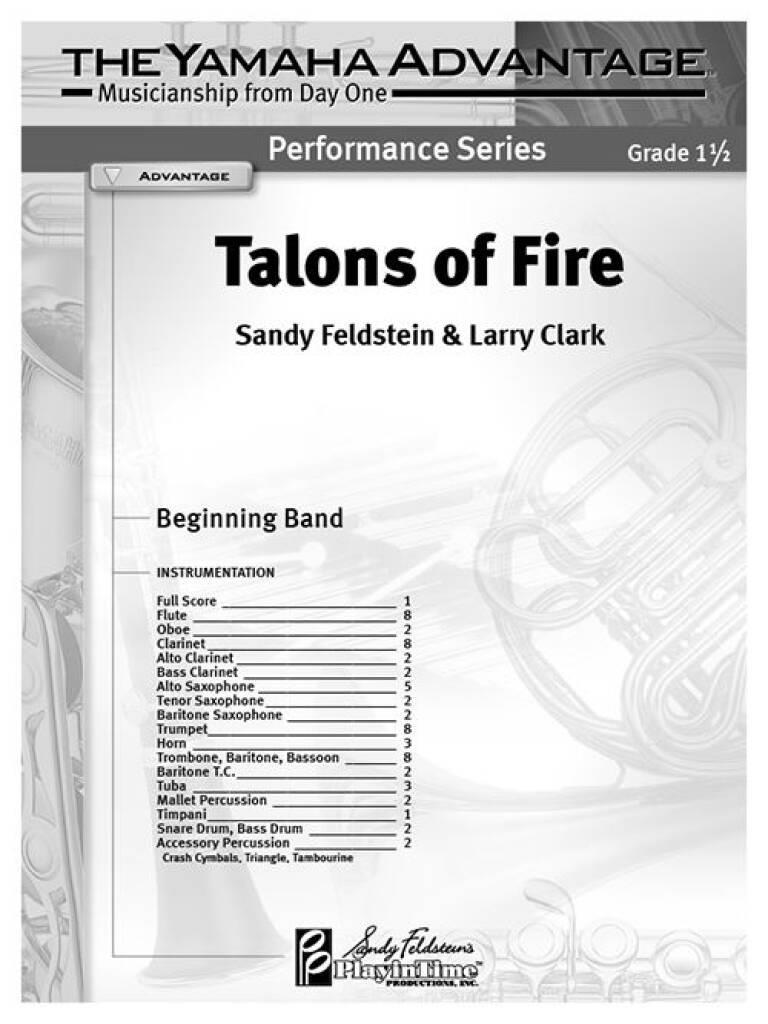
Talons of Fire - Sandy Feldstein
Take your Band on an adventure! This exciting overture with a bold fanfare, strong percussion interjections, and angular rhythms is an attention-grabber that would make an excellent concert opener or festival performance choice.
Estimated dispatch 7-14 working days
-
 £189.99
Masked - Alex Shapiro
Masked by Alex Shapiro is composed in the exact shape of a Classical Minuet and Trio waltz, though the music--a whimsical if somewhat demented masked ball (or, balls, in this case)--bears little connection to that of Mozart or Haydn. Historically, third movement Minuets gave way to the joke-like Scherzo, and the Trio section tips its hat to some welcome levity. This is one of four movements in Suspended, a piece is composed in the tradition of an 18th century Classical symphony: four contrasting movements which serve specific functions and reveal a story. The work begins in absolute rage and chaos, then alternates between moments of grief and bleakness. Grim reality shifts to a macabre, circus-like insanity, and by the end, flickers of genuine hope contrast a pervasive sense of dread, and finally arrive at more optimistic possibilities. To perform the piece, you'll need an audio system capable of playing the prerecorded audio tracks from a laptop computer via a small digital audio interface connected to an audio mixer. Download information is provided in the printed piece.
Estimated dispatch 7-14 working days
-
 £50.50
Courageous Spirit - Michael Kamuf
Courageous Spirit, by Michael Kamuf, is a musical celebration of the bravery we summon in the face of uncertainty. The piece features bold and contrasting melodies, making it an ideal choice to reinforce slurs and accents with your students. Additionally, the work provides an opportunity to support and explore the SEL competency of Responsible Decision-Making during rehearsals. Whether as an opening or closing selection, this piece is perfect for your next concert! (1:40)
Estimated dispatch 7-14 working days
-
 £79.50
Waiting on Shore - Jon Bubbett
Full of emotion and passion, Waiting on Shore, by Jon Bubbett, will make for a beautiful and tender moment on your next concert. This is a beautiful melody with an Irish folk song quality. The lyrical, musical content is accessible for younger bands and provides an opportunity to teach expression. The ethereal beginning and unresolved ending add to the haunting beauty of this poignant melody. (3:10) The PerformancePlus+ series is an innovative addition to the ever-expanding MakeMusic Cloud interactive library. These engaging selections are presented with educational resources designed to enrich the rehearsal process and create outstanding performances. Including:Assignment, recording, and assessment tools within MakeMusic CloudPiece-specific exercises focused on skills and techniquesPrintable sheet music (with a standard MakeMusic Cloud subscription)Educational tips and suggestions to support learningAvailable in print and digital formats.
Estimated dispatch 7-14 working days
-
 £131.00
Notes from the Road - Franco Cesarini
"May your trails be crooked, winding, lonesome, dangerous, leading to the most amazing view. May your mountains rise into and above the clouds." - Edward AbbeyNotes from the Road was commissioned to Franco Cesarini by the music Federation of the Canton of Thurgau, Switzerland, as compulsory piece for the second category of the Canton Festival in 2023. The piece is written in the typical form of an Italian overture, with the sequence of veloce-lento-veloce tempi. Reflections on life and the street as its metaphor were the driving elements in composing this piece. The way represents a symbol characteristic to many cultures, so much so that the verb "to walk" or the word "path" indicate a way of being in life and of fulfilling oneself. "Making one's way" means affirming oneself; "Having a way" indicates one's own and personal approach. The road is the most beautiful metaphor of life: there is a departure, a destination, and in the middle lies a path that is sometimes winding, with challenges to overcome and directions to take.An introspective piece, an invitation to each of us to reflect on our own "path".
Estimated dispatch 7-14 working days
-
 £123.20
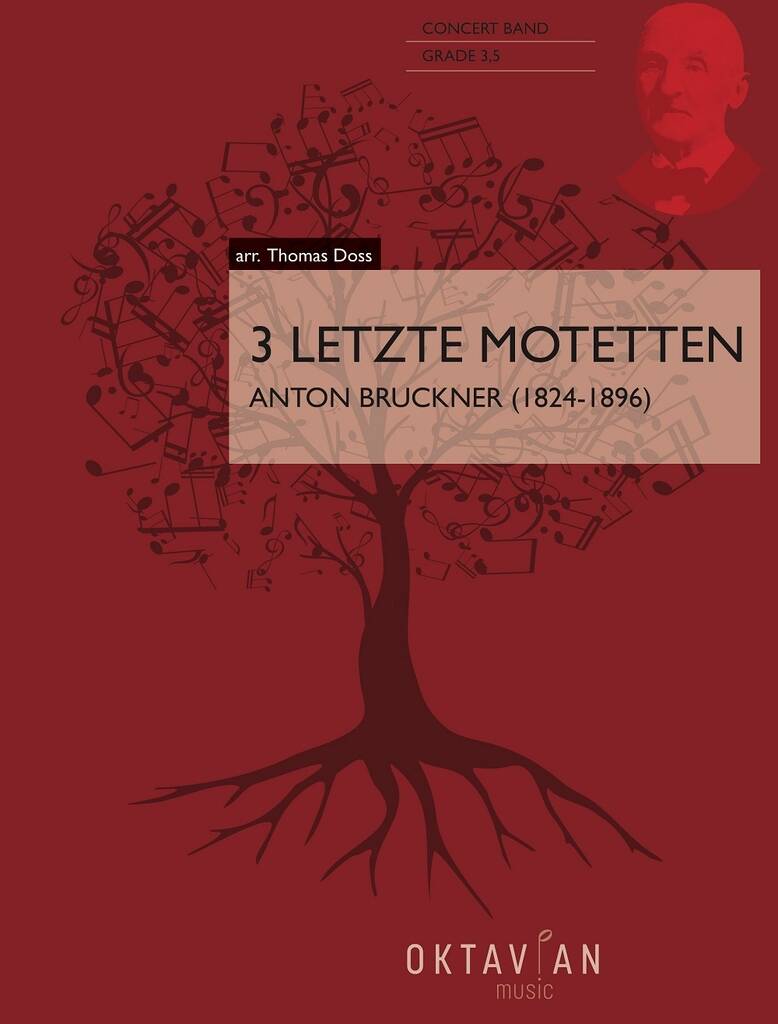
3 Letzte Motetten - Anton Bruckner
Anton Bruckner (b. 4.9.1824, Ansfelden, d. 11.10.1896, Vienna) didn't have it easy. Throughout his life, the Austrian composer was plagued by self-doubt. Anton Bruckner came from a simple, rural background. After the death of his father, he was accepted as a choirboy at the monastery of Sankt Florian in 1837. After several years as a school assistant and his own organ and piano studies, he first worked as organist in St. Florian, then from 1855 as cathedral organist in Linz. Introduced to music theory and instrumentation by Simon Sechter and Otto Kitzler, he discovered Richard Wagner as an artistic role model, whom he admired throughout his life and also visited several times in Bayreuth.In 1868 Anton Bruckner became professor of basso continuo, counterpoint and organ at the Vienna Conservatory; ten years later court organist; and in 1891 finally honorary doctor of the University of Vienna. He was considered an important organ virtuoso of his era, but had to wait a long time for recognition as a composer. It was not until Symphony No.7 in E major, composed between 1881 and 1883, with the famous Adagio written under the effects of Wagner's death, that he achieved the recognition he had hoped for, even if he was reluctant to accept it given his inclination towards scepticism and self-criticism.Anton Bruckner was a loner who did not want to follow a particular school or doctrine. He composed numerous sacred vocal works, such as his three masses, the Missa Solemnis in B flat minor (1854), the Te Deum (1881-84) and numerous motets. As a symphonic composer, he wrote a total of nine symphonies and many symphonic studies from 1863 onwards, tending to revise completed versions several times over. Bruckner's orchestral works were long considered unplayable, but in fact were merely exceptionally bold for the tonal language of their time, uniting traditions from Beethoven through Wagner to folk music, on the threshold between late Romanticism and Modernism.Anton Bruckner composed about 40 motets during his lifetime, the earliest a setting of Pange lingua around 1835, and the last, Vexilla regis, in 1892.Thomas Doss has compiled some of these motets in this volume for symphonic wind orchestra.These motets show many characteristics of personal expression, especially Bruckner's colourful harmony in the earlier works, which is in places aligned with Franz Schubert (changes between major and minor; and movements in thirds). Later works are characterised by many components which, in addition to the expanded stature of the movements, include above all a sense of the instrumentation as an outward phenomenon and the harmony as a compositional feature that works more internally. Some aspects of Bruckner's work are the result of his long period of study, which familiarised him not only with the tradition of his craft, but also gave him insights into the "modernity" of his time in such composers as Wagner, Liszt and Berlioz.From this developed his personal standpoint, which always pursues the connection between the old and the new.
Estimated dispatch 7-14 working days
-
 £74.00
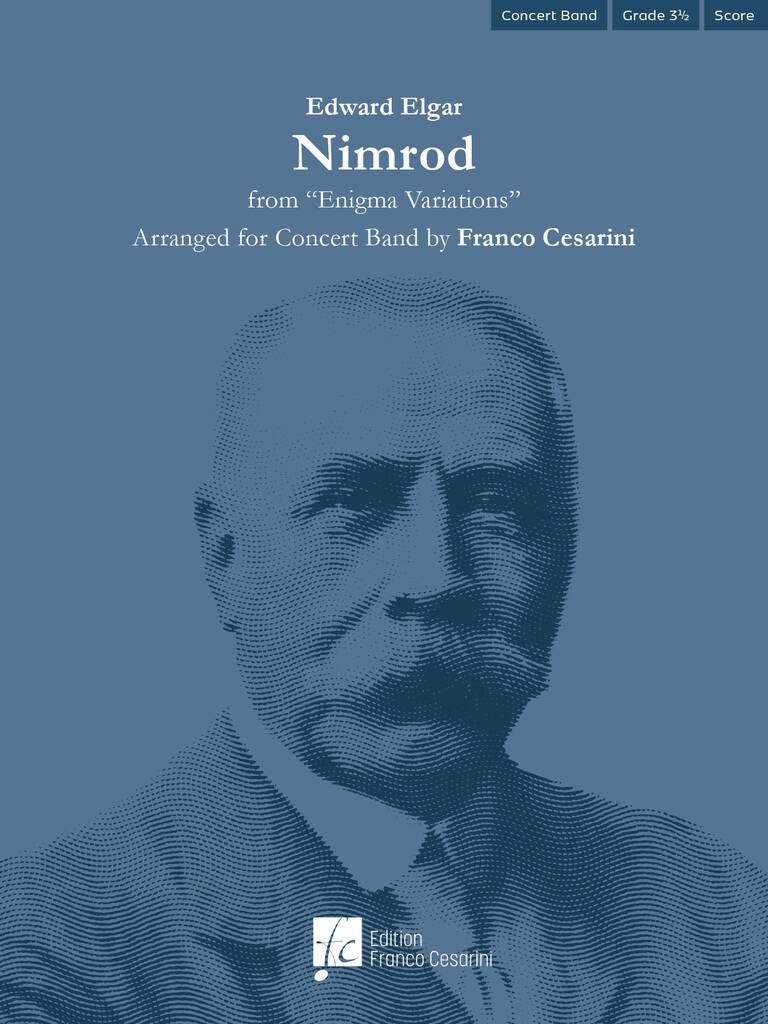
Nimrod - Edward Elgar
Nimrod is the name given to the ninth and best-known variation inEdward Elgar's Enigma Variations, an orchestral work of 14 variations on an original theme composed between 1898 and 1899. Each variation is also a portrait of one of 14 members of Elgar's family and circle of friends. A celebrated work, Nimrod is a portrait of Augustus Johannes Jaeger, who in addition to being his best friend was also Elgar's editor.The variations all represent a series of portraits and as such are entitled with a name or initials that identify the person. Biblically, Nimrod is a great hunter of the Old Testament, thus representing his muse through a play on words: Jger in German means 'hunter'. The melody appears to represent a nocturnal stroll during which the two discuss Ludwig van Beethoven's slow movements; the first eight bars, in fact, recall the beginning of the second movement of the Pathtique Piano Sonata.An arrangement of classical music signed by Franco Cesarini which stands out for its skilful and careful instrumentation.
Estimated dispatch 7-14 working days
 View Music