
Results
-
 £249.99
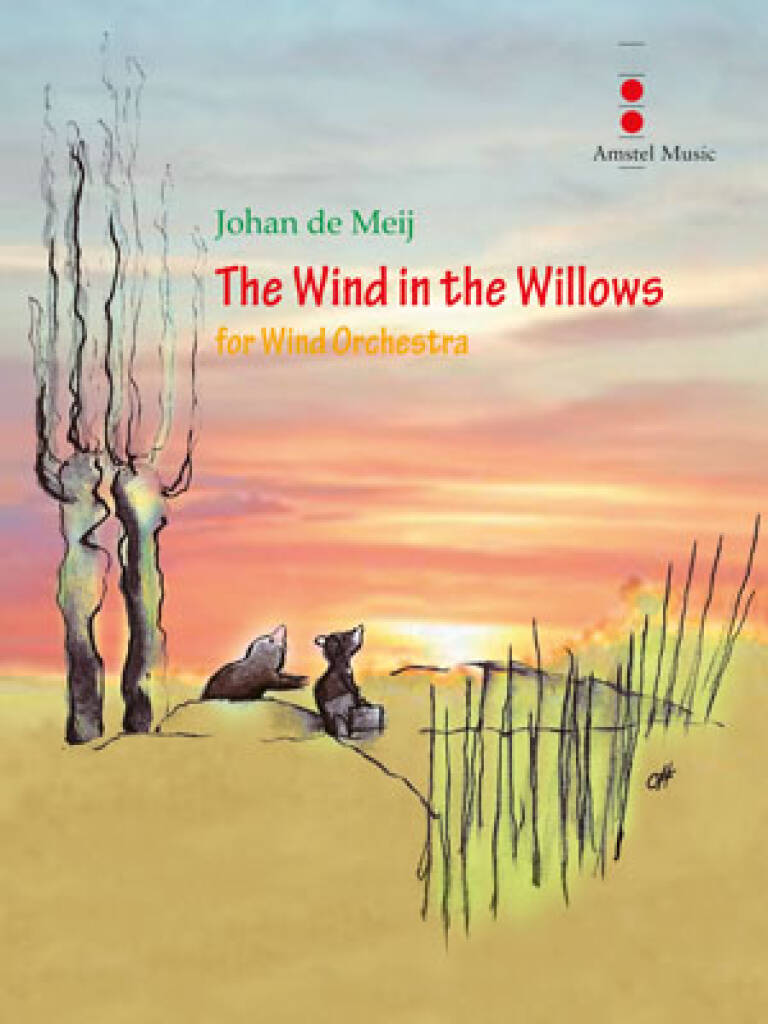
The Wind in the Willows - Johan de Meij
"A book for those who keep the spirit of youth alive in them; of life, sunshine, running water, woodlands, dusty roads, winter firesides" said author Kenneth Grahame (1859-1932) about his children's book The Wind in the Willows. Initially, he wrote the stories about Ratty, Mole, Badger and Toad to read to his visually handicapped son Alistair, but after the publication in book form in 1908, it became a worldwide success. It was later also turned into a film and a television series. What appealed ti the composer most is the friendly, very cosy atmosphere that Grahame has managed to create with his optimistic narrative style full of high spirits, an atmosphere that reminds thecomposer of his own carefree youth. It was therefore a great pleasure to set this book to music! The four movements successively describe:I) The River- The river, which flows through the habitat of the animals like a lifeline, regularly is the scene of pleasant boat trips and picnics. The animals lead their untroubled lives here. The four-tone main motif [A-C-D-C] is extensively presented by the brass section, and returns in the following movements as a countermelody. II) Ratty and Mole -The bright, energetic Rat and the melancholy doubter Mole are inseparable friends and have many adventures. Their opposite characters are illustrated by separate musical themes. III) Mister Toad - The wilful, haughty Mister Toad is indeed a unique case: time after time, he runs into tricky situations, and with his indomitable passion for fast - preferably stolen - cars he causes quite a lot of damage...IV) The Return of UlyssesAfter Toad Hall, the majestic residence of Mister Toad, is recovered from the weasels and stoats of the Wild Wood, who had captured the estate in a cowardly way, our friends get ready for a banquet. They celebrate the victory with a triumphant parade, and so both the book and the music conclude with a happy ending.
Estimated dispatch 7-14 working days
-
 £248.99
Missa Brevis - Jacob de Haan
Missa Brevis, written for choir and wind band, was commissioned by the Conseil Dpartemental pour la Musique et la Culture de Haute-Alsace (Dir.: Philippe Pfisterer) in Guebwiller (France), in celebration of the millennium of Pope Leon IX'sbirth in guisheim (France). The composer conducted the first performance on June 23, 2002. It was performed live for the French television channel France 2. The mass movements Kyrie, Gloria, Credo, Sanctus, Benedictus, and Agnus Deiare very suitable for the Catholic as well as the Protestant liturgy. For this mass, various ways for performing in diverse variable strengths are possible. An instrumental performance is possible if the brass represents the choir parts. In thisoption, it is desirable for the brass to be positioned separately from the rest of the band (on a gallery, for example), so that the idea of two choirs is approached. In a performance with a large choir, the brass can work very well as a support. Inthat case, the dynamics of the brass should be adapted somewhat, since these are actually intended for an instrumental performance. You can also leave out the brass entirely for the benefit of the choir. For the accompaniment of smaller choirs, youcan opt for a small ensemble from the band. This can also be a quartet, put together as desired. For the performance of this mass, the obvious choice is one of the above options. However, as an alternative, a performance with a combination of theseoptions (vocally/instrumentally) is also possible not just from an artistic point of view (variation), but also from a practical starting point for example in the case that the choir has rehearsed only two movements. With a full strength, theconductor can vary the instrumentation to his or her liking. Then the brass can also play a role in the accompaniment (instead of supporting the choir). The following combinations are possible:1. clarinet choir (from Eb Clarinet to BassClarinet)2. clarinet choir + saxophones3. brass (flugelhorns, horns, euphoniums, bass section)4. brass (2 trumpets / 2 trombones)5. double reeds (optional + flute, optional + string bass)6. tutti7. all winds8. allbrassIn a performance by brass band and choir, it is usually advisable to leave out option 1 (choir + brass + band). The choir sings self-reliantly, accompanied by a full brass band. In an instrumental performance, you can consider a combinedquartet (two cornets and two trombones) + brass band.Choral parts available separately.
Estimated dispatch 7-14 working days
-
 £76.99
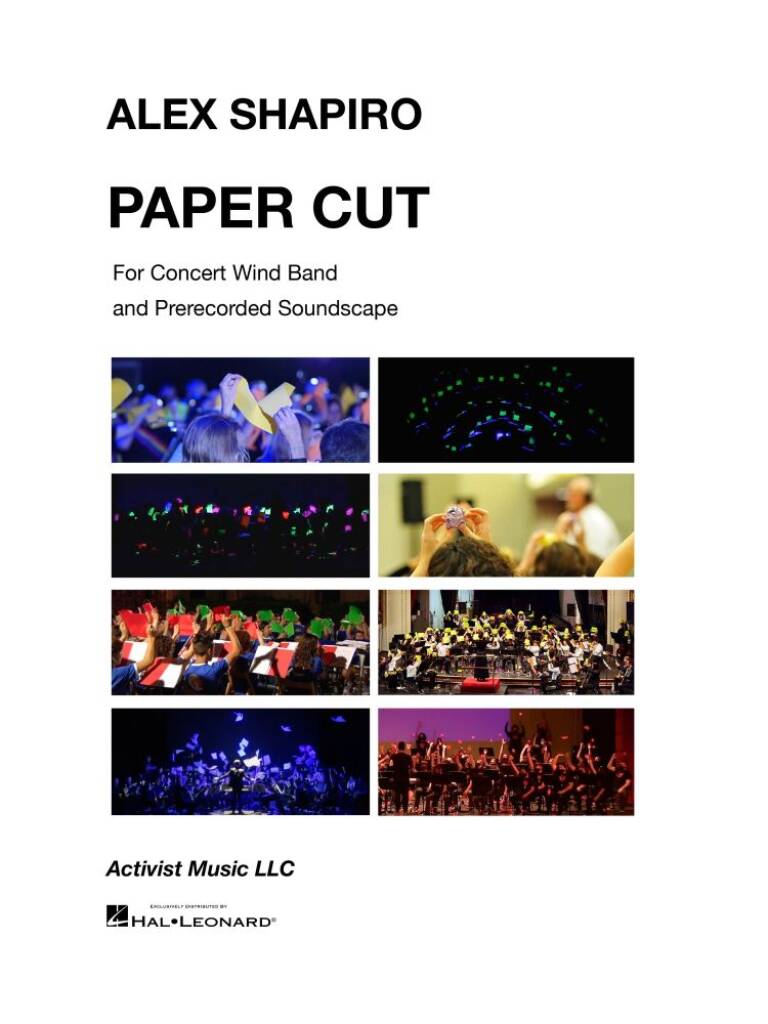
Paper Cut - Alex Shapiro
Composer Alex Shapiro's piece Paper Cut is reminiscent of a movie soundtrack to which the musicians can imagine their own dramatic scene. Paper Cut is written to make the players themselves part of the action with choreographed maneuvers that look as compelling as they sound. In fact, the band members don't even play their instruments until halfway into the piece - instead they play paper along with a prerecorded track! The unusual element of paper and the myriad sounds that can emerge from something so simple offers a fresh view of what music-making can be and opens everyone's ears to the sonic possibilities found among everyday objects. Although Paper Cut was composed with middle schoolers in mind, it's also suited to more advanced musicians, since the paper techniques and the skill of playing against a prerecorded track are interesting for all ages. To perform the piece, you'll need an audio system capable of playing the prerecorded audio tracks from a laptop computer via a small digital audio interface connected to an audio mixer. Download information is provided in the printed piece. A free downloadable interdisciplinary curriculum for teaching Paper Cut is also available for download at www.BandQuest.org. Learn more on YouTube!. Bandquest, an exciting series of new music and accompanying curricula for band, is a program published by the American Composers Forum. The series was started as a response to feedback from music educators that there is a pressing need for new, fresh band music. The heart of this program is new works written by a diverse group of leading American composers who have created challenging pieces that are a true departure from standard middle school repertoire. Every BandQuest project includes a residency component in which the composer works collaboratively with a middle school as they create their new piece.Many BandQuest pieces are accompanied by an interdisciplinary curriculum designed to assist students as they learn the music and to integrate each piece with non-music studies. Visit www.bandquest.org to learn more about this innovative series, and email [email protected] to request a free downloadable audio catalog.
Estimated dispatch 7-14 working days
-
 £78.20
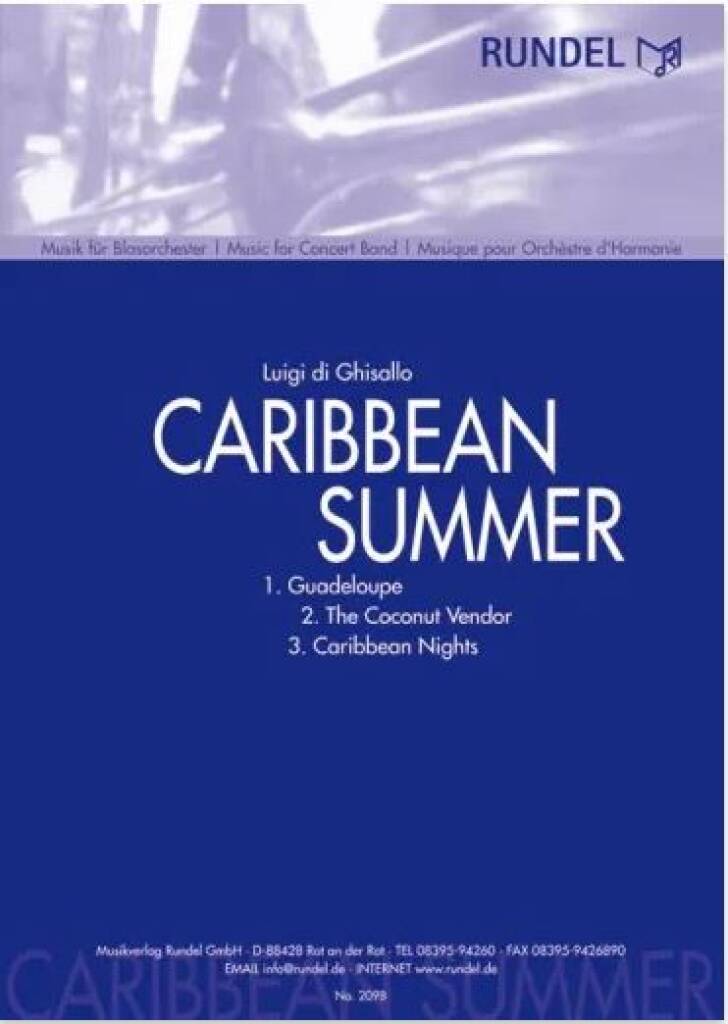
Caribbean Summer - Luigi di Ghisallo
Most people who live in the Caribbean are of an outspokenly straightforward nature, and always in good mood. "Caribbean Summer", a three-movement piece, captures this very mood: Very early in the morning, a summer day begins with "Guadeloupe", a Caribbean waltz. In this the change from a triple meter to a duple meter counter rhythm is of prime importance. From it, the music draws a particular lilt.At noon there is a happy and lively hustle and bustle on the beach. Vendors ("The Coconut Vendor") sing and offer their sugar-peanuts ("Chou-Cou"). A guest spontaneously begins to drum his fingers on a table, a second one reaches for a calabash or a cowbell - a cha-cha-cha is born. Finally, in "Caribbean Nights" a joyful parade of happy people march down the streets. Based on this very feeling, a special dance developed chiefly in the Dominican Republic: a simple basic two-step pattern in even rhythm becomes a "Merengue" together with the right, so to speak contra rotating motion of the hips! This cheerful dance then marks the close of day in a happy way - and in the morning everything will begin over again...
Estimated dispatch 7-14 working days
-
 £113.30
Via Della Terra - Marco Somadossi
Composing music also involves being able to imagine the sound of something that has no sound of its own. "Via della Terra" is a soundtrack without a film, a story without a narrator; "Via della Terra" is a street in a town, but not just any street, because if a street could tell its story, "Via della Terra" would not know where to start or where and indeed if it should finish. Like all "Vie della Terra", this street in this piece is full of sounds, none of which, however, have ever belonged to it for more than a fleeting moment, just long enough to be reflected here and there and then up and away from the earth, to be lost in the air. The steps of Mozart as a child as he whistled a piece of music, never again to be remembered or written; the philosophical thoughts, or mere everyday cares, uttered to a friend by Rosmini (whispered? or declaimed?); the excited or humorous comments of people who saw Depero's futuristic works for the first time; the voices of marketstall owners, rendered louder and more acute by the noisy crowd of women sorting through the stalls of rustling and colourful silk (so many desires; silent pauses between one item of gossip and the next); the absolute and devastating roar of cannons that violated every corner of the town, injuring bodies and mutilating the memories of its inhabitants... followed by a seeming eternity, as the citizens held their breath, waiting... "Via della Terra" is the old imperial road along which the town of Rovereto was built and has developed. "Via della Terra" is music for an imaginary, impossible and simultaneous representation of all its stories. The composer has always lived in this town, which he dearly loves, and on innumerable occasions he has imagined the voices, smells, people and the lives that have been such a part of it. With his composition, "Via della Terra", Marco Somadossi won second prize (no first prize was awarded) at the XXI Corciano International Competition for original band music in the grade 4 category.
Estimated dispatch 7-14 working days
-
 £124.99
Sonoritas - Jan Van der Roost
Sonoritas was commissioned by the Kaohsiung City Wind Orchestra, a professional wind orchestra from Taiwan. The work premiered on 10 September 2023 in the beautiful Kaohsiung Weiwuying Concert Hall, performed by the same orchestra and conducted by the composer. This impressive hall holds the largest concert organ in Asia, inspiring the composer to grant this majestic instrument a role in the composition - albeit ad libitum. Accordingly, all the important passages have also been provided for woodwind or brass instruments, so that the work can be performed with or without an organ.The title Sonoritas reflects the musical content, the rich timbres and sounds of both the wind orchestra and the organ being fully employed in this dynamic composition. A chorale melody with expansive chords opens the work and culminates in a driving theme presented by the brass instruments in various registers. The woodwinds, in turn, introduce a virtuoso saltarello-like theme, followed by a development of all these thematic elements in various forms and combinations. The work concludes grandly with an organ-like finale and, as a high point, a sonorous final chord, which crowns this wonderful sound piece with its broad lines and full harmonies, as well as rhythmic and technical fireworks.
Estimated dispatch 7-14 working days
-
 £60.99
Shibuya Scramble Crossing - Satoshi Yagisawa
This work was composed in 2018 as a commission to commemorate the 40th anniversary of the Shibuya Youth Band, based in Tokyo, Japan. Its world premiere was conducted by the composer's mentor, Masato Sato.Shibuya, a special ward in Tokyo, is a symbol of Japanese urban landscape and a center of culture, entertainment, and fashion. It is known for its scramble crossing, the most famous intersection in the world.With this opening piece, perfect for your next concert, Satoshi Yagisawa paints a vivid impression of a city filled with love and dreams where so many people gather.
Estimated dispatch 7-14 working days
-
 £149.40
Storsltt - Øystein Olsen Vadsten
"Storsltt" or in English "Grand Nordic Tune" is one of many original pieces written by composer ystein Olsen Vadsten. "Sltt" is a general term for music played to traditional Norwegian dances."Grand Nordic Tune" was a commissioned work for the Rlingen Musikklag's 70-year anniversary concert in 2022, where the piece was premiered. They wanted something a little pompous, and preferably something in the style of Nordic folk music, which the composer is known for. The title in Norwegian then was obvious, "Storsltt", which in Norwegian has a double meaning, both a big tune and, in a double meaning, pompous or magnificent.As usual, the starting point is a traditional Nordic dance form, and this time the choice fell on the distinctive Swedish "polska", which is played in . The dance, despite its name, reportedly has no connection to Poland, but is entirely of Scandinavian origin. It has been danced for centuries, and has also been called the devil's dance, because it had a hypnotizing effect on people, so that they could not stop, but danced themselves to death. Hence people thought that it must have been the devil who caused it.Traditionally, there is a lot of repetition in this type of music, which contributes to this hypnotic effect.
Estimated dispatch 7-14 working days
-
 £129.99
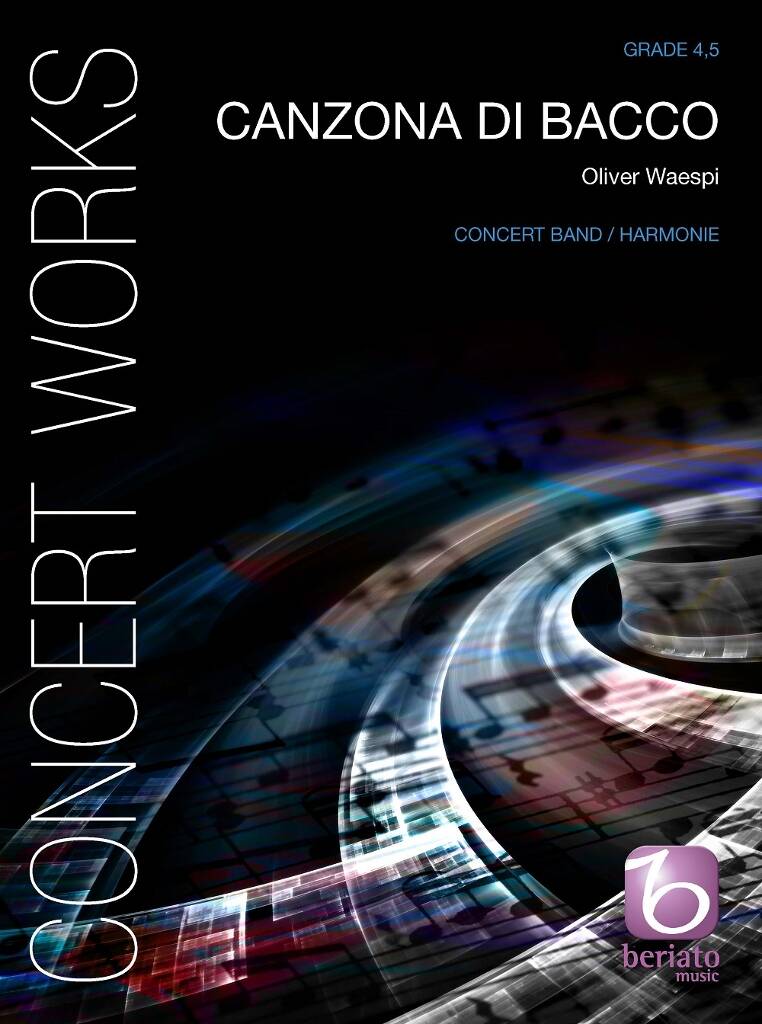
Canzona di Bacco - Oliver Waespi
This piece comprises a series of variations on the melody of "Ami, dans cette vie" ("Friend, in this life), an 18th century French song. Like the famous poem "Canzona di Bacco" by Lorenzo de' Medici, this song invites the listener to enjoy life, friendships, love and wine while there is still time to do so. The epicurean nature of this text contrasts with a deeply melancholic melody, a contradiction which is explored in the present work. After a somewhat turbulent first part, the original melody is revealed in a serene and pensive middle section which highlights several soloists. In the last movement, the atmosphere is transformed to become increasingly exuberant, like a Bacchus incantation. The piece concludes with a final dazzling statement of the original theme. Canzona di Bacco was commissioned by the Vesoul Municipal Wind Band, who premiered the work on 24 June 2022 at the Edwige Feuillre Theatre in Vesoul (France), under the direction of Mathieu Anguenot.
Estimated dispatch 7-14 working days
-
 £159.99
Guardian Angels - Kevin Houben
Guardian Angels gives a musical expression to the legend of Reverend Louis Henri Bhler referring to the use of Psalm 34.North-west Veluwe and in particular Oldebroek (The Netherlands) has a very rich religious tradition which is demonstrated by its monumental churches. They tell the story of a stirring history in which Reverend Bhler played a crucial role. Inspired by his arrival as a pastor in 1870 in the neighbouring Oosterwolde, two big religious communities came into existence with their characteristic churches but this rivalry also resulted in great social unrest.This composition reflects on this striking personality and in particular on the story of the Angel Guard.'One evening Reverend Bhler has given a sermon in Oldebroek and he walks over the Church path through the pastures to Oosterwolde. On this dark and stormy evening Bhler's opponents are waiting for the pastor in ambush. They want to drown him in a watercourse near the Church path but abandon their plan because Bhler is accompanied by two men. The next day it comes to an encounter between Bhler and his opponents. They repent their, fortunately unexecuted , plan. Bhler firmly believes that on the previous night he walked alone over the Church path, and was not accompanied by two men. It was concluded that it must have been the angels who had protected Bhler.'Psalm 34 is central to this composition and this because of its powerful melody but also because the lyrics of verse 4 of the rhymed version fit in well with the special legend of Reverend Bhler:The Lord's angel gathered round himAn invincible heavenly guard,Who tries God's will, around himSo he's well guard(ed)A second melodious and harmonic cell is a musical transformation of the name 'Bhler'. This cell is varied in major and minor third chords and sometimes used as the main idea or apotheosis, but also serves as an accompanying cell or as a bridge between other melodic and rhythmic constructions.The composition was made possible by contributions of: Mr Evert van de Poll, owner of the Van Gelder Groep, Het Prins Bernhard Cultuurfonds Gelderland en Het Feteris Oosterbaan Fonds.
Estimated dispatch 7-14 working days
 View Music