
Results
-
 £210.80
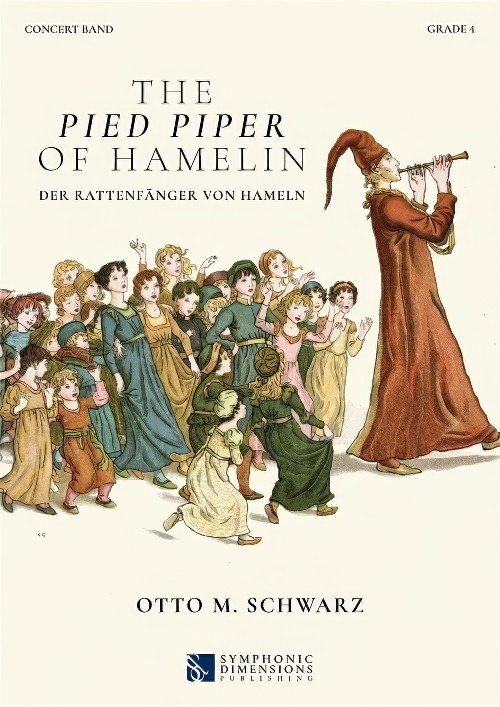
The Pied Piper of Hamelin (Concert Band - Score and Parts) - Schwarz, Otto M.
Stories, sagas and legends--who among us don't know them? Always delivered with a tinge of brutality, these cautionary tales are a legacy of moral education from times past: inquisitive children alone in the forest are generally eaten by a witch; the 'Soup-Kasper' of Hoffmann's Struwwelpeter dies from starvation rather than eating his soup; anyone letting in strangers usually gets devoured; anyone who plays with matches gets burned; and thumb-suckers get their thumbs cut off. The list of unfortunate demises is almost endless.In the tale of The Pied Piper of Hamelin, parents lose their children through greed, ridicule, scorn and a failure to appreciate art. There is still a street in the town of Hamelin in which neither drumming nor playing has not been allowed since 130 children disappeared into a mountain, never to be seen again. This composition by Otto M. Schwarz opens with exactly this scene, taking us back to the year 1284. As in many towns at the time, Hamelin in Germany suffered with hygiene problems--rats and mice began to multiply rapidly, and the town was overrun with the plague. There appeared a man dressed in colourful clothes who promised the locals to free them from this burden. They agreed and settled on a fee. Then the man pulled out a pipe and began to play. When the rats and mice heard this, they followed him. He led the animals into the Weser River, where they all drowned. Back in town, the people refused to pay him. They didn't recognise this man's skills and knowledge and were only prepared to pay for simple labour. A pact with the devil was made, which led to the Pied Piper leaving the town in a furious rage. One Sunday, when many people were at church, he returned, took out his flute and began to play. The town's children were so enchanted by his playing that they followed him. He led them out of the town and disappeared with them forever into a mountain forever. Of all the children, only two survived--however one was mute, and one was blind. In the street from which the children left Hamelin, music may no longer be played in memory of this event. The work may be performed in two different versions: 1. Purely instrumental (without narrator)--the GPs (pauses) must be kept short 2. With narrator--he speaks in the GPs but not during the music.Duration: 14.15
Estimated dispatch 7-14 working days
-
 £75.00
Believe in life (from The Gift of Life) (Concert Band with Optional Choir - Score and Parts) - Rutter, John - Noble, Paul
The Gift of Life was written early in 2015 as a commission to honour a retiring Minister of Music at a church in Dallas, Texas. In planning this piece, John Rutter has stated: In 1985 I had written a Requiem - which, like any Requiem, inevitably reflects on death - why not write the opposite, a work celebrating life? Unlike a Requiem, where a set form of words is laid down in Catholic liturgy, no framework exists for a celebration of life, and I had to choose (and in three cases, write) texts which were appropriate to a theme rarely expressed in music since Haydn's wondrous oratorio The Creation in 1798. The six movements reflect different facets of the miracles of creation and of life. This arrangement is written for combined Concert Band and Chorus, but may be performed by Concert Band alone.
Estimated dispatch 7-14 working days
-
 £95.00
Hymn to the Creator of Light (from The Gift of Life) (Concert Band with Optional Choir - Score and Parts) - Rutter, John - Noble, Paul
The Gift of Life was written early in 2015 as a commission to honour a retiring Minister of Music at a church in Dallas, Texas. In planning this piece, John Rutter has stated: In 1985 I had written a Requiem - which, like any Requiem, inevitably reflects on death - why not write the opposite, a work celebrating life? Unlike a Requiem, where a set form of words is laid down in Catholic liturgy, no framework exists for a celebration of life, and I had to choose (and in three cases, write) texts which were appropriate to a theme rarely expressed in music since Haydn's wondrous oratorio The Creation in 1798. The six movements reflect different facets of the miracles of creation and of life. This arrangement is written for combined Concert Band and Chorus, but may be performed by Concert Band alone.
Estimated dispatch 7-14 working days
-
 £95.00
O All Ye Works of the Lord (from The Gift of Life) (Concert Band with Optional Choir - Score and Parts) - Rutter, John - Noble, Paul
The Gift of Life was written early in 2015 as a commission to honour a retiring Minister of Music at a church in Dallas, Texas. In planning this piece, John Rutter has stated: In 1985 I had written a Requiem - which, like any Requiem, inevitably reflects on death - why not write the opposite, a work celebrating life? Unlike a Requiem, where a set form of words is laid down in Catholic liturgy, no framework exists for a celebration of life, and I had to choose (and in three cases, write) texts which were appropriate to a theme rarely expressed in music since Haydn's wondrous oratorio The Creation in 1798. The six movements reflect different facets of the miracles of creation and of life. This arrangement is written for combined Concert Band and Chorus, but may be performed by Concert Band alone.
Estimated dispatch 7-14 working days
-
 £95.00
O Lord, How Manifold are Thy Works (from The Gift of Life) (Concert Band with Optional Choir - Score and Parts) - Rutter, John - Noble, Paul
The Gift of Life was written early in 2015 as a commission to honour a retiring Minister of Music at a church in Dallas, Texas. In planning this piece, John Rutter has stated: In 1985 I had written a Requiem - which, like any Requiem, inevitably reflects on death - why not write the opposite, a work celebrating life? Unlike a Requiem, where a set form of words is laid down in Catholic liturgy, no framework exists for a celebration of life, and I had to choose (and in three cases, write) texts which were appropriate to a theme rarely expressed in music since Haydn's wondrous oratorio The Creation in 1798. The six movements reflect different facets of the miracles of creation and of life. This arrangement is written for combined Concert Band and Chorus, but may be performed by Concert Band alone.
Estimated dispatch 7-14 working days
-
 £75.00
The Gift of Each Day (from The Gift of Life) (Concert Band with Optional Choir - Score and Parts) - Rutter, John - Noble, Paul
The Gift of Life was written early in 2015 as a commission to honour a retiring Minister of Music at a church in Dallas, Texas. In planning this piece, John Rutter has stated: In 1985 I had written a Requiem - which, like any Requiem, inevitably reflects on death - why not write the opposite, a work celebrating life? Unlike a Requiem, where a set form of words is laid down in Catholic liturgy, no framework exists for a celebration of life, and I had to choose (and in three cases, write) texts which were appropriate to a theme rarely expressed in music since Haydn's wondrous oratorio The Creation in 1798. The six movements reflect different facets of the miracles of creation and of life. This arrangement is written for combined Concert Band and Chorus, but may be performed by Concert Band alone.
Estimated dispatch 7-14 working days
-
 £440.00
The Gift of Life (Concert Band with Optional Choir - Score and Parts) - Rutter, John - Noble, Paul
The Gift of Life was written early in 2015 as a commission to honour a retiring Minister of Music at a church in Dallas, Texas. In planning this piece, John Rutter has stated: In 1985 I had written a Requiem - which, like any Requiem, inevitably reflects on death - why not write the opposite, a work celebrating life? Unlike a Requiem, where a set form of words is laid down in Catholic liturgy, no framework exists for a celebration of life, and I had to choose (and in three cases, write) texts which were appropriate to a theme rarely expressed in music since Haydn's wondrous oratorio The Creation in 1798. The six movements reflect different facets of the miracles of creation and of life. This arrangement is written for combined Concert Band and Chorus, but may be performed by Concert Band alone.
Estimated dispatch 7-14 working days
-
 £85.00
The Tree of Life (from The Gift of Life) (Concert Band with Optional Choir - Score and Parts) - Rutter, John - Noble, Paul
The Gift of Life was written early in 2015 as a commission to honour a retiring Minister of Music at a church in Dallas, Texas. In planning this piece, John Rutter has stated: In 1985 I had written a Requiem - which, like any Requiem, inevitably reflects on death - why not write the opposite, a work celebrating life? Unlike a Requiem, where a set form of words is laid down in Catholic liturgy, no framework exists for a celebration of life, and I had to choose (and in three cases, write) texts which were appropriate to a theme rarely expressed in music since Haydn's wondrous oratorio The Creation in 1798. The six movements reflect different facets of the miracles of creation and of life. This arrangement is written for combined Concert Band and Chorus, but may be performed by Concert Band alone.
Estimated dispatch 7-14 working days
-
 £139.99
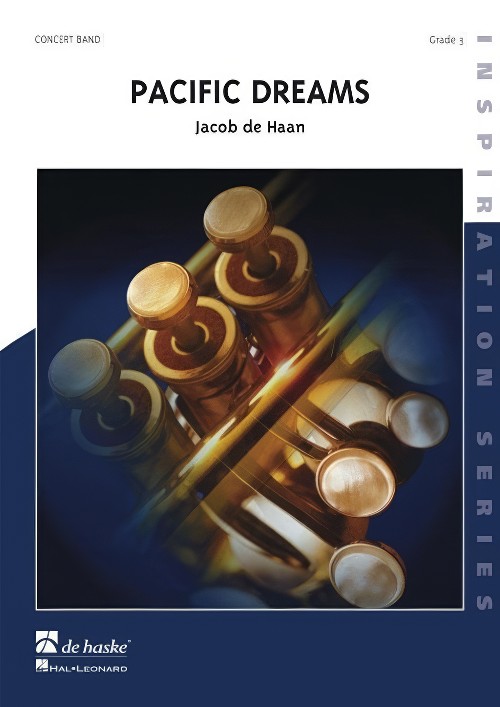
Pacific Dreams (Concert Band - Score and Parts) - De Haan, Jacob
Pacific Dreams describes the experience of Miguel, a traveling composer from Spain who, feeling somewhat alienated from his homeland, is wandering through an area of Sydney known as The Rocks. At a small outdoor market in a typical street of this old colonial neighbourhood, he discovers a print of William DeShazos painting Pacific Dreams. Portrayed in the painting is the surf of one of the exotic islands in the Pacific. Next, with the impressive Sydney Harbour Bridge looming over the narrow streets of The Rocks, he envisions sultry Pacific beaches. Suddenly a theme he once composed about the lakes in Japan comes to him. Is it the Asian influences present in cosmopolitan Sydney that bring this theme to mind? Or perhaps the waters around Sydney, over which he could sail to Tahiti? He is uncertain. Could this same theme be used to create a new composition about his feelings for the metropolis Sydney? How then to work his Pacific Dreams into the mix? Miguel is certainly no fan of Hawaiian music. Maybe he could use the vocabularies of islands like Hawaii and Tahiti, their beautiful vowel combinations being sung ad libitum by a mixed choir.With these ideas and his newly purchased print of Pacific Dreams, he boards the Metro at Circular Quay. He has a final glimpse of the harbour and the Sydney Opera House as the train races into the ground. On to the hotel! To work! He must compose!Maestoso: Miguel is impressed as he gazes upon the Sydney Harbour Bridge. And yet, he wants to go away from this city. Away, to an exotic island in the Pacific.Steady Rock : In the Rocks, musicians are playing at a square. Miguel basks in the atmosphere but at the same time he is fantasising about Hawaii and Tahiti.Andante Lamentoso: In his hotel room, Miguel is feeling sad and lonely in this big city. He takes comfort in his Pacific Dreams.Allegro: Miguel boards the boat that takes him from Darling Harbour to Circular Quay. In his mind he is travelling on to Hawaii. Or is it home, where the bolero is playing? He is pulled back to reality by the skyline of Sydney.Duration: 9:15
Estimated dispatch 7-14 working days
-
 £332.99
Cantica de Sancto Benedicto Wind Band Set (Score & Parts)
Cantica de Sancto Benedicto is a three-movement work for mixed choir, soprano solo, concert band and organ ad libitum - on Latin lyrics that relate to the life of Saint Benedict. It was commissioned by the city of Norcia in Italy, where Benedict was born. The holy Benedict (480-547) is considered the founder of monastic life within the Roman Catholic Church. His enormous influence is especially owing to his monastic rule, the Regula Benedicti.Jacob de Haan has named the movements of Cantica de Sancto Benedicto after the Holy Trinity: the Father (Gloria Patri), the Son (Gloria Filio) and the Holy Spirit (Gloria Spiritui Sancto). The lyrics of thehymn Gemma Caelestis, (which, like the other texts, were originally used in Gregorian chant) are voiced by the choir. To this purpose, Jacob de Haan composed new, choral-like, homophone music. The sequence Laeta Quies is rendered by the soprano; the verses (divided over the three movements) are alternated with those of Gemma Caelestis. The work closes with an impressive grand finale, in which texts are used from the proprium of the mass in honor of the saint's day of the holy Benedict (11 July). Notes to the conductor: For this cantata, there are various possibilities for the performance. The first involves a performance in which the choir and soprano parts are only accompanied by organ. Such a performance has several advantages: since the band never sounds together with the choir and the soprano, no balance problems occur, and even a performance with a large concert band and a small cantata choir is conceivable. A special layout is also possible - with which you can set up a three-dimensional performance in a church. For example, the choir can sing in the chancel, accompanied by the choir organ; the soprano can stand on the gallery, accompanied by the main organ; and the band can be seated in another part of the church. The choir could also sing from a gallery. With layouts like this, working with two conductors is advisable. Choral parts available separately. 0:28:30
Estimated dispatch 7-14 working days
 View Music