
Results
-
 £435.40
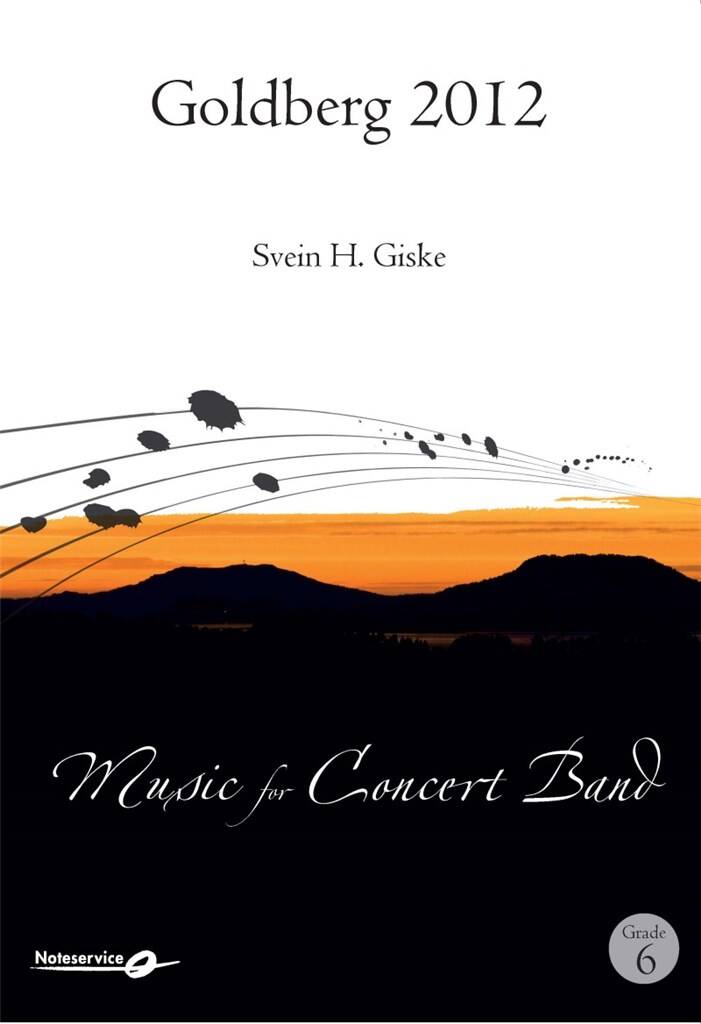
Goldberg 2012 - Svein H. Giske
The first time I heard Bach's Goldberg Variations was in the movie Silence of the lambs, in the early 1990s. I noticed the beautiful background music in one of the scenes, but at that time I didn't know what it was. A few years later, when I was studiying at the Grieg Academy, I got to know the entire piece. For me, this is a piece of music which I can listen to countless times. I think it sounds as fresh today as it did more than 15 years ago and it never ceases to inspire me. Both Bach's composition and Glenn Gould's famous 1955 recording (which was the first one I heard) still makes a great impression on me. Before Gould recorded it at age 22, it wasn't a highly ranked piece amongst pianists and Bach was by many viewed as a bit old-fashioned. The young Canadian turned all this around. He managed to portray Bach in a reformed way, producing fine nuances in phrasing and making the many layers in Bach's music more transparent than anyone before him. Thus he plunged both himself and Bach (back) onto the international music scene. When The Norwegian Band Federation (NMF) asked me to write the test piece for NM in 2012, it was only natural for me to use the Goldberg Variations as a starting point and inspiration for my work. Since I was a teenager at NMF's summer courses in the mid eighties I've always listened to many different styles of music. Growing up in Sunnmre with the Brazz Brothers as teachers and mentors, jazz-, pop/rock- and folk music were early on a natural part of my musical background. I also have my classical education from the Grieg Academy on trumpet. As the title of my piece implies, I've wanted to bring Bach to the present and put his music into various modern musical landscapes. I think you can bring about a special kind of energy when music from different genres are mixed and I've tried to do this by mixing Bach with artists and musical styles from the present. In Goldberg 2012, the music is often constructed by several layers, which in a way are living parallel musical lives. They are seemingly moving or floating freely, almost unaware of each other, but bound together by the same basic pulse. The rythms, however, are often notated on a different rythmic subdivision level than the usual 8th- or 16th note levels. By doing this, I hope to achieve transparent sounds that rythmically are perceived as more free and detached from each other. In large sections of the piece, pop/jazz is fusioned with elements from Bach. I guess you could have this little scene as a synopsis for the piece: picture a group of musicians meeting: some are classical performers, some are jazz. They start to improvise together, each in their own voice or musical dialect and I'm sort of in the middle, trying to write down what they are playing. This is what I feel much of Goldberg 2012 is about. The foundation of the piece, in addition to Bach and references from pop/jazz music, lies also in my own material. This material, basically two chords, is heard in it's purest form in the 1st movement. I use these chords to create scales, new chords and different motifs which contribute to blend together the different moods of the piece. It has not been my intention to copy Bach's form (theme and 30 variations), but rather to use the bits and pieces that I like the most as an inspiration for my own variations. The 1st movement, Aria 2, is for my 3rd son, Olav, who was born on the 21st of April 2011, and the 5th movement, From long ago, is dedicated to the memory of my father, Svein J. Giske, who passed away on the 6th of June 2011. -Svein H. Giske, January 2012-
Estimated dispatch 7-14 working days
-
 £92.99
Final Covenant - Fisher Tull
As the title implies, the work expresses the deep religious emotions of the promises made by God to mankind. Two thematic elements are employed: the first, a dramatic proclamation, is introduced by horns and subsequently taken bytrumpets and woodwinds - the second plaintive theme, in the manner of a supplication, is presented by oboes followed by flutes and clarinets. The first theme returns leading to a climactic section by the full ensemble. Adevelopment section focuses on fragments from the principal theme culminating in a brief brass fanfare based on the earlier accompanying motives. The recapitulation of the principal theme brings the work to a quiet and peacefulclose. (8:00)
Estimated dispatch 7-14 working days
-
 £94.99
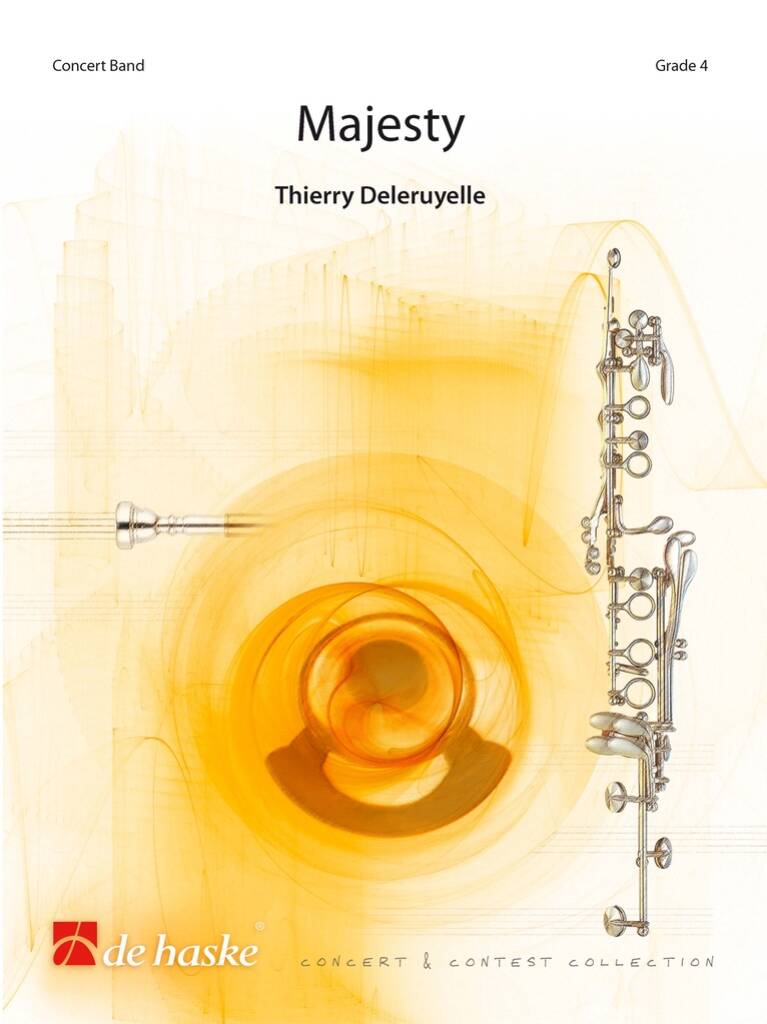
Majesty - Thierry Deleruyelle
Majesty is a powerful and spectacular overture. Right from the start, the brass open the work brilliantly before making way for a majestic hymn mostly played by the woodwind. The end of the piece repeats the opening fanfare as a monumental finale in the style of an American symphonic march. This work was commissioned by the Bourbourg Wind Orchestra (France), conducted by Claude Deconinck, on the occasion of its 230th anniversary. This piece was premiered by the commissioning orchestra on 19 November 2022, just two months after the death of Queen Elizabeth II. Naturally, this work is dedicated to her.
Estimated dispatch 7-14 working days
-
 £84.99
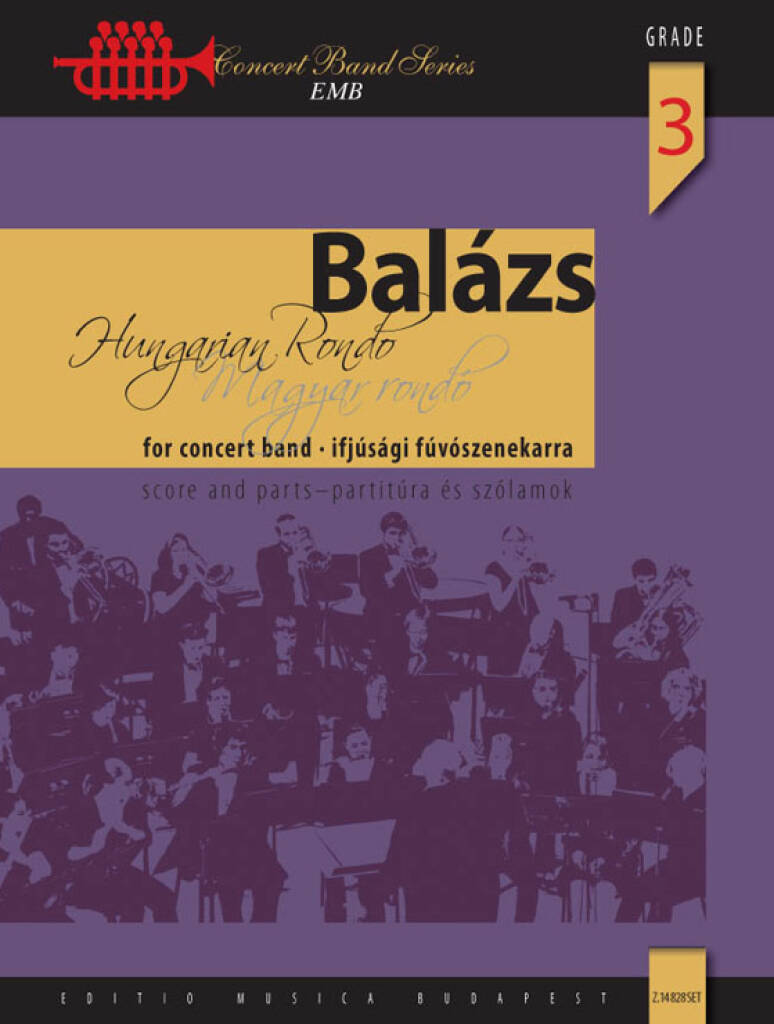
Hungarian Rondo - Árpád Balázs
The Hungarian Rondo by rpd Balzs is cheerful, good-humoured music, a finely formed work crafted withgreat professional skill. Its structure is clear: the double recurrence of the rondo theme results in a five-part form. The two episodes differ in character. The first consists of increasingly densely woven imitations that chase eachother playfully, the second evokes the mood of bagpipe tunes. In the latter, above the melody moving evenly in crotchets in the middle parts a pastel-tinted cloud of woodwind notes floats upwards, while the sound is extended downwards by the deep-toned brass stepping lower by semitones. A brilliant device by the composer! In thecourse of its repeats the rondo theme appears more and more richly garbed, particularly the sparkling semiquavers of the woodwind make it ever more decorative. The Hungarian Rondo is the kind of music that drives your cares away.
Estimated dispatch 7-14 working days
-
£264.99
Diferencias on an Old Spanish Song - Yasuhide Ito
I am immensely happy that my Gloriosa, symphonic poem for band (1990), has been performed by so many bands in the last thirty years.During this period, the growth of the internet has made it much easier to access information.When I composed Gloriosa, I only had limited information about the period when Christianity and Western music was first introduced to Japan, and had to rely a lot on my imagination.However, nowadays, it is easy to obtain various source materials and to read interesting studies on the music of the past.In recent years, the music of Luis de Narvez (born ca.1500 - died between 1555-1560), Spanish composer and vihuela player, has become increasingly known, and several CDs of his music are now available.Narvez composed the earliest-known set of diferencias, a forerunner of the variation form. One of his works is Seys diferencias sobre el himno "O gloriosa domina" [Six diferencias on the hymn "O gloriosa domina"] (1538), based on the Spanish Marian hymn, and it was this melody I used in the first movement of my Gloriosa.Western music has been my musical roots since childhood, and throughout my career as a composer, it has continued to fascinate me. One could say that this has provided the inspiration for Diferencias on an Old Spanish Song, my own take on the diferencias form.Actually, such music from the early sixteenth century could sound fresh to our modern ears. So I decided to quote the melody from Narvez's Sey diferencias at the beginning and end of the piece, in order that people can get the feel for the period.The main section (bars 42-390) is formed of 13 diferencias, similar to the first movement of the Gloriosa.In the middle section, which begins after the eighth diferencia(from bar 187), one should be totally absorbed in the tranquility and the beauty of the music. Although it's in the style of a sarabande, it should be taken slower and played as pianissimo as possible.This is followed by folk-style dance music. (As only standard percussion instruments are used, try to be creative with tonal colours and sense of rhythm).The structure of the work is simple, but be aware of the connection between the sections when constructing the whole.Also, think about the tonality. Overall, the work is in F minor. The main section is basically in D minor, but from bar 102, it modulates to A flat minor and G minor, and then in the middle section it suddenly switches to A flat major (which is the furthest key from D minor, and the relative major of F minor). From bar 219, it modulates to F minor and then to C minor, then back to F minor by way of A minor.N.B. The Oboe II part can be substituted by the English Horn (as indicated in the parts). One can choose according to the player's skills or preference.Recent new compositions for wind band are often full of rhythm, dynamism, and tonal colour, and compositional techniques and orchestration have also evolved greatly. Yet on the other hand, they tend to feature fewer melodic or expressive elements. Since this work is the test piece for WMC Kerkrade 2022, I had to think about what "tests" or "challenges" to set, and I decided to compose something that doesn't involve a lot of technical display, but requires beautiful sounds and harmonies, and above all, musical expressivity. I didn't put many expression markings in the score, because I wanted the performers to think about how best to express this music. If it is played merely as notated, it's not going to sound very interesting.Christianity was introduced to Japan in the mid-16th century, but it was subsequently banned and Japan entered a period of national isolation, which meant that there was hardly any international exchange for two hundred years. As a result, the Christian hymns that were introduced prior to the isolation became almost unrecognizable over the centuries. This was the theme I explored in my Gloriosa thirty years ago.Now, in 2021, the whole world has been forced to "isolate" due to the Covid-19 pandemic. In such times, it seems pertinent that I've written a work using this melody again. I sincerely hope that people will be able to gather in Kerkrade in 2022.(English Translation:Nahoko Gotoh)
Estimated dispatch 7-14 working days
-
 £184.99
Children'S March Over The Hills And Far Away - Percy Aldridge Grainger
Percy Grainger's extraordinary scoring skills permeate this classic, carefree work for symphonic band. Children's March: Over the Hills and Far Away, originally a piano solo, was orchestrated by the composer while he was a member of the U.S. Coast Guard Artillery Band. It includes two unusual scoring elements for the time - a prominent part for piano (cued in the winds), and brief four-part vocal interludes to be sung by members of the band (or a small chorus ad lib). Grainger believed that the greatest expressivity could be found in the lower instruments of the band (particularly the lower woodwinds), and Children's March includes a liberal and highly specialized use of the bassoons, English horn, bass clarinet and low saxophones. The march was first performed by the renowned Goldman Band in 1919, and was recorded in its original form by the same band with the composer conducting. (Full set includes a vocal score.)
Estimated dispatch 7-14 working days
-
 £204.99
Out to Sea and The Shark Cage Fugue (from Jaws) - John Williams
Referring to the 1975 blockbuster Jaws, director Steven Spielberg states that John Williams' music was clearly responsible for half the success of the movie. This suite features two of the signature musical sequences. In Out toSea, the trio of shark hunters led by police chief Martin Brody (played by Roy Scheider) heads into open water to find the menacing beast. This is followed by the Shark Cage Fugue, a classically inspired and sophisticatedaccompaniment to a tense underwater scene in which Hooper (portrayed by Richard Dreyfuss) comes face-to-face with the great white in an all-too-fragile suspended cage. Performance time - ca. 3:40
Estimated dispatch 7-14 working days
-
 £204.00
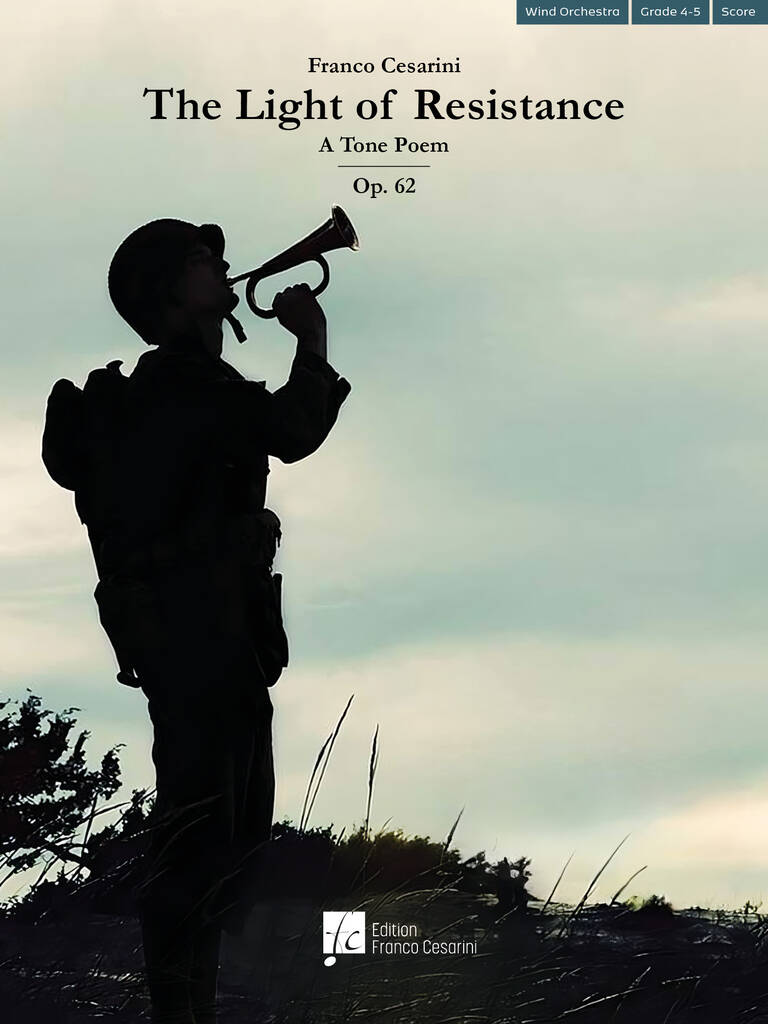
The Light of Resistance - Franco Cesarini
Franco Cesarini was commissioned to write The Light of Resistance by the Filarmonica di Villadossola APS (Piedmont, Italy) for its 125th anniversary. The Villadossola revolt was an uprising that took place in November 1943 in the homonymous municipality during World War II. The partisans, with the support of local workers, managed to temporarily liberate the town from nazi-fascist forces. It was one of the first acts of armed resistance against the German occupation in Italy but was harshly repressed by nazi-fascist troops who regained control of the territory. Although it was suppressed, the uprising remained a symbol of courage and determination.The slow introduction of the composition creates an atmosphere of latent tension, which gradually intensifies until it explodes in a rapid movement, symbolizing the struggle. Two contrasting musical themes collide, embodying the conflict between opposing forces. In the central section, a prayer rises delicately, then evolves into a heroic parade celebrating the temporary triumph of the revolt. However, this victory is fleeting; dissonant harmonies interrupt the scene, representing the brutal repression of the insurrection. In the finale, the heroic theme reemerges, evoking sacrifice as a spark of unshakeable hope. A moment of contemplation closes the composition, honouring the lives broken and reaffirming hope for a future of peace and regained freedom.The premiere of The Light of Resistance took place on 30th March, 2025 in Villadossola, performed by the Filarmonica di Villadossola, Franco Cesarini conductor.
Estimated dispatch 7-14 working days
-
 £79.99
Hope Arises - James Barnes
Hope Arises is one of two new works requested in 2021 of composer James Barnes by Colonel Donald Schofield, to be written for the United States Air Force Band. It is a short piece intended to be used as an opener for AFB's tour concerts. It opens with a dramatic brass fanfare, based on consecutive perfect fourths first introduced by horns and euphoniums, followed by a short oboe solo. An ascending line in mallets and woodwind provide a rather celestial transition, taking the listener to a lively, melodic allegro, which is based on the same opening fourths. This allegro theme is developed until a return to the opening fanfare is powerfully re-announced in brass. The work concludes quite dramatically, and includes a return of the ascending line in woodwinds, mallets, harp and piano.
Estimated dispatch 7-14 working days
-
 £74.00
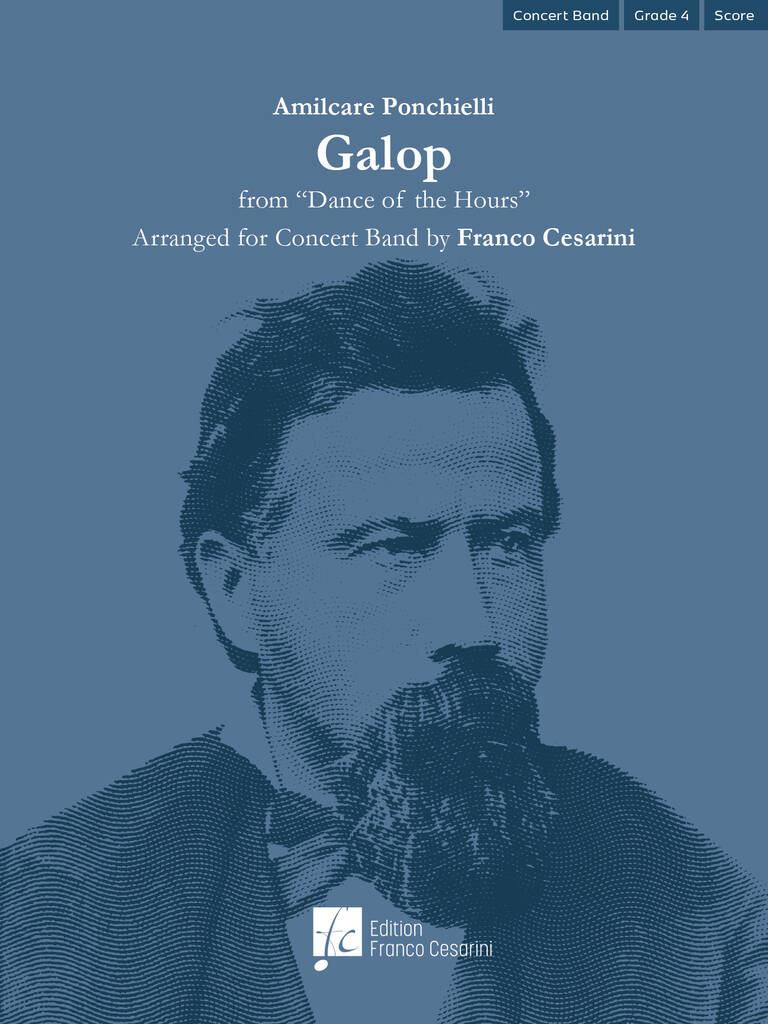
Galop - Amilcare Ponchielli
La Gioconda, with a libretto by Arrigo Boito, is the most successful theatrical work by Amilcare Ponchielli (1844-1886). In this work there are two dance pieces: the Furlana at the conclusion of the 1st act and the Danza delle ore in the 3rd act. The Dance of the Hours has a precise choreographic outline: it is a masked ball which includes the "hours" of dawn, day, evening and night successively, and ends with a wild finale of galop. The latter is a sort of fast polka, in binary rhythm and unbridled pace. A French variant of it is the can-can. The finale in galop time of the Dance of the Hours recalls certain playful dances by the composer Jacques Offenbach, such as the famous Can-can that concludes the overture of the operetta Orphe au enfers.
Estimated dispatch 7-14 working days
 View Music