
Results
-
 £79.99
Liberty - Rossano Galante
Comprised of two main themes, Liberty strives to capture the essence of Americana. The first of the two themes is stated by a trumpet duet, then later the full ensemble. The second theme is robust and emotionally dynamic and accompanied by a driving, rhythmic pulse. The arc of the piece returns to the first theme, this time more transparent, and ending on a gentle, quiet note. A rewarding work for winds with plenty of variety and depth. Dur: 5:15 (Recorded by the West Genesee (NY) High School Wind Ensemble, Andrew Perry, conductor) (G. Schirmer, Inc.)
Estimated dispatch 7-14 working days
-
 £233.99
First Symphony, Op. 35 - James Barnes
Composed during the summer and fall of 1974, Barnes' FIRST SYMPHONY, Op. 35 was his master's thesis at The University of Kansas. It was premiered in the spring semester of 1976 by their Symphonic Band, Robert E. Foster conducting. The following year, the symphony was awarded the American Bandmasters Ostwald Composition prize, which led to a second performance (of only the first two movements) by the Northwestern Wind Ensemble at the American Bandmasters convention with Col. Jack Cline (U.S Marine Band) conducting. Following this performance, Barnes submitted the work to several publishers, all of which declined on the basis it was too long and difficult to be marketable. For this reason, Barnes set the work aside and there it remained until 2022, when an offer came from the Osaka Shion Wind Orchestra to record all nine of Barnes'_x001A_symphonies to help celebrate their 100th anniversary. Barnes seized the opportunity, engraving all four movements, with revisions and corrections, an effort that took seven days a week for two months to complete. As a result, after almost fifty years, all nine of the Barnes symphonies are finally available for performance.
Estimated dispatch 7-14 working days
-
 £149.40
Grevling i taket - Øystein Dolmen og Gustav Lorentzen
This is an arrangement which has to be performed a bit humorous in the spirit of the original.It starts with a kazoo-like opening, played on the mouthpieces. At C, flutes and clarinets should stand up. Maybe the musicians can play it by heart?Two bars before D, the tempo increase. On E, the trumpet players should stand (and play by heart)?New, even higher tempo two bars before F. The trombonists should stand up in bar 103 to prepare for a terrific tempo. But G will be played like a laidback reggae-version. The saxophonists can stand up simultaneous with the glissando in bar 120.The tempo at H should be high and fresh and with several sections standing. In bar 158 should almost all players sit. At bar 160 everyone should stand up.In bar 162, all players should turn to the audience during the crescendo.
Estimated dispatch 7-14 working days
-
 £100.00
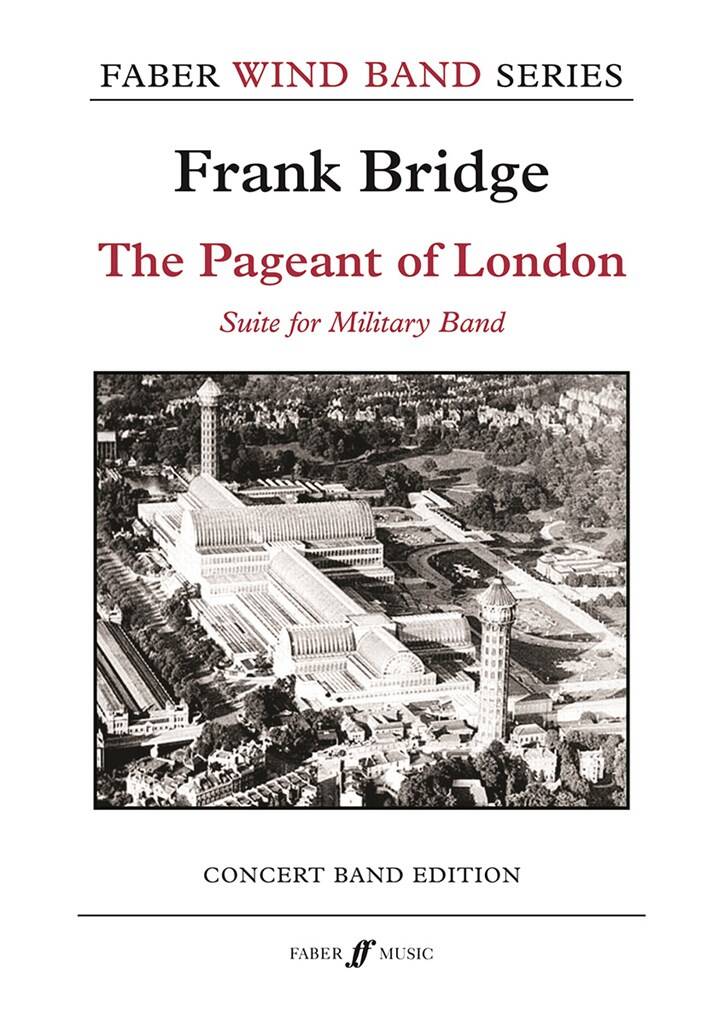
The Pageant of London - Frank Bridge
Frank Bridge was one of the finest English composers of the first half of the 20th century. The Pageant of London is his only work for wind band, comprising of two marches, one scored from Bridge's best known organ piece and including the chimes ofBig Ben, plus three short renaissance pastiche items, one arranged from Playford (later used by Peter Warlock in Capriol Suite). The music is tuneful, approachable and, in the words of wind band 'legend' Timothy Reynish makes a fine alternative toHolst's two suites, which were composed around the same time. Reynish has introduced this work to concert bands right across the world. It has been performed in USA and the Far East, recorded by the celebrated Kosei Wind Orchestra of Japan and alsoby the BBC National Orchestra of Wales in the Chandos edition of Bridge Orchestral Music.
Estimated dispatch 7-14 working days
-
 £154.99
Symphonic Variations - Jacob de Haan
This composition is based on a passacaglia theme, in which artistic perfection, symphonic drama and oriental melody lines play a role. The passacaglia is originally a dance made up of a series of variations above a bass line constantly present as an ostinato. It is not in this sense that the "Symphonic Variations" are in the passacaglia form but in the sense of the open form of the variations. Jacob de Haan, himself originally an organist, took his inspiration for this piece from the famous passacaglia for organ in C-minor by J.S. Bach. Following the introduction of the passacaglia theme (in the bass) the entry by the trumpets and trombones forms the majestic start to amusical adventure, in which this theme (often fragmentary) returns in variations. Then there follow two faster movements with dramatic contrasts and virtuose passages. Particularly striking here is the use of two characteristic intervals from the beginning of the theme namely the minor second and the augmented fourth. An apause in the composition comes in the slow bridge where a syncopated bourdon (perfect fifth) is constantly repeated. The tension grows in dynamics and harmony, and the oriental-flavour becomes obvious in the melody. We arrive at a faster movement via an accelerando, in which a perpetuum mobile based on the passacaglia theme is central. Finally the whole flows into a martial theme, in which the ostinato accompaniment n the descant derives from the passacaglia theme.
Estimated dispatch 7-14 working days
-
 £115.60
Hard to Say I'm Sorry - Peter Cetera
"Hard to Say I'm Sorry" is one of the greatest hits by US rock band Chicago. It was the first single record from the "Chicago 16"-album (1982). The song went to no. 1 on the Billboard charts and stayed there for two weeks. Produced by David Foster, the song was given a typical early 80's sound with synthesizers and heavy guitars dominating the sound. The album-version of the song included a part two of the song, "Get Away", a up-tempo song featuring the famous horn-section of the band.
Estimated dispatch 7-14 working days
-
 £84.99
Twinkling Flutes - Richard Comello
Composer Richard Comello observed that there is practically no music written for two flutes accompanied by concert band, so he composed this delightful piece convinced that this it will fill this little gap in the repertoire. Following a solemn baroque style introduction, joyful characteristic flute sounds develop with subtle band accompaniment. The two flute parts can be played by more players so enabling this piece to put your complete flute section in the spotlight.
Estimated dispatch 7-14 working days
-
£134.99
Milestone Overture - Dirk Brossé
This work was written at the pivotal point of both two centuries and two millennia. With its hopeful melodies and triumphant parts in the brass section, the opening pictures the dawning of a new era of great expectations, characterized by the high speed of communicating all over the world, which is one of the most important aspects of life in the 21st century. This is achieved by musical themes being rapidly transferred from one musician to another. In this vortex of information and fast business transactions, the sense of individuality threatens to become extinct. At this point, Brosse silences the orchestra (a symbol of society) and draws attention to those peoplewho are less fortunate than most of us. This focus on other people culminates with an orchestral climax in which all powers come together with a feeling of euphoria.
Estimated dispatch 7-14 working days
-
 £214.80
Dance Suite - Joseph Horovitz
This work follows a tradition established at the end of the seventeenth century: the creation of a musical structure by using a succession of dance movements, composed in such a way that a satisfying cumulative effect is produced. This method can be traced, starting from the works of Corelli, through the so-called Mannheim school to Mozart, and on to Brahms and beyond. Indeed, most classical symphonies owe their origin to this tradition.Each of the three movements of Dance Suite contains themes and motifs which are based on clearly identifiable dance patterns, more or less traditional and tonal in harmonic language.The first movement is a mixture af march- and gavotte elements, but these occur as variants of a single main theme. The tempo is brisk and the strongly accentuated four-beat measures creates a feeling of motoric drive. This is often counteracted by unexpected syncopation and surprising modulations. Horovitz dispenses with a second subject in favour of a very elaborate development, which makes the final quotation of the theme into a sort of recapitulation.In contrast, the second movement is a gentle, gracefully undulating dance, using two steady beats in every measure. Here there are two themes, the first more rhythmic, the second more lyrical. The second theme always uses the first as accompaniment, rather as a singer might use a guitar. Both themes undergo several modulations before returning to the home key. A Spanish flavour pervades the rhythmic and melodic elements of this movement.The finale is a fast rondo (in 6/8) whose main theme is best described as a tarantella. This alternates several times with a more solid, rustic theme (in 2/4). However, the main theme is recalled in varying guises, including a parody Latin-American version. The orchestration becomes mor elaborate and exciting as the movement proceeds, and the whole work ends with a coda recalling the main rond-theme with an enthusiastic flourish.Joseph Horovitz wrote about Dance Suite: "Most of the melodies and rhythms in the Dance Suite have been in my thoughts for many years, ever since my eraly career as conductor of ballet, and later as composer of some sixteen ballet scores. Some of these ideas were sketched on manuscript paper, others remained in my head and even in my dreams. The composition of this work gave me the chance to search among these half-subconscious sources and to offer my discoveries to the wind-orchestra repertoire."
Estimated dispatch 7-14 working days
-
 £115.60
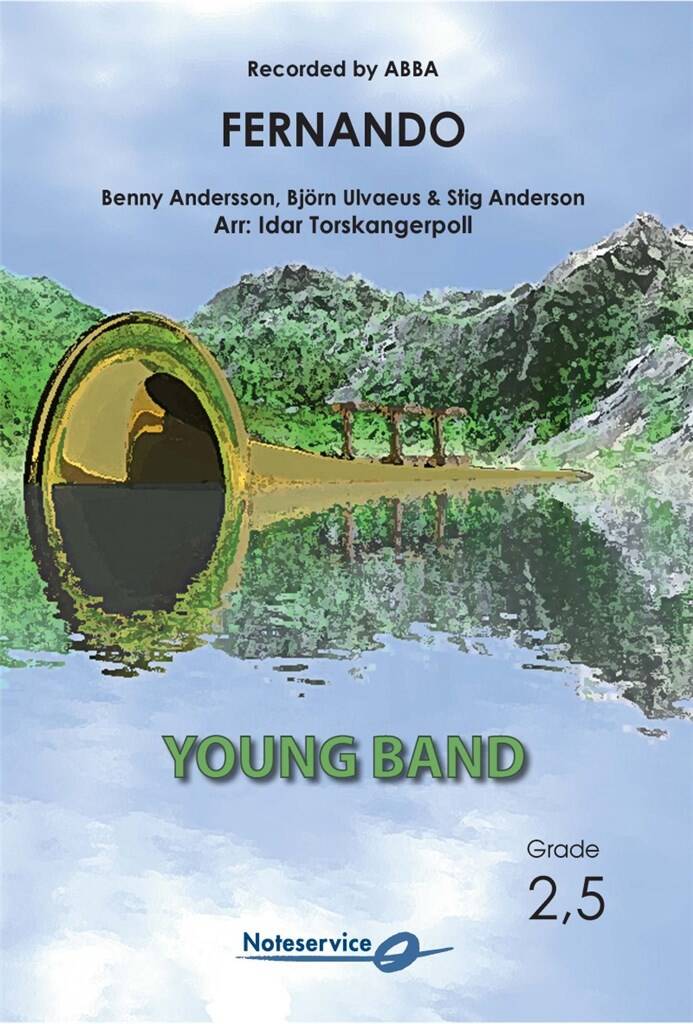
Fernando - Andersson
This song was released as single record by Swedish pop group ABBA in 1976. The lyrics is about two older veteran talking about the Mexican-American war. In this arrangement, the verse occurs in two different instrumentations. Please be aware of the balance between the melody and accompaniment. In the beginning of the arrangement, the bass ostinato may be devided by Tuba and Baritone.
Estimated dispatch 7-14 working days
 View Music