
Results
-
 £44.95
Now is the Day (Concert Band - Score and Parts) - Fraser, Bruce
Warlike, then noble, Now is the Day is based on the great figure in Scottish history - William Wallace, often called Braveheart. Opening with the woodwinds playing drums along with the percussion section against brass fanfares, this piece will create an air of excitement. An alto saxophone solo provides a brief moment of solace between the battle scenes.
Estimated dispatch 7-14 working days
-
£8.95
Now is the Day (Concert Band - Score Only) - Fraser, Bruce
Warlike, then noble, Now is the Day is based on the great figure in Scottish history - William Wallace, often called Braveheart. Opening with the woodwinds playing drums along with the percussion section against brass fanfares, this piece will create an air of excitement. An alto saxophone solo provides a brief moment of solace between the battle scenes.
Estimated dispatch 7-14 working days
-
 £179.99
Brasserie (Brass Quintet with Concert Band - Score and Parts) - Schwarz, Otto M.
This work was conceived by Otto M. Schwarz as a piece that progresses through different styles in a manner similar to his Concerto Grosso.Thematic material is introduced by a quintet and then taken over by the band, and vice versa. Brasserie is one of the very few works of its type.Duration: 9:45
Estimated dispatch 7-14 working days
-
 £138.00
The Saints And the Royal - Eric Swiggers
The Saints and the Royal was composed on behalf of Royal brass band St. Willibrord Heeswijk on the occasion of its 200th anniversary in 2023.When the marching band was founded in 1823, it was given the name "Harmonie Sint Cecilia," referring to Saint Cecilia, the patron saint of music. Around 1904, the name was changed to 'Kerkelijke fanfare Willibrord', strongly emphasizing the connection with the church in Heeswijk, of which Saint Willibrord is the patron saint. In 1973, at its 150th anniversary, the band received the predicate 'royal'. From that time on one speaks of the Royal brass band Saint Willibrord.The composition musically depicts both Saints Saint Cecilia and Saint Willibrord and the jubilee royal brass band. Although one of the oldest musical societies in the Netherlands, this fanfare is alive and kicking and will celebrate its 200th anniversary in 2023. The composition therefore opens festively and energetically. The alto saxophone plays a recitative, the Gregorian "Cantantibus organis Caecilia virgo in corde suo soli domino decantabat" from the vespers of the feast day of Saint Caecilia, the patron saint of music. This is taken over by the full wood and soft brass group. After a brief, playful interlude, this chant is played by the full orchestra, like an organ, larded with circumambulations.St. Willibord was born in England but made the crossing to the Netherlands in 690 to preach the gospel as a missionary. This was far from harmless and he faced frequent uprisings. After his death he was buried in Echternach in Luxembourg. In this place he is commemorated to this day with the annual "Spring Procession" or "Dance Procession". This procession of Echternach went as follows until 1947: 3 steps forward, 2 steps backward. Hence we hear this procession back in a 5/8 measure: 3 + 2.After this procession, the Gregorian vesper of Sint Caecilia sounds one more time, leading the composition to a reprise of the opening: The jubilee Royal Fanfare Sint Willibord Heeswijk.
Estimated dispatch 7-14 working days
-
 £206.99
Omaggio - Philip Sparke
Omaggio was commissioned by Steven Mead in celebration of his 60th birthday and in memory of his father, Rex. He gave the premiere of the brass band version in Rome in March 2022, accompanied by the Italian Brass Band conducted by Filippo Cangiamilla. The concert band premiere took place on 6th July that year as part of the 2022 Spanish International Tuba Euphonium Conference, accompanied by the Banda municipal de msica de Mlaga. The concerto is set in 3 continuous movements, which are united by a recurring syncopated interval of a fifth. The first movement, FANTASIA, opens with this motive accompanying an extended monologue for the soloist. This is followed by a lengthy bridge passage by the band (piano), which is eventually joined by the soloist, who guides the music back to the opening soliloquy, leading to an energetic central section. This develops until the opening material again returns to introduce the second movement, BALLAD, which revolves around an expressive melody for the soloist, interspersed by accompanied cadenzas. The third movement, THE KING TRIUMPHANT, pays homage to Steven's late father, Rex, and its title alludes both to Rex's name ('Rex' being Latin for 'king') as well as his love of Eric Ball's Salvationist masterpiece, The Kingdom Triumphant. The finale is an energetic tour-de-force featuring an acrobatic 6/8 melody, which is interrupted twice by the magnificent hymn tune, Helmsley, which Ball uses so effectively in The Kingdom Triumphant. A galloping coda brings the work to a close.
Estimated dispatch 7-14 working days
-
 £68.80
Big Bass - Scott Rogers
Every beginning low brass player deserves a big bassline. With a rhythmic focus on quarter- and eighth notes and a range of a fourth, this piece is easily accessible for all beginning low brass players - and mastery breeds motivation, and that's something young musicians on trombone, baritone and tuba need.There is also a short chromatic motive that appears at B. This is written to lie well on the slide and valves and can be a good way to teach the important difference between concert E and Eb.
Estimated dispatch 7-14 working days
-
 £124.99
Resurgence - Philip Sparke
Resurgence was commissioned by Nishiusuki Kyoiku Shinko Rengokai to celebrate its 10th anniversary in 2023. The commissioners are a non-profit organization for educational promotion in Japan and have founded a concert band, who gave the premiere at their anniversary concert. The piece opens with a flourish which leads to a martial theme in the brass, but this quickly subsides to introduce a chorale in the lower brass. After reaching a climax, the work slowly builds to the main vivo section. Here the opening fanfare is repeated, but instead leads to a dance-like tune in the clarinets. This is taken up by the full band and develops until the saxes change key with a legato melody. Following a repeat on trumpet, the chorale from the introduction briefly reappears to herald a recapitulation, which drives to a short coda, where hints of the opening martial theme bring the work to a triumphal close.
Estimated dispatch 7-14 working days
-
 £214.80
Skies - Oliver Waespi
Program notes by Oliver Waespi on his composition Skies:Skies is the plural of Sky. We may wonder are there several skies? Is the sky we all long for not the same for everybody? While travelling on foot and "in the open air" I have observed the firmament often in quite different shapes, so that I can say I have indeed experienced the sky in different ways. Years ago I already wanted to portray "my sky" in music; I finally have been able to realise this long-cherished dream.This composition deals with the sky, more precisely with my sensual and emotional experience of the sky in all its aspects. Two point of views are combined in this composition: one showing the sky as it presents itself to me, the other showing the sky as I observe it. The music was bom simultaneously by intemal and extemal inspiration: it describes nature but also the emotional and spiritual experience of nature. To me, the experience of nature is not abstract, but it is connected with concrete ages, places or people from my neighbourhood. This is why I have combined several parts of this composition with certain landscapes.The sky presents itself in different landscapes in the most varied ways: for the sensual experience, there is no sky as such. The indications of places spread all over the score, are primarily clues for myself; they represent certain atmospheres, which I have experienced especially in England and Scotland. They can however also be useful to the musicians and the audience, providing they know those landscapes and the celestial atmospheres linked to them.The music is independent from the atmospheres described in the subtitles, as those are rather connected to a tragic nature, and so the music is not based on any program. Musically spoken, the composition has a symphonic structure, which means that the complete musical material is derived from three contrasting main themes. In the first part, the description of a noctumal sky ("Night") two themes are developed in an organic way; the first, rather "dusky", is to be found with the horns, the second, "in bright daylight", with the oboe and flute, the third, "more quiet" , with the brass instruments. In the next part, we have clouds and rain over the Isle of Skye (one of the Hebrides islands in Scotland) and here several elements of the first theme are still more developed. Then we get an increasingly dark mood, which is released, in heavy chords. Then suddenly, the sun breaks through and the music gets a majestic character. We have a new shape of the initial theme, first with the French horns and then with the trombones. The music gets a quicker tempo and flows into a quick movement describing the winds and waves at sea ("Wind and Waves"). Three themes are gathering and some variations are developed. The music gets more and more energetic and, after a climax, calms down again. Then we have a kind of "summer pastoral" which suggests summer at the South coast of Cornwall ("South Coast of Penwith Peninsuia in Summer"). This is certainly not the hotte st summer in Europe, but still it is beautiful in this country that is blessed with so much rain. In the "pastoral" , the sea is already sketched in broad outlines in the French horn solo. The magnificence of an aftemoon at the seaside is developed at the end of the composition ("Noon at Treen Cliff', a rock protruding in the sea next to Porthcumo at the South Coast of Cornwall); here the music gets stronger and stronger and after a majestic climax it vanishes completely.
Estimated dispatch 7-14 working days
-
 £118.99
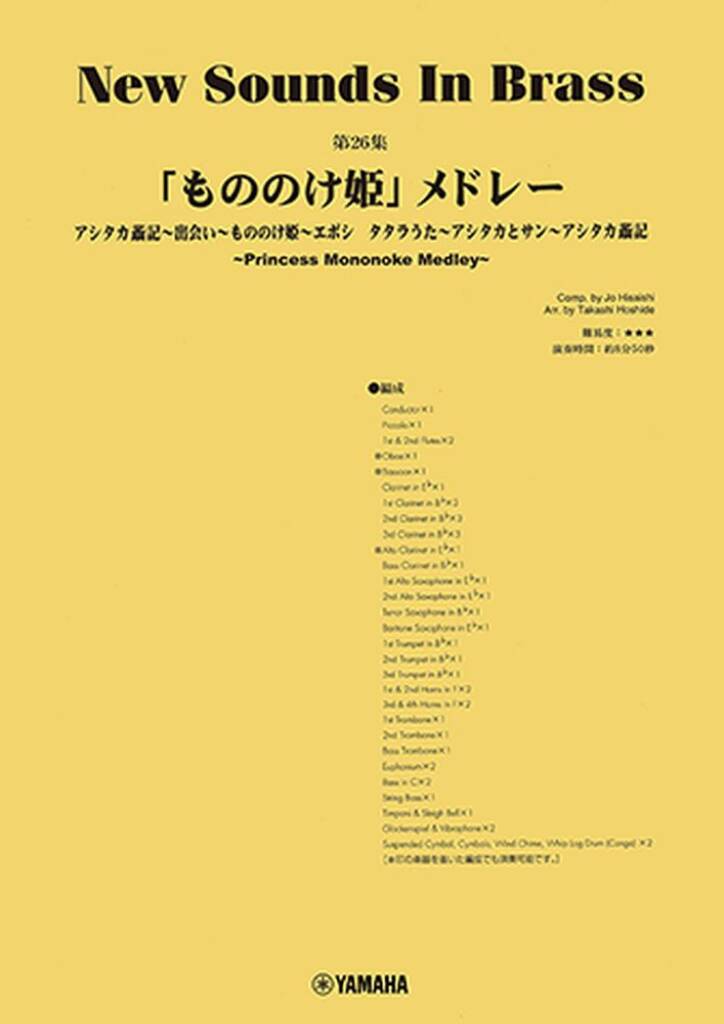
Princess Mononoke, Medley - Joe Hisaishi
Series: New Sounds in Brass (NSB); Duration: approx.8'50"; Composed by Joe Hisaishi; Arranged by Takashi Hoshide. Arranger Takashi Hoshide says, "I have selected beautiful melodies from the soundtrack of 'Princess Mononoke' (1997, directed by Hayao Miyazaki) and arranged them into a medley. What can be said about these songs as a whole is that they combine a grand continental scale with the delicacy that reflects Japanese emotions. Since there are no upbeat songs in this selection, I had to work hard on the arrangement, but this allowed for creating contrasts and transitions between each scene in the performance. 'Ashitaka Sekki (English title: The Legend of Ashitaka)' - 'Sekki' means a story that is not recorded but passed down orally. In this anime, this can be considered a sub-main theme. The song starts with a feeling that the story is about to begin and, once the theme kicks in, aim for a grand performance to convey its scale. 'Encounter' - This is the music that plays during the scene where the protagonist Ashitaka meets San. Interestingly, the motif of the main theme 'Princess Mononoke' is used in this melody. Here, let's pursue the shifts in the timbre of individual phrases, creating a beautiful and aesthetic soundscape. 'Princess Mononoke' - This is the main title of the anime. The melody line is carried by horns and trumpets."
Estimated dispatch 7-14 working days
-
 £154.60
Rendezvous - Torstein Aagaard-Nilsen
Rendezvous was commissioned by Krohnengen Brass Band for their 50th Anniversary in 2019. This version for Concert Band was scored autumn 2020.Rendezvous is devided into three sections. Each section are referring to Edvard Grieg's own titles. but twisted, to make sure that everybody understand that this music is a mash-up of themes Edvard Grieg used in opus 54 (for piano) and opus 61 (songs for children).1. Trolltog med avsporing (March of the Trolls derailment)March of the Trolls is a famous part of Edvard Grieg lyric pieces, opus 54.2. Klokkeklang i feil sang (Bell ringing in wrong tune).Bell ringing show that Grieg was one of the first composers to write the way impressionists did. What happens if this beatiful piece is combined with several other themes from the same book? It somehow works in its own way.3. Pep talk til Blakken (Pep talk to Blakken)The riff used in the first part becomes an important part of the third part: a funky treat of the childrens song "Kveldssang for Blakken" (Evening song for Blakken).I felt that a rather tired old horse needed a pep talk more than a slow tune. So that is why you get this music(!) - and this is how my rendezvous with Grieg ends.Not sure what maestro Grieg would have thougt... But, I have read that the fiddlers that played the tunes Grieg used was not happy with the way Grieg used them.So there you go...Torstein Aagaard-Nilsen
Estimated dispatch 7-14 working days
 View Music