
Results
-
 £64.99
On Christmas Day - James Curnow
A remarkably fresh take on a great old Christmas carol! James Curnow has faceted a gem of an arrangement for that extremely important Grade 11/2 level. Rich with musicality, On Christmas Day encourages your young musicians to take musical expression to a new and higher level. This will be the big hit at your developing band's winter concert.Sparkling!
Estimated dispatch 7-14 working days
-
 £72.99
Nature's Way - Gunther Schuller
From the composer: Nature's Way for intermediate level band was commissioned by BandQuest, a project initiated by the American Composers Forum. Their mission is for major composers of national reputation to write works of high quality that take into consideration the (still comparatively limited) levels of musical development--both technical and conceptual--typical of such ensembles. I eagerly accepted the commission and the challenges implied thereby--that is, to reign in my creative imagination to some extent and limit the technical/conceptual demands to a more moderate level than is to be found in my previous compositions for band. Nonetheless, since the process of rehearsing, studying and performing a work created specifically for the school student market is--and must be, in my view--primarily educational, it was very clear to me that my work would (and should) challenge the players at least to their top levels, and even a little beyond that. Thus Nature's Way in no way represents a compromise of my personal style, nor my long held concepts of form, continuity, texture, and instrumentation. I have known for a long time that young, inquisitive minds are eager to learn from new experiences, from previously never encountered challenges, that is to say, to be pushed--gently--to rise above their present levels of achievement. That's what education is all about. BandQuest, an exciting series of new music and accompanying curricula for band, is a program published by the American Composers Forum. The series was started as a response to feedback from music educators that there is a pressing need for new, fresh band music. The heart of this program is new works written by a diverse group of leading American composers who have created challenging pieces that are a true departure from standard middle school repertoire. Every BandQuest project includes a residency component in which the composer works collaboratively with a middle school as they create their new piece. Many BandQuest pieces are accompanied by an interdisciplinary curriculum designed to assist students as they learn the music and to integrate each piece with non-music studies. Visit www.bandquest.org to learn more about this innovative series, and email [email protected] to request a free downloadable audio catalog.
Estimated dispatch 7-14 working days
-
 £138.00
San Pedro de Alcntara - Valdemar Gomes
The Spanish war galleon with 64 cannons, built in Cuba between 1770 and 1771 for an English shipowner in the service of the King of Spain left Peru for Cadiz in 1784 with a huge cargo of copper, gold, silver and other valuables on board. There were also more than 400 people on board, including passengers, crew and Inca prisoners after a revolt. The Atlantic crossing went smoothly, passing Portugal to take advantage of favourable winds. The shipwreck off Peniche was the result of human error, apparently due to French maps with dramatic errors in the position of the islands of Berlengas and neighbouring islets. On 2 February 1786, the sea was calm and the night clear, but they hit the rock formation Papoa and the hull immediately broke in two. The bottom sank quickly, while the deck remained afloat for some time. 128 people lost their lives, including many Indians who were trapped in the basement. This shipwreck is considered one of the most important in maritime history.What the composer wants to convey, and what can be felt as one listens, is first of all the sound of power, of hope, of the glory of conquest, of the splendour of wealth. This is followed by the perception of the maritime environment, the harmony with the softness of the ocean, the gliding of the hull in the foam of the sea on sunny, blue days. But along with this tranquillity, you soon hear a rhythmic chain that makes you feel a representation of the hustle and bustle, of the busy crew, of the hard work of a sailor, of the desperation of an exotic people imprisoned in a dark, damp cellar. A distinct rhythm that reminds us of the "salero" of Andalusia, with its Arab influences and its people, the soothing of the resignation of others who are forced to submit. Then we clearly hear a crescendo that makes us imagine the agony of the collision that precedes the shipwreck. The breaking of the hull, the water flooding everything, the despair, the clash of bodies on the rocks, the tragedy to come. Before the "grand finale", in which the return of musical softness reminds us that the story is over. The supremacy of nature over human greed. The waves, though gentle, sweep the wreckage, the lives and the treasures of the New World to the bottom of the sea.
Estimated dispatch 7-14 working days
-
 £105.80
No War - Marco Somadossi
The theme of this composition is immediately evident from the title, which almost requires no further explanation. It will never be possible to represent or reproduce the full implications of a tragedy such as war, all too often forgotten, concealed, exploited or written off as being an evil that is "necessary" for the development of civilisation. War changes the course of human history: man kills man, fathers bury their sons, children take up arms, and mankind is devastated by evil, choosing death over life. The atrocities, repeatedly perpetrated and evident to all observers, are an offence to human dignity. Yet they are tolerated and, at times, even re-interpreted as inevitable remedies for "obstacles" to the global economy, in order- it would seem- to build "a better world". And all this goes on despite the fact that the terrible scars left by past wars are still evident and should serve as a warning to ensure that such tragedies do not return to devastate our world. "No War" is thus a heart-felt protest against any form of culture that justifies war as a means of gaining wealth and power, satisfying the economic needs of the richest countries at the expense of the poorest nations. In so doing the one truly fundamental value is annihilated, that of human life.
Estimated dispatch 7-14 working days
-
 £154.60
Den store dagen - Benny Borg
This beautiful song contains a huge contrast between the hopeful and the disappointing. A mother has her birthday and is waiting her children to celebrate it. Each verse starts optimistically, but the short chorus is characterized by the disappointment, that everyone calls, and cannot come. This has been tried recreated musically, mostly in the last two choruses, as it dawns on her that she will not receive a visit. It's a beautiful tune, but with a serious message that it's easy to take someone for granted.One of the elements the musicians came up with after rehearsal, was that they really liked the change between the ballad parts with even eights and the swing parts. This also gives the piece a sense of "parlando" character, which tells a story, and is therefore important to focus. It is not quite simple, as the melody also in those parts with even eights has some triplet rhythms. Therefore, this is a topic you can work on.Regarding instrumentation, Flugelhorn, Alto Saxophone and Euphonium have important roles, in addition to the rest of the first parts in the Band. The arrangement is written so you are not depending on "special" instruments. Important details are also often duplicated so you can use the arrangement for a smaller Wind Band.It is also possible to use a vocal soloist, but then you must soften the instruments that holds the melody.
Estimated dispatch 7-14 working days
-
 £228.70
Konsertouverture - Viktor Widqvist
This piece was composed in 1937 in the composer's later part of life. Here, Widqvist shows his broad competence as a composer by using both classic marching and late-romantic thematic elements with exciting harmonic twists. In addition, you can find a perfect fugue where the composer shows that he masters this advanced composition technique. One can imagine that Widqvist wanted to show off his entire repertoire of knowledge to take the lead in the unspoken competition with colleague and friend Sam Rydberg. Rydberg had several years earlier composed a concert overture with a similar form. However, this piece is simpler in its design and lacks the technical brilliance that Widqvist shows in his contrapuntal treatment and harmonious diversity.The concert overture was re-orchestrated in 1939 by the composer for symphony orchestra, and it is this version and the original score for a large military orchestra that form the basis for this edition. My aim has been to keep all of Widqvist's original intentions, but still make use of all the possibilities of the modern symphonic wind orchestra. The composer's own arrangements for symphony orchestra have been of great help in this work.- Niclas Blixt -
Estimated dispatch 7-14 working days
-
£63.99
Nurture - Edward Fairlie
"There are some people for whom the act of nurturing is innate. The work they do is often unheralded, acknowledgement of their effort the last thing on their mind. But nurturers carry pain, too. Their own burdens, anxieties and hardships often take a back seat to that nurturing impulse. This piece is a meditation on that idea; that some people, not without their own deep personal obstacles, can't help but live out the powerful instinct to hold those around them in a warm embrace of care." - Edward Fairlie -
Estimated dispatch 7-14 working days
-
 £228.70
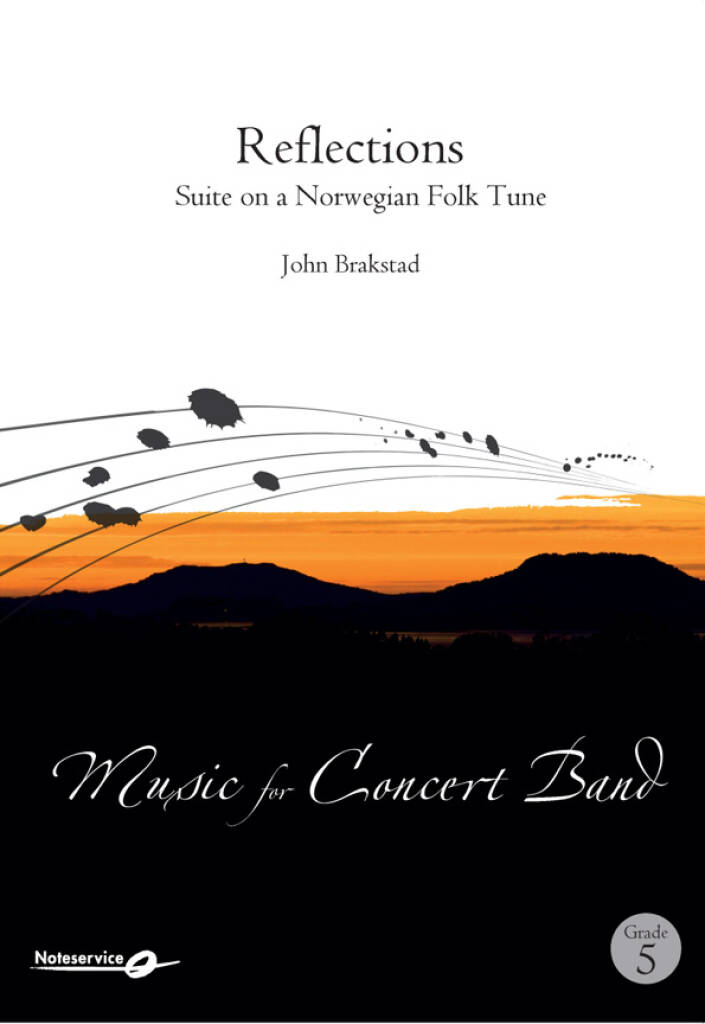
Reflections - Suite on a Norwegian Folk Tune - John Brakstad
The suite is constructed around a Norwegian folk tune. The melody is called "Dark Forebodings", and the words of the song revolve around thoughts and reflections on a future that can take unexpected, insecure, or perhaps dramatic and tragic turns.This is essentially a sad song with a beautiful melody. The folk tune itself is presented in the 2nd movement. In the 1st movement, the folk tune is joined with fleeting themes that indicate the unexpected; as if the music sometimesis confused as to which way to go. There are constant changes in atmosphere and feeling, from the harsh and dissonant, to the harmonious and melodic. The 3rd movement presents a more lively variant of thefolk tune, showing optimism andhappiness, even though the "halting" character of the rhythm underscores the unpredictable. The title "Reflections", therefore, refers to thoughts we can have about life. To the Conductor:The 2nd movement has an alternativeending which is may be used if the movement is played as an independent lyrical piece in a concert.It is advisable to begin first rehersal with the 2nd movement so that the main theme is known, before beginning on the 1st movement with itsmore semi-tonal parts. Intervals and intonation can provide much of the challenge in this movement.The 3rd movement can be more technically challenging, but there is considerable leeway in the tempo marking! It is important to maintain theenergy and intensity of the music through the whole movement.
Estimated dispatch 7-14 working days
-
 £75.50
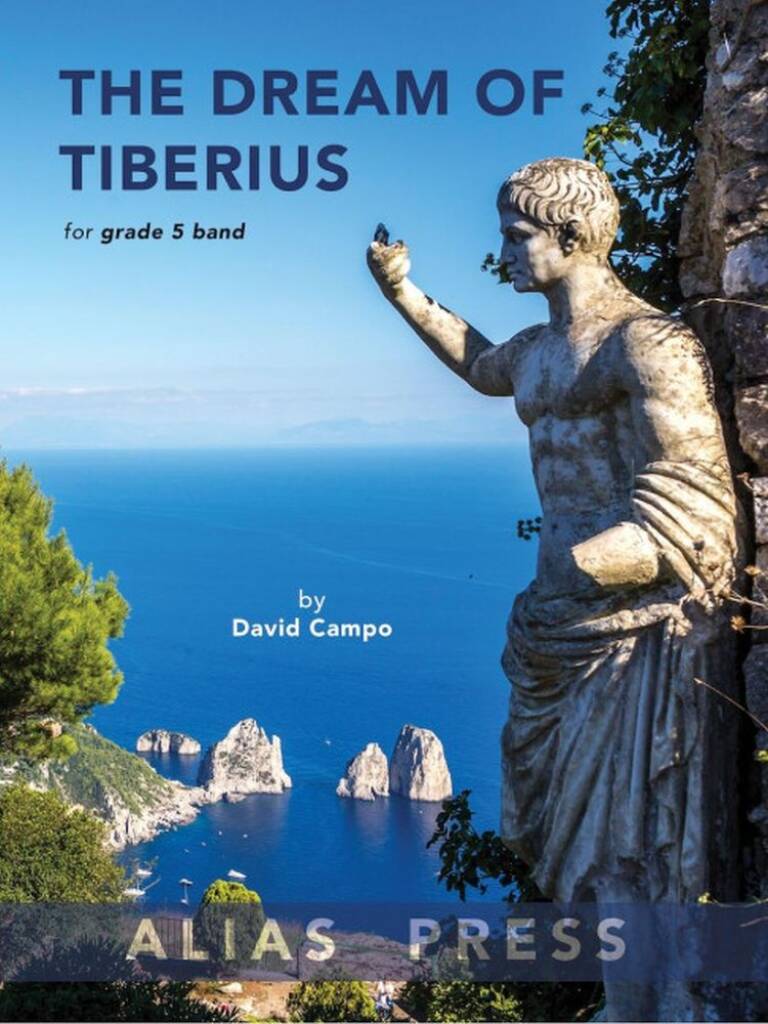
The Dream of Tiberius - David Campo
The Roman Emperor Tiberius was born in 42 BCE to Tiberius Claudius Nero and Livia Drusilla, both descendants of prestigious political families, at a time when Rome was undergoing significant political upheaval. Julius Caesar had begun a brutal civil war in 49 BCE to end Rome's rule as a Republic and consolidate his power as supreme ruler. Following Caeser's assassination in 44 BCE, Tiberius' father backed the forces wishing to return Rome to a Republic, but they were defeated by Caesarian loyalists led by Caeser's heir Octavian. As a result, Tiberius' early life was spent on the run and in political exile with his parents. In 27 BCE, Octavian would become the first Emporer of Rome and assume the name Augustus. Augustus forced Tiberius' parents to divorce and took Tiberius' mother as his new bride, separating the family and forcing Tiberius to live with his father. Upon his father's death, Tiberius went to live with his mother and Emporer Augustus, a situation Tiberius found extremely uncomfortable but one over which he had no control. Having been adopted by the Emperor, Tiberius assumed the military and political life thrust upon him. He proved to be an outstanding military and political leader, and with his marriage to Vipsania Agrippina his life took on a heretofore unknown stability. However, Augustus would intervene in Tiberius' life once more, forcing him to abandon his happy marriage and take Augustus' daughter Julia (Tiberius' step sister) as his new wife. This arrangement, while securing Tiberius' place as Augustus' heir and ensuring he would one day be Emperor of Rome, was disastrous. Julia's drunken licentiousness was a constant source of scandal and embarrassment for Tiberius (and her father, the Emperor) and she was eventually exiled by her father Augustus. Tiberius was named Emperor of Rome upon the death of Augustus in AD 14, assuming his position as the most powerful man on Earth. However, no matter how powerful he had become, Tiberius never felt as if he had ever had any control over his life, having been manipulated from childhood through adulthood by the whims of Augustus. As Emperor, he soon became disgusted with the political intrigue of the Roman Senate and by AD 26 left Rome and took up residence on the island of Capri, where he lived out the rest of his life. History does not regard Tiberius fondly and by all accounts towards the end of his reclusive life on Capri, he had become a miserable, sick and mentally unstable old man reveling in debauchery and cruelty. It is also informative to note that he was Emperor of Rome when Jesus of Nazareth was crucified, and while there is no indication that Tiberius was even aware of the existence of Jesus, as Emperor he was responsible for the appointment of Pontius Pilate as Governor of Judea. Even considering this, it is difficult to look on the life of the Emperor Tiberius and not feel some sympathy and pity. It's in this spirit that I composed "The Dream of Tiberius." I imagine the man sitting in thoughtful seclusion on the beautiful island of Capri imagining what his life might have happily been had not power been thrust upon him: husband, father and humble servant of the people.
Estimated dispatch 7-14 working days
-
 £134.99
Dublin Pictures - Marc Jeanbourquin
Ireland is a multi-faceted country that has developed a popular and distinctive musical culture. The first movement of Dublin Pictures reflects Irish festivals where there is dancing and traditional beer flowing. More tranquil in its feel, the second movement illustrates the landscape that can be seen from the Ha'penny Bridge, a bridge that crosses the River Liffey in Dublin. This movement highlights the wide range of the orchestra's sound colours as the musicians' voices combine with the wind and percussion to accompany the soloist. The lively and joyful rhythms of the last movement take the listener to Temple Bar, the famous tourist quarter of the city, well knownfor its vibrant nightlife. The music's energy and virtuosic motifs are in contrast to the previous movement and provide a spirited and festive finale.Marc Jeanbourquin wrote this piece in three movements for Azimuts Brass in 2011. He then arranged it for Concert, Fanfare or Brass Band
Estimated dispatch 7-14 working days
 View Music