
Results
-
 £95.00
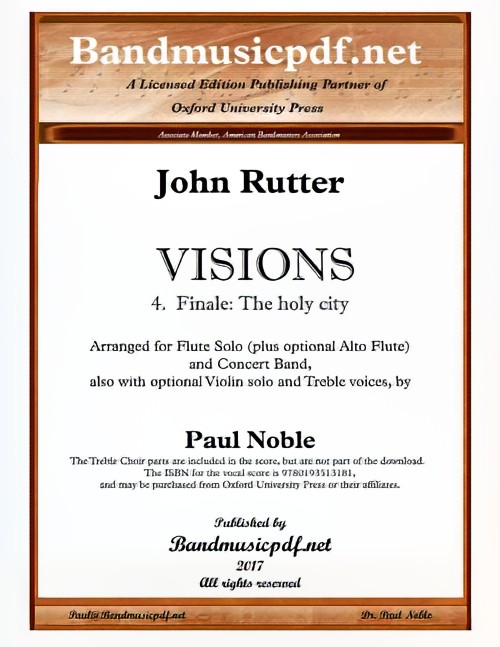
Finale: The Holy City (from Visions) (Flute or Violin Solo with Concert Band and Optional Treble Choir - Score and Parts) - Rutter, John - Noble, Paul
Visions is one of John Rutter's most recent compositions (2016). It was written for violin solo, treble voice choir, strings and harp. This arrangement maintains the violin solo as an option, but it is presented as a flute (and optionally with a movement for alto flute) solo with band. The vocal parts are included as an option, but the arrangement is also scored so that it may be performed without the treble choir. Visions is a tribute to Jerusalem, with the four movements titled: 1. Jerusalem the blessed; 2. Arise, shine; 3. Lament for Jerusalem; 4. Finale: The holy city. A showcase for the soloist, the depth of meaning and feeling in this music will make it an important addition to the repertoire of the Concert/Wind Band.
Estimated dispatch 7-14 working days
-
£45.10
Holy City, The
Estimated dispatch 7-14 working days
-
 £75.00
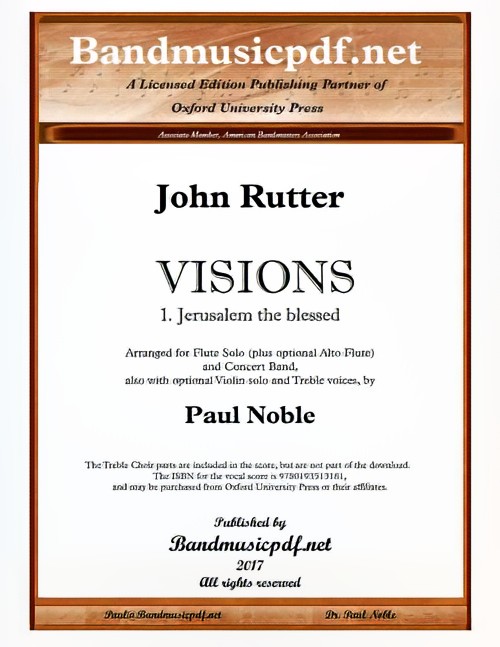
Jerusalem the Blessed (from Visions) (Flute or Violin Solo with Concert Band and Optional Treble Choir - Score and Parts) - Rutter, John - Noble, Paul
Visions is one of John Rutter's most recent compositions (2016). It was written for violin solo, treble voice choir, strings and harp. This arrangement maintains the violin solo as an option, but it is presented as a flute (and optionally with a movement for alto flute) solo with band. The vocal parts are included as an option, but the arrangement is also scored so that it may be performed without the treble choir. Visions is a tribute to Jerusalem, with the four movements titled: 1. Jerusalem the blessed; 2. Arise, shine; 3. Lament for Jerusalem; 4. Finale: The holy city. A showcase for the soloist, the depth of meaning and feeling in this music will make it an important addition to the repertoire of the Concert/Wind Band.
Estimated dispatch 7-14 working days
-
 £244.99
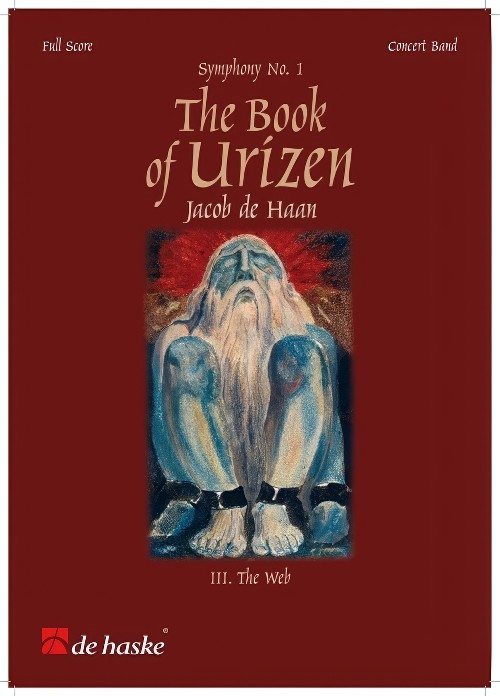
The Book of Urizen (Movement III: The Web) (Soprano, Narrator and Concert Band - Score and Parts) - De Haan, Jacob
The Book of Urizen is a work for concert band, solo soprano, and a male narrator in which sound collages of religious expressions are used. The piece is inspired by the compelling visionary poem of the same name (which the poet illustrated himself) by the Englishman William Blake (1757-1827), who occupies a unique position in western literature and the visual arts. He was not just a poet and a writer, but he was also a graphic artist, a painter, an illustrator, a spiritualist, a religious visionary, and a mystic philosopher. For the performance of this work, a professional sound system, including two microphones and a CD player, is needed. The three sound collages are three separate tracks on the enclosed CD and can be played easily at the right moment.The Book of Urizen bears resemblance to Genesis and Exodus, of which the contents form the basis of the Christian, Jewish, and Islamic faith. Blake adhered to the principle that all religions are in fact one, and that deities reside in human beings. In The Book of Urizen this is represented in "The Net of Religion," which is spanned over the earth by Urizen. The sound collages, compiled by Jacob de Haan in the studio, find their origin in Jerusalem, the Holy City, where the afore-mentioned faiths come together.The first two movements, The Vision and The Creation, are available in a separate set.
Estimated dispatch 7-14 working days
-
 £421.99
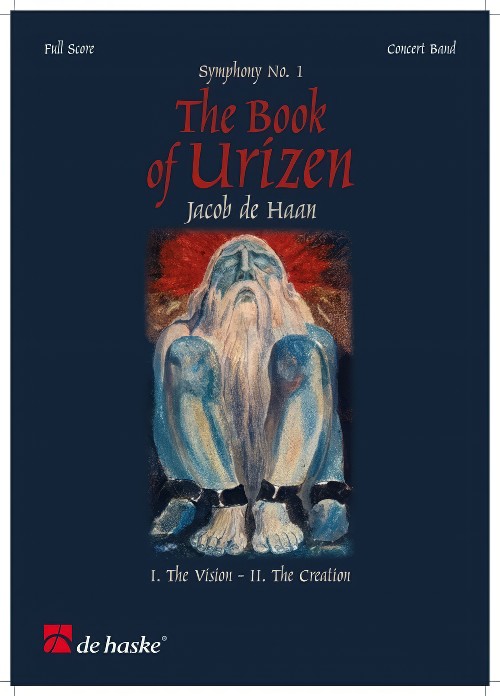
The Book of Urizen (Movements I: The Vision and II: The Creation) (Soprano, Narrator and Concert Band - Score and Parts) - De Haan, Jacob
The Book of Urizen is a work for concert band, solo soprano, and a male narrator in which sound collages of religious expressions are used. The piece is inspired by the compelling visionary poem of the same name (which the poet illustrated himself) by the Englishman William Blake (1757-1827), who occupies a unique position in western literature and the visual arts. He was not just a poet and a writer, but he was also a graphic artist, a painter, an illustrator, a spiritualist, a religious visionary, and a mystic philosopher. For the performance of this work, a professional sound system, including two microphones and a CD player, is needed. The three sound collages are three separate tracks on the enclosed CD and can be played easily at the right moment.The Book of Urizen bears resemblance to Genesis and Exodus, of which the contents form the basis of the Christian, Jewish, and Islamic faith. Blake adhered to the principle that all religions are in fact one, and that deities reside in human beings. In The Book of Urizen this is represented in "The Net of Religion," which is spanned over the earth by Urizen. The sound collages, compiled by Jacob de Haan in the studio, find their origin in Jerusalem, the Holy City, where the afore-mentioned faiths come together.In the first movement of this composition, The Vision, Urizen prepares his vision of the world, and he presents this to the "Eternals." His vision is rejected, and Urizen locks himself up in his own abstract world. When he does emerge again, he is confronted with rage by the gathered Eternals. Urizen flees the wrath of the Eternals, "the flames of eternal fury," and enwombs himself in his own world. When the Eternals see Urizen in his "stony sleep," they wonder if this is death. The blacksmith Los is torn by grief because of the isolation of Urizen. It brings him to rouse his fires, prepare his forge, and to give Urizen's world concrete form.In the second movement, The Creation, Urizen's world, but also man, woman, and child are created. Los is horrified with the appearance of Urizen's body. He mourns and pities Urizen, and from his blood a female form comes into being, with the name Enitharmon. The Eternals, fearful of the female form, decide to erect a tent to obstruct their view to eternity. Enitharmon and Los beget a son, called Orc. Los baptizes him as a child of the "fallen world." Orc is fed at Enitharmon's breast, which makes a girdle of jealousy restrict Los' chest. He takes the child to the top of the mountain and chains him down. The cries of Orc awaken Urizen, who explores his world creating instruments of scientific measurement to do so. Los encircles the face of Enitharmon from the sight of Urizen and Orc. She then populates the earth by giving birth to an enormous race.The Web, the third movement of The Book of Urizen, is available in a separate set.
Estimated dispatch 7-14 working days
-
 £85.00
Arise, Shine (from Visions) (Flute or Violin Solo with Concert Band and Optional Treble Choir - Score and Parts) - Rutter, John - Noble, Paul
Visions is one of John Rutter's most recent compositions (2016). It was written for violin solo, treble voice choir, strings and harp. This arrangement maintains the violin solo as an option, but it is presented as a flute (and optionally with a movement for alto flute) solo with band. The vocal parts are included as an option, but the arrangement is also scored so that it may be performed without the treble choir. Visions is a tribute to Jerusalem, with the four movements titled: 1. Jerusalem the blessed; 2. Arise, shine; 3. Lament for Jerusalem; 4. Finale: The holy city. A showcase for the soloist, the depth of meaning and feeling in this music will make it an important addition to the repertoire of the Concert/Wind Band.
Estimated dispatch 7-14 working days
-
 £100.00
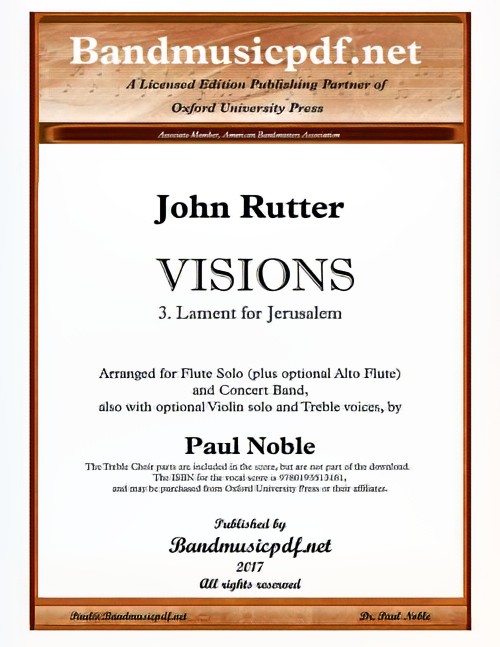
Lament for Jerusalem (from Visions) (Flute or Violin Solo with Concert Band and Optional Treble Choir - Score and Parts) - Rutter, John - Noble, Paul
Visions is one of John Rutter's most recent compositions (2016). It was written for violin solo, treble voice choir, strings and harp. This arrangement maintains the violin solo as an option, but it is presented as a flute (and optionally with a movement for alto flute) solo with band. The vocal parts are included as an option, but the arrangement is also scored so that it may be performed without the treble choir. Visions is a tribute to Jerusalem, with the four movements titled: 1. Jerusalem the blessed; 2. Arise, shine; 3. Lament for Jerusalem; 4. Finale: The holy city. A showcase for the soloist, the depth of meaning and feeling in this music will make it an important addition to the repertoire of the Concert/Wind Band.
Estimated dispatch 7-14 working days
-
 £310.00
Visions (Flute or Violin Solo with Concert Band and Optional Treble Choir - Score and Parts) - Rutter, John - Noble, Paul
Visions is one of John Rutter's most recent compositions (2016). It was written for violin solo, treble voice choir, strings and harp. This arrangement maintains the violin solo as an option, but it is presented as a flute (and optionally with a movement for alto flute) solo with band. The vocal parts are included as an option, but the arrangement is also scored so that it may be performed without the treble choir. Visions is a tribute to Jerusalem, with the four movements titled: 1. Jerusalem the blessed; 2. Arise, shine; 3. Lament for Jerusalem; 4. Finale: The holy city. A showcase for the soloist, the depth of meaning and feeling in this music will make it an important addition to the repertoire of the Concert/Wind Band.
Estimated dispatch 7-14 working days
-
 £332.99
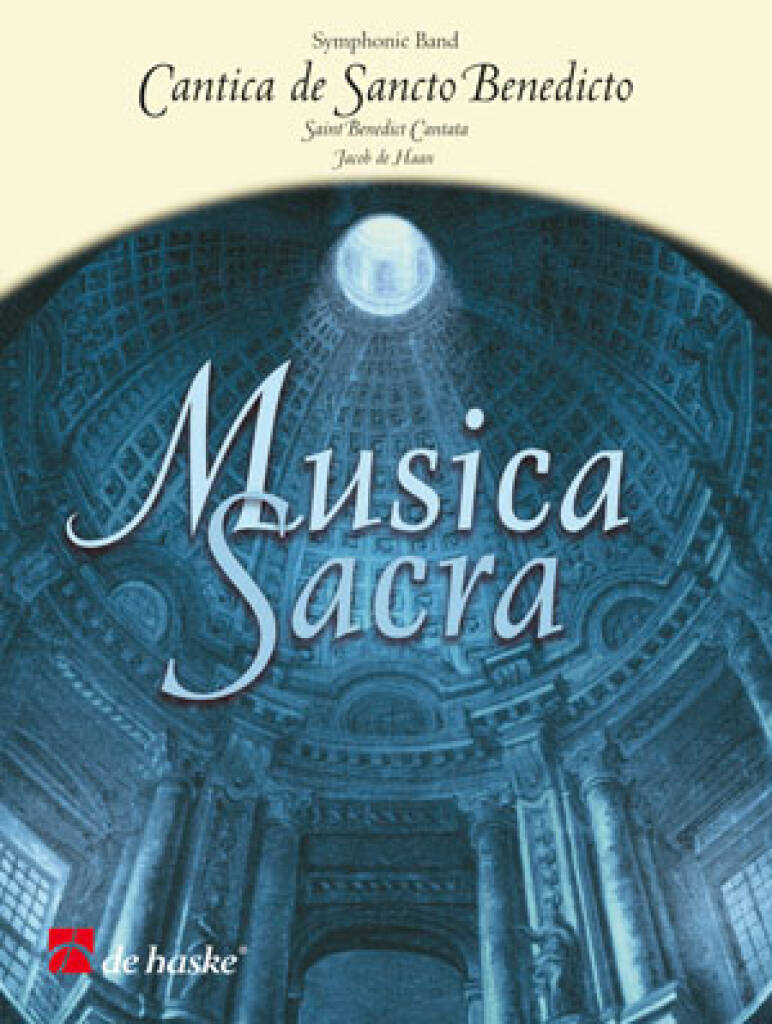
Cantica de Sancto Benedicto - Jacob de Haan
Cantica de Sancto Benedicto is a three-movement work for mixed choir, soprano solo, concert band and organ ad libitum - on Latin lyrics that relate to the life of Saint Benedict. It was commissioned by the city of Norcia in Italy, whereBenedict was born. The holy Benedict (480-547) is considered the founder of monastic life within the Roman Catholic Church. His enormous influence is especially owing to his monastic rule, the Regula Benedicti.Jacob de Haan has named the movements ofCantica de Sancto Benedicto after the Holy Trinity: the Father (Gloria Patri), the Son (Gloria Filio) and the Holy Spirit (Gloria Spiritui Sancto). The lyrics of thehymn Gemma Caelestis, (which, like the othertexts, were originally used in Gregorian chant) are voiced by the choir. To this purpose, Jacob de Haan composed new, choral-like, homophone music. The sequence Laeta Quies is rendered by the soprano; the verses (divided over the threemovements) are alternated with those of Gemma Caelestis. The work closes with an impressive grand finale, in which texts are used from the proprium of the mass in honor of the saint's day of the holy Benedict (11 July). Notes to the conductor:For this cantata, there are various possibilities for the performance. The first involves a performance in which the choir and soprano parts are only accompanied by organ. Such a performance has several advantages: since the band never soundstogether with the choir and the soprano, no balance problems occur, and even a performance with a large concert band and a small cantata choir is conceivable. A special layout is also possible - with which you can set up a three-dimensionalperformance in a church. For example, the choir can sing in the chancel, accompanied by the choir organ; the soprano can stand on the gallery, accompanied by the main organ; and the band can be seated in another part of the church. The choir couldalso sing from a gallery. With layouts like this, working with two conductors is advisable. Choral parts available separately.
Estimated dispatch 7-14 working days
-
£271.60
Ljodgata - Torstein Aagaard-Nilsen
The old Norwegian name Ljodgata means the main road. This road (or path) has existed since the iron age. In 12 century christians walked from Oslo to Nidaros (Trondheim) to visit the Cathedral containing the tomb of King Olav the Holy. Part 1 The Tomb and the Church is a musical picture of religious activities in the area. The tomb of King Rakne, one of the largest graves in the northern Europa is now a monument in the area, even if Hovin Church has been a symbol of christianity sincethe 1400 century. Part 2 The Woods of Trandum Pictures the military acitivities that has been going on for more that 250 years. During the 2nd World War, an execution of innocent people took place in the woods. Part 3 Jetset Picture of the present.The international airport at Gardermoen has made the village Jessheim become a town. People now live moderne city lives.
Estimated dispatch 7-14 working days
 View Music