
Results
-
 £149.40
En bitte liten funklende stjerne - Numme
This song written by Yngvar Numme and Benny Borg was made popular by Norwegian group Dizzie Tunes on one of their Christmas-albums. This arrangement is based on the Dizzie Tunes version and features the original solo for trumpet or cornet. The Drum Set part is optional so one can perform the arrangement without this part.
Estimated dispatch 7-14 working days
-
 £228.70
Pulsar - The Metamorphosis of a Star - John Brakstad
4th July in 1054 AD one of the most spectacular events was witnessed in the Cosmos. A massive star blew out; a supernova explosion.From the Earth it appeared as a new, bright star; the most brilliant in the sky. It was visible for three weeks, also in daylight, before it then faded away.But what was left of it is spectacular. Today we call it the "Crab Nebula".And in the very centre of the Nebula lies the remnant of the star; the core crushed by the force of gravity.This is a rotating neutron star, a pulsar, just 20 kilometres across, but so dense that it weighs more than our sun.As the neutron star spins, ejected particles stream out from its poles at almost the speed of light.These jets create powerful beams that sweep around as the star rotates.When the beams sweep across the Earth, they can be heard as regular pulses. We call them pulsars.In this piece there are three percussion parts. In addition there is an "optional part" to replace the marimba and vibraphone written in the three original percussion parts if desired. This fourth part is shown in the full score.
Estimated dispatch 7-14 working days
-
 £127.30
I hop med Grieg - Marsj - Fredrick Schjelderup
Onwards with Grieg is a festive march commissioned by the Norwegian concert band, Skjold Nesttun Janitsjar, for their 115th anniversary in 2019.The famous Norwegian composer, Edvard Grieg (1843-1907), wanted a local band in his area and donated money for instruments so the band could establish in 1904.The march quotes some of Grieg's most famous works: Piano Concerto in A-minor, Triumphal March as well as his own signature interval.
Estimated dispatch 7-14 working days
-
 £144.20
Isolation - Suite in 5 Movements - Øystein Sjøvaag Heimdal
This suite in 5 movements was written during the Corona pandemic and is inspired by experiences and feelings during this period. Feelings like insecurity, frustration, happiness, sorrow, hope, and optimism are the underlying themes, and this can be heard through the music. This is not, however, program music, so the audience may have their own perception of what the music is about.This piece provides the opportunity to focus on the different elements of music, such as dynamics, articulation, expression, tone control and timbre.The five movements can be performed separately.
Estimated dispatch 7-14 working days
-
 £228.70
Montain Songs and Arias - Stig Nordhagen
I have always had a love for both classical and folk music.It is in between these expressions I thrive while composing.This piece contains both fast and lingering alternations between these expressions, complementing each other and creating a whole. This whole creates something larger than just the two individual constituents, a new entity. So with the classic (Arias) and folk music (Mountain songs), I want to create something new where the expressions enhances each other, and merges into an elevated state.- Stig Nordhagen
Estimated dispatch 7-14 working days
-
 £101.30
Honor to the Veterans - Tormod Brufladt
The march "Honour to the Veterans" was the composers third composition ever. He sent this march to Kjell Martinsen, who was the conductor of The Kings Guards Band in Norway. He liked the march so much that it was included on the CD which was releasedin connection with the bands 150 years anniversary.The march is not very difficult. There is a variety of melody lines in the march that differs from many other marches, especially the piccolo flute solo makes it a little bit special. Themarch is also playable for bands lacking a piccolo flute player, because the melody line in this part of the march is well taken care of.
Estimated dispatch 7-14 working days
-
£43.00
Dis & Co. - Leslie Searle
Dis & Co. has different musical themes to 'Chips in a bag', but there are also similarities so that it could be played as an alternative or an extension.
Estimated dispatch 7-14 working days
-
£43.00
Fanfare Und Entrata - Franz R. Miller
This is a ceremonious, sonorous work for wind band with four solo fanfares (valve fanfares) or solo trumpets. The accompanying part can also be reduced and played by a brass ensemble. It is easy to play and so particular suitable for mass music-making at large events. Franz R Miller who was a pupil of Carl Orff's among others, used to be an editor for Bayerische Rundfunk [Bavarian Radio]. He is in particular highly regarded as an expert in choral music.
Estimated dispatch 7-14 working days
-
£34.00
Komm, Trink Und Lach Am Rhein - Fred Raymond
Norbert Studnitzky has made a new arrangement in a contemporary style of this popular waltz and song traditionally sung whilst rocking to and from in time to the music with linked arms and so it can now be played by wind bands. Set of parts does not include parts in Benelux notation.
Estimated dispatch 7-14 working days
-
 £292.00
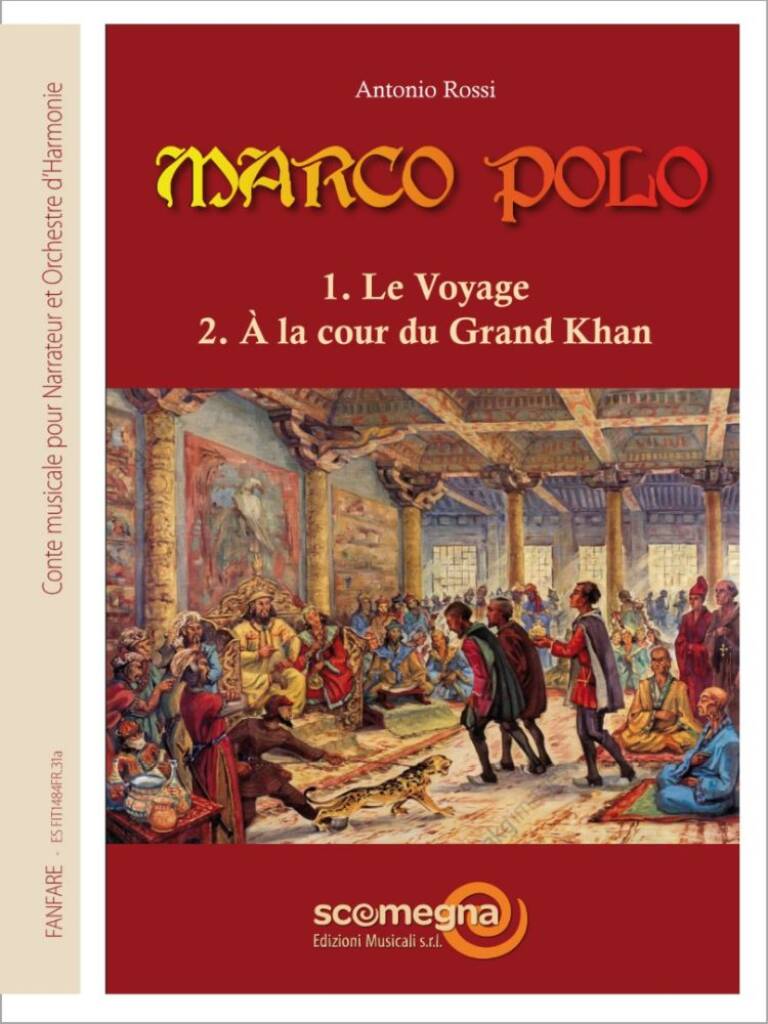
Marco Polo (French text) - Antonio Rossi
Marco Polo (Venice, 1254), son of Venetian merchants, left in 1271 with his father Niccol and his uncle Matteo, towards the distant China at the court of the Mongol emperor Kublai Khan. The long journey, which lasted three and a half years, led the Polos to cross Turkey, Central Asia, the Pamir, and the Gobi desert. The intelligence of the young Marco and his curiosity towards new customs and languages raises the interest of the emperor so much that he decides to keep him at his court by appointing him ambassador. This assignment takes him to newly conquered southern China and other parts of southern Asia. In 1292, the Great Kublai Khan agrees, albeit reluctantly, to let him go.Marco, after 17 years at his service, can finally return to Venice, but not before completing a last mission for the Grand Khan: accompanying his niece, Princess Kokachin, to Persia, where she would marry. A few years after his arrival in Venice, Marco finds himself involved in a naval battle against the Genoese people in which the Venetians are defeated. Consequently, Marco is captured and taken to prison in Genoa. There, he meets the storyteller Rustichello da Pisa to whom he tells the story of his adventurous journey. After his release, Marco returned to Venice and led a comfortable life until his death in 1324.
Estimated dispatch 7-14 working days
 View Music